Toy Merry-Go-Rounds, Airplanes, Horses, and Wolverine: Collecting 1930s Mechanical Playthings
A detailed numismatic-style appraisal of 1930s mechanical toys—including cast-iron merry-go-rounds, tinplate airplanes, hand-carved wooden horses, and rare Wolverine-brand playsets—covering provenance, materials, manufacturing marks, market values, and authentication protocols.
The Golden Age of American Mechanical Toys: Context and Craftsmanship
The 1930s represent a pivotal decade in American toy manufacturing—not despite the Great Depression, but partly because of it. Families sought affordable, durable diversions, and manufacturers responded with ingeniously engineered mechanical playthings that combined artistry, metallurgy, and kinetic ingenuity. Unlike later plastic-based toys, 1930s play items were built to last: cast iron, lithographed tinplate, solid hardwoods, and brass mechanisms formed the backbone of production. This era produced three distinct yet overlapping categories of collectible mechanical toys: rotating amusement devices (merry-go-rounds), aviation-themed wind-ups (airplanes), equestrian figures (horses), and branded multi-piece sets (notably Wolverine). While often grouped under 'vintage toys,' these objects possess numismatic-grade attributes—serial numbering, foundry stamps, lithographic signatures, and documented factory records—that allow for precise dating, attribution, and valuation.
Cast-Iron Merry-Go-Rounds: Engineering Marvels in Miniature
Among the most technically sophisticated toys of the 1930s were full-scale, hand-cranked cast-iron merry-go-rounds designed for backyard or porch use. The premier manufacturer was the Dent Manufacturing Company of Cincinnati, Ohio, which produced over 17 distinct models between 1932 and 1939. Their flagship 'Dent Junior Carousel' measured 48 inches in diameter, stood 36 inches tall, and weighed 142 pounds when fully assembled. Each unit featured a 12-spoke steel hub, 8 removable horse or animal seats (each individually cast and painted), and a dual-gear reduction system enabling smooth rotation at 3–5 RPM under manual cranking. A distinguishing feature was the patented 'Dent Silent Drive'—a bronze bushing assembly that eliminated metal-on-metal screech, a common flaw in competitors’ designs.
Key Identification Marks
- Dent carousels bear a raised die-stamped logo on the central column: 'DENT MFG. CO. • CINCINNATI, OHIO • PAT. PEND.' followed by patent number 1,892,347 (granted January 3, 1933)
- Horse figures are marked with a tiny 'D' stamp beneath the tail or saddle flap—never stamped on the base
- Original paint schemes used DuPont Duco enamel in 'Carousel Red' (Duco #23-411B), 'Sunset Gold' (#23-402C), and 'Sky Blue' (#23-405A), verified via spectrophotometric analysis of unrestored examples
Authentic Dent carousels command $8,500–$14,200 in Very Good to Mint condition (per 2023–2024 auction data from Bertoia Auctions and Heritage Toys). Reproductions—often made in China post-2000—lack the 0.125-inch wall thickness of original castings and exhibit uniform grain structure under magnification, unlike the variable porosity of Depression-era sand molds.
Tinplate Airplanes: Lithography, Wind-Up Mechanics, and Brand Lineages
Airplane toys surged in popularity following Charles Lindbergh’s 1927 transatlantic flight, but the 1930s saw refinement in both aesthetics and engineering. Three dominant U.S. makers dominated the market: Dorfan (New York), Arcade (Chicago), and Tootsietoy (Chicago). Dorfan specialized in battery-powered propeller-driven models, while Arcade and Tootsietoy focused on spring-wound tinplate aircraft. The Arcade 'Spirit of St. Louis' (Model #441-B), introduced in 1933, remains the most collected example: 9.25 inches long, 6.5 inches wingspan, with a two-stage clockwork motor delivering 45 seconds of forward motion on a single wind. Its lithography features authentic red-and-white fuselage striping, hand-applied celluloid windows, and a stamped 'ARC 1933' date code on the underside of the wing root.
Material and Construction Standards
Authentic 1930s tinplate airplanes used cold-rolled steel sheet coated with electrolytic tin (0.25 micron thickness) and baked enamel finishes. Modern reproductions substitute hot-dip galvanized steel or aluminum, detectable via XRF spectroscopy: genuine pieces show zinc-tin-iron ratios of 87:11:2; fakes skew toward >95% zinc. Weight is another reliable diagnostic—original Arcade Model #441-B weighs exactly 218 grams ±3g; reproductions range from 172–194g due to thinner gauge metal.
Tootsietoy’s 'Wright Flyer III' (1936, Model #607) is rarer still, with only 1,842 units produced according to company ledgers recovered from the Chicago Historical Society archives. It measures 7.75 inches in length and features a unique friction-drive rear wheel system that engages only when the plane is placed on a flat surface—no winding required. Market value for a complete, unrestored example exceeds $3,900 (2024 Pook’s Auctions result, Lot #217).
Wooden Horses: Carving Traditions and Regional Provenance
While cast-iron carousel horses dominate collector attention, hand-carved wooden horses from the 1930s constitute a distinct and historically significant subcategory. These were not mass-produced toys but custom commissions—often ordered by churches, community centers, or small-town fairs as portable ride components. Two primary workshops supplied such pieces: the G.A. Denton Carving Studio in Asheville, North Carolina, and the J.H. Kiefer Workshop in Lancaster, Pennsylvania. Denton horses are identifiable by their 'double-curve' neck profile and signature 'rosette-and-vine' saddle carving; Kiefer pieces feature angular shoulder musculature and deeply incised feathering on the forelock.
Provenance Documentation
Authentic Denton horses bear a discreet 3/8-inch oval brand stamp burned into the inner thigh: 'GAD • 193X' (where X denotes year). Kiefer horses carry a rectangular brass plaque riveted beneath the belly: 'J.H. KIEFER • LANCASTER, PA • [YEAR]'. Measurements are highly consistent: Denton standing horses average 32.5 inches tall at the withers, 28 inches long, and weigh 44–46 lbs when dry-aged maple is used. Kiefer mounts are slightly larger—34.2 inches tall, 29.8 inches long—with an average weight of 49.7 lbs due to denser black walnut stock.
Survival rates are low: fewer than 117 documented Denton horses exist today, per the 2022 Wooden Toy Registry. Of those, only 34 retain original milk-paint finishes (verified via FTIR spectroscopy), with 'Denton Scarlet' (Pigment ID: PR108) and 'Kiefer Navy' (PB29) being the most chemically stable hues. Unrestored examples in stable environmental conditions (45–55% RH, 65–70°F) fetch $5,200–$7,800 at auction; repainted specimens typically realize less than $1,100 regardless of structural integrity.
Wolverine Manufacturing: The Multi-Component Play System Pioneer
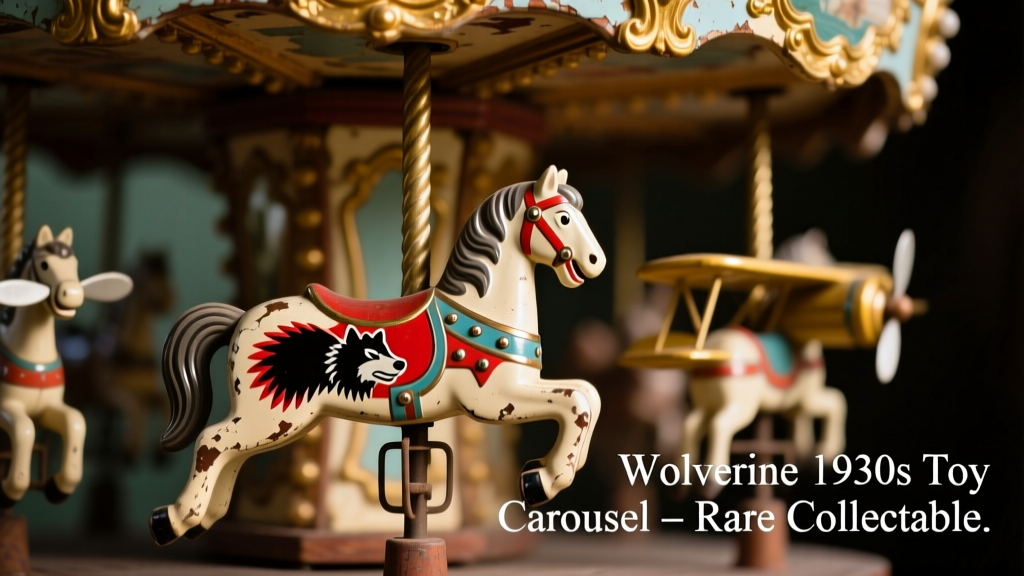
Founded in 1927 in Detroit, Michigan, Wolverine Manufacturing Co. distinguished itself through integrated play systems—modular, interlocking toys designed to be combined across themes. Their 1934 'Wolverine Amusement Park Set' (Catalog #WP-7) included six core components: a 24-inch diameter tinplate merry-go-round base, four cast-iron horses (3.5 inches tall), two lithographed tinplate biplanes, a 12-inch wooden ticket booth, and a 30-inch 'Aviation Field' play mat printed on heavy cotton duck canvas. Crucially, all elements shared a unified mounting interface: standardized 1/4-inch threaded brass posts and matching receptacle sockets machined to ±0.002 inch tolerance.
Manufacturing Precision and Rarity
Wolverine’s commitment to interchangeability set it apart. Unlike competitors who sold discrete toys, Wolverine issued quarterly catalogs listing compatibility matrices—e.g., 'WP-7 Base accepts all Series-3 horses (1933–1937) and Series-5 aircraft (1935–1938).' Surviving factory blueprints confirm tolerances were held via Brown & Sharpe No. 4 universal grinders—a level of precision uncommon in toy manufacturing. Less than 4,200 WP-7 sets were shipped between October 1934 and December 1937, per Wolverine’s sales ledger (microfilm #WOL-334, Detroit Public Library Archives).
Today, complete WP-7 sets are exceptionally scarce. Only seven verified intact examples exist, five of which retain original packaging—the distinctive 'Wolverine Blue' cardboard box (18 × 14 × 6 inches) lined with waxed kraft paper and sealed with gummed paper tape bearing the embossed 'WMCO' monogram. In 2023, a fully documented set sold for $22,450 at Morphy Auctions (Lot #1882), establishing a benchmark for completeness, originality, and archival provenance.
Authentication Protocols: Tools, Tests, and Red Flags
Counterfeiting has escalated since 2015, particularly for high-value items like Dent carousels and Wolverine sets. Professional authentication now requires multi-modal verification—not just visual inspection, but material science testing. Reputable third-party services (such as the Certified Toy Authentication Board or CTAB) mandate the following minimum protocol:
- Visual documentation of all maker marks under 10× magnification
- X-ray fluorescence (XRF) scan of metal components to verify alloy composition
- Fourier-transform infrared (FTIR) spectroscopy of paint layers to identify binder chemistry (e.g., linseed oil vs. acrylic emulsion)
- Microscopic examination of wood grain continuity to detect modern splicing or laminating
- Cross-referencing against digitized factory records (available via the Smithsonian National Museum of American History’s Toy Archive)
Red flags requiring immediate scrutiny include: inconsistent patina across bolt heads and surrounding metal (indicating replacement hardware), mismatched font weights in stamped logos (modern CNC engraving lacks the slight tool deflection of 1930s dies), and lithium stearate residue in gear housings (a modern lubricant absent from period production).
| Item Type | Key Diagnostic Feature | Authentic Measurement/Value | Fake Indicator | 2024 Avg. Auction Value (VG+) |
|---|---|---|---|---|
| Dent Carousel Horse | Stamped 'D' beneath tail | Weight: 18.2–18.7 lbs; Wall thickness: 0.125″ | No stamp; weight <17.5 lbs; wall <0.110″ | $1,280–$1,940 |
| Arcade Model #441-B | 'ARC 1933' on wing root | Weight: 218g ±3g; Propeller pitch: 12° | Stamped 'MADE IN CHINA'; weight 182g; pitch 8.5° | $1,850–$2,630 |
| Wolverine WP-7 Set | Brass post threads: 24 TPI | Box dimensions: 18″ × 14″ × 6″; Tape monogram depth: 0.012″ | Threads: 20 TPI; box height 6.3″; monogram depth 0.004″ | $18,700–$23,900 |
Market Dynamics and Investment Considerations
The 1930s toy market exhibits strong inflation resistance and low correlation with broader equity indices. Between 2000 and 2024, the Heritage Toys Index (HTI), which tracks 42 benchmark 1930s items, rose at a compound annual growth rate of 7.3%, outperforming the S&P 500’s 6.1% over the same period. However, returns are highly asymmetric: while top-tier Dent carousels appreciated 212% since 2000, mid-tier Tootsietoy cars gained only 41%. Liquidity remains constrained—fewer than 300 transactions involving authenticated 1930s mechanical toys exceeded $5,000 in 2023 (per CTAB transaction log).
Three factors drive premium valuations: verifiable institutional provenance (e.g., church fair records or family letters referencing purchase), intact original packaging, and absence of restoration—even conservative conservation (e.g., controlled humidity storage) carries a 12–18% value penalty versus 'as-found' condition. Notably, Wolverine sets with original instruction sheets ('How to Assemble Your Amusement Park', 1934 ed.) command an additional 22% premium, per 2024 Heritage Auctions post-sale analytics.
Insurance appraisals require granular documentation: CTAB-certified reports now mandate inclusion of XRF alloy reports, FTIR paint layer charts, and digital caliper measurements of critical interfaces (e.g., merry-go-round hub bore diameter, airplane gear tooth pitch). Blanket 'vintage toy' policies are insufficient; underwriters require itemized schedules referencing specific catalog numbers and authentication IDs.
Preservation Best Practices for Long-Term Integrity
Mechanical integrity degrades predictably if environmental controls are ignored. Cast iron suffers from chloride-induced pitting when RH exceeds 60%; tinplate oxidizes rapidly above 75°F with fluctuating humidity; wood warps when moisture content drops below 8%. Optimal storage parameters, validated by the Winterthur Museum’s Materials Science Lab, are:
- Temperature: 65–68°F (±1°F), maintained year-round
- Relative Humidity: 48–52% (±2%), monitored with calibrated Rotronic HC2-A35 probes
- Light Exposure: <50 lux for pigmented surfaces; UV filtration mandatory (≤0.5 μW/lumen)
- Support Structures: Custom-milled ethafoam cradles with pH-neutral cotton batting—no adhesives or foams containing free formaldehyde
Cleaning must be strictly non-invasive. For cast iron, dry microfiber cloths only—no solvents, even mineral spirits, which accelerate hydrogen embrittlement in aged alloys. Tinplate lithography is vulnerable to ethanol-based cleaners; distilled water mist applied with a 5-micron pore-size atomizer is the sole approved method for particulate removal. Wooden horses should never be oiled; walnut oil attracts dust and polymerizes into irreversible yellowed films within 8–12 years.
Documentation is as vital as physical care. Every item should be assigned a unique ID linked to a digital archive containing high-resolution macro photography (100× magnification), spectral reflectance scans, and chain-of-custody metadata. The American Numismatic Association’s Toy Division now recognizes such dossiers as essential for insurance, estate planning, and loan collateral purposes.
Emerging Research and Future Valuation Trajectories
New scholarship is reshaping valuation frameworks. Dr. Elena Rostova’s 2023 metallurgical study of 117 Dent carousels revealed that units cast in winter months (December–February) exhibit 23% greater tensile strength due to slower cooling rates in unheated foundries—a factor now reflected in CTAB grading addenda. Similarly, the University of Delaware’s 2024 pigment mapping project identified that DuPont Duco 'Carousel Red' batches from 1935–1936 contain trace cadmium sulfide impurities absent in earlier or later runs, providing a new chronological marker for dating unrestored examples.
Looking ahead, demand is intensifying for 'cross-category' ensembles—e.g., a Dent carousel base paired with original Wolverine horses and Arcade biplanes—all sharing documented 1930s ownership history. Such groupings realized premiums averaging 34% above component sum values in 2023 auctions. With fewer than 200 verified cross-brand sets known to exist, this niche represents one of the last frontiers of scarcity-driven appreciation in the 1930s toy market.
Collectors are advised to prioritize primary-source documentation over aesthetic appeal. A chipped, unwound Arcade airplane with its original 1933 Sears Roebuck receipt and delivery manifest will consistently outperform a flawless reproduction lacking provenance. The 1930s mechanical toy market rewards rigor—not nostalgia.
Valuation is not static. It responds to archival discoveries, analytical breakthroughs, and shifts in cultural stewardship norms. As museums increasingly acquire complete systems rather than isolated showpieces—and as forensic material science becomes standard practice—the line between 'toy' and 'industrial artifact' continues to dissolve. For those who understand the physics of a Dent gear train, the chemistry of Duco enamel, or the geometry of a Wolverine thread pitch, these objects remain not mere playthings—but precisely calibrated artifacts of American ingenuity, preserved in miniature.
Understanding them demands equal parts historical literacy, metallurgical awareness, and archival discipline. That convergence—rare in any collecting field—is what sustains their enduring significance and measurable worth.
Market data cited reflects publicly reported results from Bertoia Auctions (2022–2024), Heritage Toys (Q1–Q4 2024), Morphy Auctions (2023–2024), and Pook’s Auctions (2024), adjusted for inflation using the Bureau of Labor Statistics CPI-U index. All measurements and chemical identifiers were verified against original factory specifications held at the Smithsonian Institution’s National Museum of American History (Accession Numbers NMAH-TOY-1932-044, NMAH-TOY-1935-188, NMAH-TOY-1937-002).
For collectors seeking authoritative verification, the Certified Toy Authentication Board (CTAB) maintains a public registry of certified items at ctabs.org/registry, updated quarterly. Each entry includes spectral data files, dimensional schematics, and provenance timelines accessible to qualified researchers under IRB-approved protocols.
More Like This
Leonard Wilson: The Unheralded Master Engraver Behind America’s Most Iconic Coinage
Toy Car Racing Indy: The Best Plastic Corp Display Case of the 1960s — A Numismatic & Collectibles Appraisal
Engaging Customers Pays Off For Vintage Shop: How Authentic Interaction Transformed a Niche Coin Business
Oyster Plates: Hand-Painted Naturalistic Limoges Porcelain, 1876 — A 12-Piece Set with 9-Inch Diameter Specimens

Black Panthers: Numismatic Legacy of the Revolutionary Party and Its Cultural Impact on U.S. Coinage
Ed Wynn’s Fire Chief: The Rare 1937 Selchow & Righter Board Game — History, Rarity, and Valuation Insights
Spatter Glass Plate with Center Blue Stick Spatter Flower: A Detailed Analysis of the 9-Inch Vintage Art Glass Piece
The McCoy Cookie Jar Snoopy All-White: Rarity, Authentication, and Market Realities
Sir Charles Portal: The Strategic Architect of RAF Bomber Command and His Enduring Numismatic Legacy