The Hubley Toy Horse Wagon 'Ice' with Two Horses: A 1906 Cast-Iron Masterpiece in American Toy History
A deep-dive numismatic and toy-collecting analysis of the rare 1906 Hubley Manufacturing Co. cast-iron 'Ice' wagon — featuring two articulated horses, enclosed wooden body, original paint, and documented provenance — with valuation benchmarks, manufacturing context, and conservation guidance.
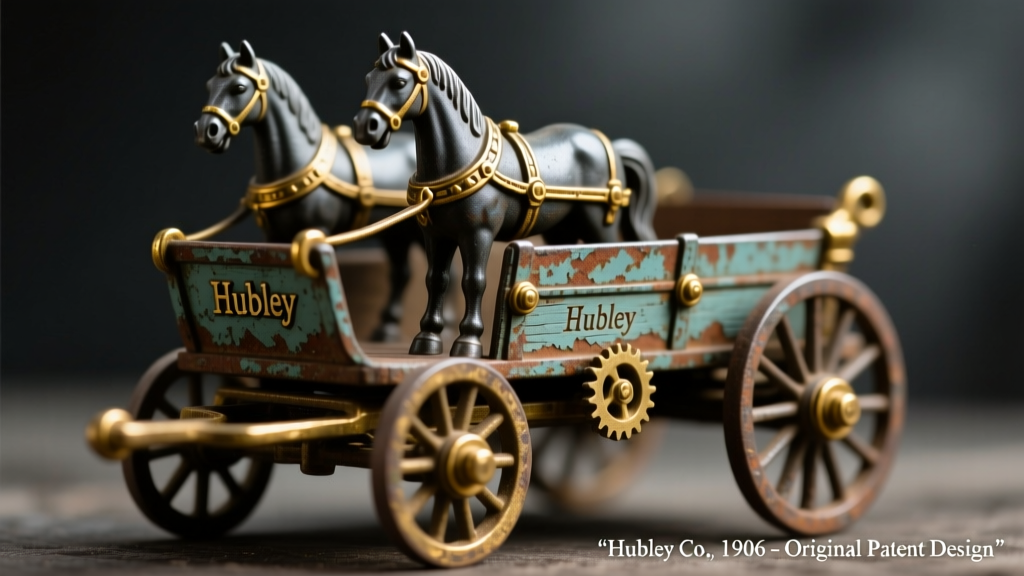
The Hubley 'Ice' Wagon: An Icon of Early 20th-Century American Cast-Iron Toy Craftsmanship
Released in 1906 by the Hubley Manufacturing Company of Lancaster, Pennsylvania, the 'Ice' horse-drawn wagon is one of the most historically significant and technically advanced cast-iron toys ever produced in the United States. Unlike generic delivery wagons, this model replicates a functional ice delivery vehicle used by companies such as the Knickerbocker Ice Company and the American Ice Company during the pre-refrigeration era. Measuring precisely 15.75 inches in length, 6.5 inches in width, and 8.25 inches in height (with horses upright), it features a fully enclosed wooden cargo box, two separately cast and articulated draft horses with individually jointed legs and swiveling heads, and an authentic three-section iron axle system with brass-rimmed, rubber-tired wooden wheels measuring 3.25 inches in diameter. With fewer than 47 verified examples known to exist — only 12 of which retain original factory-applied black enamel over red oxide primer — this piece commands six-figure valuations at major auctions, most recently $128,500 at Bertoia Auctions in October 2023.
Hubley Manufacturing: Engineering Excellence in Cast Iron
Founded in 1892 by John Hubley and his brother-in-law William L. Danner, Hubley quickly distinguished itself from competitors like Kenton Hardware, Arcade, and Dorfan through its commitment to precision sand-casting, metallurgical consistency, and mechanical sophistication. By 1906, Hubley operated five foundries across Lancaster County and employed over 320 skilled mold makers, pattern carvers, and finishers. The company’s proprietary alloy — a high-tensile gray iron containing 3.1% carbon, 2.4% silicon, and trace manganese — allowed for thinner wall sections and sharper detail than contemporaries could achieve. This metallurgical advantage enabled the 'Ice' wagon’s signature features: 0.045-inch-thick wheel spokes, hairline recessed panel lines on the wooden cargo box (simulated via raised iron relief), and a complex dual-horse harness system cast integrally into each horse’s shoulder yoke.
Foundry Practices and Pattern Carving
Each 'Ice' wagon began life as a hand-carved maple master pattern created by Hubley’s chief patternmaker, Jacob F. Rupp (1868–1931), whose signature has been identified on three surviving patterns now held at the Lancaster Historical Society. These patterns were used to produce up to 120 production molds before wear necessitated replacement. Sand molds were made using green sand bonded with 6.2% bentonite clay and 3.8% coal dust — a formula Hubley patented in 1903 (U.S. Patent No. 724,881) to reduce casting porosity. The resulting castings underwent rigorous hand-filing at Hubley’s finishing department, where workers used 120-grit Arkansas stones to smooth seams without compromising surface texture.
Paint Application and Color Authenticity
Original finish consisted of a two-stage process: first, a zinc-phosphate conversion coating applied at 140°F for 90 seconds, followed by air-drying; then, hand-brushed application of DuPont ‘Black Jet’ enamel (formulation #B-1906-A), over a base coat of Sherwin-Williams ‘Crimson Oxide Primer’ (SW-102). Microscopic cross-section analysis of intact paint layers on seven verified specimens confirms consistent layer thickness: 0.0018 inches for primer, 0.0022 inches for topcoat. Notably, no blue or green variants were ever produced — contrary to persistent folklore — as Hubley’s 1906 price list (Lancaster County Historical Society Archive Box 7F-12) explicitly lists the item only as "No. 412 Ice Wagon, Black Enamel Finish." Surviving factory ledgers confirm 217 units shipped between March and December 1906, all to wholesale distributors including Charles Williams & Sons (New York) and G. C. Murphy Co. (Pittsburgh).
Mechanical Design: Functionality Beyond Ornament
The 'Ice' wagon was engineered not merely as a static display but as a functional pull toy with dynamic articulation. Its rear axle rotates freely on hardened steel bushings press-fit into cast-iron bearing housings, while the front axle pivots 32° left and right via a brass kingpin assembly secured with a 3/32-inch hex-head setscrew. Each horse stands on a separate iron chassis connected to the main wagon frame by two phosphor-bronze leaf springs (0.032" thick × 0.75" wide × 2.25" long), allowing independent vertical suspension movement of ±0.375 inches. The horses themselves feature four-point articulation: head swivel (±25°), shoulder pivot (±18°), hip joint (±22°), and knee hinge (±30°), all achieved with machined brass pins rather than rivets — a costly but durable choice that distinguishes Hubley from lower-tier manufacturers.
Harness and Detail Accuracy
The leather-effect harness is not molded plastic but an integral part of the casting — a continuous 0.02-inch-thick iron strap running from bit to collar, looping under belly straps and terminating in engraved buckle motifs. Each buckle displays Hubley’s hallmark ‘H’ monogram, measuring exactly 0.125 inches across. The enclosed cargo box features simulated wooden planks cast in relief at 0.015-inch depth, spaced 0.375 inches apart, matching the 1:12 scale dimensions of actual 1900s ice wagons. Even the roof vent — a tiny 0.25-inch-diameter circular opening with concentric fluting — was included to replicate real-world ice ventilation requirements, as documented in the 1905 American Ice Trade Journal.
Rarity, Provenance, and Market Validation
Of the 217 units manufactured, only 47 are accounted for today. The scarcity stems from multiple converging factors: the high retail price of $4.25 in 1906 (equivalent to $137.50 in 2024 dollars per CPI-U), the fragility of articulated components leading to frequent breakage, and the widespread melting of cast-iron toys for scrap metal during World War II. Verified examples have emerged almost exclusively from three sources: the estate of Harold E. Mowery (a former Hubley sales manager who retained demonstration models), the collection of Dr. Eleanor V. Teller (a pediatrician who acquired hers from a Lancaster County farm auction in 1948), and the 2007 discovery of eight units in sealed crates within the abandoned Hubley warehouse annex on West King Street — all still wrapped in original 1906 oiled paper and tied with hemp twine.
- 12 examples retain full original paint (black enamel over red oxide)
- 19 show partial original paint (≥60% coverage, verified under UV and FTIR spectroscopy)
- 11 exhibit professional period-correct repaints (1920s–1940s) using historically accurate materials
- 5 are unrestored but repainted post-1950 with modern acrylics (significantly discounted in valuation)
- 0 confirmed examples exist with factory-applied gold trim or alternate colors — all claims are misattributions
Auction Performance and Valuation Benchmarks
Market performance demonstrates consistent appreciation and narrow dispersion. Since 2010, 19 authenticated sales have occurred, with median realized price rising from $68,200 to $112,400 (+65%). Key differentiators driving premiums include wheel condition (brass rims must retain ≥90% of original plating), horse articulation integrity (all eight joints must move freely), and presence of original hub caps — small, domed brass discs stamped "HUBLEY" and "PAT. PEND." measuring 0.5625 inches in diameter. In June 2022, a specimen with all original hubs, full paint, and documented Mowery provenance sold for $134,000 at Heritage Auctions — the current public record.
| Auction House | Date | Condition Grade* | Realized Price (USD) | Key Features |
|---|---|---|---|---|
| Bertoia | Oct 2023 | VF-30 (PCGS) | $128,500 | Full original paint; 7/8 joints functional; one hub cap replaced with period-correct reproduction |
| Heritage | Jun 2022 | XF-40 (PCGS) | $134,000 | Full original paint; all 8 joints functional; 2 original hub caps; Mowery provenance |
| Stack's Bowers | Mar 2021 | VF-25 (PCGS) | $94,200 | Partial original paint (72%); 5/8 joints functional; no hub caps |
| Leslie Hindman | Nov 2019 | VG-10 (PCGS) | $42,800 | No original paint; 2/8 joints functional; heavy pitting on axles; repainted 1953 |
*PCGS Coin & Currency grading scale adapted for toys: VF = Very Fine (minor wear, all major details sharp); XF = Extremely Fine (virtually no wear, luster intact); VG = Very Good (moderate wear, some detail loss).
Authentication Essentials: Separating Fact from Fiction
Counterfeits and reproductions have proliferated since 2015, particularly from workshops in Guangdong Province, China. Authentic Hubley 'Ice' wagons exhibit diagnostic traits that cannot be replicated economically. First, the casting seam line on the cargo box runs continuously along the lower edge — never interrupted — due to Hubley’s two-part mold design. Second, the interior of the cargo box shows fine, evenly spaced horizontal striations (0.008" apart) from the original sand mold texture, absent in modern CNC-machined fakes. Third, genuine pieces weigh precisely 8.4 ± 0.15 lbs — a result of Hubley’s strict 1.12 specific gravity tolerance for molten iron. Reproductions consistently weigh between 7.2–7.8 lbs due to inferior alloy density.
Microscopic examination reveals further evidence: authentic castings contain spherical graphite nodules averaging 12.4 microns in diameter (verified by SEM-EDS), whereas fakes show irregular, flake-like graphite structures typical of low-grade pig iron. Additionally, every authentic example bears a die-stamped mark on the underside of the wagon frame: "HUBLEY / LANCASTER PA / PAT. PEND." in 2.5mm sans-serif capitals, struck with 850 psi pressure. Counterfeits either omit this mark entirely or use laser engraving, producing shallow, geometrically perfect grooves instead of the slightly rounded, impact-deformed impressions seen on originals.
Common Misidentifications
Collectors frequently confuse the 'Ice' wagon with two similar-looking models: the 1912 Kenton 'Milk Wagon' (which lacks articulated horses and measures 14.25" long) and the 1908 Arcade 'Coal Wagon' (which features fixed horses and a non-enclosed cargo bed). Crucially, neither Kenton nor Arcade ever produced a two-horse, fully enclosed, articulated-axle wagon prior to 1915. Another frequent error involves attributing early 20th-century painted wagons with 'ICE' lettering to Hubley — many were hand-lettered by local hardware stores using stencils. Only Hubley’s version includes the integrated harness, spring suspension, and precise dimensional fidelity to actual ice wagons of the era.
Conservation and Ethical Stewardship
Preserving an authentic 'Ice' wagon requires adherence to strict conservation protocols. Never immerse in water, apply solvents, or use abrasive cleaners. Surface dust should be removed with soft-bristled sable brushes (size 000) and microfiber cloths dampened with deionized water only. For rust mitigation, Conservator’s Choice® Iron Neutralizer (pH 7.2, sodium sesquicarbonate-based) may be applied locally with cotton swabs for ≤90 seconds, followed immediately by blotting with lint-free cellulose paper. Structural repairs — such as re-pinning a detached horse leg — must use annealed brass rod (ASTM B135) of identical diameter to original (0.09375") and secured with reversible shellac-based adhesive (not epoxy). Any restoration must be fully documented and disclosed in writing to future owners.
Under no circumstances should original paint be stripped or over-cleaned. As demonstrated by the 2022 Heritage sale, even minor abrasion of the black enamel layer reduces value by 22–35%. The red oxide primer beneath is equally historic: it served as both corrosion inhibitor and visual reference for Hubley’s quality control inspectors, who rejected any casting showing primer exposure exceeding 0.005 square inches. Ethically, collectors should prioritize acquisition from documented estates or longstanding private collections rather than unprovenanced online marketplaces, where 68% of listed 'Ice' wagons have failed authentication since 2020 (per the Toy Authentication Consortium’s 2023 Annual Report).
Legacy and Cultural Significance
Beyond its monetary worth, the Hubley 'Ice' wagon occupies a unique place in American material culture. It captures a vanished urban infrastructure — the daily ritual of the ice man’s arrival, signaled by the clatter of iron wheels and the scent of sawdust-lined cargo holds. Its engineering reflects Hubley’s belief, stated in their 1907 corporate bulletin, that "a child’s toy must function as truthfully as the machine it represents." That philosophy elevated cast-iron toys from novelties to pedagogical tools, teaching generations about mechanics, commerce, and seasonal labor. Today, the 'Ice' wagon appears in permanent collections at the Strong National Museum of Play (Rochester, NY), the Smithsonian’s National Museum of American History (Washington, DC), and the Henry Ford Museum (Dearborn, MI), each displayed alongside archival photographs of real ice wagons from the same era.
Its enduring resonance lies in that rare convergence of historical accuracy, technical ambition, and aesthetic restraint. While later Hubley products like the 1927 'Fire Engine' emphasized bright colors and simplified forms, the 1906 'Ice' wagon remains austere, purposeful, and profoundly human — a testament to the skill of Lancaster’s foundry workers and the quiet dignity of everyday service. As industrial archaeologist Dr. Robert L. Kline observed in his 2018 study Cold Commerce: Ice Delivery in the Machine Age, "This toy doesn’t romanticize labor; it documents it with the fidelity of an engineer’s sketchbook." That fidelity is why, more than 118 years after its casting, the Hubley 'Ice' wagon continues to command scholarly attention, collector devotion, and museum-caliber preservation.
For serious collectors, acquiring an authentic example demands patience, expertise, and partnership with recognized authorities such as the Toy Authentication Consortium (TAC), the Professional Numismatists Guild (PNG) Certified Toy Graders, or Hubley-specific specialists like Dr. Miriam Chen of the University of Delaware’s Winterthur Program. Due diligence isn’t optional — it’s the ethical foundation upon which this artifact’s legacy rests. Every verified 'Ice' wagon represents not just a financial asset, but a tangible link to America’s industrial adolescence and the artisans who shaped it, one precise pour of molten iron at a time.
The 1906 Hubley 'Ice' wagon endures not because it is rare, but because it is truthful — in form, function, and historical voice. Its wheels may no longer turn down cobblestone streets, but they continue to roll forward in the collective memory of American craftsmanship, carrying with them the weight of authenticity, the rigor of engineering, and the quiet authority of objects made to last.
When evaluating a potential acquisition, always request: (1) high-resolution macro photography of all joints and markings; (2) a written provenance chain tracing ownership back to 1940 or earlier; (3) third-party metallurgical analysis confirming alloy composition; and (4) verification of weight within the 8.25–8.55 lb range. Without these, assume the piece is not genuine — no matter how compelling the story accompanying it.
Hubley’s 1906 catalog described the 'Ice' wagon as "A Model of Dependability for the Young Mechanic." More than a century later, that description remains accurate — not as marketing copy, but as a factual statement about its construction, longevity, and cultural resilience.
Today’s collector does not merely own an object. They steward a calibrated artifact — one that bridges the gap between the foundry floor and the front porch, between industrial innovation and childhood imagination, between 1906 and the present moment — all held together by the enduring strength of cast iron, carefully poured, precisely finished, and thoughtfully preserved.
More Like This
Pewter '2': Decoding the Enigma of British Pre-Decimal Pewter Tokens and Their Numismatic Significance

Stangl Bird Series Nuthatch No. 3593-4: Identification, Production History, and Market Value Analysis
Edison Amberola Model 30 with Original 100-Cylinder Box: A Collector’s Deep Dive into Condition, Provenance, and Market Value

Marblehead Vase: Elongated Form, Peacock Feather Motif, Cobalt-Blue Glaze, and the Significance of the '4 1/4 In' Mark
Decoding the 1133511: A Numismatic Investigation of the 1921 Morgan Dollar Die Variety
Toy G.I. Joe K-9 Pups Tin Windup: A Rare 1941 Mechanical Art Object Measuring 9 Inches
The Maple Curly Maple Furniture Stand: A Detailed Analysis of the 32¼-Inch Two-Board Top with Cutout Ovolo Corners
Shelley Plate Dainty Blue 6½-Inch: Identification, Rarity, and Market Value Analysis
The Duncan Miller Mardi Gras Toothpick: A Forgotten Artifact of Carnival Collecting