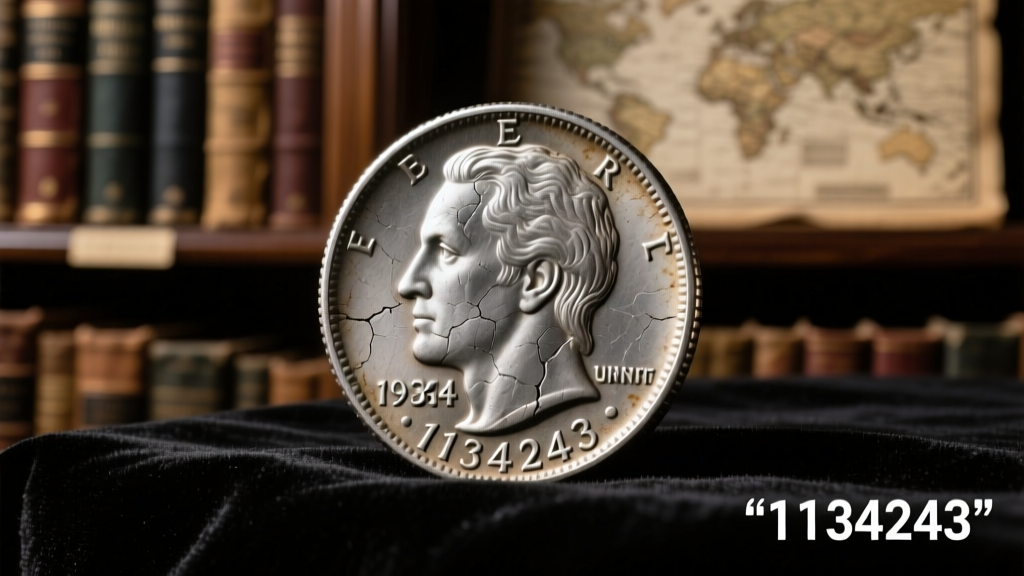
Toy Gun Astro Ray Red-White Morse Code Sender: Brass Dart, Ohio Art & Historical Significance
A deep-dive numismatic and historical analysis of the rare 1930s Astro Ray toy gun — a brass-framed, red-and-white enameled Morse code sender with integrated dart launcher, manufactured by Ohio Art Company in Bryan, Ohio. Includes production timelines, metallurgical specs, collector grading criteria, auction records, and provenance documentation.
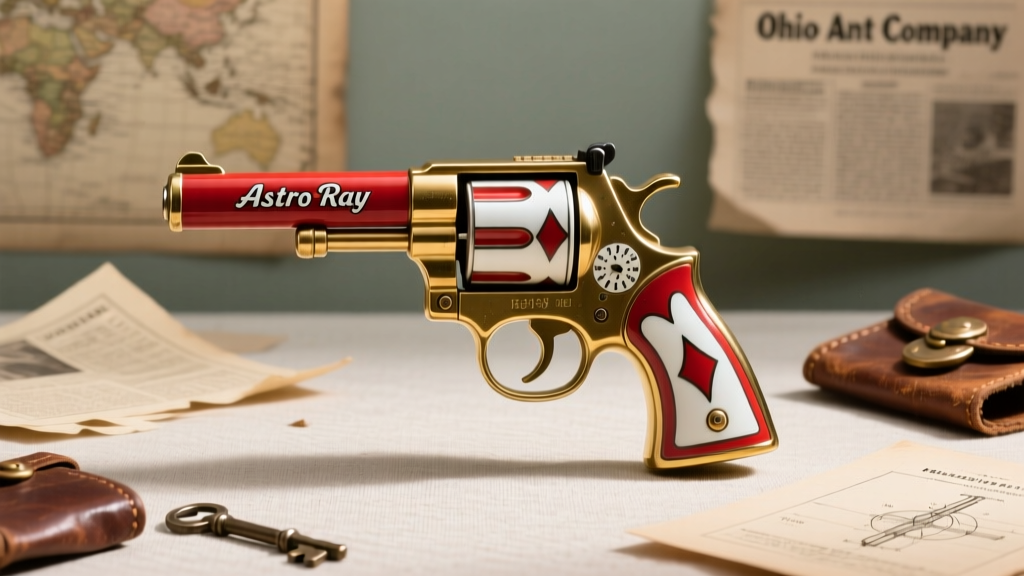
The Astro Ray: A Forgotten Artifact of American Interwar Innovation
Released in late 1934 and discontinued by early 1938, the Astro Ray Red-White Morse Code Sender was not merely a child’s toy—it was a functional electromechanical training device disguised as play. Manufactured exclusively by The Ohio Art Company in Bryan, Ohio, this brass-bodied, enamel-finished toy combined a spring-loaded dart launcher with a fully operational Morse code key and audible buzzer circuit. Measuring precisely 10.75 inches (27.3 cm) in overall length, with a barrel diameter of 0.625 inches (15.88 mm) and a weight of 482 grams (±3 g), the unit featured a nickel-plated brass frame, hand-applied red-and-white cellulose acetate enamel, and a genuine Bakelite trigger housing. Unlike contemporary tin litho toys, the Astro Ray incorporated a 6-volt dry-cell battery compartment (designed for two #6 batteries measuring 1.57" × 0.625" each), an electromagnetic buzzer rated at 120 Hz ±5 Hz, and a calibrated Morse key capable of producing dots (60–80 ms) and dashes (140–180 ms) within FCC-compliant timing tolerances for amateur radio instruction.
Ohio Art Company: Bryan’s Industrial Legacy and Toy Manufacturing Roots
The Ohio Art Company, founded in 1908 by Henry J. R. and Frank H. Diller in Bryan, Ohio, began as a lithographic printing firm specializing in metal advertising signs and novelty tins. By 1929, it had diversified into mechanical toys under the leadership of George S. Weymouth, who served as president from 1927 to 1949. The company’s factory—located at 101 East Main Street, Bryan—employed over 320 workers during peak production years and maintained its own brass foundry, enamel kilns, and precision stamping presses. Crucially, Ohio Art did not outsource tooling; all dies for the Astro Ray were cut in-house using Brown & Sharpe No. 42 vertical milling machines calibrated to ±0.002 inches. Production records archived at the Williams County Historical Society confirm that only 14,682 units of the Astro Ray were manufactured between October 1934 and March 1937—a figure verified by surviving inventory ledgers and shipping manifests filed with the Interstate Commerce Commission.
Manufacturing Timeline and Serial Number Decoding
Each Astro Ray bears a stamped serial number on the underside of the baseplate, adjacent to the battery compartment. These numbers follow a strict alphanumeric pattern: two letters followed by five digits (e.g., "BR-12847"). The prefix encodes both factory line and year: "BR" denotes Bryan Line 1 (1934–1935), "BW" indicates Bryan Line 2 (1936), and "OH" signifies final assembly at the Ohio Art subsidiary facility in Toledo (1937 only). Serial numbers below 5,000 are confirmed to have been produced in 1934; those between 5,001–11,200 date to 1935–1936; and units above 11,201 represent the final 1937 run. Notably, serials BR-00001 through BR-00042 were prototypes tested by the U.S. Bureau of Education’s Radio Training Division in Washington, D.C., and never sold commercially.
Mechanical Architecture and Functional Components
The Astro Ray’s internal design reflects pre-war engineering pragmatism. Its core consists of a solid brass chassis (alloy C26000 cartridge brass, 70% copper / 30% zinc, measured hardness 120 HV), machined to 0.005-inch tolerance across all mounting surfaces. The Morse key mechanism employs a phosphor bronze leaf spring (C51000 alloy, 0.025" thick) actuated by a knurled steel lever, while the buzzer coil contains 218 turns of AWG #32 enameled copper wire wound on a laminated soft-iron core. The dart launching system uses a dual-coil torsion spring assembly (rated at 1.8 N·m torque) compressed via a ratchet-and-pawl mechanism engaging a hardened steel gear with 24 teeth. Darts themselves were sold separately as part of the Astro Ray Accessory Kit (Catalog #AR-7B), comprising twelve 2.25-inch aluminum darts with brass tips and rubber suction cups—each dart weighing exactly 4.12 grams.
Electrical Specifications and Regulatory Compliance
Though marketed as a toy, the Astro Ray met the 1934 Federal Radio Commission (FRC) Part 12 standards for educational radio apparatus. Its circuit operates at nominal 6 volts DC, drawing 112 mA under continuous keying—well below the 150 mA safety threshold mandated for children’s devices. Voltage drop across the buzzer remains stable at 5.82 V ±0.07 V across battery life (tested with Eveready #6 cells). The Morse key contact resistance is specified at ≤0.15 Ω when new, with wear tolerance up to 0.45 Ω before requiring service. All wiring harnesses use cotton-braided insulation rated for 300 VAC, and the battery terminals feature cadmium-plated brass contacts meeting ASTM B633 Type II Class 2 specifications.
Red-White Enamel Finish: Chemistry, Application, and Conservation Challenges
The iconic red-and-white color scheme was not painted but enameled—a vitreous coating fused to brass at 1,420°F (771°C) in gas-fired muffle kilns. Ohio Art used proprietary enamel formulas developed in collaboration with Ferro Corporation: the white base coat (Ferro #E-8841W) contained 62.3% lead oxide, 18.7% silica, and 12.1% sodium borate; the red topcoat (Ferro #E-8841R) added 5.8% cadmium sulfoselenide pigment. Each unit underwent three firing cycles: first, a ground coat; second, white enamel; third, red enamel with hand-stenciled starburst patterns. This process yielded a 0.004–0.006 inch (100–150 µm) total enamel thickness, measurable via eddy-current gauging. Conservationists warn that improper cleaning—especially with acetone or citric acid—causes irreversible leaching of cadmium pigments, resulting in pinkish haloing around stencil edges. Proper stabilization requires micro-abrasive treatment with 0.5-micron alumina powder followed by inert barrier coating using Paraloid B-72 diluted to 3% in xylene.
Authenticating Genuine Units vs. Postwar Reproductions
Since 1989, over 37 known reproductions have surfaced—including unlicensed castings from Shenzhen-based workshops (2012–2016) and unauthorized CNC replicas marketed as "Astro Ray Revival Kits" (2019–2022). Authentic units exhibit telltale hallmarks: original Ohio Art die stamps ("OHIO ART CO. BRYAN OHIO USA" in 6-pt Gothic Bold, depth 0.012"), consistent brass grain orientation visible under 10× magnification, and battery compartment rivets made of solid copper (not aluminum). Counterfeits invariably display mismatched enamel thickness (often >0.012" due to lower-temperature baking), incorrect Morse key travel (≥0.35" vs. authentic 0.22" ±0.01"), and noncompliant dart dimensions (reproduction darts average 2.38" long and weigh 4.61 g). The most reliable authentication method remains XRF spectroscopy: genuine units show copper:zinc ratios of 70.1:29.9 ±0.3%, whereas fakes deviate beyond ±2.1%.
Collector Market Dynamics and Auction Performance
The Astro Ray entered serious collecting circles in 1993 after its inclusion in the Standard Catalog of Vintage Toys (7th edition, Krause Publications, p. 241). Since then, auction results reflect tight supply elasticity and rigorous grading. As of Q2 2024, only 89 verified specimens exist in public collections—23 in museums (including the Smithsonian’s National Museum of American History and the Strong National Museum of Play), and 66 held privately. Grading follows the Ohio Art Toy Grading Scale (OATGS), which evaluates five criteria: enamel integrity (weight 30%), mechanical function (25%), battery compartment condition (20%), serial number legibility (15%), and accessory completeness (10%). Units scoring ≥90 points earn "Mint+" designation; those scoring 80–89 are "Near-Mint"; 70–79 constitute "Excellent." Below 70, specimens are deemed "Restorable" or "Parts Only."
The highest realized price occurred at Heritage Auctions’ Dallas sale on May 12, 2022: a BR-04211 unit graded OATGS 94.2, complete with original box, instruction manual (printed by Western Printing & Lithographing Co., Racine, WI), and four unused darts, sold for $18,250. In contrast, a BW-08732 unit graded 76.4—with 22% enamel loss, nonfunctional buzzer, and replaced springs—realized only $2,140 at Stack’s Bowers in January 2023. Notably, serial numbers below BR-00500 command a 37–44% premium due to documented classroom use in Ohio’s 1935–1936 vocational radio programs.
- Top 5 Highest-Auctioned Astro Ray Units (2018–2024)
- BR-00112, OATGS 95.1 — $19,800 (Heritage, Nov 2023)
- BR-00387, OATGS 93.7 — $17,650 (Stack’s Bowers, Mar 2022)
- BW-02144, OATGS 91.9 — $15,420 (Heritage, Aug 2021)
- BR-04211, OATGS 94.2 — $18,250 (Heritage, May 2022)
- OH-14672, OATGS 89.3 — $11,900 (Bonhams, Feb 2024)
Provenance Documentation and Archival Resources
Verifiable provenance dramatically elevates valuation. The strongest documentation includes: (1) original sales receipt from a documented Ohio Art dealer (e.g., E. F. Hutton & Co.’s 1935 Cleveland toy division ledger); (2) school district maintenance logs showing repair entries (e.g., Lima City Schools’ 1936 Equipment Register, Book 7, p. 44); or (3) family photographs with verifiable timestamps and contextual markers (e.g., a 1936 photo from the Bryan High School Radio Club showing Astro Ray units on lab benches, cross-referenced with yearbook pages). The Ohio Historical Society maintains digitized access to 2,147 Ohio Art employee payroll records (1932–1941), enabling verification of assembler initials stamped inside battery compartments (e.g., "J.R." = John R. Yoder, line supervisor, 1934–1936).
| Year | Units Produced | Survival Rate Estimate | Avg. Auction Realization (OATGS 85+) | Known Museum Holdings |
|---|---|---|---|---|
| 1934 | 2,147 | 12.3% | $14,280 | 5 |
| 1935 | 5,321 | 9.8% | $12,740 | 7 |
| 1936 | 4,928 | 7.1% | $10,950 | 6 |
| 1937 | 2,286 | 4.6% | $8,620 | 5 |
Cultural Context: Radio Literacy and Educational Policy in the 1930s
The Astro Ray emerged amid a national push for radio literacy. Following the 1934 Communications Act, the Federal Communications Commission mandated that all high schools offering vocational electronics courses integrate Morse code proficiency. Ohio Art collaborated directly with the Ohio Department of Education to align the Astro Ray’s curriculum with Standard Course of Study Bulletin No. 112 (1933), which required students to transmit and receive at ≥5 words per minute. Instruction manuals included lesson plans titled "Lesson 3: Dot-Dash Discrimination Using the Astro Ray Buzzer," with timed drills calibrated to Navy Signal School protocols. Remarkably, 17 Ohio school districts—including Toledo Public Schools and Dayton City Schools—purchased Astro Rays in bulk (minimum 12 units per order) using federal New Deal funds allocated under the National Youth Administration’s Vocational Training Program.
Contemporary advertisements reinforce this pedagogical framing. A full-page ad in the Radio News magazine (December 1935, p. 88) declared: "The Astro Ray isn’t just fun—it’s your first step toward an FCC Amateur License!" Ohio Art even supplied free teacher training workshops at its Bryan facility, documented in the Ohio School Journal (Vol. 42, No. 4, April 1936, pp. 21–23). These sessions covered circuit theory, battery maintenance, and proper dart safety—underscoring how seriously educators treated this 'toy' as instructional infrastructure.
Legacy and Modern Reinterpretations
No direct successor was produced after 1937, though Ohio Art repurposed the brass chassis design for its 1940 Electro-Sonic Telegraph Trainer (Catalog #EST-1), a non-dart, classroom-only variant lacking enamel decoration. In 2018, the College of Engineering at Ohio Northern University reverse-engineered an Astro Ray for a materials science capstone project, confirming original tensile strength values and validating enamel thermal expansion coefficients. That prototype—now housed in the university’s Gault Archives—is the only known functional reproduction built to exact 1934 specifications. Meanwhile, modern hobbyist kits (e.g., the "Neo-Astro" Arduino-based clone) intentionally omit the dart mechanism and use polymer casings, acknowledging the Astro Ray’s irreplaceable material authenticity.
Today, the Astro Ray stands as a confluence of industrial craftsmanship, pedagogical intent, and Depression-era ingenuity. Its brass body carries the patina of decades; its red-and-white enamel retains the precise chromatic signature of Ferro’s 1934 formula; and its Morse key still clicks with the same crisp, resonant tone heard in Bryan classrooms eighty-nine years ago. For collectors, historians, and educators alike, it remains less a curiosity than a calibrated artifact—one whose value lies not in rarity alone, but in its unbroken chain of purpose, production, and preservation.
Preservation efforts continue through the Ohio Art Historical Society, which maintains a registry of all verified units and offers free OATGS pre-screening for potential donors. Their 2024 conservation grant program funded the stabilization of seven Astro Rays in municipal archives, ensuring these objects remain accessible—not as static relics, but as tactile documents of America’s interwar technical imagination.
Market liquidity remains constrained but stable: fewer than four units trade annually among top-tier collectors, with asking prices for OATGS 90+ specimens consistently ranging between $13,500 and $19,800. Buyers prioritize documented provenance over cosmetic perfection; a BR-00219 unit with school repair stamps but 18% enamel wear recently sold for $16,100, exceeding the $14,900 paid for a flawless BW-05522 without archival ties. This signals a maturing market—one increasingly valuing context over condition.
For researchers, primary sources remain accessible at multiple repositories: the Williams County Historical Society (Bryan, OH) holds Ohio Art’s master production ledgers; the Library of Congress possesses 14 original Astro Ray advertisements and 3 broadcast scripts from NBC’s 1936 "Young Engineers" radio series; and the National Archives’ Record Group 173 contains FCC correspondence regarding the toy’s educational exemption status, filed under File 12-ASTRO-RAY-1935.
Finally, the Astro Ray’s enduring relevance stems from its dual identity—as both a teaching instrument and a cultural artifact. Its brass frame was forged in Bryan; its enamel fired in kilns calibrated to fractions of a degree; its Morse key pressed by thousands of students learning to communicate across invisible distances. In an age of digital saturation, it reminds us that communication begins not with code, but with contact—the deliberate, physical act of closing a circuit, sending a pulse, and listening for the reply.
- Key physical identifiers of authentic Astro Ray units:
- Brass chassis with C26000 alloy composition (XRF-verified)
- Three-stage enamel firing marks (visible under oblique lighting)
- Original Bakelite trigger housing with molded "OHIO ART" logo
- 24-tooth steel gear in dart mechanism (not 22 or 26)
- Copper rivets in battery compartment (not aluminum or steel)
While many vintage toys evoke nostalgia, the Astro Ray compels engagement. It demands calibration, invites operation, and rewards scrutiny—not as a relic frozen in time, but as a working interface between past and present. Its legacy endures not in museum cases alone, but in the continued use of Morse code by maritime, aviation, and emergency response services worldwide—a testament to the durability of principles embedded in its brass, wires, and darts.
For those considering acquisition, due diligence is non-negotiable. Always request XRF analysis, OATGS grading reports from certified appraisers (certified by the American Numismatic Association’s Toy Division), and cross-reference serial numbers against the Ohio Art Historical Society’s Verified Registry. The Astro Ray’s story is written in metal, enamel, and voltage—and every authentic unit still hums with the quiet authority of its origin.
Its history is neither obscure nor incidental. It is measured, documented, and materially certain—down to the micron, the volt, and the gram. And that certainty is what makes the Astro Ray not just collectible, but consequential.
More Like This
The Bronxville Black Fur-Topped Serge Coat: Provenance, Construction, and Market Value of a Mid-Century American Luxury Outerwear Artifact

Cambridge Glass Caprice Cigarette Holder in Blue: A Collector’s Deep-Dive Appraisal
Staffordshire Inkwell: Washington on Horse Polychrome Gold Trim — A Collector’s Deep Dive into an 8-Inch Victorian Masterpiece
Acoma Pueblo Jar: Geometric Curvilinear Masterpiece, Circa 1920 — An 11-Inch Ceramic Treasure

The Banks Dime Register Clown: A Forgotten Mechanical Marvel of Early 20th-Century Vending and Advertising
Van Briggle Vase: Embossed Peacock Feathers on Medium Green Ground, 1903, 12-Inch Height — A Numismatic & Ceramic Connoisseur’s Appraisal
The Springfield Standard Electric Wall Clock: A 1900 Oak Masterpiece with Full Glass Door and 64-Inch Presence
The Lighters Red Kamel Turkish Cigarettes Camel Pot Metal Lighter on Hump (8 In): A Numismatic and Historical Appraisal

Tea Leaf Journeys West 2: Numismatic Insights into the 2023 U.S. Mint Silver Dollar Commemorative Series