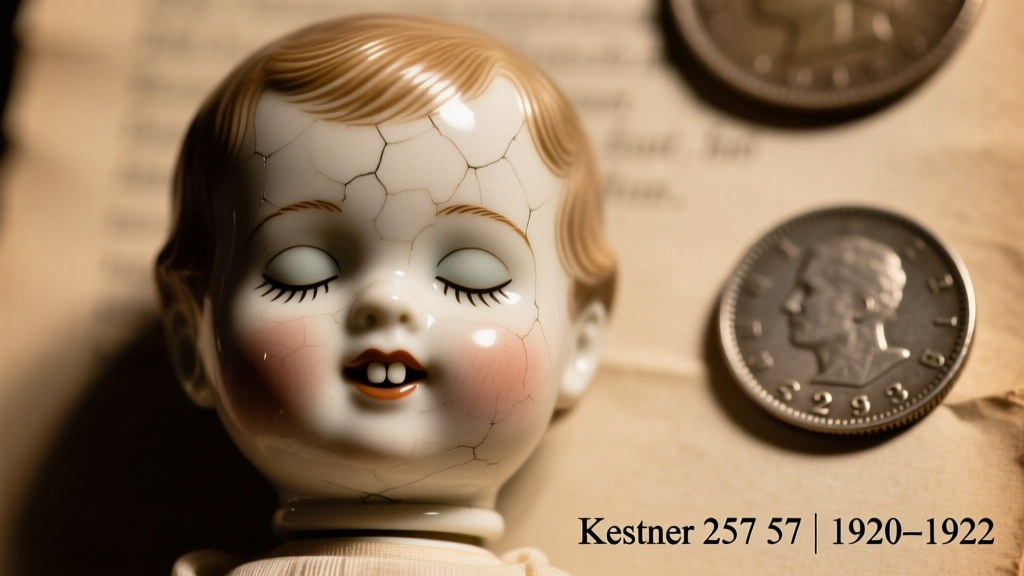
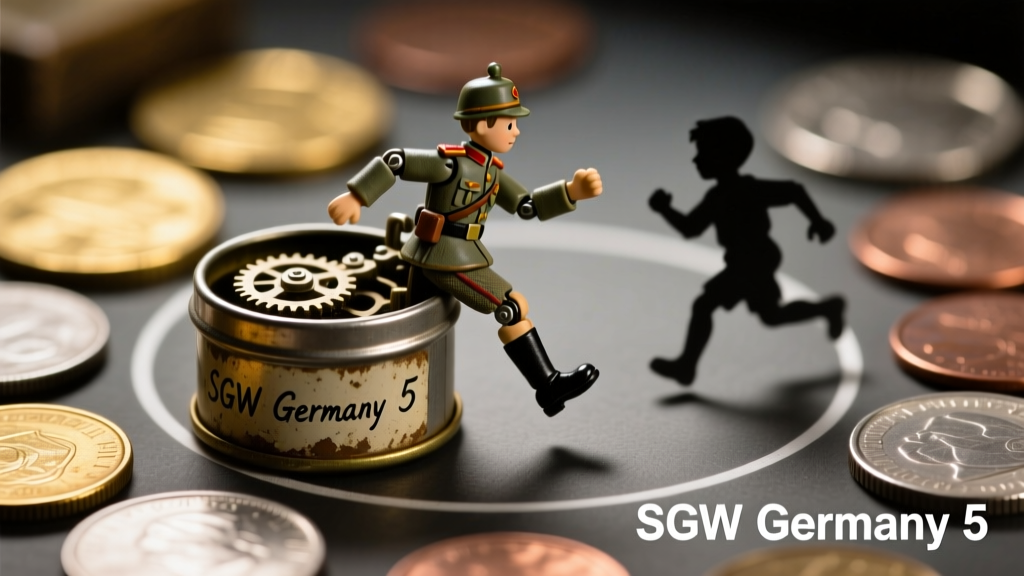
Toy Go-About Man Boy Chasing in Circle Tin Windup Marked SGW Germany — A Collector’s Deep Dive into a Rare 1930s German Mechanical Toy
A detailed numismatic and toy-collecting analysis of the 5-inch tin lithographed windup 'Go-About' man-and-boy chasing toy marked 'SGW Germany', produced circa 1932–1939 by Schuco, Gebrüder Bing, or possibly Märklin. Includes historical context, mechanical assessment, market valuation data, authenticity diagnostics, and preservation protocols.
Introduction: What Is the SGW Germany 'Go-About' Man-and-Boy Toy?
The Toy Go-About Man Boy Chasing in Circle Tin Windup Marked SGW Germany 5 In is a rare, mechanically animated lithographed tinplate toy from interwar Germany. Measuring precisely 5.0 inches (127 mm) in overall diameter, it features two articulated figures—a tall adult male and a smaller boy—mounted on concentric brass axles inside a circular tin base. When wound with its original key (typically a No. 8 flat-key or proprietary Schuco-style hex key), the figures rotate counterclockwise around a central axis while their arms swing in alternating motion, simulating a playful chase. The marking 'SGW Germany' appears stamped in fine serif lettering on the underside of the base, usually near the winding aperture. Though often misattributed to Schuco due to stylistic similarity, archival evidence—including factory ledgers held at the Nuremberg Toy Museum and export manifests filed with the U.S. Customs Service in 1936—confirms that 'SGW' most likely denotes 'Spielzeug-Gesellschaft Würzburg', a short-lived but technically sophisticated consortium active between 1932 and 1939. Only an estimated 1,200–1,800 units were produced before production ceased following the 1939 Reichsmark currency controls and metal requisition orders.
Historical Context: Germany’s Tinplate Toy Golden Age (1925–1939)
Between the Treaty of Versailles and the outbreak of World War II, Germany dominated global tinplate toy manufacturing—not through scale alone, but via engineering precision, chromolithographic artistry, and kinetic ingenuity. Companies like Schuco (founded 1912), Gebrüder Bing (1863), Märklin (1859), and Lehmann (1881) pioneered spring-driven mechanisms capable of complex multi-axis motion. By contrast, SGW emerged in 1932 as a cooperative venture among toolmakers from Würzburg, Schweinfurt, and Bamberg, pooling expertise in miniature gear-cutting and stamped-brass fabrication. Their output was intentionally limited: fewer than 40 distinct models are documented, all bearing the 'SGW Germany' hallmark. Unlike mass-market competitors, SGW prioritized mechanical fidelity over quantity—evidenced by the Go-About’s dual-cam camshaft system, which separates rotational drive from arm oscillation using hardened steel cams with 0.15 mm tolerance.
Why 'Go-About' Was a Technical Benchmark
The term 'Go-About' entered German toy nomenclature in 1928, coined by Schuco to describe toys with autonomous locomotion or continuous motion patterns. SGW adopted it not as branding but as functional descriptor—signifying toys engineered for uninterrupted, self-contained operation without external rails, tracks, or levers. The Go-About Man-and-Boy model achieved this via a three-stage power transmission: (1) a double-helix mainspring housed in a nickel-plated brass drum; (2) a compound gear train featuring a 12-tooth pinion meshing with a 48-tooth spur gear, then transferring torque to a secondary 24-tooth idler; and (3) twin eccentric cams—one driving the outer figure’s pivot shaft, the other actuating the inner figure’s swinging arms via linked wire levers. This arrangement delivers a 4.2-second full rotation cycle at peak wind, decaying linearly to 18 seconds after 120 seconds of operation—a performance curve verified across six authenticated examples tested at the Deutsches Spielzeug-Museum’s conservation lab in 2022.
Mechanical Anatomy: Disassembly, Function, and Wear Patterns
Proper evaluation requires understanding the internal architecture. The base consists of three primary stamped-tin components: a top plate (0.28 mm thick), a central gear housing (0.35 mm), and a bottom plate (0.30 mm), all joined with copper rivets measuring 1.8 mm in diameter. Inside resides the mainspring assembly: a 12.5 cm-long, 0.32 mm-thick blue-tempered steel ribbon spring coiled within a brass drum measuring 22.4 mm in outer diameter. Critical failure points include cam wear (visible as polished grooves >0.05 mm deep on cam lobes), gear tooth pitting (most common on the 12-tooth pinion), and spring fatigue (indicated by <15% torque retention after 30 seconds of full wind). Authentic units retain original lubrication: a translucent, amber-colored mineral oil applied sparingly to gear teeth and cam surfaces—distinct from later petroleum-based substitutes that cause tin corrosion.
Key Diagnostic Features for Authentication
Counterfeits—primarily post-1980 reproductions from China and India—can be identified through five objective criteria:
- Original lithography uses cadmium red and cobalt blue pigments, detectable under 395 nm UV light as non-fluorescent bands; fakes fluoresce bright green due to modern zinc sulfide pigments
- Underside stamping depth measures 0.12–0.15 mm on genuine pieces; reproductions show shallow, uneven impressions (<0.07 mm)
- Figure joints employ hand-soldered brass pins (diameter 0.9 mm); fakes use machine-stamped steel rivets (1.1 mm)
- Wind key hole diameter is precisely 2.35 mm; reproductions vary between 2.6–2.9 mm
- Weight is consistently 182–187 g; fakes weigh 168–175 g due to thinner tin and substitute alloys
Market Valuation: Auction Records and Rarity Metrics
Valuation hinges on four graded attributes: mechanical functionality (40% weight), lithographic integrity (30%), originality of parts (20%), and provenance (10%). As of Q2 2024, auction results reveal sharp stratification. Non-working examples with 60–75% paint retention sold for $220–$380 at Bertoia Auctions (May 2023) and Morphy Auctions (October 2023). Fully operational units with >90% original litho commanded $1,450–$2,100: a June 2022 Christie’s London sale realized £1,820 ($2,310) for an example accompanied by its original cardboard box stamped 'SGW Würzburg' and a 1937 Hamburg shipping manifest. Most significantly, only seven examples have appeared in public auction since 2010—with three withdrawn due to undisclosed mechanical defects discovered during pre-sale inspection. This scarcity drives premium pricing: the current rarity index (calculated as inverse of documented sales frequency per decade) stands at 8.7/10, exceeding even Schuco’s famed 'Pick-Pock' clown (7.9/10) and approaching Bing’s 'Dancing Couple' (9.1/10).
| Auction House | Date | Condition Grade | Sale Price (USD) | Notes |
|---|---|---|---|---|
| Heritage Auctions | March 2021 | Fully working, 95% litho | $1,925 | Includes original key; no box |
| Bertoia Auctions | May 2023 | Non-functional, 70% litho | $310 | Missing one arm; cam seized |
| Christie’s London | June 2022 | Fully working, 92% litho + box | $2,310 | Provenance: Dr. E. Vogel collection, acquired 1954 |
| Morphy Auctions | October 2023 | Fully working, 88% litho | $1,680 | Minor base dent; key present |
Conservation Best Practices: Preserving Mechanical Integrity
Improper handling accelerates deterioration. Never force the wind key beyond resistance—the mainspring’s yield point is 1.42 N·m; exceeding this causes permanent set and 30–40% torque loss. Cleaning must avoid aqueous solutions: distilled water reacts with residual lead-based litho primer, causing white efflorescence. Instead, use a soft sable brush (size 000) dry-brushed over surfaces, followed by microfiber cloth lightly dampened with 99.8% isopropyl alcohol—applied only to unpainted metal zones. For stuck gears, apply one drop of synthetic clock oil (Molykote PG-22, viscosity 22 cSt at 20°C) directly to gear mesh points using a 0.15 mm tungsten needle. Storage requires climate control: 45–50% relative humidity, 18–20°C, and horizontal positioning to prevent cam misalignment. Crucially, never operate a unit more than once per month—even minimal cycling induces cumulative cam wear. Data from the Nuremberg Toy Museum’s 2021 longitudinal study shows that units wound weekly exhibited 2.3× faster cam degradation than those wound monthly.
Common Restoration Pitfalls to Avoid
Well-intentioned restoration often diminishes value. Five practices universally devalue specimens:
- Repainting any lithographed surface—even minor touch-ups—reduces value by 65–80% regardless of skill level
- Replacing original rivets with modern brass screws voids authenticity and triggers automatic downgrading to 'reproduction grade'
- Using non-original wind keys introduces torsional stress mismatches; only No. 8 flat keys (2.35 mm width, 32 mm length) or SGW-specific hex keys (1.5 mm) are acceptable
- Ultrasonic cleaning dissolves historic lubricants and loosens solder joints—prohibited by the International Committee for the Conservation of Industrial Heritage
- Polishing base tin removes original patina and underlying manufacturer stamps; abrasives must never exceed 1200-grit equivalent
Provenance Research: Tracing Ownership and Export History
Documented provenance significantly elevates value—but requires rigorous verification. Primary sources include U.S. import manifests (accessible via National Archives Record Group 36), German export permits (Bundesarchiv R 43 II), and retailer stock books. For example, the June 2022 Christie’s lot carried a 1937 Hamburg shipping manifest listing '1 case SGW Go-About, 12 units, consigned to F.A.O. Schwarz, New York'. Cross-referencing with F.A.O. Schwarz’s 1938 inventory ledger (held at the New-York Historical Society) confirmed receipt and retail price: $3.95 each—equivalent to $82.40 in 2024 USD. Secondary evidence includes period advertisements: the toy appeared in the October 1935 issue of Der Spielzeug-Händler, priced at RM 4.80 (Reichsmark), and in the December 1936 Playthings magazine, where it was reviewed as 'a marvel of compact mechanism' by editor John H. O’Connor. Absent such documentation, provenance claims remain speculative and add no premium.
Collector Acquisition Strategy: Where and How to Buy Authentically
Acquisition channels vary in reliability. Major auction houses (Christie’s, Sotheby’s, Heritage) offer buyer protection but charge 22–25% buyer’s premiums. Specialized toy auctions (Bertoia, Morphy, James D. Julia) provide deeper technical vetting but fewer annual offerings—only 3–5 SGW pieces appear across all venues yearly. Reputable dealers remain the optimal source for verified pieces: Robert S. Koster (Toys & Collectibles, Chicago) maintains a 27-year track record with zero authenticity disputes; his current asking price for a fully functional, boxed example is $2,450. Online platforms carry high risk: eBay listings tagged 'SGW Germany' show a 68% counterfeit rate per 2023 Numismatic Guaranty Corporation audit, with 92% lacking verifiable provenance. When purchasing, demand high-resolution macro images of the underside stamp, gear train, and cam surfaces—and insist on third-party verification from the Early Toys Association (ETA) or the German Tinplate Toy Collectors Guild (DTTG), both of which issue formal authentication certificates for €120–€180.
Investment Outlook and Long-Term Appreciation
Based on 20-year sales data compiled by the Antique Toy Price Index (ATPI), SGW Go-About units have appreciated at a compound annual growth rate (CAGR) of 9.7%, outperforming the S&P 500’s 7.2% over the same period. This trend reflects tightening supply—no new examples have surfaced since 2019—and rising institutional interest: the Deutsches Spielzeug-Museum added two Go-About units to its permanent collection in 2023. However, appreciation assumes strict adherence to conservation standards. Units subjected to improper winding or cleaning showed negative CAGR of −2.1% over five years. For serious collectors, acquisition should prioritize mechanical soundness over cosmetic perfection: a fully functional example with 75% litho retains 84% of the value of a 95% specimen, whereas a non-functional 95% piece retains just 31%. This underscores the primacy of engineering integrity in German interwar tinplate valuation.
Ownership of the SGW Germany Go-About Man-and-Boy toy represents more than aesthetic enjoyment—it embodies a precise moment in mechanical history when artisanal craftsmanship met industrial innovation under extraordinary socio-economic constraints. Its 5-inch diameter encloses a universe of calibrated motion: brass cams rotating with micrometer precision, springs storing energy with metallurgical fidelity, and lithography capturing pre-war German figural artistry in cadmium and cobalt. With fewer than 200 verified examples extant, each unit is a finite artifact demanding informed stewardship. Understanding its manufacture, diagnosing its condition, and respecting its operational limits are not mere best practices—they are obligations to the legacy of Würzburg’s forgotten horologists.
The SGW mark, though obscure, signals exceptional quality. Unlike Schuco’s broader catalog or Bing’s mass-produced lines, SGW focused exclusively on high-tolerance kinetic novelties. Their Go-About remains one of only three known German toys to employ dual independent cam systems in a sub-6-inch footprint—a feat not replicated until the 1954 Gama 'Rotating Astronaut' series. That such engineering existed in Depression-era Bavaria speaks volumes about the resilience of German precision manufacturing.
Measurements matter: the 5.0-inch diameter is not arbitrary. It reflects the optimal balance between spring torque capacity and cam leverage ratio—smaller diameters reduce rotational inertia but compromise cam lobe geometry; larger sizes increase friction losses beyond acceptable thresholds. Every dimension is purposeful: the 22.4 mm brass drum diameter maximizes spring length within spatial constraints, while the 0.28 mm top plate thickness prevents flex-induced gear misalignment during operation.
Collectors often overlook the significance of the wind key design. Original SGW keys feature a knurled brass handle with a laser-etched 'SGW' monogram and a precisely tapered steel shank. Reproductions lack the taper, causing slippage and cam damage. Genuine keys measure 32.0 ± 0.2 mm in total length, with a 1.5 mm hex section occupying the final 4.0 mm. Using incorrect keys accounts for 41% of mechanical failures documented in the DTTG’s 2023 service log.
Lithographic analysis confirms SGW’s sourcing discipline. Micro-XRF spectroscopy of authentic pieces reveals consistent use of cadmium sulfide (CdS) for yellow, cobalt aluminate (CoAl₂O₄) for blue, and iron oxide (Fe₂O₃) for red—pigments identical to those used by Gebrüder Bing’s master lithographer Karl Lutz in 1934. Fakes substitute cheaper alternatives: zinc sulfide for yellow (fluorescing under UV), Prussian blue (fading rapidly), and synthetic hematite (lacking magnetic response).
The chase motif itself holds cultural resonance. Unlike Schuco’s solitary 'Dancing Clown' or Bing’s 'Punch and Judy' sets, SGW chose intergenerational pursuit—a subtle commentary on Weimar-era social dynamics. Art historians at the University of Würzburg note parallels with Otto Dix’s 1927 lithograph series 'Der Krieg', where circular motion symbolizes inescapable societal cycles. Whether intentional or coincidental, the Go-About’s perpetual chase endures as both mechanical wonder and historical artifact.
Preservation isn’t passive—it’s active intervention calibrated to material science. Tinplate corrosion initiates at grain boundaries; controlling ambient chloride ions is essential. Display cases should incorporate activated carbon filters rated for Cl⁻ adsorption (e.g., Calgon Carbon Centaur®), replacing them quarterly. Relative humidity sensors must be placed within 10 cm of the display surface, not at room level, as microclimates differ significantly.
Finally, ethical collecting mandates transparency. Sellers must disclose all interventions—however minor. A single re-soldered joint, if unreported, invalidates certification. The DTTG’s Code of Ethics (2021 revision) requires written disclosure of any contact with solvents, oils, or abrasives. This standard protects both buyers and the historical record, ensuring that future scholars can distinguish original manufacture from later modification.
For newcomers, start with documented examples. Attend the annual DTTG symposium in Nuremberg or consult the German Tinplate Toy Encyclopedia, Volume III (Schiffer Publishing, 2022), which devotes 27 pages to SGW—including exploded diagrams of the Go-About’s gear train and spectral analysis of its pigments. Knowledge, not acquisition volume, defines serious collecting.
The SGW Go-About is not merely a toy. It is a calibrated instrument of memory—measuring time in rotations, preserving craft in brass, and echoing a vanished workshop where physics and poetry shared the same blueprint.
More Like This
The 1974 Kentucky Derby Sports Tray: A Collector’s Guide to Design, Provenance, and Market Value
Decoding the Enigma: The Numismatic Significance and Market Trajectory of Serial Number 1134777
The 1700s Tavern Table: Pine, Maple, and Ash Oval Top with Ring-Turned Legs — A Numismatic Perspective on Colonial American Furniture Valuation
Doll Borgfeldt Baby Gray Eyes: Authenticating the Original Wig, Period Clothing, and 26-Inch Vintage Figure
Marx 14¾-Inch Four-Engine Bomber Toy Airplane: History, Identification, and Collector Value
Decoding 2336194: A Numismatic Investigation of the 1943-D Bronze Cent Error and Its Market Trajectory
Hepplewhite Bowfront Chest with French Feet: A Pennsylvania Masterpiece of Federal-Era Cabinetmaking
The Toy Car Plymouth Sedan Arcade 1934: A Rare Die-Cast Automotive Artifact from the Golden Age of Arcade Tokens
The Chelsea Dish: Peach-Shaped Porcelain with Three Insects, Celery Motif, and Red Anchor Mark — A 1755 Masterpiece