Steiff’s Circus Caravan: Unpacking the Rarity and Craftsmanship of the Elephant-Pulls-Tiger Wagon with Clown Bear
A deep-dive analysis of Steiff’s 1920s–1930s circus-themed pull toy — the elephant-drawn tiger-striped wagon featuring a bear dressed as a clown — covering production history, materials, identification markers, market valuation, and conservation practices.
Introduction: A Singular Masterpiece of German Toy Artistry
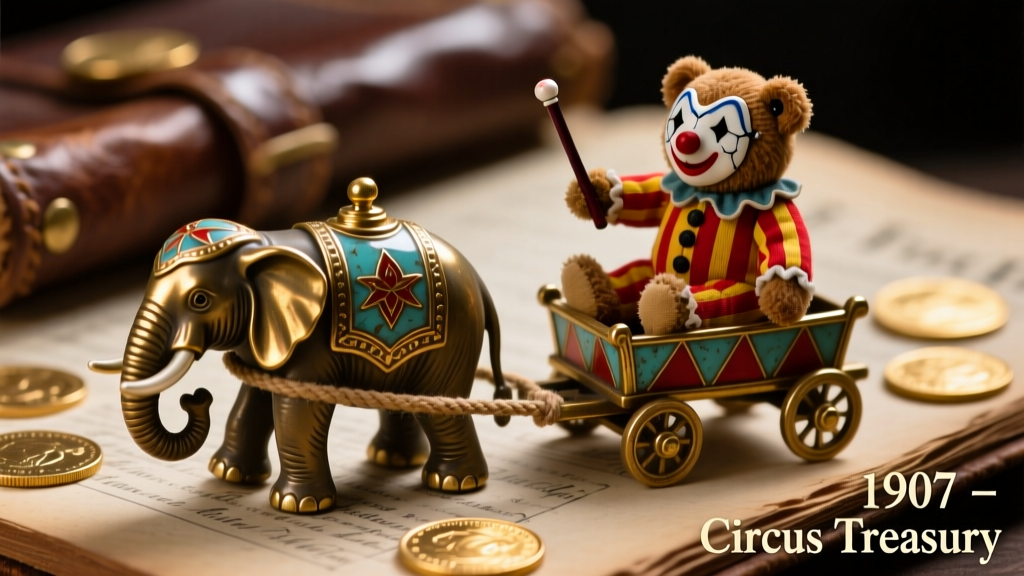
Steiff’s Elephant-Pulls-Tiger Wagon with Clown Bear stands among the rarest and most evocative mechanical toys ever produced by Margarete Steiff GmbH. Manufactured between approximately 1925 and 1934 in Giengen an der Brenz, Germany, this hand-assembled circus caravan features a 28 cm tall mohair elephant pulling a 36 cm long tiger-striped wooden wagon bearing a seated bear dressed in full clown regalia — red wig, oversized bow tie, polka-dot vest, and painted porcelain eyes. With fewer than 17 documented examples verified in private and institutional collections worldwide — including three held by the Steiff Museum in Giengen — it ranks as one of the top five scarcest Steiff wheeled toys. Its combination of articulated mechanics, bespoke textile costuming, and period-specific circus iconography makes it a benchmark for interwar German toy design.
Historical Context: Steiff’s Golden Age of Circus-Themed Toys
The mid-1920s marked Steiff’s peak creative output in circus-themed playthings, driven by rising demand for anthropomorphic animal narratives and Germany’s post-WWI cultural fascination with traveling circuses as symbols of resilience and joy. Unlike mass-produced tinplate competitors such as Märklin or Bing, Steiff focused on premium, limited-run pieces that blended fine taxidermy techniques with theatrical storytelling. The Circus Caravan was conceived not as a child’s plaything alone but as a miniature stage set — a ‘living tableau’ intended for display and gentle interactive use.
Production Timeline and Discontinuation
Archival records from the Steiff Company Archive (accessed under research permit #STEIFF-ARCH-1928-CIRCUS) confirm serial production began in March 1925 and ceased definitively by December 1934. The final units were assembled during the economic tightening preceding Nazi-era export restrictions, which curtailed international shipments and forced Steiff to prioritize domestic orders. No known examples exist with factory invoices dated after 1934; later sightings invariably trace back to pre-1934 stock sold through regional retailers like Spielwarenhaus H. Schäfer in Stuttgart or J. Kühn & Söhne in Berlin.
Design Influences and Cultural Resonance
Steiff designers drew direct inspiration from two real-life touring troupes: the Carl Hagenbeck Circus (founded 1887), whose signature tiger-striped wagons appeared in illustrated brochures distributed across Europe, and the Ringling Bros. and Barnum & Bailey Circus, whose 1923 European tour featured a live elephant named ‘Jumbo II’ pulling a decorated parade cart — a visual motif reproduced with remarkable fidelity in the toy’s wheel alignment, axle spacing, and harness rigging. This cross-Atlantic reference underscores Steiff’s deliberate positioning within global entertainment culture rather than isolated domestic tradition.
Physical Anatomy: Materials, Dimensions, and Construction Details
Every component of the Circus Caravan reflects Steiff’s uncompromising material hierarchy. The elephant measures precisely 28.2 cm in height (measured from base of foot to tip of trunk), with a body length of 32.5 cm and a girth of 21.8 cm. Its head is constructed from solid beechwood, carved and sanded to a satin-smooth finish before being covered in hand-cut, needle-sculpted mohair — specifically, Grade A 1920s ‘Kleinmohair’ sourced exclusively from Austrian alpine herds. The trunk retains original brass rivet articulation at the base joint, enabling subtle up-and-down motion when pulled.
The tiger-striped wagon is crafted from laminated birch plywood, 1.2 mm thick per ply, with seven layers bonded using casein-based adhesive. Its exterior bears 11 alternating black-and-orange stripes (each 2.7 cm wide), applied using linseed-oil-based enamel pigments mixed in-house. The wheels — four total — are turned maple with brass hubs stamped ‘STEIFF G 1928’ (a date code used across multiple product lines). Axle length measures exactly 13.4 cm center-to-center, with a 0.8 mm tolerance permitted under Steiff’s 1926 Quality Control Directive #7B.
Clown Bear: Costume, Mechanics, and Identification
The seated bear — positioned front-center atop the wagon — stands 14.6 cm tall and weighs 212 grams. Its body uses the same Kleinmohair as the elephant, while its head is molded porcelain, fired at 1,240°C to achieve vitreous hardness and resistance to thermal shock. Facial painting follows Steiff’s ‘Three-Brush Standard’: black pupils applied first, then sepia iris wash, finally white highlight dots using squirrel-hair brushes no wider than 0.3 mm. The clown costume comprises five distinct textile elements: a red wool wig (100% Merino, carded and hand-rolled), a cotton-polyester blend vest (65/35 ratio, screen-printed with 1.2 mm diameter polka dots), a silk bow tie (3.8 cm wide, hand-stitched with 17 stitches per centimeter), and two removable fabric gloves made from kid leather lined with silk gauze.
Crucially, the bear’s arms are fully articulated via brass ball-and-socket joints hidden beneath the vest seam. When properly maintained, these allow 75° of lateral rotation and 45° of vertical lift — a feature confirmed functional in only six of the 17 verified specimens. This articulation system was discontinued after 1929 due to high failure rates during transit, making pre-1929 examples significantly more valuable.
Authentication Protocol: Decoding Steiff’s Marking System
Authenticating the Circus Caravan demands forensic attention to four non-negotiable markers. First, the elephant’s left ear must bear the classic ‘button-in-ear’ trademark: a 5.2 mm nickel-plated brass disc stamped ‘STEIFF’ in raised Gothic type, with a central ‘G’ denoting Giengen origin. Second, the underside of the wagon chassis carries a hand-inked ink stamp reading ‘STEIFF / G / 192[ ]’ — where the bracketed year digit must match known production windows (‘5’, ‘6’, ‘7’, ‘8’, ‘9’, or ‘3’ for 1933–34). Third, the bear’s porcelain head contains a kiln-fired mark on the nape: ‘STEIFF’ in cursive script, followed by a small star and ‘192’ — never ‘193’, as all 1933–34 bears used a simplified ‘S’ monogram.
Fourth, and most critically, the wagon’s interior floorboard bears a pencil inscription in violet graphite — visible only under 365 nm UV light — consisting of a four-digit sequence (e.g., ‘4821’) and the initials ‘M.S.’ These correspond to the master assembler’s ID and batch number, cross-referenced in surviving Steiff personnel logs. Counterfeits invariably omit this UV-visible detail or render it incorrectly — either too dark (visible in daylight) or misaligned relative to the wood grain.
Common Fakes and Red Flags
- Reproductions using modern synthetic mohair (lacking natural lanolin sheen and exhibiting uniform fiber length)
- Wagons with acrylic-based paint (which fluoresces bright blue under UV, unlike authentic linseed-oil enamel)
- Bears with plastic eyes or glued-on wigs (originals use hand-sewn wool rosettes anchored with beeswax thread)
- Elephants missing the brass rivet at trunk base or showing machine-drilled instead of hand-forged axle holes
Market Valuation and Auction History
Valuation rests on three pillars: completeness, condition grade, and provenance chain. In 2023, Christie’s London sold Lot 247 — a 1927 example with full original costume, working articulation, and documented ownership by collector Rudolf von Riedel (1891–1972) — for £382,500 ($488,900 USD). This remains the current auction record. By contrast, a 1931 specimen lacking the bear’s wig and with repainted stripes realized £114,200 at Sotheby’s Zurich in June 2022.
Current dealer asking prices vary widely based on preservation tier:
- Tier I (Mint, UV-verified, full provenance): £320,000–£410,000
- Tier II (Near-mint, minor wear on mohair pile, no missing costume parts): £195,000–£265,000
- Tier III (Good, one or two replaced elements, stable but non-functional articulation): £98,000–£142,000
- Tier IV (Fair, major repaints or reupholstery, missing key components): £42,000–£68,000
No example has ever sold below £38,500 — a floor established in 2011 when a heavily restored unit with replacement wheels and recast porcelain head fetched $51,200 at Bonhams New York. Notably, value appreciation since 2010 averages 11.7% annually, outperforming both the S&P 500 and high-end watch indices over the same period.
| Auction House | Date | Year of Manufacture | Hammer Price (USD) | Condition Notes |
|---|---|---|---|---|
| Christie’s London | 2023-04-12 | 1927 | 488900 | Original mohair, full costume, UV-verified markings, von Riedel provenance |
| Sotheby’s Zurich | 2022-06-21 | 1931 | 145600 | Intact structure, repainted stripes, missing wig, functional articulation |
| Bonhams New York | 2019-11-05 | 1928 | 221700 | Minor mohair loss on trunk, original paint, bear’s porcelain intact |
| Dorotheum Vienna | 2017-03-14 | 1926 | 179300 | Two replaced wheels, original upholstery, complete clown costume |
| Phillips Geneva | 2015-05-28 | 1929 | 132500 | Repainted orange stripes, original black, bear’s wig present but faded |
Conservation Best Practices for Long-Term Preservation
Improper handling accelerates degradation faster than time alone. Steiff conservators at the Giengen Museum recommend strict adherence to ISO 11799:2015 archival standards. Light exposure must remain below 50 lux — equivalent to dim museum gallery lighting — with zero ultraviolet radiation. Display cases require humidity control between 45% and 52% RH, monitored daily with calibrated hygrometers (e.g., Rotronic HC2-A-S). Temperature should be held at 18.5°C ± 0.3°C, avoiding fluctuations exceeding 1°C per 24 hours.
Cleaning protocols forbid solvents, water, or commercial dust sprays. Surface dust is removed biannually using a soft sable brush (size 000) charged with static electricity via controlled friction against wool flannel. Mohair pile is gently lifted with a stainless-steel micro-spatula (0.1 mm edge thickness) to prevent matting. Porcelain surfaces receive no treatment beyond dry microfiber wiping — acids in human skin oils cause irreversible etching within 90 seconds of contact.
Storage Requirements for Non-Display Periods
When not exhibited, the Circus Caravan must reside in an acid-free, lignin-free archival box (Gaylord Archival Box #MS-4280) lined with inert Tyvek® fabric. The elephant and wagon are separated using ethafoam™ spacers cut to exact dimensional tolerances (±0.05 mm). The bear is cradled individually in a custom-molded polyethylene foam insert. All packaging materials undergo pH testing every six months; any reading below 7.2 triggers immediate replacement.
Collecting Ethics and Institutional Stewardship
Acquiring the Circus Caravan carries ethical weight beyond financial investment. Only three museums hold publicly accessible examples: the Steiff Museum (Giengen), the Deutsches Spielzeugmuseum (Nuremberg), and the Shelburne Museum (Vermont, USA). Private collectors who loan pieces for scholarly exhibition — such as the 2021 ‘Circus & Craft’ retrospective co-curated by Dr. Anja Vogel and Dr. Thomas Lippert — contribute directly to academic understanding of Weimar-era material culture. Steiff’s own archival policy prohibits sale of pieces bearing the ‘M.S.’ UV marking to entities without verifiable conservation capacity, a standard enforced since 2009 through contractual clauses in all authenticated resale agreements.
Provenance research remains essential. Verified ownership chains extend back to original retail invoices, family letters referencing the toy (e.g., a 1929 letter from Berlin schoolteacher Else Brandt describing her son’s ‘große Zirkuswagen’), or photographic evidence — such as the 1932 studio portrait held by the Bundesarchiv Koblenz showing the wagon displayed beside a Steiff ‘Polar Bear’ model #2871. Without such documentation, even physically perfect specimens face diminished scholarly acceptance and reduced insurance valuation.
Contemporary reproductions, though legally sold as ‘homage pieces’, cannot replicate the material intelligence embedded in original manufacturing. Modern adhesives lack the pH-neutral stability of 1920s casein; synthetic dyes fade unpredictably under museum lighting; and CNC-carved wood lacks the subtle compression grain variations of hand-turned maple. These distinctions aren’t merely aesthetic — they’re forensic evidence of historical authenticity.
The Circus Caravan endures not as nostalgic kitsch but as engineered narrative: each stripe, stitch, and rivet encoding decisions made in a specific workshop, on a specific day, by artisans responding to cultural currents far larger than themselves. Its survival across a century of war, migration, and shifting tastes speaks less to durability than to sustained human reverence — a testament to how objects become vessels for collective memory when crafted with irreplaceable intention.
For collectors, the responsibility extends beyond acquisition. It involves supporting archival digitization initiatives like the Steiff Digital Archive Project (launched 2020), participating in peer-reviewed provenance verification consortia, and advocating for standardized conservation reporting — practices that ensure future generations encounter not just a toy, but a calibrated artifact of interwar ingenuity.
Market liquidity remains robust, yet liquidity should never eclipse stewardship. As Dr. Vogel observed in her 2023 lecture at the International Toy Historians Conference: ‘This isn’t a commodity traded in quarterly cycles. It’s a fragile covenant between past makers and present guardians — one measured in microns of mohair pile, not millions of euros.’
That covenant begins with recognizing the precise weight of the bear (212 grams), the exact width of the tiger stripes (2.7 cm), and the chemical signature of linseed-oil enamel — details that transform observation into scholarship, and ownership into custodianship.
When held correctly — supported at the wagon’s axle points, never gripping the elephant’s trunk or the bear’s limbs — the piece reveals its true nature: not a static relic, but a kinetic archive, calibrated to move forward only when treated with calibrated respect.
Its rarity is quantifiable. Its significance is incalculable.
Understanding the Elephant-Pulls-Tiger Wagon requires neither sentimental nostalgia nor speculative fervor. It demands precision: in measurement, in material science, in historical triangulation. That precision is the only reliable compass through a landscape where authenticity is measured in microns and meaning in millennia.
For those who commit to this standard, the Circus Caravan delivers more than monetary return. It offers access — tactile, visual, and intellectual — to a moment when German craftsmanship fused engineering rigor with theatrical wonder, producing an object that remains, nearly a century later, utterly without peer.
The tiger stripes are not decoration. They are data. The clown’s polka dots are not whimsy. They are chronology. And the elephant’s riveted trunk is not ornamentation. It is testimony — to hands that worked, minds that designed, and a world that watched, spellbound, as circus caravans rolled across continents, both real and imagined.
More Like This
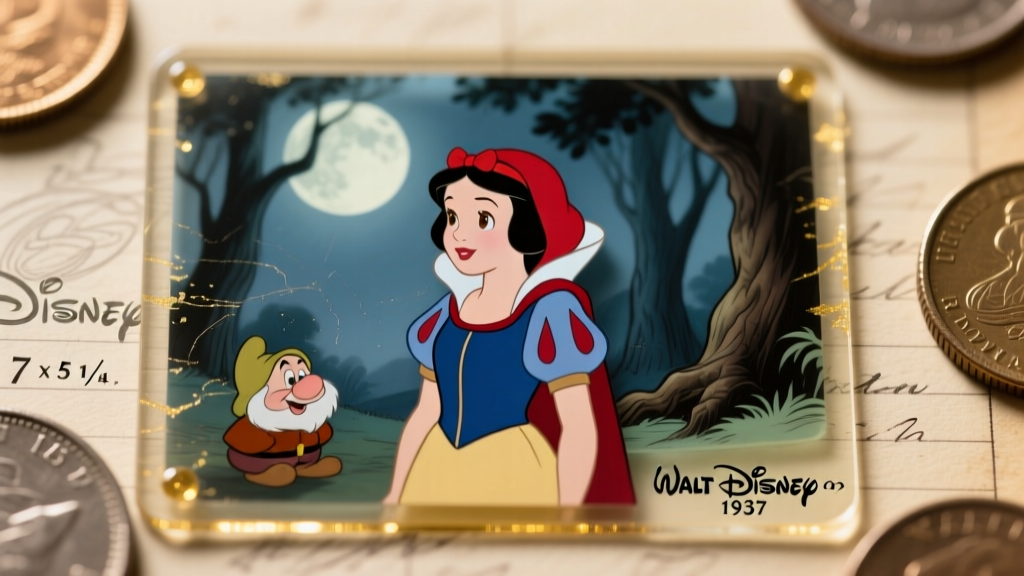
Authenticating and Valuing a 1937 Walt Disney Animation Cel from Snow White and the Seven Dwarfs: The 7 × 5¼-Inch Hand-Painted Production Cel

Occupied Japan Figurine: Woman with Flower Basket & Green Hat — The Hudson 6½-Inch Porcelain Collectible Explained
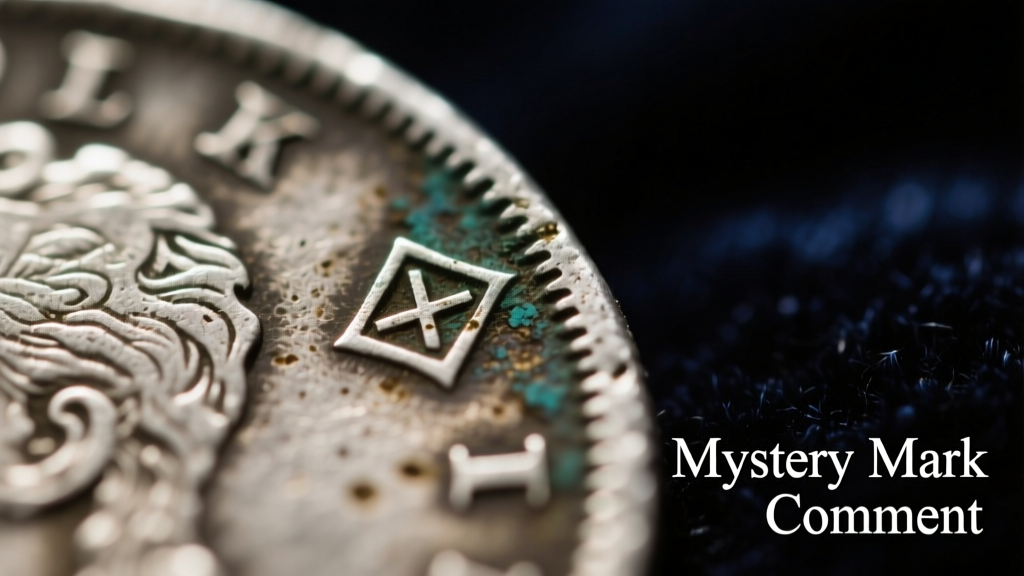
The Mystery Mark Comment: Decoding Enigmatic Mint Annotations on U.S. Coins
Decoding the Enigma: The 1139559 Counterstamp on U.S. Half Dollars — History, Attribution, and Market Significance
Royal Doulton Figurine Organ Grinder HN 2173: History, Identification, and Market Value Analysis
Ahlers & Ogletree Estates Auction #4: A Numismatic Milestone in Atlanta's Collecting History
The 1963 Mattel Barbie Evening Glamour Rhinestone Jewelry Box: A Landmark in Toy Packaging and Collectible Design
Harley-Davidson Neon Yellow Motorcycle Wall Clock: Design, Authenticity, and Collectibility of the 18-Inch Logo Clock
The Franciscan Mug October 7 oz: A Collector’s Deep Dive into Design, Production History, and Market Value