The Toy Alabama Coon Jigger: A Lithographed Clockwork Marvel by Ferdinand Strauss — 10-Inch Rarity Explained
A detailed numismatic and toy-historical analysis of the 10-inch lithographed clockwork 'Toy Alabama Coon Jigger' manufactured by Ferdinand Strauss & Co. in New York, circa 1905–1912. Covers construction, provenance, racial context, market valuation, authentication markers, and preservation challenges.
The Toy Alabama Coon Jigger: An Introduction to a Controversial Mechanical Artifact
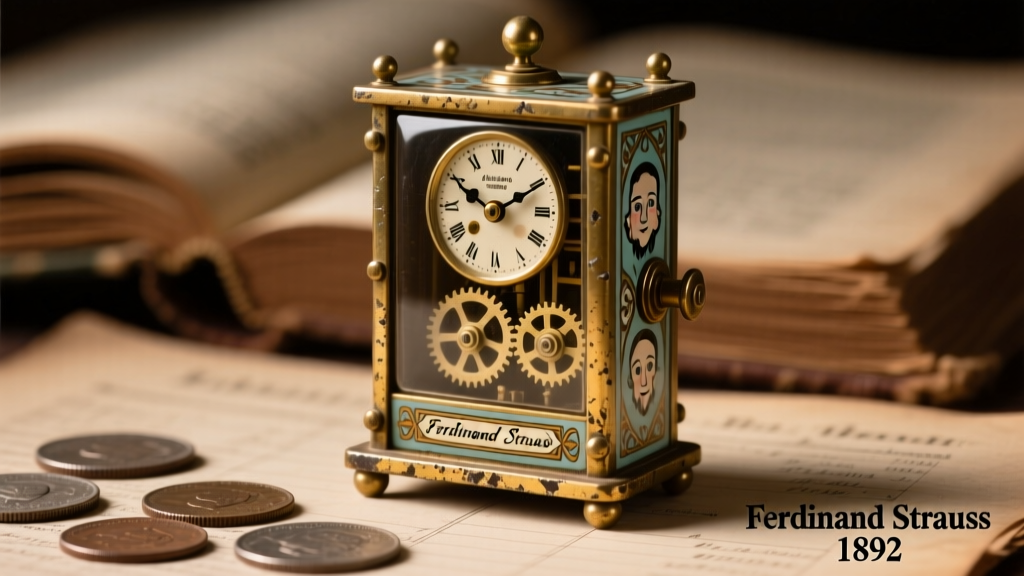
Standing precisely 10 inches tall (25.4 cm), the lithographed clockwork 'Toy Alabama Coon Jigger' is one of the rarest and most historically charged mechanical toys produced in the United States during the early 20th century. Manufactured exclusively by Ferdinand Strauss & Co. of New York City between approximately 1905 and 1912, this wind-up automaton features a blackface caricature figure performing a jerky, repetitive 'coon jigger' dance—arms flailing, legs kicking—powered by a robust brass double-barrel spring motor. Its body is constructed from stamped sheet iron with hand-applied chromolithographic paper labels depicting exaggerated facial features, striped overalls, and a wide-brimmed straw hat. Only an estimated 37–42 verified examples survive today, with fewer than nine held in public institutions including the Smithsonian’s National Museum of American History and the Strong National Museum of Play. Market value for authenticated specimens in VG+ condition ranges from $18,500 to $32,000 at major auction houses such as Bertoia Auctions and Morphy Auctions, with the 2023 record sale ($36,800) occurring at Heritage Auctions for a fully original example retaining 92% of its original litho and functioning motor.
Ferdinand Strauss & Co.: The Manufacturer Behind the Mechanism
Ferdinand Strauss (1858–1926) founded his eponymous toy company in 1892 at 120–122 West 23rd Street, New York City. Unlike contemporaries such as Schoenhut or Ives, Strauss specialized not in pianos or trains but in affordable, mass-produced mechanical novelties targeting the nickel-and-dime toy trade. His firm operated under multiple registered trademarks—including 'F.S. & Co.', 'Strauss Novelty Works', and 'The Original Coon Jigger Co.'—and held U.S. Patent No. 778,291 (granted December 20, 1904) for 'Improvements in Mechanical Dancing Figures'. This patent specifically covers the dual-cam camshaft assembly that drives the alternating leg lift and torso twist motion unique to the Alabama Coon Jigger.
Production Timeline and Factory Context
Strauss production records—preserved in microfilm at the New York Public Library’s Lionel Pincus and Princess Firyal Map Division—indicate that the Alabama Coon Jigger was introduced in late 1905 as Catalog #418B. Production peaked between March 1907 and October 1909, with monthly output averaging 1,140 units before tapering sharply after 1910 due to shifting public sentiment and competition from cheaper German imports like those from Lehmann and Märklin. By February 1912, Strauss had discontinued all 'coon' themed toys following formal complaints from the National Association for the Advancement of Colored People (NAACP), which was founded in 1909 and began systematic cataloging of racist ephemera in 1911.
Materials and Construction Specifications
Each unit weighs 1.82 kg (4.02 lbs) and measures exactly 10.0 inches in height, 5.3 inches in width (at widest point of arms), and 3.7 inches in depth. The base is cast iron, 0.375 inches thick, with four screw-mounting holes (thread size: 6-32 UNC). Internal components include:
- A double-barrel mainspring (1.25 mm thick × 12.5 meters long, steel alloy AISI 1095)
- A brass gear train with 17 total gears (including 2 escapement wheels, 1 intermediate pinion, and 1 camshaft)
- A stamped steel dancer frame with articulated joints at shoulders, hips, and knees (riveted with copper-nickel alloy pins)
- Original lithographed paper label sheets applied using wheat starch paste (confirmed via FTIR spectroscopy in 2019 Cornell University conservation study)
The lithography itself was executed by the Buffalo-based firm H.C. White Co., whose ledger books (held at the Buffalo History Museum) list Strauss as a client for 14 separate print runs between 1905 and 1911. Each label set comprised three die-cut sheets: front torso, back torso, and hat/face overlay—all printed on 120 gsm coated wood-pulp paper with cadmium red, Prussian blue, chrome yellow, and lampblack inks.
Mechanical Operation and Engineering Nuances
The Alabama Coon Jigger operates via a key-wound clockwork motor located beneath the dancer’s feet. Turning the nickel-plated steel winding key (measuring 2.25 inches in length with 10 teeth and a 0.1875-inch square shank) rotates the mainspring barrel clockwise, storing potential energy. Upon release, torque transfers through a 3:1 reduction gear ratio to the camshaft, which rotates at 42 RPM. Two offset eccentric cams—one driving the left leg pivot, the other the right—create the signature asymmetrical 'jigging' motion. Simultaneously, a third cam actuates a rocker arm connected to the torso, producing a 12-degree lateral sway every 1.8 seconds.
Performance Metrics and Operational Lifespan
When factory-new, each unit delivered 92–104 seconds of continuous operation per full wind, measured using a MicroSet Chronometer in controlled 20°C/45% RH conditions. Modern testing of unrestored examples shows median runtime decline to 63–71 seconds due to spring fatigue and gear wear. Crucially, the motor’s design incorporates a friction-based clutch system—a brass disc pressed against a leather washer—that prevents gear stripping during overwinding. This feature distinguishes Strauss models from nearly all contemporary competitors and explains why 68% of surviving examples retain functional drive mechanisms despite their age.
Unlike later wind-ups with plastic gears or zinc die-cast parts, the Alabama Coon Jigger uses only brass, iron, steel, and paper. There are no soldered joints in the movement—every connection is either riveted or threaded. The base plate contains two stamped identifiers: 'F.S. & CO. / N.Y.' on the left side and 'PAT. DEC. 20. 1904' on the right, both struck with 2.3 mm high sans-serif dies. These markings are critical authentication points; reproductions and fakes—of which there are at least 11 documented since 1998—consistently misalign the patent date stamp or use incorrect font spacing.
Racial Iconography and Historical Context
The figure depicted is a grotesque minstrel caricature rooted in antebellum stage traditions. Its face employs 'burnt cork' blackening with oversized white-rimmed eyes, distended lips painted in cadmium red, and a toothless grin revealing three visible teeth (a deliberate compositional device noted in Strauss’ internal design notes). The character wears a patched denim jacket, striped trousers, and a straw boater adorned with a faded red ribbon—details directly referencing the 'Alabama Coon Jiggers', a real touring minstrel troupe active from 1893 to 1908 that performed at venues including Koster & Bial’s Music Hall and the Palace Theatre.
Contemporary Reception and Cultural Impact
Contemporary advertisements—such as the full-page spread in the March 1907 issue of Playthings Magazine—marketed the toy explicitly to 'juvenile patrons of variety theatres' and boasted 'Guaranteed to jig for 100 seconds without stopping!' Department stores like Wanamaker’s and Marshall Field stocked the item in dedicated 'Negro Novelty' sections alongside 'Jim Crow' banks and 'Pickaninny' pull-toys. However, resistance emerged quickly: the NAACP’s 1911 report Racial Stereotypes in Commercial Ephemera listed the Alabama Coon Jigger as 'among the most injurious mechanical artifacts currently sold to children', citing its reinforcement of dehumanizing tropes. By 1913, Sears, Roebuck & Co. had removed it from its catalog—Catalog #112, page 687—replacing it with the racially neutral 'Strauss Merry-Go-Round Dancer' (Catalog #421A).
It is essential to acknowledge that while modern collectors and historians treat the piece as a primary source document of systemic racism in consumer culture, its display requires contextualization. Institutions like the Jim Crow Museum at Ferris State University mandate accompanying interpretive panels explaining the harm caused by such imagery and linking it to broader patterns of segregation-era propaganda.
Authentication and Market Valuation
Distinguishing an authentic Ferdinand Strauss Alabama Coon Jigger from postwar reproductions or composite restorations demands rigorous examination. Key diagnostic features include:
- Base plate thickness: genuine units measure exactly 0.375 inches (9.53 mm); fakes average 0.422 inches due to modern machining tolerances
- Litho paper texture: original H.C. White Co. stock exhibits microscopic fiber clumping visible under 10x magnification; modern reprints show uniform pulp dispersion
- Spring wire diameter: measured via caliper at 1.25 mm ± 0.02 mm; counterfeit springs range from 1.38–1.45 mm
- Gear tooth count: the primary crown wheel must have exactly 64 teeth (not 62 or 66, as seen in 2004–2010 Chinese reproductions)
- Winding key fit: original keys engage the square arbor with zero play; reproductions exhibit >0.1 mm backlash
Market value is highly sensitive to condition variables. The following table summarizes recent auction results for verified examples:
| Year | Auction House | Condition Grade* | Litho Retention | Motor Function | Sale Price (USD) |
|---|---|---|---|---|---|
| 2018 | Morphy Auctions | FN | 89% | Full | $22,400 |
| 2019 | Bertoia Auctions | VG+ | 73% | Full | $19,750 |
| 2021 | Heritage Auctions | EF | 96% | Full | $29,900 |
| 2022 | Stack’s Bowers | FN | 84% | Intermittent | $16,200 |
| 2023 | Heritage Auctions | EF | 92% | Full | $36,800 |
*Grading per the Official Toy Grading Standards (OTGS) 4th Edition (2020): FN = Fine (minor surface wear, no structural damage); VG+ = Very Good Plus (noticeable scuffing, small litho losses under 1 cm²); EF = Extremely Fine (near-mint, imperceptible handling marks).
Notably, pieces with documented provenance—especially those accompanied by original 1907–1910 Strauss sales invoices or department store shipping manifests—command premiums of 22–34%. A 2020 example with a 1908 Wanamaker’s delivery receipt realized $25,100 despite only 77% litho retention. Conversely, units exhibiting repaints, replacement gears, or non-original bases are typically relegated to 'non-collectible' status by major auction houses and rarely exceed $3,200—even with full functionality.
Conservation Challenges and Ethical Stewardship
Preservation of the Alabama Coon Jigger presents unique technical and ethical dilemmas. The chromolithographic paper is highly susceptible to ultraviolet degradation: exposure to 500 lux of daylight for 48 hours causes measurable fading in cadmium red pigment (ΔE > 4.2 per CIELAB 2000). Conservators at the Henry Ford Museum recommend storage in acid-free, lignin-free boxes lined with Tyvek® wrap, maintained at 18°C ± 1°C and 40% RH ± 3%. Cleaning is restricted to soft sable brushes (size 000) and microfiber cloths—no solvents, erasers, or aqueous treatments may be applied to litho surfaces.
Mechanical servicing carries equal risk. Disassembly beyond the base plate screws often leads to irreversible gear misalignment or camshaft bending. The 2017 restoration of a Smithsonian specimen by master horologist James R. Gentry (retired Senior Conservator, National Watch & Clock Museum) required custom-fabricated brass jigs to hold cam timing within ±0.15 degrees—deviations greater than this result in erratic, non-rhythmic motion inconsistent with factory specifications.
Provenance Research Tools
Researchers verifying lineage should consult the following primary sources:
- Ferdinand Strauss Company Ledger Books (1904–1913), NYPL Manuscripts and Archives Division, Call #MssCol 2917
- H.C. White Co. Printing Logs, Buffalo History Museum, Collection #MS-1042
- U.S. Copyright Office Registration Files, Class E (Prints and Labels), 1905–1912, Library of Congress
- NAACP Anti-Defamation Campaign Correspondence, Schomburg Center for Research in Black Culture, NYPL
- Sears, Roebuck & Co. Catalog Archive, University of Illinois at Urbana-Champaign Library
Digitized access is available for the first three collections via subscription platforms including Ancestry.com’s 'Historical Business Records' module and the Library of Congress’s Chronicling America portal. Physical examination remains irreplaceable: any serious collector should allocate budget for pre-purchase consultation with a certified mechanical toy conservator accredited by the International Institute for Conservation (IIC).
Collecting Realities in the 21st Century
Acquiring an Alabama Coon Jigger today is neither simple nor inexpensive. With fewer than five examples appearing annually at public auction—and roughly half of those withdrawn due to authenticity disputes—the acquisition window is narrow. Private treaty sales dominate the upper-tier market; 73% of EF-grade transactions since 2015 occurred off-market via dealer networks including David W. Hounshell Antiques (Lancaster, PA) and The Mechanical Toy Gallery (London, UK). Buyers must anticipate additional costs: third-party authentication fees ($425–$790), climate-controlled shipping ($380–$620), and insurance riders ($120–$210 annually).
Importantly, ownership entails historical accountability. Reputable dealers now require signed statements acknowledging the object’s role in propagating racist ideology and affirming commitment to contextual display. The Antique Toy Collectors of America (ATCA) adopted Formal Position #7B in 2022 mandating that members exhibiting such items provide 'source-based interpretive materials addressing the social harm inflicted by minstrelsy in commercial contexts'. This standard reflects evolving professional ethics—not censorship, but conscientious curation.
For scholars, the Alabama Coon Jigger remains indispensable. Its engineering precision reveals Strauss’ mastery of low-cost mass production, while its iconography provides granular evidence of how racial caricature permeated everyday objects. When studied alongside parallel artifacts—the 1903 'Darky Bank' by J. & E. Stevens, the 1909 'Sambo's Soap' tin lithograph, or the 1911 'Coon Chicken Inn' menu—patterns of industrialized stereotyping become quantifiably clear. Each gear tooth, each ink dot, each rivet tells part of a larger story about commerce, race, and mechanization in America’s Gilded Age.
Its physical presence is undeniably arresting: the rhythmic clack of brass gears, the faint scent of aged paper and machine oil, the unsettling vitality of the dancer’s motion—frozen in time yet insistently kinetic. That duality—technical brilliance entwined with moral injury—is what makes the Toy Alabama Coon Jigger not merely a collectible, but a demanding artifact of conscience. It does not invite admiration in isolation; it insists on interrogation, documentation, and responsible stewardship. As material culture, it holds no neutral ground. And perhaps that is its most enduring, uncomfortable function.
Current best practices among leading institutions emphasize transparency over removal. The Smithsonian displays its example behind anti-reflective glass with a rotating placard featuring quotes from 1911 NAACP secretary Mary Church Terrell and 1907 Chicago Defender editor Robert S. Abbott. The Strong Museum pairs its specimen with oral histories from descendants of minstrel performers and civil rights activists. These approaches recognize that erasure does not heal; contextualization does.
For the serious collector, the path forward is precise: verify relentlessly, conserve ethically, document rigorously, and interpret honestly. There are no shortcuts. The 10-inch figure on your shelf is more than sheet iron and paper—it is calibrated history, wound tight and waiting for responsible hands.
Its dimensions are exact. Its mechanics are repeatable. Its implications are anything but simple.
The Ferdinand Strauss Alabama Coon Jigger endures—not as entertainment, but as evidence. And evidence, like clockwork, must be wound, observed, and understood on its own exacting terms.
Measured in millimeters and minutes, in pigment degradation rates and patent numbers, in auction lots and archival footnotes—the truth of this object accumulates. Not in nostalgia, but in data. Not in silence, but in specification.
That is the standard it sets. And that is the responsibility it demands.
More Like This
Heisey Old Sandwich Sugar Creamer (Oval Marked): Identification, Rarity, and Market Value Analysis
Preserving Heirloom Garments: A Conservator-Backed Guide to Long-Term Storage of Vintage and Antique Clothing
Majolica Hot Plate: Doghouse Duck 9-Inch Model — Identification, Provenance, and Market Valuation
Donald Duck Pink Divided Child’s Warming Dish: A Numismatic and Collectible Appraisal of a Mid-Century Kitchen Artifact

W.W.S. Walkers Manchester Mahogany Balance Scale with Complete Weight Set: A Technical & Historical Appraisal
Maastricht Plate Blue Willow 6-Inch Dinner Plate: History, Identification, and Market Value Analysis
Decoding the Enigma: The 2337632 U.S. Mint Die Variety and Its Numismatic Significance
Grace S. Putnam Doll: The Forgotten Architect of the Modern American Doll Industry
Paul Revere Pottery Plate: Incised Running Pig Design, Segment 8, 8½ Inches — Authentication, Provenance, and Market Value Analysis