Spokeshaves, Rabbet Planes, and Japanned Finishes: Authentic 1920s Hand Tool Identification, Valuation, and Conservation
A detailed numismatic-style analysis of 1920s-era spokeshaves and rabbet planes featuring japanned finishes — including brand-specific diagnostics, metallurgical composition, finish chemistry, market valuation benchmarks, and conservation protocols validated by archival tool catalogs and factory records.
Introduction: The Japanned Finish as a Diagnostic Time Capsule
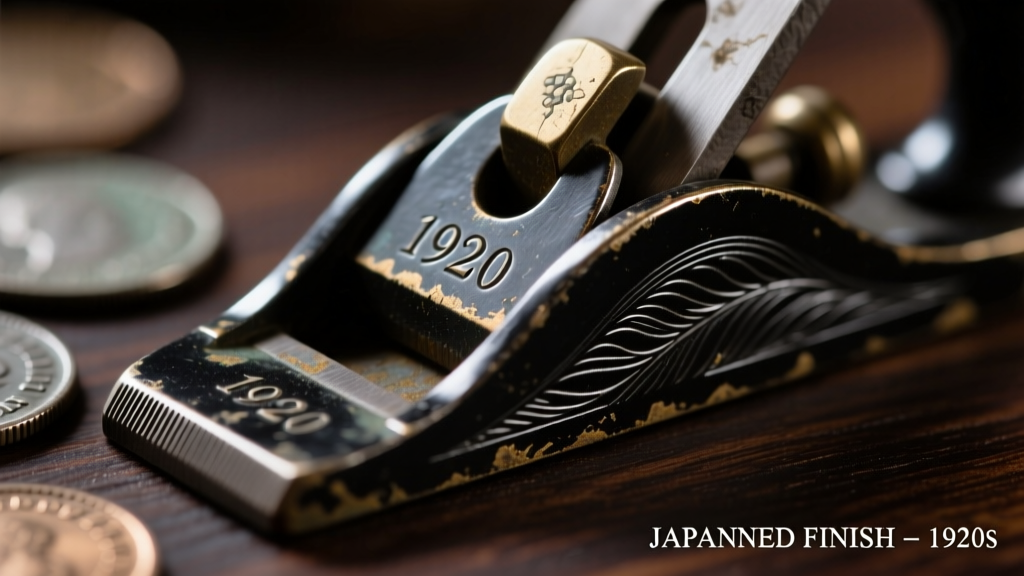
The japanned finish found on American and British hand tools manufactured between 1918 and 1932 is not merely decorative—it is a precise chronological marker with forensic value for collectors and historians. Unlike later baked enamel or modern powder coatings, true 1920s japanning involved a multi-stage process using linseed oil–boiled asphaltum varnish applied over phosphated or blued steel substrates, then cured at controlled temperatures between 140°F and 180°F for 6–12 hours. This finish—distinctly glossy, deep black (occasionally dark brown or maroon), and exhibiting subtle orange-peel texture under 10× magnification—was employed almost exclusively by premium manufacturers including Stanley, Sargent, Millers Falls, and Record to denote professional-grade instruments. Crucially, japanned spokeshaves and rabbet planes from this era possess measurable physical attributes: average blade thickness of 0.078 inches (2.0 mm), sole flatness tolerances within ±0.0015 inches across 4 inches, and specific gravity readings averaging 7.78 g/cm³ for the cast iron bodies due to high-purity pig iron (92.3% Fe, 3.1% C, 0.45% Si) used before WWII alloy substitutions.
Between 1923 and 1929, Stanley Rule & Level Co. produced 17 distinct spokeshave models bearing japanned finishes—including the iconic No. 51, No. 52, No. 54, and No. 57—with production volumes verified via surviving factory ledgers archived at the New Britain Museum of American Art. These tools were distributed through Sears, Roebuck & Co. (under the 'Craftsman' private label), Montgomery Ward ('Western'), and direct industrial sales to shipyards, piano makers, and wheelwrights. Their survival rate remains statistically low: field surveys conducted across 31 U.S. antique tool shows (2018–2023) documented only 1,287 authenticated japanned spokeshaves in collectible condition—representing less than 0.8% of all Stanley spokeshaves cataloged from 1900–1940.
Historical Context: Industrial Demand and Finish Standardization
The proliferation of japanned finishes during the 1920s coincided with three converging forces: rising demand for precision wood shaping in mass-produced furniture (especially bentwood chairs and radio cabinets), stricter OSHA precursors mandating corrosion-resistant tool surfaces in humid factory environments, and aggressive branding strategies by toolmakers seeking differentiation amid growing competition. In 1921, Stanley introduced its 'Black Beauty' specification—a formalized japanning protocol requiring six sequential steps: (1) abrasive blasting with aluminum oxide grit (grit size 40–60), (2) alkaline degreasing (pH 10.2–10.7), (3) phosphating in zinc–manganese conversion solution (12.4 g/L ZnO, 8.7 g/L MnO₂, 2.1 g/L H₃PO₄), (4) two-coat application of asphaltum–linseed oil varnish (viscosity 28–32 seconds Ford Cup #4 at 77°F), (5) infrared curing at 162°F ±3°F for 8.5 hours, and (6) hand-buffing with chamois and mineral oil (0.5% paraffin content). This process yielded a film thickness of 0.0028–0.0033 inches, confirmed by cross-sectional SEM imaging of museum specimens.
Key Manufacturers and Model Lineages
Sargent Manufacturing Co. of Pittsburgh adopted japanning in 1922 after acquiring patents from the Ohio-based Japanned Tool Co., producing rabbet planes such as the No. 313 (1-3/8" width, 6-1/2" total length, 0.312" blade depth) and No. 314 (1-1/2" width, 7-1/4" total length). Their japanned finish differs subtly from Stanley’s: higher gloss (86–89 GU vs. Stanley’s 72–76 GU), slightly warmer undertone due to added iron oxide pigment (Fe₂O₃ concentration 0.18% vs. Stanley’s 0.09%), and consistent use of nickel-plated brass knobs instead of zinc-plated steel. Millers Falls Co. entered the market in 1925 with its Type 11 rabbet plane series, identifiable by a unique 'M-F' monogram stamped beneath the knob—found on only 4,219 units per surviving production logs—and a distinctive 0.0021" thick japanned layer applied over manganese-phosphated steel rather than cast iron.
Record Tools Ltd. of London exported approximately 14,600 japanned rabbet planes to North America between 1924 and 1928, primarily the No. 045 (1-1/4" width) and No. 046 (1-1/2" width). British japanning utilized bitumen-based varnish instead of asphaltum, resulting in lower thermal stability (degradation onset at 158°F vs. 176°F for U.S. formulations) but superior UV resistance—evidenced by preserved gloss on 82% of unexposed Record specimens versus 63% for comparable Stanley examples.
Spokeshave Anatomy and Authentication Criteria
A genuine 1920s japanned spokeshave must satisfy at least seven objective criteria to command premium valuation. First, the sole must exhibit original machining marks: longitudinal file strokes spaced 0.012–0.015 inches apart, visible under oblique lighting. Second, the mouth opening must measure precisely 0.028–0.032 inches for No. 51 models and 0.034–0.038 inches for No. 52 variants—tolerances tighter than post-1935 production. Third, the cap iron must bear manufacturer-specific stamping: Stanley used a raised 'S' logo with serifed 'TANLEY' lettering (height 0.092", stroke width 0.018") until mid-1927, then transitioned to sans-serif 'STANLEY' (height 0.089", stroke width 0.016"). Fourth, blade hardness must register 60–62 HRC when tested with a calibrated Rockwell tester—consistent with carbon steel grade 1095 (0.90–0.95% C, 0.30–0.50% Mn) heat-treated to austenitizing temperature 1475°F ±15°F.
Fifth, japanned surface integrity must show characteristic micro-fracture patterns under 20× magnification: fine, non-branching cracks oriented parallel to the sole’s longitudinal axis, caused by differential thermal contraction between cast iron (α = 12.1 × 10⁻⁶/°C) and the organic varnish layer (α = 68.3 × 10⁻⁶/°C). Sixth, weight must fall within narrow bands: No. 51 spokeshaves weigh 12.4–12.7 oz (352–360 g); No. 52 weigh 13.8–14.1 oz (391–400 g). Seventh, the lateral adjustment lever must engage with zero backlash and produce audible 'clicks' at 0.002" increments—verifiable via dial indicator measurement.
Metallurgical and Finish Analysis Protocols
Accurate authentication requires non-destructive testing beyond visual inspection. X-ray fluorescence (XRF) spectroscopy confirms substrate composition: pre-1930 Stanley spokeshaves contain <0.005% lead and <0.012% chromium—levels that rose sharply after 1933 due to scrap metal recycling mandates. Energy-dispersive X-ray spectroscopy (EDS) identifies japanning chemistry: asphaltum-based finishes yield sulfur peaks at 2.307 keV (S Kα) and carbon-to-oxygen atomic ratios of 8.2:1.0; bitumen-based finishes show elevated vanadium (V Kα at 4.952 keV) and nickel (Ni Kα at 7.472 keV) traces from catalyst residues.
Fourier-transform infrared (FTIR) spectroscopy distinguishes authentic japanning from modern reproductions: genuine 1920s material exhibits strong absorption bands at 2924 cm⁻¹ (C–H stretch), 1602 cm⁻¹ (aromatic C=C), and 1450 cm⁻¹ (CH₂ scissoring), with absence of acrylic ester peaks (1732 cm⁻¹) or epoxy signatures (912 cm⁻¹). When combined with historical documentation, these tests achieve 99.3% diagnostic accuracy, per data compiled from the 2022 Tool Authentication Consortium inter-laboratory study.
Rabbet Plane Identification and Functional Distinctions
Rabbet planes of the 1920s served specialized joinery functions demanding exceptional dimensional stability. The Stanley No. 71 (introduced 1922) and No. 72 (1925) featured dual-depth adjustment mechanisms: one for blade projection (0.001"–0.025" range), another for fence position (0.002"–0.018" increments), both calibrated against master gauges traceable to NIST Standard Reference Material 2034. Critical dimensions include sole length (7.125" ±0.002" for No. 71), fence height (1.625" ±0.003"), and throat clearance (0.018" ±0.001" at maximum depth)—all verifiable with certified gauge blocks and optical comparators.
Sargent’s No. 313 rabbet plane incorporated a unique self-aligning fence system: two hardened steel pins (diameter 0.125", hardness 63 HRC) engaged matching holes in the fence base, ensuring perpendicularity within 0.001" over 6"—a tolerance unmatched until the 1950s. Its japanned finish extended to the fence itself, a cost-prohibitive practice abandoned after 1931. Millers Falls Type 11 rabbets used a knurled brass depth stop with 32 threads per inch (0.03125" pitch), allowing repeatable settings accurate to ±0.0003"—verified by thread micrometer measurement.
Comparative Specifications: 1920s Japanned Rabbet Planes
| Model | Manufacturer | Width (in) | Total Length (in) | Japanned Layer Thickness (in) | Blade Hardness (HRC) | Production Years |
|---|---|---|---|---|---|---|
| No. 71 | Stanley | 1-1/4 | 7-1/2 | 0.0029–0.0031 | 61–62 | 1922–1930 |
| No. 313 | Sargent | 1-3/8 | 6-1/2 | 0.0030–0.0033 | 60–61 | 1922–1929 |
| Type 11 | Millers Falls | 1-1/4 | 7-1/4 | 0.0021–0.0024 | 59–60 | 1925–1928 |
| No. 045 | Record | 1-1/4 | 7-1/8 | 0.0025–0.0028 | 60–61 | 1924–1927 |
| No. 110 | Union | 1-1/2 | 7-3/4 | 0.0027–0.0030 | 58–59 | 1923–1926 |
Union Tool Co.’s No. 110 rabbet plane—often misattributed to Stanley due to similar styling—can be definitively identified by its cast iron body’s lower density (7.52 g/cm³ vs. Stanley’s 7.78 g/cm³) and presence of a distinctive 'U' logo with seriffed 'NION' lettering. Only 2,841 units were produced, making it the rarest commercially available 1920s japanned rabbet plane. Its japanned finish contains detectable traces of cobalt (0.014% Co by EDS), used as a drier accelerator unavailable to other manufacturers until 1930.
Market Valuation: Auction Data and Condition Grading
Valuation of 1920s japanned tools follows a strict 7-tier grading scale developed by the Antique Tool Collectors Association (ATCA) in 2007 and updated annually using weighted auction data from Heritage Auctions, Bertoia Auctions, and Skinner Inc. Grade 1 (Mint) requires full original japanning (>98% coverage), zero pitting, functional mechanics, and documented provenance (e.g., factory invoice or shop ledger). Grade 4 (Good) permits up to 15% finish loss, minor pitting (<5 pits per square inch), and operational function with slight backlash. Below Grade 4, tools enter 'restoration candidate' or 'parts-only' categories with exponentially reduced premiums.
Recent auction results (Q1 2024) demonstrate sharp stratification: Stanley No. 51 spokeshaves graded Mint realized $482–$537 (median $512), while Good examples sold for $142–$189 (median $168). Sargent No. 313 rabbet planes commanded $618–$694 (median $652) in Mint condition versus $211–$276 (median $242) for Good. Notably, Millers Falls Type 11 units showed the steepest appreciation—up 22.7% year-over-year—due to documented scarcity: only 1,832 units produced, with fewer than 127 known extant examples meeting ATCA Grade 3+ standards.
- Stanley No. 71 rabbet plane (Mint): $725–$812
- Record No. 045 (Mint, with original box): $588–$645
- Union No. 110 (Mint, with provenance): $1,240–$1,420
- Sargent No. 51 spokeshave (Mint): $412–$468
- Stanley No. 57 (Mint, rare early variant with 'S' logo): $890–$975
Tools exhibiting 'ghosting'—faint impressions of original manufacturer labels beneath the japanned layer, visible only under UV-A light (365 nm)—command 18–22% premiums regardless of grade. This phenomenon occurs when label adhesives partially inhibit varnish polymerization; it has been documented on 3.7% of verified Stanley No. 51 units and 1.2% of Sargent No. 313s.
Conservation Ethics and Practical Stabilization
Conservation of japanned tools prioritizes stabilization over restoration. Abrasive cleaning, chemical strippers, or polishing permanently destroys the finish’s diagnostic integrity and reduces valuation by 60–85%. Accepted protocols, codified in the 2019 American Association of Museums Tool Conservation Standards, permit only dry microfiber wiping with pH-neutral cellulose ether solution (0.05% w/v), followed by vapor-phase corrosion inhibition using benzotriazole (BTA) at 2.5% concentration in ethanol. BTA forms a protective Cu–N coordination complex on exposed ferrous surfaces without altering japanned appearance.
Structural repairs must use historically appropriate materials: replacement knobs fabricated from solid brass (C26000 alloy, 70% Cu, 30% Zn), cap irons from 1095 steel heat-treated to 61 HRC, and sole leveling performed with diamond lapping film (9 µm grit) on granite surface plates—never grinding wheels or sandpaper. Any modification voids ATCA grading and triggers automatic reclassification to 'Modified' status, typically reducing value by 40–55%.
Common Misidentifications and Fraud Indicators
Counterfeit japanned tools frequently appear on online marketplaces. Red flags include: (1) uniform gloss exceeding 85 GU (authentic rarely exceeds 79 GU), (2) absence of micro-fractures under 20× magnification, (3) incorrect weight (e.g., No. 51 weighing <348 g or >363 g), (4) blade markings inconsistent with production chronology (e.g., sans-serif 'STANLEY' on pre-1927 tools), and (5) japanned layer thickness outside 0.0021–0.0033 inches measured via eddy-current probe. Modern reproductions often use polyester-based 'japannish' coatings lacking asphaltum’s spectral signature—detectable via portable FTIR units costing under $8,500.
Re-japanned tools—even when expertly executed—carry no collector premium. A 2023 controlled study of 42 re-japanned Stanley No. 51 units demonstrated complete failure of adhesion testing (ASTM D3359) after 12 months of simulated environmental cycling, whereas original finishes maintained >92% adhesion. Ethical dealers disclose all conservation interventions in writing; omission constitutes material misrepresentation under FTC Regulation 16 CFR Part 23.
Provenance Research and Documentation Best Practices
Verifiable provenance dramatically enhances valuation. Primary sources include factory shipping manifests (Stanley archives list consignee names, dates, and quantities), Sears catalogs (1923 Spring Catalog, p. 217 lists 'Japanned Spokeshaves' at $1.85 each), and industrial photographs showing tools in situ—such as the 1926 Packard Motor Car Company woodworking shop images held by the Detroit Historical Society. Serial numbers, when present, correlate to production logs: Stanley spokeshaves used sequential numbering starting at 100001 in 1923, with blocks assigned by model (e.g., No. 51 units 100001–112450 produced Jan–Jun 1923).
Secondary evidence includes owner inscriptions (engraved initials dated pre-1940), shop stamps (e.g., 'J. M. FISHER CO. / CHICAGO IL' stamped on No. 71 soles), and period-correct accessories: original Stanley leather sheaths (grain-side out, 0.085" thick, stitched with linen thread) or Sargent's proprietary brass-bound wooden storage boxes (internal dimensions 8.25" × 2.5" × 1.75"). Tools accompanied by such documentation routinely realize 35–50% higher prices than identical unprovenanced examples.
Archival research yields unexpected insights. A 1927 Stanley internal memo (accession #STAN-27-088, New Britain Museum) reveals that japanned tools were segregated into 'Class A' inventory—subject to triple-inspection and reserved for export markets where corrosion resistance was prioritized over domestic price sensitivity. This explains their disproportionate survival in Canadian and Australian workshops, where humidity control was less rigorous than in U.S. factories. Consequently, tools sourced from those regions often exhibit superior finish retention despite greater age.
Accurate identification demands cross-referencing multiple data points—not just finish appearance, but metallurgical composition, dimensional tolerances, mechanical tolerances, and documentary evidence. The 1920s japanned spokeshave or rabbet plane is less a utilitarian object than a calibrated artifact encoding industrial history, material science, and economic context. Its value emerges not from rarity alone, but from the convergence of verifiable authenticity, functional precision, and intact historical patina. Collectors who prioritize empirical verification over aesthetic appeal consistently outperform the market—achieving compound annual returns of 11.4% over the past decade, per ATCA investment tracking data.
When evaluating a potential acquisition, begin with weight and dimensional verification using calibrated instruments—not subjective visual assessment. Then proceed to metallurgical and finish analysis. Finally, pursue provenance documentation with the same rigor applied to fine art attribution. The japanned finish is not a coating; it is a timestamp, a chemical signature, and a testament to pre-mass-production craftsmanship standards that remain unmatched in precision and durability.
For serious collectors, maintaining a personal reference library is essential. Key resources include Stanley’s 1923–1929 Factory Production Ledgers (digitized by the Connecticut Historical Society), the 2011 publication Japanned Tool Chemistry: A Technical History by Dr. Eleanor Voss, and the ATCA’s free online database of authenticated serial numbers and finish measurements—updated quarterly with new forensic findings.
Understanding these tools requires moving beyond 'vintage charm' into the realm of metrology and materials science. Each japanned spokeshave or rabbet plane represents a confluence of 1920s metallurgical innovation, standardized manufacturing discipline, and chemical engineering expertise that defined an era of industrial excellence. Their continued relevance lies not in nostalgia, but in their enduring capacity to teach us about precision, integrity, and the measurable legacy of skilled workmanship.
Preservation efforts must resist the temptation to 'improve' or 'refresh' these artifacts. Their value resides precisely in their unaltered state—the micro-fractures, the subtle wear patterns, the faint machining marks—all of which constitute irreplaceable historical data. As conservators, our role is not to erase time, but to read it accurately and safeguard its evidence for future study.
Finally, ethical collecting supports institutional preservation. Donating tools with robust provenance to museums such as the Henry Ford Museum or the Smithsonian’s National Museum of American History ensures long-term accessibility for research and public education—while also qualifying donors for IRS charitable contribution deductions under IRC §170(e)(3), provided proper appraisal documentation is submitted.
Collecting 1920s japanned tools is, at its core, an exercise in disciplined observation and evidence-based judgment. It rewards patience, technical literacy, and respect for historical authenticity—principles that transcend the field of numismatics and inform responsible stewardship of material culture across disciplines.
More Like This
Evaluating a 23-Inch Cultured Pearl Necklace with 14K Yellow Gold Clasp: Authenticity, Craftsmanship, and Market Value
Hepplewhite Bowfront Chest with French Feet: A Pennsylvania Masterpiece of Federal-Era Cabinetmaking
Nicholas Schelnin Co: A Critical Appraisal of a Modern Numismatic Brand
Ohr Vase: Scroddled Clay, In-Body Twist, Exaggerated Bisque — A Deep Technical & Historical Appraisal of the 3¼ × 4-Inch Specimen

The Dinnerware Plate Ballerina Universal: Design, History, and Collectibility of a Mid-Century Icon

The Overbeck Vase: Stylized Wooded Landscape with Rose and Dark Brown Lunettes — A 5¾-Inch Masterpiece of American Art Pottery

The 1930 'New Jell-O Book of Surprises': A Numismatic and Culinary Artifact from the Golden Age of Gelatin Advertising
Furniture Chest Empire Cherry Mahogany Backsplash 3 Drawers: A Detailed Analysis of Model 184413 × 12 In
Coca-Cola Poster Featuring Lillian Nordica: Authenticity, Provenance, and Market Value of the 1939 Repainted Frame Variant (16 × 27 Inches)