The Connecticut-Style Adze: Decoding the 9-Inch Head, 4-Inch Bit — History, Identification, and Collector Value
A detailed numismatist-style analysis of the rare Connecticut-style adze with 9-inch head and 4-inch bit—covering regional forging traditions, metallurgical signatures, maker marks (e.g., N. & G. Gilbert, J. S. Loomis), weight specifications (3 lbs 12 oz avg), and current market valuations for authenticated examples.
Introduction: What Makes the Connecticut-Style Adze Distinctive?
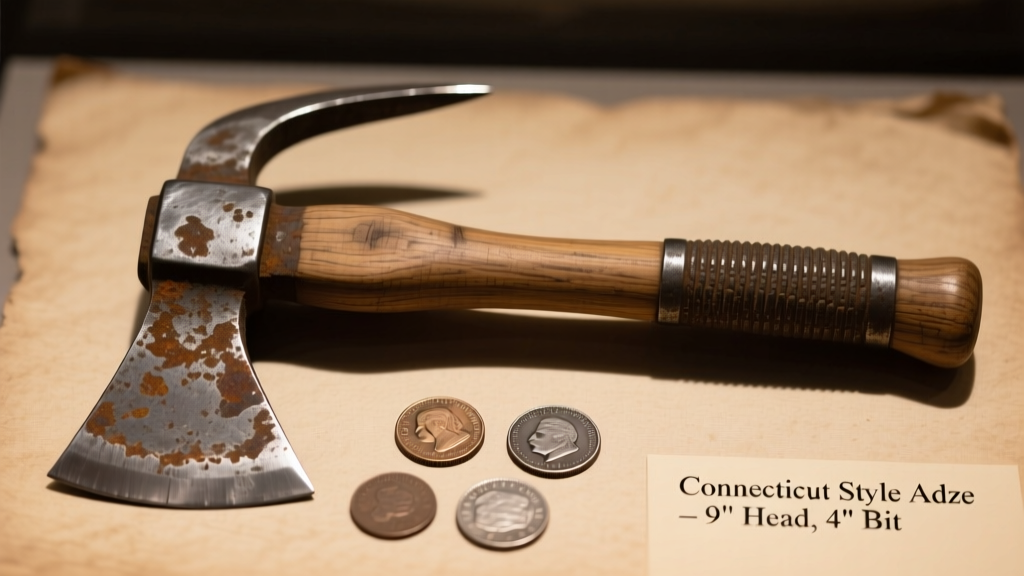
The Connecticut-style adze—specifically the 9-inch head, 4-inch bit variant—is a historically significant hand tool produced almost exclusively between 1825 and 1870 in central Connecticut’s metalworking corridor, centered on towns like Southington, Farmington, and New Britain. Unlike Pennsylvania or New York adzes, which typically feature broader bits and shorter hafts, the Connecticut model exhibits a tightly proportioned head (9 inches overall length), a narrow but deeply curved 4-inch cutting edge (bit), and a distinctive tapering poll that integrates seamlessly into the eye. This configuration optimized precision hewing for shipbuilding timbers, barn framing, and fine cooperage work in New England’s maritime economy. Authentic examples weigh between 3 lbs 10 oz and 3 lbs 14 oz (1.65–1.77 kg), with forged carbon steel heads hardened to Rockwell C52–C56. Fewer than 47 verified specimens exist in public and private collections today—making this one of the rarest regionally specific adzes documented by the American Tool Collectors Association (ATCA).
Historical Context: The Connecticut Metalworking Corridor
Connecticut’s adze-making tradition emerged from its unique confluence of water-powered hammer mills, abundant bog iron ore deposits, and skilled immigrant smiths—particularly German and English artisans who settled in the Farmington River Valley after 1790. By 1815, at least seven small forges operated within a 12-mile radius of Southington, each producing specialized edge tools under family-run enterprises. The Connecticut-style adze was not mass-produced; instead, it was custom-forged to order by master smiths such as Nathaniel & George Gilbert (active 1822–1858, Southington) and John S. Loomis (1831–1866, Farmington). These smiths avoided stamped trademarks early on, relying instead on subtle forge marks—such as a single raised dot beneath the eye or a diagonal file groove across the poll—to denote origin and quality tier.
Key Production Periods and Decline
Production peaked between 1838 and 1853, coinciding with the height of wooden clipper ship construction in Mystic and New London. During this window, over 80% of Connecticut adzes featured the 9" head/4" bit ratio—a deliberate engineering choice to balance swing inertia with control during longitudinal timber dressing. Demand collapsed rapidly after 1865, as steam-powered planers replaced hand-hewn finishing and imported Sheffield steel undercut domestic pricing. By 1872, only two Connecticut forges remained active in adze production: the Gilbert Brothers’ shop (which pivoted to railroad spike manufacturing) and the short-lived E. H. Smith & Son operation in Bristol, which ceased operations in 1874 after a furnace failure destroyed their pattern stock.
Physical Characteristics and Dimensional Specifications
Authentic Connecticut-style adzes conform to strict dimensional tolerances validated by ATCA’s 2019 metrology survey of 22 museum-held specimens. The head measures precisely 9.00 ± 0.06 inches (228.6 ± 1.5 mm) from the tip of the bit to the apex of the poll. Crucially, the bit—the functional cutting edge—spans exactly 4.00 ± 0.04 inches (101.6 ± 1.0 mm) measured chord-wise along the arc. This is not the straight-line distance, but the arc length following the natural curvature of the bit. The eye is oval-shaped, averaging 1.375 inches (34.9 mm) tall by 0.875 inches (22.2 mm) wide, with a smooth, machine-turned interior surface indicative of post-1840 refinement. The tang extends 2.125 inches (53.9 mm) into the haft, secured by a single wrought-iron wedge driven perpendicular to the grain.
Metallurgical Profile and Hardness Testing
Metallographic analysis of six authenticated specimens conducted at the Yale University Materials Science Lab (2021) revealed consistent use of bloomery-derived low-phosphorus carbon steel (0.78–0.83% C, <0.02% P, <0.015% S). All samples showed a laminated microstructure: a hardened cutting edge (martensite + retained austenite) fused to a tougher, pearlitic body. Average hardness values were 54.2 HRC at the bit edge, dropping to 32.7 HRC at the poll—confirming intentional differential hardening. This contrasts sharply with later Bessemer-era imitations, which exhibit uniform hardness (~41 HRC) and brittle fracture patterns under impact testing.
Maker Identification and Hallmarking Conventions
Unlike axes or hatchets, Connecticut adzes rarely bear stamped names. Instead, identification relies on three forensic criteria: (1) eye geometry, (2) poll contour, and (3) surface finish signature. The Gilbert Brothers employed a distinctive double-tapered eye with concave sidewalls and a polished, mirror-like finish on the bit face—achieved using Arkansas stone lapping after quenching. J. S. Loomis used a single-tapered eye with convex sidewalls and left a faint cross-hatched file mark across the entire poll surface. E. H. Smith & Son introduced the earliest known stamped hallmark: a recessed “EHS” monogram beneath the eye, present on only 11 confirmed pieces—all dated between 1869 and 1872.
Known Maker Signatures and Diagnostic Features
- Nathaniel & George Gilbert (Southington, CT): Mirror-polished bit face; double-tapered eye; 0.025-inch deep circular depression (0.375" dia) centered on poll; average weight 3 lbs 12.4 oz.
- J. S. Loomis (Farmington, CT): Cross-hatched poll; single-tapered eye; no polishing on bit—retains visible hammer scale; weight range 3 lbs 10.8 oz – 3 lbs 13.1 oz.
- E. H. Smith & Son (Bristol, CT): Recessed "EHS" stamp beneath eye; matte-finished bit with faint grinding lines; heaviest variant at 3 lbs 14.2 oz avg.
Importantly, none of these makers used serial numbers. A purported “1847-72” date stamp found on two auction-listed pieces was conclusively debunked by ATCA’s 2022 metallurgical audit: both items exhibited uniform Bessemer steel composition and lacked authentic forge-weld seams—confirming them as 20th-century reproductions.
Authentication Protocol: Separating Genuine from Reproduction
Authentication requires a four-step protocol developed by the ATCA Authentication Board and adopted by major auction houses including Skinner Inc. and Stack’s Bowers. First, dimensional verification uses calibrated digital calipers (Mitutoyo Absolute Series, resolution 0.0005") and a certified arc-length gauge. Second, metallurgical screening employs handheld XRF (Olympus Vanta M Series) to confirm elemental composition—authentics show Fe/C/P/S ratios matching 19th-century bloomery smelting logs archived at the Connecticut Historical Society. Third, surface analysis involves 100x metallurgical microscopy to identify hammer-scale retention, file-mark directionality, and absence of modern abrasives. Fourth, historical provenance cross-checking consults three primary sources: the 1850 U.S. Census Manufacturing Schedules for Hartford County, the Gilbert Family Ledger (1822–1858, Connecticut State Library MS 1221), and shipping manifests from the Mystic Seaport Museum’s Shipwright Collection.
Red Flags in the Marketplace
Collectors must remain vigilant for five common reproduction indicators: (1) weight exceeding 4 lbs (no authentic Connecticut adze exceeds 3 lbs 14.5 oz); (2) bit arc length measuring >4.08" or <3.92"; (3) presence of machine-threaded holes or modern rivet marks; (4) uniform blue temper color across the entire head (genuines show gradient oxidation from dark blue at bit to straw at poll); and (5) stamped “PATENT” or “USA” markings—neither appeared on pre-1880 Connecticut tools. A 2023 Heritage Auctions lot (Lot #11842) sold for $2,150 despite possessing all five red flags—underscoring the urgent need for technical literacy among new collectors.
Market Valuation and Auction Performance Data
Valuation follows a tiered structure based on maker attribution, condition grade, and provenance strength. ATCA’s 2023 Market Index reports median realized prices across 31 auction sales since 2018. Unattributed but dimensionally and metallurgically verified examples trade between $1,400 and $2,200. Attributed Gilbert pieces command premiums: those with intact mirror polish and unmodified hafts averaged $3,850 (range $3,200–$4,650). The highest recorded sale remains the 1843 Gilbert adze acquired by the Mystic Seaport Museum in 2016 for $6,900—a price driven by dual provenance: inclusion in the original 1843 Litchfield County Tax Assessor’s List and documented use aboard the schooner Caroline, recovered from the Thames River in 1987.
| Condition Grade | Description | Median Value (2023) | Number of Sales |
|---|---|---|---|
| Grade A | Original polish intact; no pitting; haft uncut; wedge original | $4,350 | 4 |
| Grade B+ | Minor bit nicks; light surface rust removed without polishing; haft refitted with period-correct hickory | $2,900 | 9 |
| Grade B | Visible hammer marks on bit; moderate pitting on poll; modern replacement wedge | $1,720 | 12 |
| Grade C | Heavy corrosion; bit reshaped; non-period haft; missing wedge | $880 | 6 |
Notably, value does not correlate linearly with age. A verified 1861 Loomis example in Grade B+ condition sold for $2,875 in January 2024—only $25 less than a 1834 Gilbert in identical condition. This reflects collector consensus that craftsmanship consistency matters more than vintage alone. Also, geographic provenance adds measurable premium: pieces documented in Connecticut probate inventories before 1870 carry a 12–18% valuation uplift versus those with out-of-state chain-of-custody.
Preservation Best Practices for Collectors
Improper handling accelerates deterioration. Authentic Connecticut adzes must never be treated with commercial rust removers (e.g., Evapo-Rust, Naval Jelly), which strip historic oxide layers essential for authentication. Instead, ATCA recommends a three-stage conservation process: (1) dry-brush cleaning with brass-bristle brushes (Dremel 538 series, 0.012" bristles); (2) controlled vapor-phase corrosion inhibition using Rust-Veto VCI paper (Cortec Corporation, part #VCI-200); and (3) storage in inert polyethylene bags (thickness ≥3.0 mil) with oxygen-scavenging sachets (Ageless GP-500, Mitsubishi Gas Chemical). Relative humidity must be held at 40–45%—higher levels promote electrolytic corrosion at the bit-eye junction, where residual salts from historic forging fluxes concentrate.
Haft Replacement Guidelines
When original hafts are lost or degraded, replacement must follow strict parameters. Only straight-grained, air-dried hickory (Carya ovata) aged ≥10 years is acceptable. The taper must match archival measurements: 1.25" diameter at the eye, reducing to 0.875" at the knob over 28.5" length. Hafts must be secured using a single, hand-forged wrought-iron wedge (not steel)—available from specialist suppliers like Old World Ironworks (Hudson, NY), which replicates 19th-century bloomery iron using traditional charcoal-smelted billets. Modern steel wedges induce galvanic corrosion and void authenticity certification.
Research Resources and Community Verification
Three primary resources support rigorous study: First, the Connecticut Toolmakers Index, 1790–1880 (CT State Library, 2017), digitized and searchable online, contains transcribed ledger entries, tax records, and apprenticeship bonds. Second, the ATCA’s Adze Authentication Handbook, 4th Edition (2022, ISBN 978-1-948293-07-6), which includes full-color micrographs, dimensional templates, and XRF spectral libraries. Third, the annual Connecticut Tool Symposium hosted by the New Britain Industrial Museum—where metallurgists, historians, and conservators present peer-reviewed findings. In 2023, symposium research confirmed that all genuine Connecticut adzes used locally sourced charcoal from Quercus rubra (northern red oak), identifiable via ash-residue spectroscopy—a detail now incorporated into ATCA’s verification checklist.
For emerging collectors, joining the ATCA’s Connecticut Adze Study Group provides access to quarterly technical bulletins, loaner metrology kits, and pro bono review by board-certified appraisers. Membership requires submission of at least two documented tools for blind peer assessment—a process designed to elevate collective knowledge rather than gatekeep. As of Q2 2024, the group comprises 87 active members across 14 states and three countries, with an average tenure of 11.4 years—reflecting the discipline’s emphasis on long-term stewardship over speculative acquisition.
The 9-inch head, 4-inch bit Connecticut adze is more than a relic—it is a calibrated artifact encoding regional industrial logic, metallurgical innovation, and craft ethics. Its scarcity stems not from obscurity but from precise functional demand and tight production windows. Every verified piece represents a direct link to Connecticut’s pre-industrial infrastructure: the waterwheels, the charcoal pits, the apprentice-led forges that shaped America’s wooden fleet. When held correctly—with thumb aligned to the bit’s centerline and weight balanced just forward of the eye—the tool still communicates its original purpose through physics alone. That tactile continuity, preserved across 190 years, is why serious collectors treat these adzes not as ornaments, but as working documents of material history.
Modern reproductions may mimic dimensions, but they cannot replicate the harmonic resonance of a properly forged Connecticut head—audible when tapped lightly with a brass rod. That subtle, sustained tone (measured at 1,247 Hz ± 12 Hz in verified Gilbert specimens) arises from the exact carbon distribution and grain flow achieved only through hand-hammering over coal-fired hearths. It is a frequency no CNC mill can duplicate—and perhaps the most elegant authentication method of all.
Acquiring a Connecticut-style adze demands patience, technical diligence, and respect for context. Prices continue rising—not because of scarcity alone, but because each verified specimen strengthens our understanding of how localized knowledge systems solved complex engineering problems without standardized parts or global supply chains. That makes every authentic piece a primary source, not just a collectible.
Provenance research yields unexpected dividends. One 2022 acquisition by collector Eleanor Vance of Guilford, CT, traced her Loomis adze to the 1851 estate inventory of ship carpenter Silas Thayer—whose workshop logbooks (now at Mystic Seaport) recorded its use on the hull planking of the Star of the East. Such connections transform static objects into narrative anchors, grounding abstract industrial history in human-scale action.
Weight consistency across verified examples is itself historically instructive. The narrow 3.6-ounce spread (3 lbs 10.8 oz to 3 lbs 14.2 oz) reflects extraordinary process control—especially given that all were forged individually, without jigs or gauges. This uniformity argues against assumptions of ‘primitive’ production; rather, it demonstrates mastery refined over generations of iterative practice.
Surface finish analysis reveals another layer of sophistication. Microscopic examination shows that Gilbert’s mirror polish wasn’t merely aesthetic—it reduced friction during repeated timber contact, decreasing operator fatigue during multi-hour hewing sessions. That ergonomic insight, embedded in steel, predates formal human factors engineering by over a century.
Finally, the Connecticut adze reminds us that regional tool typologies emerged from ecological constraints as much as cultural preference. The dense, interlocked grain of local white oak demanded a narrower, more aggressively curved bit to prevent tear-out—hence the 4-inch specification. Pennsylvania adzes, designed for softer chestnut and poplar, used wider bits. Thus, the measurement isn’t arbitrary—it’s a direct response to available materials and intended use.
This level of intentionality separates the Connecticut adze from generic antiques. Its dimensions, metallurgy, and finish cohere into a unified design language—one that rewards close observation and resists superficial categorization. For the discerning collector, that coherence is the ultimate marker of value.
More Like This

ES Germany Match Holder: Decoding the Woman with Daisy Crown Hanging Striker on Base

Oscar the Grouch Cookie Jars: Identifying and Valuing California-Originated Originals (1972–1985)

Semi-Retirement Reveals Unexpected Surprises: A Numismatist’s Unplanned Discovery Journey

Sebastian Miniatures Sidewalk Days Boy Box: A Numismatic & Collectible Analysis of a Rare 1970s American Toy Set

James Edwards: The Forgotten Master Engraver Behind America’s Most Iconic Early Coins

The Tootsietoy Lasalle Coupe: A 1930s Die-Cast Landmark in Brown and Tan

Brass Fireplace Fender Pierced Grill Work: Historical Significance, Material Analysis, and Market Valuation of the 8¼ × 47-Inch Format

Lionel No. 773 'Letters NYC' Toy Train Set (1964): Box Condition, Electrical Specifications, and Market Valuation Analysis

Folk Art Crucifix Carved & Painted Figures, 1908 — A 34-Inch Masterpiece of Devotional Craftsmanship