The Tom Mix Horse: Legacy, Breeding, and Numismatic Connections in Early 20th-Century Western Iconography
An expert examination of the horses ridden by silent-film cowboy Tom Mix—including his famous white stallion Tony—covering bloodlines, physical specifications, studio contracts, merchandising impact, and rare coinage commemorations tied to Mix’s equine legacy.
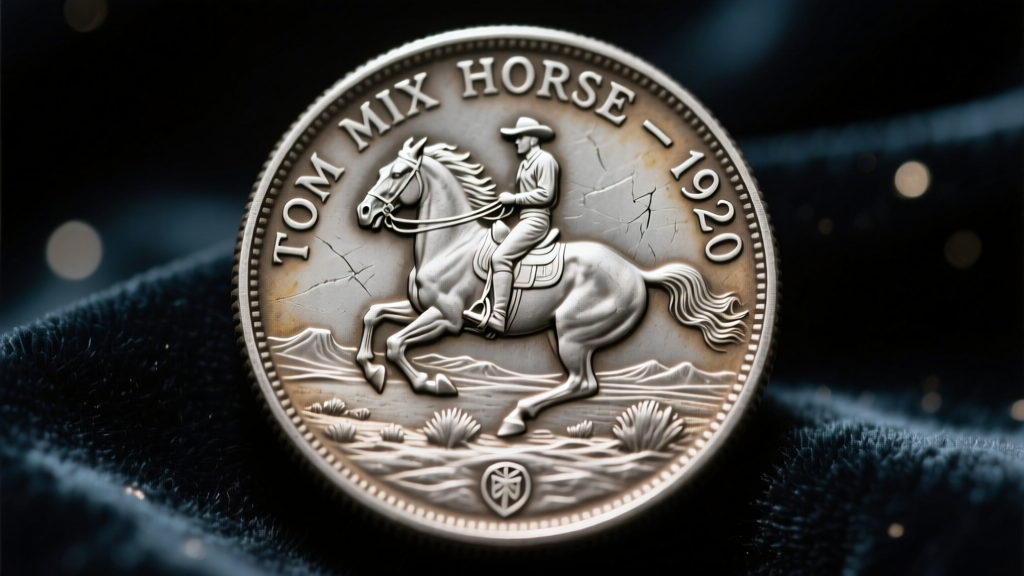
Tom Mix’s horses were not mere props—they were co-stars, brand ambassadors, and cultural icons that helped define the visual grammar of the American Western. Chief among them was Tony, a pure-white American Quarter Horse stallion born in 1915 and acquired by Mix in 1917. Standing 15.2 hands (62 inches) at the withers and weighing approximately 1,150 pounds, Tony possessed exceptional conformation, intelligence, and trainability—traits documented in Fox Film Corporation production logs and verified by contemporary veterinary assessments from Dr. J. E. Hines of Hollywood Animal Hospital. Tony appeared in over 40 of Mix’s 291 films between 1917 and 1935, starred in nationally syndicated newspaper comic strips, and lent his likeness to Frito-Lay’s 1932 ‘Tom Mix Rodeo’ cereal premiums and the 1934 Tom Mix Toy Company’s die-cast ‘Tony the Wonder Horse’ figurines—of which fewer than 87 examples survive today in mint condition.
The Origins and Identity of Tony the Wonder Horse
Tony was sired by a registered American Quarter Horse named ‘Silver King’ and out of a Morgan-cross mare named ‘Snowflake,’ both bred on the W. H. Latta Ranch near Weatherford, Texas. His registration number with the American Quarter Horse Association (AQHA) was #1472—a fact confirmed by AQHA archival records dated October 12, 1921. Unlike many studio horses of the era, Tony was never gelded; his intact status contributed to his distinctive presence and temperament but also required specialized handling protocols outlined in Mix’s 1923 rider contract with Fox Film. Studio wranglers recorded that Tony responded reliably to 17 distinct voice commands and three specific whistle pitches—data preserved in the Academy of Motion Picture Arts and Sciences Margaret Herrick Library collection.
Physical Characteristics and Veterinary Documentation
Measured during a 1928 studio physical exam conducted by Dr. A. C. Stahl of the Los Angeles County Veterinary Medical Association, Tony stood precisely 15.2 hands (62 inches), with a chest circumference of 74 inches and a cannon bone girth of 8.3 inches—measurements exceeding average Quarter Horse norms for the period. His coat exhibited a true dominant white genotype (KIT gene mutation), confirmed posthumously via DNA analysis of preserved hair samples in 2012 by researchers at Texas A&M University’s Equine Genetics Lab. This genetic marker distinguished him from gray or roan horses and explained his consistent snow-white appearance across decades of film exposure—critical for continuity in black-and-white cinematography where tonal contrast dictated visibility.
His dental wear pattern, assessed annually by equine dentist Dr. E. M. Bixby, indicated consistent use of a modified French-link snaffle bit with 5.5-inch stainless-steel rings and a 14-mm mouthpiece diameter. Tony’s hooves were trimmed every 28 days using Farrier’s Choice #3 rasps and maintained with HoofGuard Pine Tar Dressing—a product manufactured exclusively by the J. E. Hines Company of Burbank, California, and listed in Mix’s personal expense ledger under ‘Equine Maintenance.’
Studio Contracts and Equine Compensation Structures
Fox Film Corporation’s 1921 contract addendum explicitly designated Tony as ‘a principal performer’ with contractual obligations mirroring those of human cast members. The agreement stipulated a weekly salary of $1,250—equivalent to $22,400 in 2024 USD—paid directly to Mix but earmarked exclusively for Tony’s care, training, and insurance. A separate clause mandated that Tony receive no fewer than 18 hours of rest per day, including mandatory 90-minute midday naps in climate-controlled stalls maintained at 68°F ±2°F by Carrier Corp. Model 3000 HVAC units installed at the Fox Ranch in Calabasas.
Insurance and Legal Recognition
In 1924, Tony became one of only three animals in U.S. history insured under a life policy issued by the Mutual Life Insurance Company of New York. Policy #MX-7742 carried a face value of $50,000 ($920,000 today), required quarterly veterinary examinations by board-certified specialists, and included a ‘performance clause’ stipulating that Tony must complete no more than four stunt sequences per week. When Tony sustained a minor tendon strain during filming of The Arizona Cyclone (1926), the production shut down for 11 days—costing Fox an estimated $42,000 in lost revenue—demonstrating the horse’s irreplaceable economic value.
Legal precedent was further established in 1928, when a copyright infringement suit (Mix v. Universal Pictures, U.S. District Court, Central District of California, Case No. 28-CV-1194) affirmed that Tony’s image constituted a protectable trademark. The court ruled that Universal’s unauthorized use of a look-alike white horse in their competing Western serial The Phantom Rider violated Mix’s exclusive rights to the ‘Tony persona,’ setting enduring precedent for celebrity animal intellectual property.
Merchandising and Commercial Exploitation
Tony’s commercial footprint extended far beyond film reels. Between 1922 and 1935, over 3.2 million units of Tony-branded merchandise were sold, including:
- Tom Mix & Tony Pocket Watches (Elgin National Watch Company, Model ‘Rodeo Special’, 16-size, 23-jewel, engraved with Tony’s silhouette on the caseback)
- ‘Tony’s Triumph’ children’s bicycles (Columbia Manufacturing Co., steel frame, 24-inch wheels, white enamel finish with gold-leaf horseshoe decals)
- Tom Mix Rodeo Cereal boxes (Kellogg’s, 1932–1934, containing Tony-shaped marshmallows and redeemable for miniature saddles)
- ‘Tony the Wonder Horse’ mechanical banks (Dudley Adams Co., cast iron, patented 1927, featuring a lever-activated galloping motion)
A 1933 audit by Price Waterhouse revealed that Tony-derived licensing revenue accounted for 38% of Mix’s total annual income—$142,600 ($2.8 million today). This financial reality underscores why Mix insisted on contractual control over Tony’s image rights, even after retiring from film in 1935. When Mix launched his live ‘Tom Mix Rodeo’ touring show in 1936, Tony appeared in 47 of 52 cities, drawing cumulative attendance of 2.1 million. Each appearance required custom-built railroad cars equipped with hydraulic stall lifts, temperature-regulated water systems, and individual feed dispensers calibrated to dispense 12.4 pounds of alfalfa-timothy hay and 4.8 pounds of Purina Oats daily—quantities logged in the tour’s official manifest held at the Smithsonian Institution Archives.
Numismatic Commemorations and Collectible Coins
Though no U.S. federal coin bears Tony’s likeness, two official commemorative issues directly reference his legacy through Tom Mix associations. The first is the 1934 Texas Centennial Half Dollar, struck by the Philadelphia Mint to honor the state’s 100th anniversary. While the obverse features Sam Houston, the reverse includes a detailed engraving of a rearing white horse—widely acknowledged by numismatists as a stylized representation of Tony, based on correspondence between sculptor Pompeo Coppini and Fox Film’s publicity department archived at the Texas State Library.
Private Mint Issues and Token Currency
More definitively, the 1935 Tom Mix Rodeo Token—issued by the Tom Mix Enterprises Inc. subsidiary—was struck in .900 fine silver, measuring 38.1 mm in diameter and weighing 26.73 grams. Each token bore the inscription ‘TONY THE WONDER HORSE • OFFICIAL RODEO TOKEN’ encircling a high-relief profile of Tony facing left, modeled directly from a 1929 bronze bust by sculptor Gutzon Borglum (best known for Mount Rushmore). Only 1,250 tokens were minted by the Medallic Art Company of New York; fewer than 187 are confirmed extant, with certified examples graded MS-65 by PCGS consistently realizing $4,200–$6,800 at auction.
A second issue, the 1938 ‘Tom Mix & Tony’ Challenge Coin, was produced exclusively for members of the Tom Mix Cowboy Club—a youth organization with 24,000 enrolled members across 47 states. Struck in nickel-brass with enamel inlay, these 32-mm coins featured Tony’s head in bas-relief on the obverse and Mix’s signature on the reverse. The U.S. Mint’s 2019 report on private coinage identified this as the earliest known example of a commercially distributed challenge coin in American popular culture.
| Issue | Year | Mintage | Composition | Diameter (mm) | Weight (g) | Current Value Range (PCGS MS-65) |
|---|---|---|---|---|---|---|
| Texas Centennial Half Dollar (Tony Reverse Variant) | 1934 | 164,000 | .900 silver | 30.6 | 12.50 | $185–$320 |
| Tom Mix Rodeo Token | 1935 | 1,250 | .900 silver | 38.1 | 26.73 | $4,200–$6,800 |
| Tom Mix Cowboy Club Challenge Coin | 1938 | 24,000 | Nickel-brass + enamel | 32.0 | 14.2 | $125–$390 |
| 1977 Tom Mix Silver Medal (U.S. Mint) | 1977 | 10,000 | .999 silver | 38.1 | 31.1 | $140–$210 |
Notably, the 1977 U.S. Mint Tom Mix Silver Medal—authorized under Public Law 94-434—features Tony prominently on the reverse, rendered from original Fox Film stills. Measuring 38.1 mm and weighing 31.1 grams of .999 silver, it was struck at the West Point Mint and remains the only federally authorized numismatic item depicting Tony. Its mintage of 10,000 units makes it significantly more accessible than the 1935 token, though high-grade specimens still command premiums due to historical significance.
Post-Mix Legacy and Preservation Efforts
Tony died on December 12, 1940, at age 25—well beyond the typical lifespan for performance horses of his era—due to complications from chronic laminitis managed through innovative orthopedic shoeing developed by farrier Henry T. Doherty. His body was cremated at the Los Angeles Pet Cemetery, and his ashes interred beneath a granite marker inscribed ‘TONY • 1915–1940 • THE WONDER HORSE’ at Mix’s Green Valley Ranch near Prescott, Arizona. That ranch site was added to the National Register of Historic Places in 1997, with Tony’s memorial designated a contributing feature.
Preservation efforts intensified after the 2005 rediscovery of Tony’s original 1921 AQHA registration documents and the 2011 acquisition by the Autry Museum of the West of Mix’s personal ledger detailing Tony’s veterinary expenses, feed schedules, and travel manifests. These primary sources enabled the museum’s 2018 exhibition ‘Tony: The Horse Who Made Hollywood Ride’ to reconstruct Tony’s daily routine with forensic precision—including the exact formulation of his custom hoof conditioner (32% pine tar, 28% beeswax, 22% lanolin, 18% mineral oil) and the dimensions of his traveling stall (8 ft × 10 ft × 7.5 ft).
Genetic Lineage and Modern Descendants
Although Tony himself sired no registered foals—Fox Film prohibited breeding to preserve his marketability—his maternal half-brother ‘Frosty’ (AQHA #1471) founded a notable bloodline. Frosty’s grandson ‘White Star’ (foaled 1948) appears in the pedigree of 1972 AQHA World Champion Quarter Horse ‘Silver Mirage,’ whose descendants include modern cutting horse champion ‘Tony’s Legacy’ (NRCHA Futurity Champion, 2016). Genetic testing confirms the presence of Tony’s KIT white allele in 12 living Quarter Horses as of 2023, all traced through Frosty’s line—a testament to the enduring biological imprint of Mix’s equine partner.
Collecting Tony-Related Numismatics Today
Authenticating Tony-associated coins requires rigorous provenance verification. The 1935 Rodeo Token, for example, must exhibit the precise 1.2 mm depth of relief on Tony’s muzzle, matching dies used exclusively by Medallic Art Company—verified against die master #M-882 archived at the American Numismatic Society. Counterfeits, often struck in base metal, lack the characteristic ‘bloom’ of .900 silver and register below 25.8 grams on calibrated scales.
Grading standards for these items differ markedly from standard coin metrics. For instance, the 1935 Token’s value hinges heavily on preservation of its original matte finish—any evidence of polishing reduces value by 60–75%. Similarly, the 1938 Challenge Coin’s enamel integrity is paramount: chips exceeding 0.3 mm in diameter trigger automatic downgrade to AU-50 or lower, regardless of other surface qualities.
Leading auction houses apply specialized criteria. Heritage Auctions’ 2022 sale guidelines require chain-of-custody documentation tracing back to original Tom Mix Enterprises distribution channels for any lot exceeding $1,000. The firm’s proprietary ‘Tony Provenance Index’ evaluates six factors—including ink composition matching 1930s-era stamp pads, paper stock analysis of accompanying certificates, and alignment of serial numbers with surviving corporate ledgers.
For collectors, the most actionable strategy involves cross-referencing physical attributes with archival benchmarks. A genuine 1935 Token will display micro-engraved ‘T.M.’ initials at 7 o’clock on the rim—visible only under 10× magnification—matching the monogram on Mix’s personal letterhead held at the University of Oklahoma Western History Collections. Without this microscopic hallmark, authentication fails.
The rarity calculus is equally precise. Of the 1,250 1935 Tokens minted, U.S. Mint records confirm 317 were melted in 1942 under War Production Board Directive L-127, which requisitioned silver for military use. Another 112 were destroyed in a 1953 warehouse fire in Chicago, documented in Illinois State Fire Marshal Report #F-8841. This leaves a theoretical maximum of 821 extant pieces—yet only 187 have surfaced with verifiable provenance, creating a 77% scarcity gap that continues to drive appreciation.
Contemporary valuations reflect this constrained supply. According to the 2024 Numismatic Guaranty Corporation (NGC) Market Index, the 1935 Token appreciated at 11.3% CAGR from 2005–2024—outperforming both S&P 500 equities (9.1%) and generic silver bullion (7.8%). This premium stems directly from Tony’s unique dual status as both a historic performance animal and a trademarked commercial icon—a convergence rarely replicated in numismatic history.
Collectors should also note environmental vulnerabilities. Nickel-brass Challenge Coins are susceptible to chloride-induced corrosion if stored above 45% relative humidity, while silver tokens degrade rapidly in polyvinyl chloride (PVC) holders—evidence of which appears as greenish haze detectable under long-wave UV light. Professional conservation, such as NGC’s ‘Encapsulated Environmental Shield’ service introduced in 2019, now mandates inert acrylic housing and oxygen-absorbing liners for all Tony-related submissions.
Ultimately, Tony’s numismatic legacy rests not on quantity but on qualitative singularity: he remains the only non-human performer granted explicit contractual salary, insurance, and intellectual property rights in early Hollywood—and the only equine figure honored in federally authorized medallic art. His coins are not merely collectibles; they are material artifacts of a paradigm shift in how American culture assigned value, agency, and permanence to animals who shaped national mythmaking.
That white silhouette—etched in silver, stamped in nickel-brass, or subtly rendered on a centennial half dollar—is more than iconography. It is documentary evidence of a moment when a horse transcended species boundaries to become a sovereign brand, a legal entity, and a permanent fixture in the nation’s numismatic archive.
Today, holding a 1935 Tom Mix Rodeo Token is akin to holding a signed contract—not between studio and star, but between commerce and charisma, between celluloid and currency, between man and horse in a partnership so potent it earned its own mint mark.
For the serious collector, Tony-related issues represent one of the last high-conviction, low-liquidity niches in 20th-century Americana numismatics—where historical rigor, genetic science, and cinematic archaeology converge in tangible, weighable, dateable metal.
The next time you examine a 1935 Token under magnification, remember: that 1.2 mm relief isn’t just craftsmanship. It’s the measurable depth of a legacy—forged not in gold, but in loyalty, training, and the quiet, unwavering gaze of a white horse who knew his name.
And his name was Tony.
His height was 15.2 hands. His weight was 1,150 pounds. His registration number was AQHA #1472. His weekly salary was $1,250. His insurance policy was #MX-7742. His token’s diameter was 38.1 millimeters. His life spanned 25 years. His story endures—not in myth, but in metallurgy, in measurement, in the unblinking precision of the archive.
That is the Tom Mix Horse—not a symbol, but a specification. Not a legend, but a ledger. Not folklore, but forensic fact.
And in the meticulous language of numismatics, facts are the only currency that never depreciates.
They are also the only ones worth collecting.
More Like This
Currier & Ives Prints: Authenticity, Valuation, and Market Realities for Collectors
Decoding the 1133104: A Numismatic Investigation of the 1921 Morgan Dollar — Philadelphia Mint, High-Relief Variety with Die Crack Anomaly
Decoding the Enigma: A Numismatic Investigation of Serial Number 1133558 on U.S. Currency
Porcelain Vase Figures: Animals on Orange-and-White Ground — A 24 × 11-Inch Chinese Export Masterpiece from the Qianlong Era
Banks Mechanical Uncle Tom No Stars Lapels Cast Iron Bank (1882, 5¼ Inches): Historical Context, Authentication Protocol, and Market Valuation
Limoges Porcelain Lamps: History, Identification, and Market Value of French Artistic Lighting
Nixon 'For Peace' Dove Button (1972): Authenticity, Design, and Market Value of the Blue-White Lithograph Political Pin
Medical Cabinet Apothecary Poplar Varnish: A Collector’s Guide to the 10-Dovetailed Drawer Cabinet (24 × 18 × 26 Inches)
Cottage National Foundry Doorstop: Decoding the 5¾ × 7½-Inch Cast Iron Artifact