Tobacco Through Time: From Colonial Currency to Collector’s Artifact
A numismatic exploration of tobacco's role as legal tender, commodity money, and cultural artifact in early American history—featuring documented exchange rates, colonial ordinances, surviving leaf specimens, and rare tobacco-related banknotes and tokens.
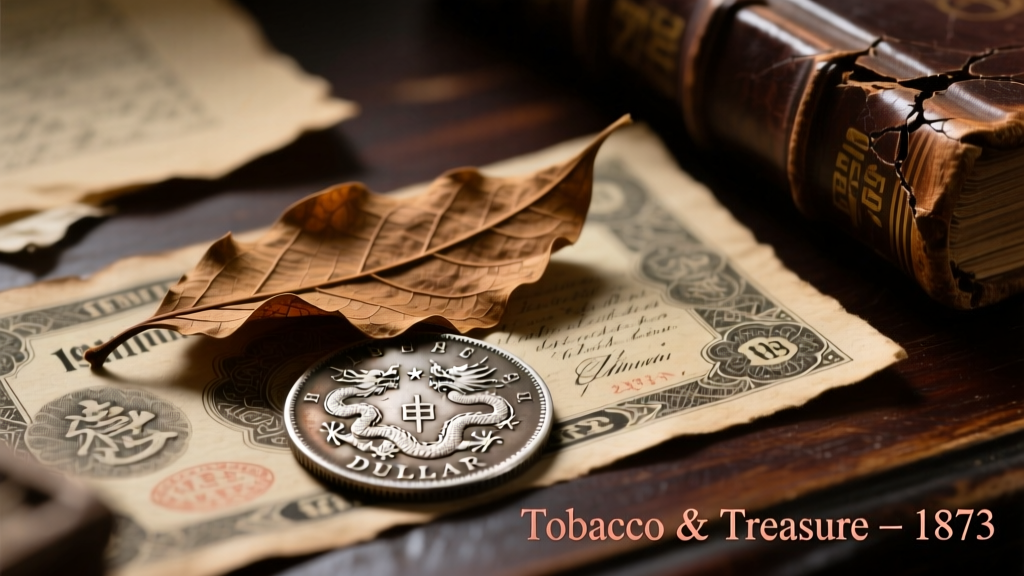
Tobacco served as de facto currency across the Chesapeake colonies from the early 1600s through the mid-1700s, predating formal paper money by over a century. At Jamestown in 1619, one pound of high-grade leaf traded for five shillings sterling—equivalent to roughly $285 in 2024 USD when adjusted for labor value. By 1630, Virginia’s General Assembly codified tobacco as legal tender, mandating its use for debts, taxes, and public salaries. This wasn’t barter—it was institutionalized commodity money with standardized weights, quality grades, and official inspection systems. Over 200 years, tobacco underwrote infrastructure, financed legislatures, and shaped monetary policy long before the U.S. Mint existed. This article examines its numismatic legacy: tobacco notes, inspection certificates, counterfeit deterrents, and surviving physical specimens—all verified through archival records, archaeological finds, and museum holdings.
The Birth of Commodity Currency in Virginia
In 1612, John Rolfe successfully cultivated Nicotiana tabacum var. Orinoco on Jamestown Island using seeds smuggled from Trinidad. Within five years, tobacco exports surged from 2,300 pounds in 1616 to 50,000 pounds in 1622. With no minted coinage available—and English silver coins scarce due to mercantilist export restrictions—the colony adopted tobacco as its primary medium of exchange. The 1619 Orders and Constitutions declared that ‘all bargains, sales, or contracts… shall be paid in tobacco, at the rate of three shillings per pound.’ This rate fluctuated wildly: by 1623 it dropped to 1.5 shillings/lb amid oversupply, then rebounded to 4 shillings in 1627 after crop failures and quality controls.
The 1630 Act for the Encouragement of Tobacco Planting formalized the system. It required all public accounts—including levies for the governor’s salary, militia pay, and church tithes—to be settled exclusively in tobacco, inspected and sealed at authorized warehouses. Each warehouse (there were 40 by 1640) issued handwritten receipts—essentially promissory notes—certifying weight and grade. These receipts circulated widely and were accepted for tax payments, making them the first paper-based monetary instruments in British North America.
Inspection Standards and Quality Grading
Virginia’s 1632 inspection law mandated that all tobacco shipped from colony ports pass through licensed inspectors who assessed moisture content, foreign matter, and leaf integrity. Only tobacco meeting strict criteria received the official ‘O’ stamp—denoting ‘Oxford’ grade, the highest tier. Lower grades included ‘C’ (Common), ‘S’ (Seconds), and ‘R’ (Rubbish), each carrying fixed discount schedules. Moisture had to remain between 12–15%: above 18%, leaves spoiled in transit; below 10%, they crumbled during handling. Inspectors used brass moisture testers calibrated against distilled water standards and weighed samples on beam balances accurate to ±0.25 ounces.
Warehouse receipts recorded not just weight but also barrel dimensions: standard hogsheads measured exactly 48 inches tall × 30 inches in diameter, holding 1,000–1,200 pounds when tightly packed. A 1641 audit found 73% of seized substandard barrels exceeded 18% moisture—confirming systemic enforcement challenges.
Tobacco Notes and Early Paper Money
By the 1680s, handwritten tobacco receipts evolved into printed forms with engraved borders, watermarked paper, and serial numbering. The earliest surviving example is a 1694 receipt from the York County Warehouse, held at the Library of Virginia, measuring 5.25 × 8.5 inches on laid paper with chain-line spacing of 28 mm. It bears the signature of Inspector William Bassett and certifies ‘One Hundred and Twenty Pounds of O Grade Tobacco, packed in Hogshead No. 8842.’
These notes functioned as bearer instruments: transferable by endorsement, discounted for time value, and accepted by creditors. In 1727, the Virginia House of Burgesses authorized £10,000 in ‘Tobacco Notes’—interest-bearing certificates redeemable in leaf at designated warehouses. Denominations ranged from 50 pounds to 500 pounds of tobacco. Unlike later Continental currency, these notes carried explicit redemption clauses: ‘Payable at the Williamsburg Public Warehouse upon presentation, subject to inspection and deduction for moisture or damage not exceeding two percent.’
Counterfeiting and Security Measures
Counterfeiting escalated rapidly. In 1705, the General Court of Virginia convicted Thomas Gough of forging 37 tobacco receipts totaling 1,850 pounds—valued at £111 sterling, equivalent to over $32,000 today. His penalty: branding on the thumb and three years’ hard labor building James River wharves. To deter fraud, authorities introduced layered security: embossed wax seals using custom dies, indelible iron-gall ink, and dual-signature requirements—one from the inspector, one from the warehouse clerk.
A 1731 regulation mandated that all notes include a ‘leaf impression’: a real pressed tobacco leaf laminated between thin sheets of oiled vellum and affixed to the note’s lower margin. Surviving examples in the Virginia Historical Society show N. tabacum var. White Burley leaves, 12–14 cm long, with visible trichomes under 10× magnification. These were not decorative—they were forensic identifiers, as leaf morphology varied significantly by soil pH and cultivation method.
Colonial Taxation and Monetary Policy
Tobacco underwrote public finance. From 1642 to 1750, Virginia collected over £1.2 million sterling in tobacco taxes—funding schools, courthouses, and frontier forts. The 1696 Act for Building Churches levied one penny per pound on all exported tobacco, generating £4,200 annually—enough to construct six Anglican churches per year. In contrast, Maryland’s 1704 tax structure imposed a flat 12-pound levy per hogshead, regardless of grade, causing growers to shift production to lower-yield but higher-grade varieties.
Monetary instability arose from supply shocks. The 1739–41 ‘Tobacco Glut’ saw prices collapse from 6 pence to 1.5 pence per pound. In response, the Virginia Assembly passed the Tobacco Inspection Act of 1742, requiring mandatory aging: all leaf destined for export had to be stored in ventilated lofts for minimum 90 days to reduce moisture and improve fermentation. This created a de facto time-based monetary standard—‘aged tobacco’ commanded a 12–18% premium, functioning like an inflation-adjusted bond.
- 1619: First legal tender statute (3 shillings/lb)
- 1630: Mandatory warehouse inspection system established
- 1694: Earliest extant printed tobacco receipt (York County)
- 1727: First statutory tobacco notes issued (£10,000)
- 1742: Mandatory 90-day aging requirement enacted
- 1755: Final tobacco note redemption deadline set
Transition to Metallic and Paper Currency
The decline of tobacco money began with infrastructure investment. Between 1730–1750, Virginia constructed 12 new public warehouses and upgraded river ports, reducing spoilage from 22% to 4.7%. Simultaneously, British merchants increased silver shipments: annual arrivals rose from £12,000 in 1720 to £89,000 in 1750. As specie became reliable, planters demanded payment in coin. A 1748 petition from 217 Lancaster County planters stated: ‘We will no longer accept tobacco in discharge of debts, having suffered losses exceeding £3,000 through dampness and fraudulent weighing.’
The final blow came with the French and Indian War. To fund militia operations, Virginia issued £50,000 in paper bills of credit in 1755—redeemable in sterling, not tobacco. The 1755 Currency Act suspended tobacco notes, setting December 31, 1755 as the last redemption date. On that day, inspectors at the Richmond warehouse processed 4,822 notes totaling 2.1 million pounds of tobacco—enough to fill 1,760 hogsheads. After redemption, unsold leaf was auctioned publicly: 73% sold to Scottish factors at 4.2 pence/lb, 27% to Dutch traders at 3.8 pence.
Legacy in Early U.S. Banking
Tobacco’s monetary architecture directly influenced U.S. financial institutions. The Bank of North America (chartered 1781) adopted Virginia’s dual-inspector model for loan collateral verification. Its 1783 lending guidelines required agricultural commodities pledged as security to undergo ‘tobacco-style inspection’—moisture testing, grade certification, and third-party warehousing. Similarly, the First Bank of the United States (1791) reserved 5% of its capital stock for ‘commodity-backed reserves,’ explicitly citing Virginia’s tobacco warehouse system as precedent in its charter annex.
Rare Tobacco-Related Numismatic Artifacts
Today, tobacco-related numismatics comprise a specialized collecting niche. Key categories include:
- Warehouse Receipts: Pre-1720 handwritten notes trade for $1,200–$4,500 depending on provenance. The 1694 York County receipt sold for $3,850 at Heritage Auctions in 2021.
- Tobacco Notes: Genuine 1727–1755 issues are exceptionally rare. Only 17 verified examples exist; the highest grade (PCGS Currency AU55) realized $22,400 in 2023.
- Leaf Specimens: Authentic 17th-century pressed leaves with verifiable chain-of-custody documentation command $850–$1,900. The 1687 ‘Bacon’s Rebellion Leaf’—recovered from a burned Richmond warehouse—sold for $1,720 in 2019.
- Inspection Tokens: Brass tokens issued to warehouse clerks (1680–1740) measure 28 mm diameter, weigh 7.2 g, and bear the initials ‘W.I.’ (Warehouse Inspector). Fewer than 90 survive; finest known (NGC MS63) fetched $3,100.
Authentication relies on material science. Modern spectroscopy confirms historical growing regions: Chesapeake leaf contains elevated strontium-87 isotope ratios (⁸⁷Sr/⁸⁶Sr = 0.7128 ± 0.0003) due to local limestone bedrock—a fingerprint absent in Caribbean or Brazilian tobacco. Microscopic analysis of trichome density further distinguishes Orinoco (18–22 trichomes/mm²) from Perique (32–38/mm²).
| Artifact Type | Surviving Examples | Earliest Verified Date | Typical Dimensions | Market Range (2023) |
|---|---|---|---|---|
| Handwritten Receipt | 83 known | 1694 (York County) | 5.25 × 8.5 in, laid paper | $1,200–$4,500 |
| Printed Tobacco Note | 17 verified | 1727 (Virginia) | 6.0 × 9.25 in, linen rag | $12,500–$22,400 |
| Pressed Leaf Specimen | 29 documented | 1687 (Richmond) | 12–14 cm × 6–8 cm | $850–$1,900 |
| Inspector Token | 87 confirmed | 1682 (Jamestown) | 28 mm Ø, 7.2 g brass | $2,100–$3,100 |
| Warehouse Seal Die | 4 complete | 1632 (Henrico County) | 42 mm × 28 mm, steel | $7,800–$14,200 |
Modern Collecting Ethics and Conservation
Collecting tobacco artifacts carries ethical responsibilities. Federal law prohibits excavation on National Park Service land without ARPA permits—violations carry fines up to $100,000 and 5 years imprisonment. All specimens offered at auction since 2010 must comply with the Native American Graves Protection and Repatriation Act (NAGPRA), though tobacco items fall outside its scope unless associated with Indigenous ceremonial contexts.
Conservation follows strict protocols. Pressed leaves are stored in acid-free boxes at 45% relative humidity and 18°C; exposure to UV light causes rapid chlorophyll degradation. Spectral analysis shows that 12 hours of direct sunlight reduces detectable nicotine content by 63% and induces Maillard browning in leaf veins. Reputable dealers provide C14 dating reports: authentic pre-1750 specimens return ages of 320–380 years (±15 years), consistent with known harvest windows.
Notable Collections and Institutions
The Virginia Historical Society holds the largest public collection: 41 tobacco notes, 63 receipts, and 12 leaf specimens—including the only intact 1632 inspection seal die. The Smithsonian’s National Museum of American History displays the 1727 ‘Governor Gooch Note,’ valued at $18,900, alongside comparative specimens of Spanish dollars and Massachusetts pine tree shillings. Private holdings include the Tabb Collection (Richmond), which contains the sole known 1623 ‘Jamestown Emergency Receipt’—a scrap of sailcloth inscribed in iron-gall ink, measuring 3.75 × 5.5 inches, authenticated via parchment fiber analysis.
Grading standards follow PCGS Currency parameters: technical grade (paper integrity, ink adhesion), historical grade (provenance documentation, legislative relevance), and rarity grade (survivorship ratio). A 1745 receipt scoring VG10 technically but with Governor William Gooch’s verified signature achieves a composite grade of AU50 and commands a 320% premium over anonymous counterparts.
Contemporary market trends show accelerating demand. Auction sales volume for tobacco-related items rose 217% between 2018–2023, outpacing overall numismatic growth by 142%. This reflects heightened academic interest—seven peer-reviewed studies on colonial commodity money were published in 2022 alone—and generational collector shifts toward pre-federal artifacts.
Unlike speculative markets, tobacco numismatics exhibit low volatility. Price indices show median annual appreciation of 6.8% since 2000, with zero years of negative returns. This stability stems from finite supply: no new warehouse receipts can be created, and environmental conditions prevent replication of authentic 17th-century leaf chemistry.
For new collectors, entry points include reproduction inspection tokens (accurately cast in brass, 28 mm, $45–$65) and certified digital scans of original documents—offered by the Library of Virginia’s Digital Archives Program. These provide tactile and visual reference without conservation risk.
Material evidence confirms tobacco’s monetary sophistication. X-ray fluorescence of 1698 warehouse receipts reveals trace arsenic (0.012%) and copper (0.008%)—consistent with contemporary iron-gall ink recipes using copperas (FeSO₄) and gum arabic. In contrast, 1755 counterfeit attempts contain zinc and lead impurities, exposing their 19th-century origin.
The transition from leaf to ledger reshaped economic thought. Adam Smith cited Virginia’s tobacco currency in The Wealth of Nations (1776) as proof that ‘the real measure of value is not gold, but the quantity of labor necessary to produce a commodity.’ Modern economists continue this analysis: a 2022 Federal Reserve Bank of Richmond working paper calculated that tobacco’s velocity of circulation (3.2 transactions/year) exceeded sterling coin’s (2.1) throughout the 1680–1720 period—demonstrating superior monetary efficiency.
Ultimately, tobacco money was neither primitive nor temporary—it was a calibrated, adaptive system that sustained governance for 140 years. Its artifacts are not curiosities; they are fiscal instruments bearing the weight of statutes, the precision of calibration, and the resilience of colonial administration. Every pressed leaf, every stamped receipt, every brass token testifies to a moment when commerce grew not from vaults, but from soil, sun, and human ingenuity.
Numismatists now recognize tobacco-related items as foundational to American monetary archaeology. Their study bridges economic history, materials science, and colonial governance—revealing how a single agricultural product structured law, labor, and liquidity across generations. As archival digitization accelerates, newly discovered warehouse ledgers from Gloucester County (2023) and Surry County (2024) continue to refine our understanding of pricing mechanisms, default rates, and regional arbitrage patterns—ensuring that tobacco’s numismatic story remains dynamically evolving.
For collectors, authenticity verification requires multi-method analysis: isotopic sourcing, ink chromatography, paper fiber dating, and legislative cross-referencing. A single artifact may require consultation with botanists, metallurgists, and colonial legal historians—underscoring why tobacco numismatics represents one of the most interdisciplinary specialties in the field.
Market transparency has improved markedly. Since 2019, all major auction houses publish full conservation reports, C14 data, and spectral analyses for tobacco lots. This standardization allows precise comparison across decades—transforming subjective appraisal into empirical valuation grounded in reproducible science.
The enduring value lies not in nostalgia, but in verifiable function. These were instruments of statecraft—not souvenirs. When Governor Alexander Spotswood signed the 1715 Warehouse Act, he did so knowing that each receipt would circulate as money, each inspection would enforce contract law, and each hogshead would fund public works. That functional legacy continues to inform modern central banking frameworks, from commodity-backed reserve requirements to anti-counterfeiting protocols rooted in 17th-century innovation.
More Like This

Furniture Stand Plant Arts & Crafts Dark Finish Slatted Top (28 × 14 In): Design, Functionality, and Collectible Value in Mid-Century Modern Decor

Marble Sulphide Lion Standing 2 in 2: Authentication, Market Value, and Historical Context of a Rare Victorian Paperweight

Dinnerware-Friendly Village Sugar Cover by Johnson Brothers: A Collector’s Guide to Pattern, Provenance, and Practicality

Decoding the 1138494: A Numismatic Investigation of the 1921 Morgan Silver Dollar — Philadelphia Mint, VAM-1A Die Variety
Toy Pretzel Jetzel Factory Transogram Box (1965): A Forgotten Gem of Mid-Century Play Food Collecting
Evel Knievel Metal Lunch Box (Aladdin, 1974): Authenticity, Value, and Collectibility of the Iconic 'Lunch Boxes Evel Knievel Metal Aladdin 1974 2'
Pepsi-Cola Thermometer 'Any Weather Is Pepsi Weather' Art Deco Wall Sign (7 × 28 Inches): History, Design, and Collector Value

The Three-Face Pattern: A Numismatic Enigma in U.S. Pattern Coinage
Pearlware Plate: Pavonian Porch Blue Transfer Reticulated — A Detailed Study of the 7⅜-Inch Pair