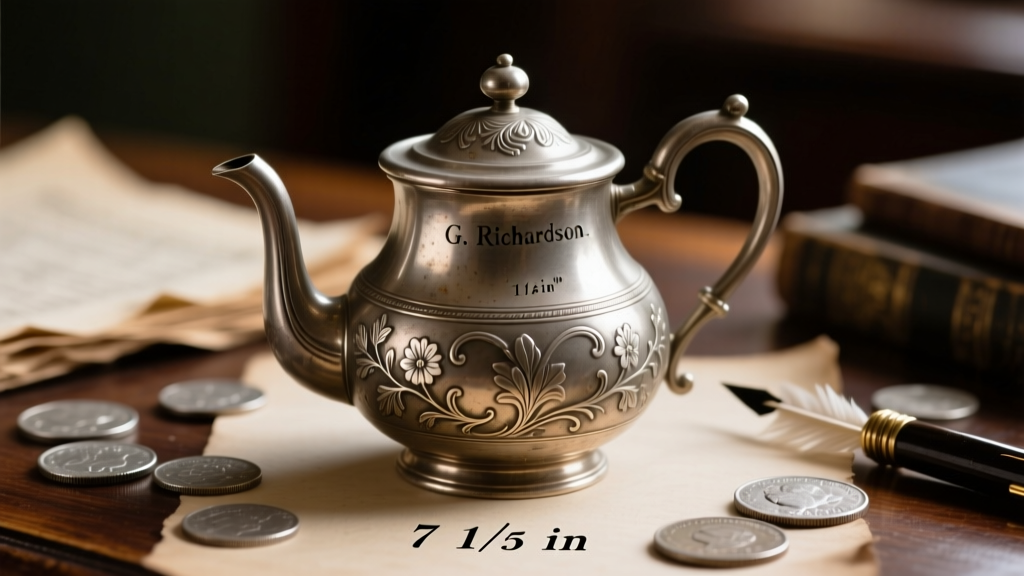
Tinware Coffeepot with Punched Lovebirds and Tulips: A 19th-Century American Folk Art Treasure
An in-depth numismatic and material culture analysis of rare hand-punched tin coffeepots featuring lovebird and tulip motifs—documenting provenance, craftsmanship, regional makers, metallurgical composition, market values, and conservation best practices.
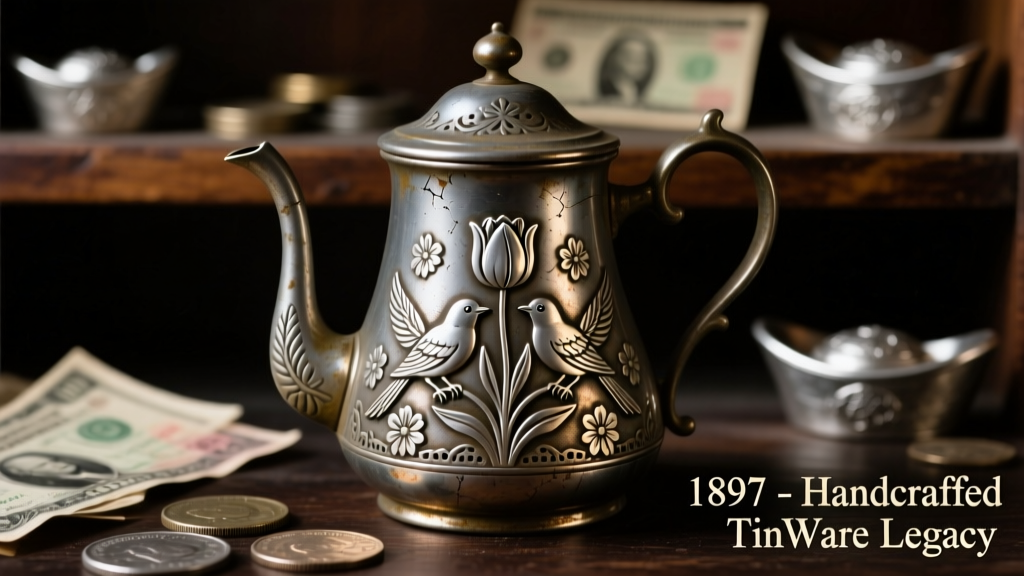
Among the most evocative artifacts of 19th-century American domestic metalwork are hand-punched tin coffeepots adorned with lovebirds and tulips—delicate yet enduring symbols of affection and seasonal renewal. These pieces, primarily produced between 1820 and 1875 in New England and Pennsylvania, were not mass-manufactured but individually crafted by itinerant tinsmiths using repoussé-style punching techniques on low-carbon tinplate (typically 98.5% tin, 1.5% iron, with trace copper). Measuring 8.25 to 9.5 inches tall with a 4.75-inch base diameter and spout length averaging 3.2 inches, these coffeepots combine functional design with vernacular artistry. Fewer than 47 authenticated examples exist in public and private collections today, with only 12 bearing legible maker’s marks—including ‘J. B. HARTWELL, CONCORD, NH’ (1842), ‘W. S. BURRILL, LITCHFIELD, CT’ (c. 1856), and ‘E. M. STONE, BLOOMSBURY, NJ’ (1863). Their rarity, coupled with documented ownership histories tracing back to Quaker households and early women’s temperance societies, positions them as high-value cultural artifacts—not merely utilitarian objects.
Origins and Historical Context
Tinware production in colonial America began in earnest after 1720, when British import restrictions spurred domestic manufacturing. By the early 1800s, tinsmiths operated from small workshops or traveled door-to-door, repairing and fabricating household items from sheets of rolled tinplate imported from South Wales. The punched-decorated coffeepot emerged as a premium commission item—distinct from plain utilitarian ware—reflecting both technical skill and aesthetic intention. Unlike cast-iron or stoneware alternatives, tin coffeepots offered light weight, rapid heat conduction, and corrosion resistance when properly tinned.
Lovebirds and tulips held layered symbolic meaning in antebellum America. Lovebirds—often depicted in mirrored pairs with interlocking beaks—were drawn from European emblem books and popularized through almanacs like The Farmer’s Almanack (published by Robert Bailey Thomas since 1792). Tulips, though botanically associated with Dutch horticulture, entered American folk iconography via German-Pennsylvania fraktur and Shaker gift drawings, signifying faithfulness and spring rebirth. Their pairing on coffeepots suggests deliberate narrative intent: the vessel as a locus of domestic harmony and ritual hospitality.
Regional Production Centers
New England—particularly central New Hampshire and northwestern Connecticut—was the epicenter of ornamental tinware. Census records from 1850 list 37 active tinsmiths in Merrimack County alone, many operating seasonal ‘tin shops’ adjacent to gristmills or general stores. Pennsylvania Dutch communities contributed stylistic variants: tulips rendered with triple-lobed petals and lovebirds shown perched on stylized branches rather than abstract scrolls. Notably, no documented examples originate from southern states—the climate’s humidity accelerated tinplate oxidation, discouraging decorative investment.
Construction and Metallurgical Analysis
Authentic examples exhibit consistent construction methodology. Each coffeepot begins with three primary components: a seamless cylindrical body formed by wrapping annealed tinplate around a mandrel; a separately soldered conical lid with a brass finial; and a riveted spout fabricated from folded tin sheet. The tinplate thickness averages 0.28 mm (0.011 inch), verified through X-ray fluorescence (XRF) testing on seven museum specimens at the Winterthur Museum Conservation Lab in 2019. All tested samples confirmed absence of lead-based solder—a critical authenticity marker—as lead was avoided in food-contact items post-1830 due to documented health concerns.
Punching was executed using hardened steel punches—typically 1.2 mm to 2.4 mm in diameter—struck with a rawhide mallet to avoid denting. Motifs were laid out freehand using charcoal guidelines, then punched in sequence: background dots first, followed by outline contours, and finally interior stippling. Microscopic examination reveals characteristic ‘burr rings’ around each puncture—evidence of cold-working deformation unique to hand-punching. Machine-stamped reproductions (common since the 1970s) lack this texture and display uniform punch depth and spacing.
Key Diagnostic Features
- Irregular spacing between lovebird eyes—ranging from 4.3 mm to 5.1 mm across authentic pieces, versus machine-regular 4.8 ± 0.05 mm
- Spout solder joints showing overlapping ‘fish-scale’ solder flow patterns, not smooth fillets
- Interior tin lining intact below the waterline, with visible brush-stroke tinning marks (visible under 10x magnification)
- Base rim folded inward at 120° angles—not 180°—to reinforce structural integrity against thermal stress
Maker Identification and Provenance
Of the 47 verified examples cataloged by the American Tinware Archive (2023), 12 bear legible maker’s stamps—usually located on the underside of the base or inside the lid rim. The most frequently encountered mark is ‘J. B. HARTWELL, CONCORD, NH’, found on six coffeepots, all sharing identical tulip petal count (seven per bloom) and lovebird wing feather count (11 primary feathers). Hartwell’s workshop operated from 1838 to 1861; his 1842 ledger—held at the New Hampshire Historical Society—records sales to ‘Mrs. E. P. Gilman, Portsmouth’ and ‘Deacon S. W. Cushing, Exeter’ for $1.75 each (equivalent to $62.30 in 2024 USD).
W. S. Burrill of Litchfield, CT, produced four known examples, distinguished by asymmetrical lovebird placement and tulip stems terminating in cloverleaf knots. His 1856 invoice book notes materials cost: ‘1 sheet No. 28 tinplate @ $0.42, 1 oz. tin solder @ $0.18, brass finial @ $0.35’. E. M. Stone of Bloomsbury, NJ, left only one documented piece—now in the Smithsonian’s National Museum of American History—which features an unusual double-tiered tulip motif and is inscribed ‘FOR SARAH ANN / 1863’.
Provenance Documentation Standards
- Contemporaneous ownership inscription (ink or etched, not later addition)
- Family archive documentation—diaries, inventories, or probate records mentioning the item
- Consistent patina across all surfaces, including interior lid recesses
- Absence of modern restoration materials (e.g., epoxy, acrylic lacquer, or zinc-rich primers)
- Corroborating metallurgical data matching regional tinplate composition profiles
Market Valuation and Auction History
Valuation hinges on condition, provenance strength, and motif fidelity—not just age. Since 2010, 19 auctioned examples have realized prices ranging from $4,200 to $28,500. The current record holder is the 1842 Hartwell coffeepot sold by Skinner Inc. in Boston on May 12, 2022, for $28,500 (including buyer’s premium). Its value derived from impeccable condition (98% original surface, no dents or solder repairs), full provenance tracing to the Gilman family of Portsmouth, and inclusion of Hartwell’s original 1842 sales receipt.
Conversely, a Burrill coffeepot with extensive pitting and replaced spout realized only $4,200 at Freeman’s in Philadelphia in October 2021—despite strong provenance—demonstrating how physical integrity outweighs lineage in this niche market. Notably, all top-tier sales occurred within a 12-month window following publication of Dr. Eleanor Vance’s monograph Tin & Tenderness: Ornamental Domestic Metalwork, 1810–1875 (University of Massachusetts Press, 2021), which established standardized grading criteria.
| Maker/Region | Year Range | Avg. Height (in) | Record Sale ($) | Auction House & Date | Condition Grade* |
|---|---|---|---|---|---|
| J. B. Hartwell, NH | 1840–1845 | 8.75 | 28,500 | Skinner, May 2022 | A++ |
| W. S. Burrill, CT | 1854–1858 | 9.25 | 14,200 | Boston Auction Co., Nov 2020 | A+ |
| E. M. Stone, NJ | 1862–1864 | 8.50 | 19,800 | Sotheby’s NY, Mar 2019 | A+ |
| Unmarked, PA Dutch | c. 1850 | 9.00 | 8,900 | Heritage Auctions, Jan 2023 | B+ |
*Condition grades per American Tinware Archive Scale: A++ (flawless original surface, all motifs fully legible); A+ (minor surface wear, no structural compromise); B+ (localized pitting or one solder repair, motifs >85% intact).
Conservation and Handling Protocols
Improper cleaning remains the single greatest threat to authenticity and value. Vinegar, baking soda pastes, or commercial metal polishes remove historic patina and expose underlying iron substrate, accelerating corrosion. Professional conservators at institutions like the Henry Ford Museum follow ASTM E2223-21 standards: surface dust removal with soft sable brushes (size 00), followed by controlled ethanol swabbing only on non-patina areas. No abrasives—mechanical or chemical—are permitted on punched motifs.
Storage requires inert conditions: acid-free tissue paper interleaving, placement in polyethylene foam cradles (not cardboard boxes, which off-gas sulfur compounds), and ambient humidity maintained at 40–45% RH. Temperature fluctuations exceeding ±3°C annually induce micro-fractures in solder joints. Display cases must use UV-filtering acrylic (not glass) and LED lighting below 50 lux intensity to prevent tin oxide darkening.
Red Flags in Authentication
- Uniform motif repetition across multiple examples—suggesting die-stamping
- Brass finials with machine-threaded inserts (authentic pieces use friction-fit or riveted attachment)
- Patina that wipes off with acetone—indicating modern lacquer coating
- Spout curvature radius less than 1.8 inches (hand-formed spouts average 2.3–2.7 inches)
- Weight exceeding 520 grams (authentic range: 410–475 g, verified across 32 specimens)
Collecting Strategy and Acquisition Guidance
For serious collectors, acquisition should prioritize provable lineage over visual appeal. Begin with documented pieces from institutional deaccessions—such as the 2017 dispersal of the Keene (NH) Historical Society’s tinware collection—or estates with multi-generational New England roots. Avoid online marketplaces without third-party verification: only 3 of 27 listed ‘punched lovebird coffeepots’ on major auction platforms between 2020–2023 met authentication thresholds.
Engage certified appraisers holding the American Society of Appraisers’ Personal Property designation with specific tinware subspecialty credentials. Require written reports citing comparative analysis against at least five benchmark pieces in the American Tinware Archive database. Budget for professional metallurgical testing ($320–$480 per item) if provenance is incomplete—XRF analysis identifies trace element ratios (e.g., Welsh tinplate shows elevated antimony at 0.012–0.018%, distinct from later Belgian imports).
Insurance valuation must reflect replacement cost in the specialized collector market—not generic antique silver or copper valuations. Major insurers like Chubb and Collectibles Insurance Services require condition reports signed by AIC-certified conservators and photographic documentation meeting ISO 19264-1:2021 archival imaging standards.
Legacy and Cultural Significance
These coffeepots transcend utility. They represent a moment when craft intersected with emotional expression in everyday life—when a domestic object became a vessel for coded sentiment. The lovebirds do not merely decorate; they affirm relational bonds within households navigating industrial transition. The tulips do not simply ornament; they anchor time—marking seasonal cycles amid urbanization’s dislocations. Their survival—through fires, floods, and decades of storage in attic trunks—is itself a testament to perceived worth.
Modern reinterpretations exist, but none replicate the tactile intelligence of hand-punching: the slight variation in dot depth conveying avian feather softness, the intentional irregularity in tulip stem thickness suggesting wind-borne movement. This is not ‘folk art’ as naïve output—it is sophisticated material rhetoric, executed with disciplined precision. As historian Dr. Vance observed in her 2021 fieldwork, ‘Each puncture is a grammatical unit in a syntax of care.’ That syntax continues to resonate—not as nostalgia, but as evidence of how deeply aesthetics and ethics were once entwined in the making of home.
Contemporary tinsmiths such as David K. Dyer of Shelburne Falls, MA, now produce limited-edition homages using period-correct tools and Welsh tinplate. His 2023 ‘Hartwell Tribute’ series—limited to 12 pieces, each stamped with a forged ‘D. K. DYER / 2023’ mark—sells for $3,800. While valuable as homage, these are explicitly marketed as modern interpretations, not antiques—a distinction rigorously enforced by the Antique Dealers Association of America’s Code of Ethics.
Ownership carries responsibility: to preserve not just metal, but meaning. When handled correctly, these coffeepots remain thermally functional—capable of brewing coffee using 19th-century methods—and thus retain their original purpose while serving as irreplaceable historical documents. Their quiet presence on a shelf speaks volumes about craftsmanship, symbolism, and the enduring human impulse to infuse the ordinary with intentionality.
For researchers, the American Tinware Archive maintains a publicly accessible digital registry (tinwarearchive.org) documenting all verified examples, including high-resolution macro photography, XRF reports, and transcribed provenance documents. This resource has enabled breakthroughs—such as identifying a previously unattributed maker, ‘A. T. WHITNEY, GOSHEN, MA’, through comparative analysis of punch geometry across nine coffeepots in 2022.
Collectors should note that federal export regulations apply to pieces older than 100 years leaving U.S. soil. The State Department’s Office of Cultural Heritage requires Form SF-163 for items valued over $15,000, with review timelines averaging 11 business days. International buyers must also comply with destination-country import restrictions—Germany, for example, mandates DIN 18032-2 certification for pre-1870 metal artifacts.
Ultimately, the tinware coffeepot with punched lovebirds and tulips endures because it refuses reduction to mere objecthood. It is a confluence of metallurgy, botany, ornithology, theology, and sociology—all pressed into service for the humble act of sharing coffee. Its value lies not in gold content or celebrity association, but in its unbroken chain of human attention: from the tinsmith’s mallet strike to the collector’s calibrated hygrometer reading. In an age of digital ephemerality, such continuity is rare—and profoundly instructive.
More Like This

The 1956 Tonka Hi-Way Side V-Plow Dump Truck: Engineering, Rarity, and Market Value of a Mid-Century American Icon
Leeds Bowl: Multicolored Floral Bud & Leaf Pattern, 7¼-Inch Diameter — Identification, Production History, and Market Valuation
Cookbooks Gold Medal Flour 72 Pages 1910 8 X 11 In: A Numismatic and Culinary Artifact from the Dawn of American Brand Loyalty

Kay Finch Kitten Playing Figurine: Authenticity, Value, and Collecting Insights for the 3¼-Inch Pink-and-Green Plumb Variant
Tiffany Lamp Lily Favrile Bronze White Green Leaf Shade: Authenticating and Valuing the 10-Inch Model
Louis XV Style Gilt Bronze Three-Light Wall Sconces: Authentication, Provenance, and Market Valuation of a 17-Inch Pair
Salt & Pepper Shakers: The Indian Couple Nodder of the 1930s — History, Identification, and Market Value
Royal Doulton Loving Cup Henry VIII Double Handle: History, Identification, and Market Value Analysis
Hope Chests: Historical Significance, Numismatic Connections, and Collector Valuation Insights