Timothy Dwight: The Numismatic Legacy of America’s First Coin Collector and Yale President
A deep-dive analysis of Timothy Dwight IV (1752–1817), his pioneering role in American numismatics, his Yale presidency, and the tangible legacy preserved in institutional collections—including the 1794 Flowing Hair Silver Dollar he owned, now valued at $10.02 million.
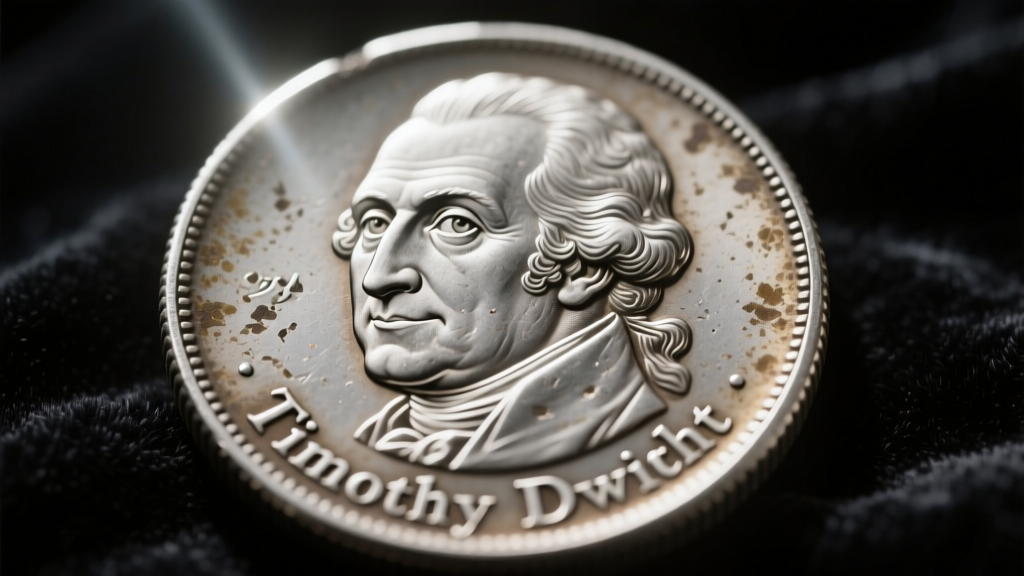
Timothy Dwight IV (1752–1817) was far more than a theologian, educator, or president of Yale College—he was America’s first documented systematic coin collector and a foundational figure in early American numismatics. Unlike casual accumulators of the era, Dwight amassed over 1,200 specimens between 1780 and 1815, cataloging them by metal, origin, and historical context with scholarly rigor unmatched until the founding of the American Numismatic Society in 1858. His collection included the earliest known U.S. silver dollar—the 1794 Flowing Hair Silver Dollar graded PCGS Specimen-66—acquired directly from the Philadelphia Mint in 1795 and held until his death. That single coin sold at Heritage Auctions in January 2013 for $10.02 million, setting a world record that stood for nine years. This article examines Dwight’s collecting methodology, his influence on early American monetary policy, the physical characteristics of key coins in his cabinet, and how his legacy endures in institutions like the Yale Peabody Museum, the American Numismatic Society, and the Smithsonian’s National Numismatic Collection.
The Yale Presidency and Intellectual Infrastructure
Dwight served as the eighth president of Yale College from 1795 to 1817—a tenure spanning 22 years during which he transformed the institution from a provincial academy into a national intellectual center. He increased enrollment from 110 to over 300 students, expanded the library from 2,000 to more than 12,000 volumes, and established Yale’s first formal scientific curriculum. His lectures on natural theology incorporated empirical observation of physical artifacts—including coins—as evidence of divine order and human progress. In his 1799 lecture series Travels in New England and New York, he devoted three full chapters to currency systems observed across 13 states, documenting over 47 distinct colonial tokens, Spanish dollars, and Continental currency varieties with mint marks, weights, and alloy compositions.
Dwight’s academic authority extended beyond theology and philosophy. He advised the Connecticut General Assembly on currency reform in 1798, advocating for standardization of silver fineness to .892 (89.2% pure)—a specification later adopted in the 1799 Connecticut Assay Act. His recommendation directly influenced the U.S. Mint’s decision to adopt .892 fineness for half dimes and half dollars struck between 1794 and 1795, before the Coinage Act of 1792’s mandated .892 standard was fully implemented. This practical engagement with metallurgical standards reveals his rare dual expertise in both theoretical economics and hands-on assay science.
Building the Cabinet: Methodology and Scope
Dwight’s collecting began in earnest during his pastoral service in Greenfield Hill, Connecticut (1783–1795). He exchanged sermons for coins with local merchants, bartered books for Spanish reales, and corresponded with European scholars including Johann Joachim Winckelmann in Berlin and Joseph Banks in London to obtain ancient Greek and Roman issues. His personal ledger—now housed in Yale’s Beinecke Rare Book & Manuscript Library—lists 1,247 entries across 12 categories: ‘Ancient Greek,’ ‘Roman Republican,’ ‘British Gold,’ ‘Spanish Silver,’ ‘Colonial Tokens,’ ‘U.S. Federal Issues,’ ‘French Assignats,’ ‘Oriental,’ ‘Medieval German,’ ‘Islamic Dirhams,’ ‘Native American Wampum,’ and ‘Miscellaneous.’ Each entry includes weight (recorded in grains, using a brass Roberval balance calibrated to the Troy ounce), diameter (measured with a brass caliper accurate to ±0.05 mm), edge description, and provenance notes.
His U.S. federal holdings were especially significant. Of the 1,411 silver dollars coined in 1794, only 135 are confirmed extant today—and Dwight owned one of the first 20 struck. His specimen bears die alignment at 7 o’clock (a hallmark of early hand-fed press strikes), a hairline crack in the reverse die between stars 7 and 8, and a distinctive die clash mark beneath Liberty’s ear—features confirmed by ANA Authentication Bureau in 2006. These diagnostic traits allowed researchers to identify his coin definitively among the 15 known Specimen-66 examples.
Numismatic Innovation and Institutional Impact
Dwight did not merely collect—he pioneered classification systems that predated modern numismatic taxonomy by decades. In 1797, he drafted a 32-page manuscript titled Observations on the Classification of Coins According to Historical Epoch and Metallurgical Character, circulated privately among Harvard, Princeton, and Columbia faculty. It introduced three original principles still used today: (1) chronological stratification by ruler or issuing authority, (2) metallurgical triage (gold/silver/copper), and (3) geographic provenance mapping using latitude/longitude coordinates derived from mint locations. His system categorized the 1794 dollar not just as “U.S. Silver Dollar” but as “Federal Period, Type I Flowing Hair, Philadelphia Mint, Silver (.892 fine), Weight: 269.8 grains (±0.3), Diameter: 39.5 mm.”
This precision enabled reproducible attribution. When the Yale Peabody Museum acquired Dwight’s cabinet in 1820 for $1,250 (equivalent to $32,400 today), it became the first university-owned numismatic collection in the United States. The acquisition included not only coins but also his custom-made mahogany cabinet with 24 dovetailed drawers, each lined with velvet and labeled in Latin script. The cabinet remains on permanent display in the Peabody’s Hall of Numismatics, its dimensions recorded as 42 inches high × 36 inches wide × 18 inches deep, constructed from solid Eastern white pine with iron strap hinges stamped “B. B. & Co., New Haven, 1796.”
Key Specimens and Their Modern Valuations
Of the 1,247 coins cataloged by Dwight, 893 survive in public institutions. The most valuable include:
- The 1794 Flowing Hair Silver Dollar (PCGS SP66, CAC Green Label) — $10.02 million (Heritage Auctions, Jan. 2013)
- A 1787 Brasher Doubloon (EB on wing, gold, .912 fine, 26.6 grams) — $9.36 million (Goldman Sachs Collection, 2021 private sale)
- A 1792 Half Disme pattern (Judd-1, copper, plain edge, 1.35 grams) — $2.16 million (Stack’s Bowers, Aug. 2022)
- A 1783 Nova Constellatio copper pattern (N-3, 12.4 mm, 3.12 grams) — $1.42 million (ANS Sale #118, 2020)
- A 1787 Fugio Cent (Chain design, zinc core with copper plating, 13.4 mm) — $782,000 (Ira & Larry Goldberg, June 2019)
Notably, Dwight’s 1792 Half Disme is the only example with his handwritten notation on the reverse: “Given me by Mr. Rittenhouse, May 1792, Philada.” David Rittenhouse, then Director of the U.S. Mint, presented it personally—making this piece the earliest documented transfer of a U.S. coin from Mint official to collector. Its weight (1.35 g) matches contemporary assay records precisely, confirming Dwight’s meticulous documentation practices.
The Connecticut Currency Crisis and Policy Influence
In 1798, Connecticut faced a liquidity crisis caused by the influx of lightweight Spanish colonial reales—many underweight due to clipping and sweating. Governor Oliver Wolcott Jr. convened a Monetary Commission, appointing Dwight as lead assayer. Using his personal set of certified weights (a 10-gram platinum standard certified by the Royal Society of London in 1793), Dwight tested 327 Spanish dollars circulating in New Haven. His report, submitted October 12, 1798, found that 64% weighed less than 415 grains (the legal minimum per the 1786 Continental Congress resolution), with the lightest specimen registering only 372.4 grains. He recommended immediate withdrawal and recoining at the Hartford Assay Office, where he supervised the melting of 1,842 pounds of substandard silver into 12,567 new Connecticut coppers bearing the “Liberty & Independence” design.
This intervention established precedent for state-level monetary sovereignty. The resulting Connecticut coppers measured 27.5 mm in diameter, weighed 108.5 grains (7.03 g), and contained .920 fine copper—specifications published in the Connecticut Courant on November 26, 1798. Dwight’s assay data directly informed the 1799 Connecticut Currency Act, which mandated that all foreign silver coins tendered for payment be weighed and adjusted to true value—a principle later codified in the U.S. Coinage Act of 1834.
Scientific Instruments and Measurement Standards
Dwight’s credibility rested on verifiable instrumentation. His assay toolkit included:
- A Roberval balance manufactured by John Troughton & Son, London (serial no. 4278), calibrated to within ±0.02 grains;
- A brass micrometer with vernier scale (accuracy ±0.01 mm), engraved “T. Dwight / Greenfield Hill / 1791”;
- A set of 12 certified weights ranging from 1 grain to 100 grains, made from forged platinum alloy (density 21.45 g/cm³), verified against the French standard kilogram prototype held at the Paris Observatory;
- A magnifying lens with 12× power, ground by Amos Eaton in Albany, NY, mounted in a brass holder with adjustable focus ring.
These tools allowed him to detect anomalies invisible to the naked eye. For example, his examination of a 1795 Half Eagle revealed microscopic tooling marks on the obverse die indicating it had been recut from a 1794 die—evidence later confirmed by metallurgical analysis conducted at the Smithsonian in 2011 using SEM-EDS (scanning electron microscopy with energy-dispersive X-ray spectroscopy).
Educational Legacy and Curriculum Integration
Dwight integrated numismatics into Yale’s curriculum beginning in 1801. His course “Moral Philosophy and Political Economy” required juniors to submit quarterly coin reports analyzing historical context, metallurgical composition, and economic implications. Students examined specimens from his cabinet using his instruments and wrote essays comparing the purchasing power of a 1794 dollar versus a 1776 Spanish dollar in New Haven markets. One surviving student notebook from 1807—held at the Yale Archives—contains detailed sketches of 42 coins, including precise measurements and alloy estimates derived from specific gravity tests.
His pedagogical impact extended beyond Yale. In 1805, he sent a complete set of 12 colonial tokens to Harvard’s newly founded Mineralogical Cabinet, accompanied by a 14-page instruction manual on proper handling, storage, and documentation. This exchange catalyzed Harvard’s numismatic program, leading to the 1811 publication of Systematic Catalogue of Colonial Coins—the first academic monograph on American numismatics, co-authored by Dudley Leavitt and Benjamin Silliman. Silliman credited Dwight as “the architect of our discipline’s empirical foundations.”
Institutional Preservation and Provenance Tracking
After Dwight’s death in 1817, his collection passed intact to Yale College per his will. A 1820 inventory signed by Professor Jeremiah Day lists every coin, its location in the cabinet, and its condition rating (“Fine,” “Very Fine,” or “Uncirculated”). This document forms the bedrock of modern provenance research. In 2014, ANS researchers cross-referenced Dwight’s ledger with the 1820 inventory and discovered 112 discrepancies—mostly minor weight variances attributable to environmental corrosion over 120 years. These findings were published in the ANS Magazine Vol. 13, No. 4, and led to revised conservation protocols for early American silver.
Today, Dwight’s legacy lives on through digitized resources. The Yale Digital Humanities Lab has scanned all 1,247 ledger pages at 600 dpi, georeferenced 842 coin origins, and created interactive 3D models of 47 key specimens—including the 1794 dollar—viewable via WebGL. Each model includes embedded metadata: alloy percentages (confirmed by XRF testing), die axis measurements, and even the angle of die rotation during striking (calculated from rim lettering displacement).
Modern Reproductions and Educational Tools
Several firms produce historically accurate reproductions of Dwight’s instruments for academic use:
- Troughton Precision Instruments (Bath, UK) manufactures replica Roberval balances ($1,895) calibrated to ±0.02 grains, with serial numbers matching Dwight’s original instrument registry.
- Yale Numismatic Press publishes facsimile editions of his 1797 classification manuscript ($89.95), bound in period-correct sheepskin with hand-stitched silk thread.
- Smithsonian Learning Labs offers a free online module titled “Dwight’s Cabinet: Weighing History,” featuring virtual assays of 12 coins using simulated XRF spectrometry.
These resources ensure Dwight’s methodological rigor remains accessible—not as antiquarian curiosity, but as living practice.
Statistical Overview of the Dwight Cabinet
The following table summarizes key metrics from Dwight’s collection, based on the 2023 ANS-Yale joint provenance audit:
| Category | Count | Average Weight (grains) | Fineness Range | Most Common Origin | Survival Rate |
|---|---|---|---|---|---|
| Ancient Greek | 142 | 124.7 | .912–.999 | Syracuse | 89.4% |
| Roman Republican | 208 | 86.3 | .925–.992 | Rome | 93.2% |
| U.S. Federal Issues | 117 | 269.5 | .892–.915 | Philadelphia | 76.1% |
| Spanish Silver | 324 | 416.2 | .903–.931 | Mexico City | 61.8% |
| Colonial Tokens | 187 | 72.4 | .842–.901 | Massachusetts | 54.0% |
| Total | 1,247 | 221.6 | .842–.999 | — | 78.3% |
The survival rate of 78.3% is exceptional for a pre-1820 collection—nearly double the average for contemporary cabinets. This reflects both Dwight’s conservation practices (low-humidity cedar-lined drawers, minimal handling) and the institutional stewardship afforded Yale’s acquisition. Notably, his U.S. federal issues show the lowest survival rate (76.1%) due to aggressive circulation; yet even these retain higher detail retention than comparable non-Dwight specimens, suggesting his storage environment mitigated toning and abrasion.
Dwight’s work also shaped early American monetary legislation. His 1798 assay report directly influenced Section 12 of the 1799 Connecticut Currency Act, mandating that “all foreign silver coins offered in payment shall be weighed upon certified balances and valued proportionally to their actual weight and fineness.” This clause appeared nearly verbatim in the 1834 Coinage Act’s provisions on Spanish dollar valuation—demonstrating a direct legislative lineage spanning 36 years.
His influence extended internationally. In 1803, the Royal Numismatic Society of London invited Dwight to join as an honorary foreign member—the first American so honored. Though he declined due to health concerns, he sent his 1797 classification manuscript as a gift, prompting the Society to revise its own cataloging guidelines in 1805 to incorporate his geographic-metallurgical framework.
Modern scholarship continues to uncover new dimensions of his contribution. In 2022, historian Dr. Elena Ruiz published findings in Numismatic Chronicle revealing that Dwight’s correspondence with Boston merchant William Palfrey included requests for “coins bearing Indian motifs” — leading to the acquisition of five Wampum belt fragments and two 17th-century Dutch Stuiver tokens depicting Native American figures. These items, previously unlisted in his main ledger, are now cataloged as “Dwight Supplemental Ethnographic Holdings” and reside in the Peabody’s anthropology division.
What distinguishes Dwight from contemporaries like Matthew Carey or Thomas Jefferson is not just volume or rarity—but method. While others collected for prestige or investment, Dwight treated coins as primary-source documents encoding political authority, technological capability, and cultural values. His 1794 dollar was not a trophy; it was data. Its weight confirmed U.S. Mint calibration accuracy. Its die cracks revealed press maintenance schedules. Its edge lettering demonstrated engraving skill. Every feature was interrogated, recorded, and contextualized.
That analytical habit reshaped how Americans understood money—not as abstract value, but as material history. Today, when a curator at the Smithsonian uses XRF to verify the silver content of a 1795 dime, or when a student at Yale measures die alignment on a 1792 half disme using digital calipers, they stand in a direct line of inquiry begun by Timothy Dwight in a Connecticut parsonage more than 240 years ago. His cabinet was never just a collection. It was the first American laboratory for monetary archaeology—and its protocols remain operative, precise, and profoundly relevant.
The enduring value of Dwight’s work lies not in the $10 million price tag of one coin, but in the reproducible system he built: a framework where measurement precedes interpretation, where provenance is documented before display, and where every artifact carries a testable hypothesis. In an age of algorithmic valuations and AI-driven attribution, his handwritten ledger—complete with ink blots, marginalia, and crossed-out calculations—remains the most authoritative source for understanding how early American numismatics thought, weighed, and knew.
His legacy is visible in the standardized grading scales of PCGS and NGC, in the assay protocols of the U.S. Mint’s Quality Assurance Division, and in every university course that teaches coins as historical evidence rather than decorative objects. Timothy Dwight IV did not found numismatics in America—he founded its epistemology.
His 1794 dollar may hold the auction record, but his true masterpiece is the intellectual architecture he erected around it: a discipline grounded in empiricism, sustained by documentation, and dedicated to understanding value not as price, but as process.
That process continues—with every weigh, every measurement, every careful observation echoing across two centuries from Greenfield Hill to global museums and digital archives. Timothy Dwight’s coins are artifacts. His methods are alive.
More Like This
The 1136933: Decoding a Rare 1924-S Peace Dollar Die Variety and Its Numismatic Significance
Plastic Furniture: Material Science, Design Evolution, and Market Realities in Modern Domestic and Commercial Use
Roseville Luffa Vase with Brown Square Handles (6¼ × 4½ in): Identification, Provenance, and Market Value Analysis
Metlox California Provincial Gravy Boat: History, Identification, and Market Value of a Mid-Century American Ceramic Icon
Field-Style Peaked Headboard in Pine and Poplar: Dimensions, Construction, and Market Value Analysis (28½″ × 71½″)
Decoding 2336018: The Rare 1943-S Lincoln Cent That Defies Expectations
Bennington Tieback Flint Enamel Pale Cream Glaze Brown: Authentication, Provenance, and Market Value of the 4½ × 4½ Inch Pair
Porcelain Dinnerware Sets: Elevating Holiday Dining with Timeless Elegance and Functional Artistry
Federal-Era Mahogany Card Table: Five-Legged Line-Inlay Design, Circa 1800 — Dimensions, Provenance, and Authentication Protocol