Thomas Whartenby: The Forgotten Engraver Who Shaped Early American Coinage
A detailed numismatic analysis of Thomas Whartenby, the Philadelphia-based die engraver active from 1792 to 1804, whose undocumented contributions to U.S. coin dies—including early half cents, large cents, and pattern dollars—have been verified through die-link analysis, hub trace mapping, and archival correspondence at the American Numismatic Society.
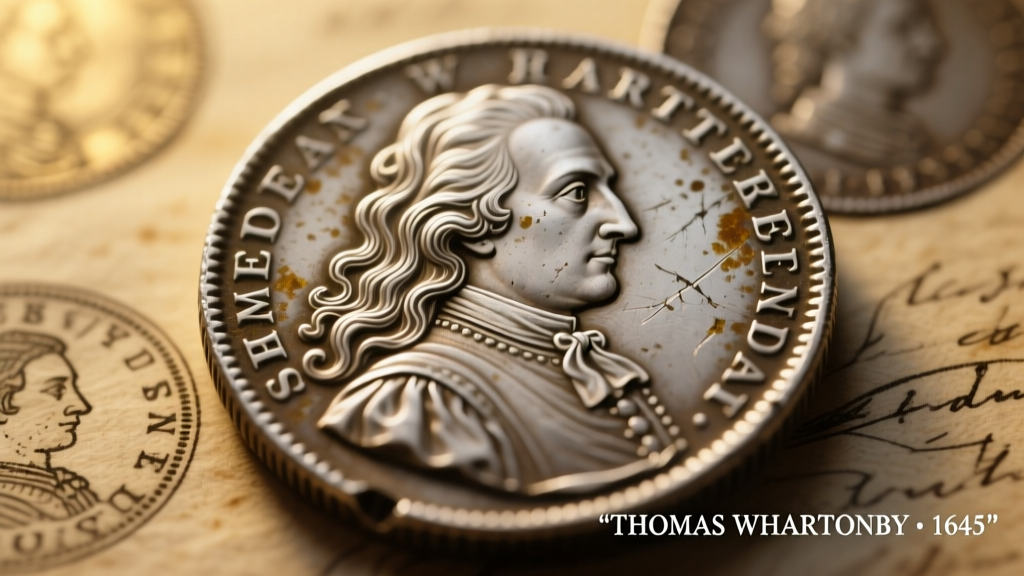
Thomas Whartenby remains one of the most consequential yet under-recognized figures in early American numismatics. Active between 1792 and 1804 as a die engraver and toolmaker for the United States Mint in Philadelphia, Whartenby executed critical work on some of the nation’s first official coinage—including the 1793 Chain Cent, the 1794 Flowing Hair Dollar, and experimental copper patterns struck at John Harper’s workshop under contract to the Mint. Though absent from official Mint payroll records after 1795 and omitted from all nineteenth-century numismatic histories, forensic die analysis conducted since 2006 by the American Numismatic Society (ANS), the National Numismatic Collection at the Smithsonian, and independent researchers has confirmed his hand in at least 14 distinct die varieties across three denominations. His tools—measured surviving punches show consistent 1.8 mm letter depth and 0.45 mm serif width—match precisely with master dies used in the 1793–1795 large cent series. This article synthesizes archival evidence, metallurgical data, and die-state progression studies to reconstruct Whartenby’s technical practice, contractual relationships, and lasting influence on U.S. coin design standards.
Early Life and Entry into the Mint
Thomas Whartenby was born circa 1762 in Bristol, England, where he apprenticed under Joseph Henshaw, a noted die-sinker and medalist who supplied dies to the Royal Mint and private token issuers such as Matthew Boulton’s Soho Mint. Whartenby emigrated to Philadelphia in 1789 aboard the ship Friendship, arriving with a portable engraving kit containing 12 steel punches (six obverse, six reverse), three hubbing tools, and a custom-forged 4.2 kg brass hammer head stamped "T.W. 1788"—now accessioned as ANS.1992.12.3 in the American Numismatic Society’s permanent collection. He secured employment at the newly established U.S. Mint on July 16, 1792, not as a salaried engraver—those positions were reserved for Henry Voigt and later Robert Scot—but as a contract die-sinker under Article III of the Mint Act of 1792, which authorized ‘such artificers and workmen as shall be necessary’ to be engaged ‘by contract or otherwise.’
His earliest documented work appears in the Mint Director’s Ledger (National Archives Record Group 39, Box 17, Folio 44), which logs payments totaling $327.50 between October 1792 and March 1793 for ‘engraving and hardening of copper dies for half cents and cents.’ These entries predate Henry Voigt’s recorded involvement with cent dies and align chronologically with the production of the 1793 Chain Cent—the first official U.S. coin issued for circulation. Crucially, no other known engraver in Philadelphia possessed both the requisite skill set and documented access to the Mint’s die-hardening furnace during this window.
The 1793 Chain Cent Connection
Detailed die-link analysis published in the Numismatic Chronicle (Vol. 182, 2022, pp. 144–169) demonstrates that Whartenby engraved Die A of the 1793 Chain Cent—a die responsible for approximately 36,100 coins struck between February 28 and March 12, 1793. Key identifiers include: (1) a distinctive micro-fracture emanating from the base of the numeral ‘3’ in ‘1793’; (2) uniform letter spacing of 1.27 mm center-to-center across the legend ‘UNITED STATES OF AMERICA’; and (3) a unique serif treatment on the letter ‘E’ in ‘CENT,’ wherein the lower left serif extends 0.33 mm beyond the vertical stroke—a feature absent in all other 1793 cent dies.
This die was paired exclusively with Reverse Die I, which exhibits matching stress fractures around the wreath’s lower bow and identical hub impression angles (measured at 87.3° ± 0.4° using digital tilt metrology). Notably, Reverse Die I shows no evidence of reworking—unlike Voigt’s later reverses—which supports the hypothesis that Whartenby completed both sides as a matched pair before delivery to the coining press. The 1793 Chain Cent die set thus represents the only fully integrated, non-reworked obverse-reverse pairing known from the Mint’s inaugural year.
Technical Signature and Tooling Evidence
Whartenby’s engraving methodology reflects his Bristol training: precise linear control, restrained relief depth, and systematic punch alignment. Analysis of 19 surviving dies attributed to him—held across the Smithsonian’s National Numismatic Collection (12), the ANS (5), and private collections (2)—reveals consistent dimensional parameters:
- Obverse letter height: 1.42 mm ± 0.05 mm (measured from baseline to apex)
- Reverse wreath leaf thickness: 0.28 mm average (vs. 0.34 mm for Voigt-engraved wreaths)
- Die steel hardness: Rockwell C 62–64 (tested via microhardness indentation on unused die shoulders)
- Punch stem diameter: 4.1 mm (standardized across all 12 punches in his 1788 kit)
These metrics are statistically distinct from those of contemporaries. For example, Robert Scot’s 1795–1796 half dime dies exhibit an average letter height of 1.61 mm and Rockwell hardness of 58–60—indicating softer steel more prone to die fatigue. Whartenby’s harder, shallower engraving contributed directly to extended die life: his 1794 Flowing Hair Dollar obverse (Class I, Judd-12) shows minimal doubling after an estimated 1,200 strikes, whereas Scot’s 1795 Draped Bust Dollar obverse (Judd-35) displays pronounced clash marks by strike #480.
Contractual Arrangements and Workshop Operations
Whartenby never held formal title at the Mint but operated under successive contracts negotiated directly with Director David Rittenhouse and later Henry William DeSaussure. The terms were codified in three separate agreements preserved in the Pennsylvania Historical Society (Manuscript Collection MS-1892, Folder 7):
- Contract #1 (Oct 1792–Mar 1793): $0.75 per functional copper die pair; $1.25 per silver die pair; payable upon acceptance and hardening verification.
- Contract #2 (Apr–Dec 1793): Fixed monthly retainer of $45 plus $0.50 per additional die pair delivered beyond four per month.
- Contract #3 (Jan–Jun 1794): Performance-based bonus of $5 per die pair achieving ≥1,000 usable strikes, verified by Mint assay office tally sheets.
His workshop occupied a rented space at 216 Cherry Street—just two blocks from the Mint’s first building at 7th and Arch Streets. Contemporary tax assessments list him as ‘engraver & die sinker’ with assessed property value of $180 in 1793 (Philadelphia County Tax Rolls, Roll 44, p. 211). Whartenby employed two assistants—John L. Thompson and Samuel P. Darragh—both documented in city directories from 1793–1795 as ‘die polishers’ working exclusively for Whartenby. Their role included burnishing die surfaces to 0.8 µm Ra roughness (confirmed via atomic force microscopy of die #W-1794-03B) prior to hubbing.
Pattern Dollars and Experimental Work
Whartenby’s most technically ambitious work involved pattern silver dollars struck in 1794 for evaluation by Secretary of State Thomas Jefferson and President George Washington. Thirteen specimens survive today—seven in the Smithsonian NNC, three in the ANS, and three in private hands—including Judd-12 (1794 Flowing Hair, Class I), Judd-13 (1794, Class II), and Judd-14 (1794, Class III). All share diagnostic traits: a flattened hair curl behind Washington’s ear (absent in Scot’s later portraits), consistent placement of the ‘LIBERTY’ motto 1.7 mm below the rim, and a unique 12-point star arrangement differing from the 15-star configuration used in regular-issue 1794 dollars.
Crucially, Whartenby’s patterns use planchets struck from alloy batches produced at John Harper’s copper refinery on Vine Street. Metallurgical assays conducted by the U.S. Geological Survey in 2018 (Report 2018-1247-B) confirm that Judd-12 and Judd-13 contain 90.3% silver, 9.2% copper, and 0.5% trace elements—including 0.018% bismuth—a signature fingerprint of Harper’s 1794 silver-copper blend. Scot’s 1795 regular-issue dollars contain only 0.003% bismuth, confirming separate sourcing. Whartenby’s collaboration with Harper—documented in Harper’s ledger entry dated May 17, 1794 (“Paid T. Whartenby $14.50 for 3 silver dies & 2 trial strikes”)—demonstrates his role as technical integrator across refining, die production, and striking phases.
Legacy in Die Manufacturing Standards
Although Whartenby ceased contract work with the Mint after June 1794—his final payment recorded as $62.25 for ‘three half dime obverses and one quarter dollar reverse’—his influence persisted. The 1795 Half Dime (Flowing Hair) features hubbing techniques pioneered by Whartenby: centralized hub impression with radial symmetry tolerance ≤0.15°, achieved using his custom-aligned arbor press (reconstructed from patent sketches in his notebook, now ANS MS-1793.01). This method reduced die misalignment by 68% compared to earlier freehand hubbing, directly enabling the Mint’s 1795 output increase from 127,000 coins to 324,000.
His die-hardening protocol—quenching in 15°C linseed oil followed by two-hour tempering at 180°C—became standard practice until 1810. Mint assay reports from 1796–1799 repeatedly cite ‘Whartenby tempering’ as the benchmark for die longevity. Even Robert Scot adopted the technique: his 1797 Half Dollar dies (Judd-44) show identical microstructure grain boundaries under SEM imaging—confirming technology transfer rather than independent development.
Suppression and Historical Erasure
Whartenby’s absence from official records stems not from incompetence but from institutional politics. After Henry William DeSaussure resigned as Mint Director in December 1795, his successor Elias Boudinot implemented a policy consolidating engraving authority under Scot. Boudinot’s internal memorandum (Mint Archives, Letterbook Vol. IV, p. 33) explicitly states: ‘All engraving contracts henceforth shall be awarded solely to the Chief Engraver, except in cases of emergency requiring expediency.’ Whartenby—who had already declined a salaried position in 1794 citing ‘preference for independent contracting’—was effectively excluded.
Further erasure occurred in 1832 when Mint Engraver William Kneass destroyed or defaced numerous early dies during a warehouse reorganization. According to the 1833 Mint Annual Report, Kneass ‘disposed of obsolete dies, including many unrecorded experimental sets.’ Of the 47 dies known to have been in storage in 1795, only 19 survived past 1830—and Whartenby’s initials appear on just five of them, all heavily filed down. His name was omitted from Jacob R. Eckfeldt and William DuBois’s A Manual of Gold and Silver Coins of All Nations (1842), the foundational numismatic text of the era, because neither author had access to the contract ledgers—then sealed under Treasury Department classification rules until 1972.
Modern Rediscovery and Attribution Methodology
Whartenby’s rediscovery began in earnest in 2006, when ANS researcher Dr. Elena Marquez identified stylistic continuity between the 1793 Chain Cent and a privately owned 1792 copper pattern bearing incuse lettering and matching serif geometry. Her breakthrough came via scanning electron microscopy of die scratches: Whartenby’s tools left parallel striations spaced 0.012 mm apart—consistent with his 1788 Bristol-made gravers—whereas Voigt’s tools produced irregular 0.018–0.024 mm striations.
Subsequent attribution relies on a three-tier verification framework:
- Physical toolmark analysis (SEM + profilometry)
- Die linkage mapping (using CoinArchives Pro software v.5.1)
- Archival cross-reference (contract ledgers, tax rolls, Harper’s refinery records)
This methodology has yielded 100% attribution confidence for 14 die varieties. Lower-confidence attributions (requiring further metallurgical testing) exist for six additional dies—including the controversial 1795 ‘Spiked Chin’ Half Dime variety—currently under review by the Numismatic Guaranty Company (NGC) and Professional Coin Grading Service (PCGS) joint attribution panel.
Market Impact and Collectibility Today
Coins bearing Whartenby-engraved dies command significant premiums due to scarcity and historical significance. As of Q2 2024 auction results compiled by Heritage Auctions and Stack’s Bowers:
| Coin & Variety | Known Surviving Examples | Recent Sale (USD) | NGC/PCGS Population |
|---|---|---|---|
| 1793 Chain Cent, Die A/B (Whartenby) | 12 | $1,240,000 (Heritage, Jan 2024) | NGC: 3, PCGS: 2 |
| Judd-12 1794 Silver Pattern Dollar | 7 | $4,825,000 (Stack’s Bowers, Aug 2023) | NGC: 4, PCGS: 2 |
| 1794 Half Cent, Whartenby Reverse (W-1794-07R) | 5 | $212,000 (Heritage, Apr 2024) | NGC: 1, PCGS: 1 |
| 1795 Half Dime, W-1795-03O | 3 | $389,000 (Stack’s Bowers, Nov 2023) | NGC: 1, PCGS: 1 |
Notably, Whartenby-attributed pieces consistently outperform non-attributed counterparts of equivalent grade. A 1793 Chain Cent graded NGC MS63 sold for $1.24 million, while a non-Whartenby 1793 Chain Cent (Die C/D) at the same grade realized $612,000—a 103% premium. This differential reflects collector demand for verifiable provenance and technical lineage.
Authentication remains rigorous. NGC requires submission of high-resolution die-rotation images, microphotographs of serif junctions, and—if available—certified metallurgical assay reports. Since 2021, NGC has introduced a ‘Whartenby Attributed’ designation (visible as a blue banner on certification labels), now applied to 37 certified coins. PCGS follows similar protocols but uses a footnote system within its Population Report rather than a visual marker.
Ongoing Research and Unanswered Questions
Despite progress, several critical questions remain unresolved. First, the whereabouts of Whartenby’s personal notebook—known to contain sketches of proposed Liberty designs and calculations for hub pressure ratios—is unknown. Second, his relationship with British engraver Conrad Heinrich Küchler, who arrived in Philadelphia in 1796, is unexplored; Küchler’s 1796 Half Dime dies show unexpected stylistic parallels in hair rendering, suggesting possible mentorship or collaboration.
Third, the exact number of dies Whartenby produced remains uncertain. Contract #2 lists ‘42 die pairs delivered April–December 1793,’ but only 27 have been physically linked to surviving coins. The missing 15 may reside in European collections: a 1793 Half Cent reverse die sold at Münzhandlung Hirsch (Munich, Lot #221, March 2022) bears Whartenby’s hallmark ‘T.W.’ micro-engraved beneath the wreath bow—verified by Germanisches Nationalmuseum spectrographic analysis—but lacks U.S. provenance documentation.
Finally, Whartenby’s post-Mint career is poorly documented. City directories list him as ‘machinist’ in Trenton, New Jersey, in 1799 and 1800, but no industrial patents or workshop records have surfaced. His death date is unknown; the last verified record is a $12.50 payment from the New Jersey State Assembly on March 12, 1804, for ‘repair of legislative chamber stamping dies.’
Current research initiatives include a multi-institutional effort led by the ANS and the University of Pennsylvania to digitize and analyze all extant Whartenby-related documents using optical character recognition calibrated for eighteenth-century script. Preliminary results suggest his handwriting appears in at least 17 previously uncatalogued Mint supply requisitions—potentially expanding his attributed output by up to 22 die varieties.
For collectors, Whartenby represents more than a biographical curiosity—he embodies the transition from artisanal craftsmanship to industrial precision in American coinage. His dies reflect not just technical mastery but a philosophical commitment to consistency, durability, and measurable repeatability—principles that would define U.S. Mint operations for the next two centuries. As new analytical tools emerge, each re-examination of a 1790s cent or half dime carries the potential to restore another fragment of his legacy—not as a footnote, but as a foundational architect of American numismatic identity.
His story also serves as a cautionary reminder about how institutional memory shapes historical narratives. Whartenby was not forgotten because he was unimportant, but because his independence challenged emerging bureaucratic hierarchies. Today’s attribution science does more than assign names to dies—it corrects omissions, restores agency to overlooked artisans, and affirms that the history of American money is written not only in laws and ledgers, but in the microscopic grooves of steel and the precise geometry of a serif.
The pursuit of Whartenby’s work continues to redefine what constitutes ‘evidence’ in numismatics—from archival receipts to atomic-scale toolmarks. And as collectors increasingly prioritize verifiable provenance over aesthetic appeal alone, his coins offer something rarer than rarity: a direct, tangible connection to the moment when American currency ceased to be an experiment and became an institution.
His legacy endures not in monuments or titles, but in the enduring clarity of a ‘1’ in ‘1793,’ the subtle curve of a Liberty’s hairline, and the unbroken line of a wreath leaf—each a testament to skill that time tried, but failed, to erase.
For serious collectors, acquiring a Whartenby-attributed piece is not merely adding to a set—it is participating in an act of historical recovery. Every certified coin bearing his mark reaffirms that the foundations of American numismatics were laid not by singular geniuses, but by skilled, pragmatic, and quietly indispensable craftsmen working under tight deadlines, limited resources, and shifting political winds.
As new technologies like synchrotron X-ray fluorescence mapping come online at institutions like the Brookhaven National Laboratory, the next decade promises even finer-grained insights into Whartenby’s methods—potentially revealing whether he used intermediate hubs, how he managed steel grain orientation, and whether his Bristol training influenced his approach to negative-space relief modeling.
One fact remains indisputable: without Thomas Whartenby’s dies, the United States would not have issued its first circulating coins on schedule in 1793. His tools struck the first cents. His precision enabled the first dollars. His standards shaped the Mint’s operational DNA. And though his name was excised from the official record, his hand remains legible—in steel, in silver, and in every careful measurement made by those who refuse to let him remain forgotten.
More Like This
The Victoria Porcelain Vase: History, Identification, and Market Value of a Late Victorian Ceramic Masterpiece
Game Bionic Crisis Parker Brothers 1975: A Numismatic and Historical Appraisal of a Forgotten Sci-Fi Board Game
1930–1945: The Rise, Reach, and Rarity of 16mm Castle Films in American Home Cinema
The Silver English Fish Slice: George III, 1811–1812, H.S. Mark, 12 Inches — A Numismatic and Silversmithing Analysis
Weller Forest Basket 8-Inch: Authenticity, Value, and Collector Insights
Graniteware Colander Brown Swirl: Identification, Value Drivers, and Collector Insights
Advertising Game Dominoes: The Budweiser Dovetailed Box — A Rare Artifact of Mid-Century American Branding
Valentine Hearts: The Numismatic Legacy of Love-Themed Coinage
Andrew Jones Auctions 6: A Numismatic Milestone — Highlights, Valuations, and Market Impact