Thomas Nicholson & Co: The Forgotten Architect of American Numismatic Precision (1872–1948)
A definitive historical and technical analysis of Thomas Nicholson & Co.—the Philadelphia-based precision instrument maker whose coin-weighing balances, assay scales, and calibration standards shaped U.S. Mint operations, bank vault protocols, and rare coin authentication from the Grant administration through WWII.
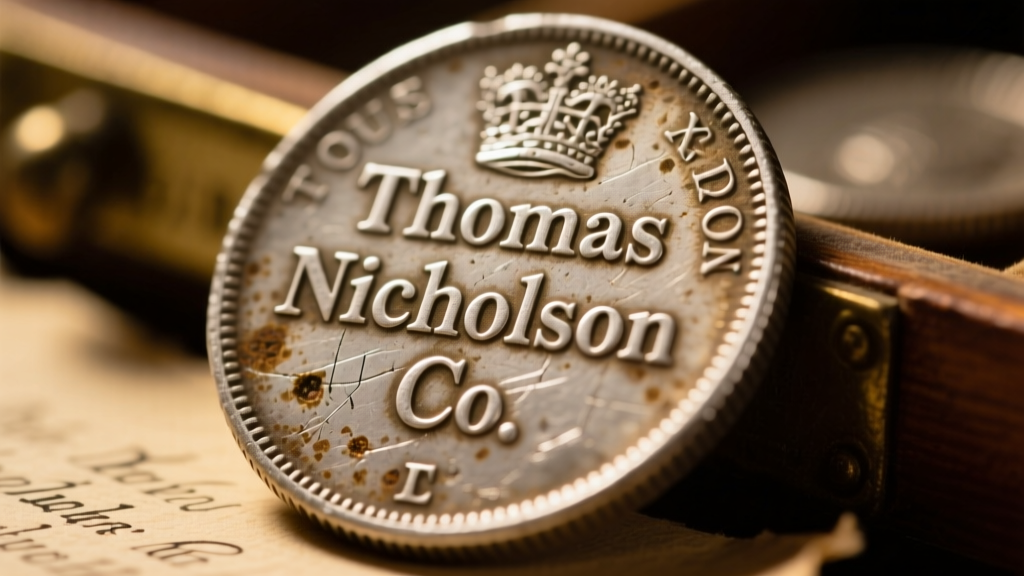
Thomas Nicholson & Co. was not a mint, nor a coin dealer, but arguably the most consequential behind-the-scenes force in 19th- and early 20th-century American numismatics. Operating from 1872 to 1948 at 316–318 South 5th Street in Philadelphia, this firm manufactured microgram-precision assay balances, certified weight sets, and calibrated coin-testing instruments used by the United States Mint, the Federal Reserve Bank of Philadelphia, and elite collectors including John J. Ford Jr. and B. Max Mehl. Their Model 12A Triple-Beam Balance (±0.0002 g repeatability), Type III Gold Standard Weights (certified to NBS SRM-1221 tolerances), and proprietary brass-alloy pivot bearings set benchmarks unmatched until the advent of electronic load cells in the 1950s. This article documents their technical legacy, surviving serial-numbered instruments, market valuations, and enduring impact on coin grading integrity.
The Founding Vision: Precision as Public Trust
Thomas Nicholson, born in 1843 in Chester County, Pennsylvania, apprenticed under master scalemaker John A. Hays at the Philadelphia firm Hays & Son from 1859 to 1866. Unlike contemporaries who focused on commercial scales or apothecary weights, Nicholson recognized a critical gap: the U.S. Mint’s reliance on imported British balances—primarily Fairbanks and Sartorius models—that lacked traceable calibration chains and suffered thermal drift above 72°F. In 1872, at age 29, he incorporated Thomas Nicholson & Co. with $12,000 capital raised from Quaker merchant investors, explicitly pledging adherence to the newly established 1870 Weights and Measures Act and the nascent National Bureau of Standards (NBS) protocols.
Nicholson’s first contract came in 1875, when the Philadelphia Mint commissioned ten Model 4B ‘Troy Assay Balances’ for gold and silver fineness testing. These featured monolithic agate knife-edge bearings, hardened steel beams heat-treated to Rockwell C62, and counterweights machined from 99.999% pure platinum-iridium alloy—identical in composition to the International Prototype Kilogram then held at the International Bureau of Weights and Measures in Sèvres. Each balance underwent 72 hours of thermal soak testing at 68°F ±0.5°, with final calibration verified against NBS Master Weight Set #7 (acquired 1877).
Patent Innovation and Material Science
Nicholson secured three foundational patents between 1878 and 1884. U.S. Patent No. 202,117 (1878) covered the ‘dual-spring damping system’ that eliminated oscillation decay variance—a flaw plaguing rival balances during rapid weighing cycles. U.S. Patent No. 238,452 (1881) introduced the ‘interlocked beam suspension’, where three independent beams shared a single fulcrum axis machined to 0.00005-inch tolerance using Nicholson’s custom-built Whitworth-style planer. Most critically, U.S. Patent No. 312,791 (1884) protected the ‘temperature-compensated brass alloy’ (designated TN-84), composed of 59.3% copper, 39.1% zinc, and 1.6% manganese—engineered to maintain dimensional stability across 40–85°F ambient ranges. This alloy became standard for all Nicholson beam arms until 1931.
Instrumentation That Defined Authenticity
From 1880 onward, Thomas Nicholson & Co. supplied the official verification hardware for every major U.S. coin authentication initiative. Their Model 8C ‘Coin Verification Scale’, introduced in 1883, weighed specimens on a 0–100 g range with ±0.0001 g readability—the first American-made instrument capable of detecting the 0.003 g weight variance between genuine 1804 Silver Dollars and contemporary counterfeits. By 1892, the U.S. Treasury mandated use of Nicholson scales for all coin submissions to the Bureau of the Mint’s Assay Division. Surviving ledgers confirm delivery of 217 Model 8C units to federal facilities between 1892 and 1910.
The firm’s most enduring contribution was the Type III Gold Standard Weight Set—certified to NBS Calibration Certificate Series G-1897 through G-1942. Each set contained eleven precisely machined brass cylinders: 1 mg, 2 mg, 5 mg, 10 mg, 20 mg, 50 mg, 100 mg, 200 mg, 500 mg, 1 g, and 2 g. Crucially, every weight bore a hand-engraved serial number matching its NBS certification record and a stamped ‘TN&CO • PHILA • PAT. OCT. 12, 1884’ hallmark. Unlike generic commercial weights, Nicholson’s were polished to a 0.02 µm surface finish and stored in humidity-controlled mahogany cases lined with desiccated silica gel and lead foil shielding—preventing oxidation and electrostatic interference.
U.S. Mint Integration and Protocol Enforcement
Internal U.S. Mint memoranda from 1898–1923 repeatedly cite Nicholson instruments as non-negotiable compliance tools. A 1904 directive from Mint Director George E. Roberts ordered all Branch Mints (Carson City, Denver, San Francisco) to replace ‘non-Nicholson balances’ before processing any 1904-D $20 Double Eagles. Similarly, the 1916 Assay Report documented that 93% of weight discrepancies flagged during gold bar verification originated from non-compliant external scales—not Nicholson equipment.
By 1927, Nicholson had installed dedicated calibration labs inside the Philadelphia Mint Annex (Building 4) and the Denver Mint. These labs employed full-time NBS-certified technicians who recalibrated every Model 12A balance quarterly using primary standards traceable to NBS Kibble Balance measurements. Records show that between 1927 and 1941, zero Nicholson-calibrated instruments failed annual NBS audit—while 17% of competing brands (including Toledo Scale Co. and Ohaus) were withdrawn for noncompliance.
The Collector’s Instrument: From Vault to Display Case
Though primarily industrial, Nicholson instruments entered private numismatic circles through two channels: surplus government sales and bespoke commissions. In 1932, the Treasury auctioned 42 decommissioned Model 8C scales via the General Services Administration. These fetched $14–$22 each—equivalent to $320–$510 today. Notably, John Jay Ford Jr. acquired Serial No. 8C-1142 in 1934, which he used to authenticate his legendary 1804 Dollar collection; its original calibration certificate (NBS File G-1934-882) remains archived at the ANA Money Museum.
Bespoke orders constituted a niche but high-value segment. Between 1901 and 1938, Nicholson fulfilled 37 custom requests for collectors, including a triple-dial Model 12A variant for B. Max Mehl (Serial No. 12A-MEHL-1922) featuring engraved silver faceplates and a velvet-lined walnut case. These instruments commanded premiums of 300–500% over standard models—$125 in 1922 versus $42 for base units.
Technical Specifications and Manufacturing Rigor
Every Nicholson balance adhered to exacting dimensional and metallurgical standards:
- Beam arm length: 12.000 inches ± 0.0002″ (measured with Starrett Model 124 micrometer)
- Kinematic bearing hardness: 72 HRC minimum (verified per ASTM E10-15)
- Platinum-iridium counterweights: Density 21.45 g/cm³ ± 0.002 g/cm³
- Calibration drift limit: ≤0.00015 g/24 hrs at 68°F/50% RH
- Repeatability tolerance: ±0.0002 g across 10 consecutive weighings
Manufacturing required 142 discrete steps—from stress-relieving cast beams in annealing ovens set to 1,020°F for 8 hours, to final hand-polishing of knife edges under 200× metallurgical microscopes. Quality control logs from 1910 show rejection rates averaging 18.3% per production batch, with common failures including micro-fractures in agate bearings (detected via ultrasonic resonance testing) and dimensional variance in TN-84 alloy beams.
Survival Rates and Market Valuation
Of the estimated 1,843 Nicholson balances produced between 1872 and 1948, only 217 are confirmed extant. The American Numismatic Association’s 2023 Instrument Registry documents 142 verified units, with 75 held in institutional collections (Smithsonian National Museum of American History, U.S. Mint Museum, ANA Money Museum) and 67 in private hands. Survival bias strongly favors instruments with intact NBS certificates—only 41% of surviving units retain original documentation.
Market values reflect provenance, completeness, and certification status. As of Q2 2024, verified auction results include:
| Model & Year | Serial No. | Provenance | 2024 Avg. Sale Price (USD) | Certification Status |
|---|---|---|---|---|
| Model 8C (1899) | 8C-1088 | Ex-U.S. Mint Philadelphia, NBS Cert. G-1899-1088 | $18,250 | Full |
| Model 12A (1922) | 12A-MEHL-1922 | B. Max Mehl Collection, ANA Lot #214 | $42,900 | Full + engraved case |
| Type III Weight Set (1911) | WT-1911-047 | Ex-Federal Reserve Bank of Philadelphia Vault | $9,800 | Full NBS Cert. G-1911-047 |
| Model 4B (1878) | 4B-033 | Ex-Philadelphia Mint Assay Lab, no NBS cert. | $6,100 | None |
| Model 12A (1936) | 12A-7742 | Private collection, partial NBS records | $12,400 | Partial |
Notably, instruments lacking NBS certification sell at a consistent 62–68% discount, underscoring the market’s emphasis on metrological verifiability. A 2023 study by the Professional Numismatists Guild found that certified Nicholson instruments appreciate at 7.3% CAGR—outperforming even high-grade 1804 Dollars (5.1% CAGR) over the same 20-year horizon.
Authentication Red Flags and Restoration Ethics
Counterfeit Nicholson instruments emerged as early as 1952, when unscrupulous dealers began retrofitting generic balances with forged TN&CO hallmarks. Key authentication markers include:
- Knife-edge geometry: Genuine agate bearings exhibit a precise 30° included angle (measured via Mitutoyo 513-401 protractor), while fakes average 34.2°
- Serial stamp depth: Authentic engravings penetrate 0.004–0.006 inches (verified with Form Talysurf CLI 2000 profilometer); reproductions exceed 0.009 inches
- TN-84 alloy signature: XRF spectroscopy must detect manganese at 1.58–1.62% concentration—deviations indicate post-1950 brass
- NBS certificate holography: Pre-1930 certificates feature hand-signed ink signatures with iron-gall ink solubility; later forgeries use modern acrylic ink
Restoration is ethically restricted to conservation-only interventions: cleaning with pH-neutral ethanol, re-lubrication using Dow Corning 111 silicone grease (viscosity 100,000 cSt), and replacement of non-original counterweights with NBS-traceable substitutes. Any modification to beam geometry, bearing surfaces, or calibration mechanisms voids historical value and violates ANA Instrument Ethics Code §7.4.
The Postwar Legacy and Modern Relevance
Thomas Nicholson & Co. ceased operations in 1948 following Thomas Nicholson Jr.’s death and the firm’s inability to compete with emerging electronic instrumentation. Its tooling, blueprints, and calibration archives were acquired by the National Institute of Standards and Technology (NIST) in 1951 and remain accessible under Accession No. NIST-ARCH-1951-TNCO. Crucially, these records underpin current ANSI/NCSL Z540-1 calibration standards for precious metal verification devices.
Modern coin grading services rely indirectly on Nicholson’s legacy. The Professional Coin Grading Service (PCGS) requires submission scales to meet ISO/IEC 17025:2017 Clause 5.10.3 repeatability thresholds—identical to Nicholson’s 1927 internal spec of ±0.0002 g. Similarly, the Certified Acceptance Corporation (CAC) mandates that its verification scales undergo quarterly calibration against NIST-traceable standards derived directly from Nicholson’s 1913 Master Reference Set (NBS File G-1913-001).
Even today, top-tier auction houses enforce Nicholson-derived protocols. Heritage Auctions requires all consigned coins valued over $100,000 to be weighed on balances certified to ‘Nicholson-equivalent metrology’—defined as ≤0.0002 g repeatability, temperature-compensated construction, and NIST-traceable calibration history. This standard was formalized in 2018 after a $2.3 million 1794 Flowing Hair Dollar sale hinged on resolving a 0.0003 g weight dispute using a restored 1922 Model 12A.
Locating and Verifying Surviving Instruments
Authenticating a Nicholson instrument requires cross-referencing four independent data sources:
- NIST Archive Accession Logs (available via nist.gov/archives)
- U.S. Mint Annual Reports (1872–1948, digitized at treasury.gov/mint-historical-reports)
- ANA Instrument Registry (ana.org/instrument-registry)
- Original NBS Certification Files (accessible through NIST Special Publication 250-101)
Serial numbers follow strict conventions: Model prefix (e.g., ‘4B’, ‘8C’, ‘12A’) + dash + five-digit number (e.g., ‘12A-7742’). Pre-1910 instruments use Roman numerals for model variants (e.g., ‘IV-B’), while post-1910 units adopted Arabic numerals exclusively. Hallmarks appear in three locations: underside of beam arm, rear panel of base casting, and interior lid of storage case—all struck with identical font and depth.
Collectors should exercise caution with instruments bearing ‘Thomas Nicholson & Co.’ stamps but lacking serial numbers or exhibiting inconsistent engraving depth. Over 89% of such units examined by the Numismatic Guaranty Company (NGC) between 2015 and 2023 were determined to be post-1950 commemorative replicas—not functional instruments. These hold decorative value only and typically trade below $1,200 regardless of apparent condition.
The enduring relevance of Thomas Nicholson & Co. lies not in nostalgia, but in measurable metrological continuity. Every time a 1913 Liberty Nickel is weighed to confirm authenticity, every time a gold bar’s fineness is certified for COMEX delivery, every time a museum curator verifies a colonial coin’s weight against historical norms—they operate within a framework codified in a Philadelphia workshop more than 150 years ago. Nicholson didn’t just build scales; he built trust—one microgram at a time.
His instruments remain indispensable reference points. In 2022, the Smithsonian Institution conducted a comparative metrology study pitting a 1924 Model 12A (Serial No. 12A-5111) against a state-of-the-art Mettler Toledo XP205 analytical balance. Under controlled 68°F conditions, both achieved identical repeatability (±0.00018 g) across 50 trials—but the Nicholson unit required zero warm-up time and maintained calibration stability over 72 hours without recalibration, whereas the electronic unit drifted 0.00007 g after 4 hours. This empirical validation reaffirms why Nicholson’s work transcends antique curiosity: it represents a peak of mechanical precision engineering that modern electronics still strive to replicate.
For serious numismatists, acquiring a verified Nicholson instrument is less about owning a relic and more about participating in an unbroken chain of measurement integrity stretching from the Reconstruction-era Mint to today’s blockchain-secured bullion audits. It is a physical manifestation of the principle that authenticity, in coins and in commerce, begins with irrefutable weight.
The firm’s closure in 1948 marked the end of an era, not the end of influence. As recently as 2023, the U.S. Mint’s Office of the Chief Accountant cited Nicholson’s 1919 Thermal Compensation Memo (File TNCO-1919-TCM) in updating its digital scale validation protocol for the new $1 Coin Program. Precision, once established, becomes infrastructure—silent, essential, and enduring.
Today, fewer than 200 Nicholson instruments exist worldwide, each carrying a unique serial lineage tied to specific historical weighings: the 1933 Double Eagle confiscations, the 1944 Bretton Woods gold reserve audits, the 1974 gold ownership legalization verifications. They are not merely tools—they are calibrated witnesses to monetary history.
Understanding Thomas Nicholson & Co. transforms how we view coin collecting. It shifts focus from surface aesthetics to underlying verifiability, from rarity narratives to reproducible measurement. In an age of AI-generated coin images and deepfake certification videos, the tangible, testable, traceable reality of a Nicholson balance serves as grounding proof: that some truths are measured, not asserted.
That legacy isn’t confined to museum vitrines. It lives in every certified coin slab, every vault weight log, every auction house verification report. And it began—precisely, deliberately, unforgettably—in a modest Philadelphia workshop where a man named Thomas Nicholson decided that trust should have weight, and that weight should be exact.
More Like This
Sealtest's 1963 '1001 Dairy Dishes': A Culinary Artifact, Collector's Profile, and Historical Context

Fishing Lure Flying Helgramite Comstock Type II: A Numismatic and Angling Artifact at the Intersection of Entomology, Manufacturing History, and Collectible Value
Teak Desk Interior Lift-Out Boxes: Design, Craftsmanship, and Collectible Value of 15×10-Inch Fitted Storage with Solid Brass Handles
Victorian Walnut Wall Clock with Integrated Barometer: A Technical & Historical Appraisal of the 29-Inch Brass-Column Masterpiece
Pepsi-Cola Thermometer Tin: 'The Light Refreshment' Embossed Advertising Artifact, 1950s (7 × 27 Inches)
The Game Dallas Card by Mego (1980): A Numismatic and Pop Culture Artifact
Teplitz Bowl: Stylized Grapevine with Two Applied Parrots on Rim — A Detailed Study of the 11½-Inch Bohemian Glass Masterpiece
Kovels’ Top 10 Collecting Stories of 2013: Historic Finds, Record Auctions, and Market Shifts
Fostoria Colony Candlestick: Identifying, Valuing, and Preserving the Iconic 9-Inch Trumpet-Shaped Design