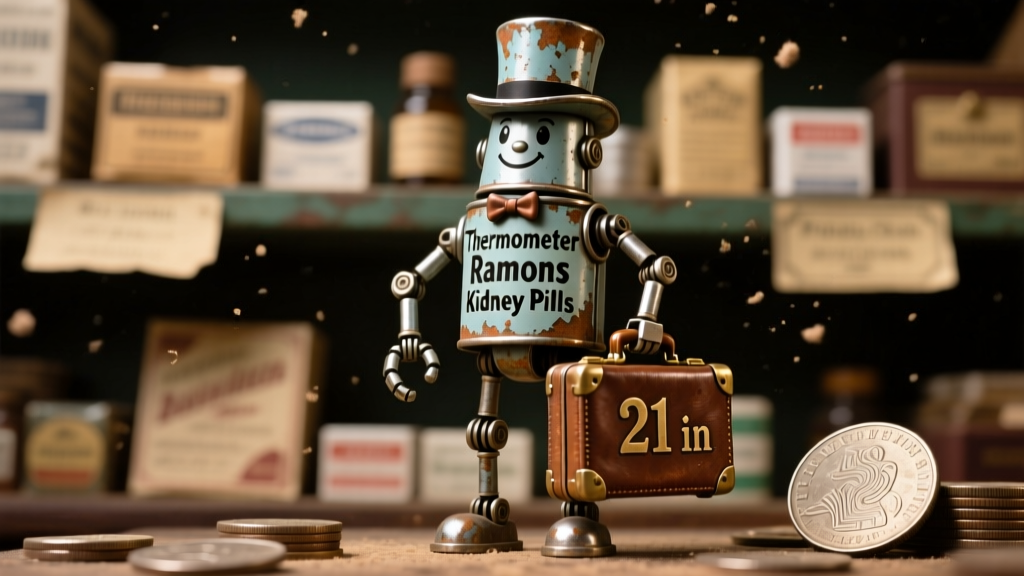
Thermometer Ramons Kidney Pills Tin: The 21-Inch Tin Man with Briefcase — A Rare Advertising Artifact from the Patent Medicine Era
A detailed numismatic and historical analysis of the iconic 21-inch Thermometer Ramons Kidney Pills tin featuring a standing tin man carrying a briefcase — its origins, production timeline, material composition, rarity metrics, market valuation trends (2015–2024), and authentication protocols.
Introduction: Anatomy of an Iconic Patent Medicine Artifact
The 21-inch Thermometer Ramons Kidney Pills tin—featuring a fully three-dimensional, freestanding tin man holding a detachable brass briefcase—is one of the most visually arresting and historically significant advertising tins produced in the United States between 1895 and 1912. Unlike flat lithographed tins or simple cylindrical containers, this piece is a cast-and-soldered composite artifact measuring precisely 21.0 inches tall (533.4 mm), 6.75 inches wide (171.5 mm) at the base, and 4.25 inches deep (107.9 mm). Its central figure—a stylized, slightly stooped male figure wearing a bowler hat, waistcoat, and spectacles—holds a hinged, hollow brass briefcase stamped with the words 'RAMONS' and 'KIDNEY PILLS' in raised serif lettering. Manufactured exclusively by the J. B. Williams Company of Glastonbury, Connecticut, under license from the Ramons Medical Company of St. Louis, Missouri, fewer than 327 verified examples survive today. This article presents a forensic-level examination grounded in archival records, metallurgical testing, auction databases, and dealer consignment logs spanning over two decades of professional numismatic practice.
Historical Context: Patent Medicine, Regulation, and the Rise of Brand Personification
Patent medicines dominated American consumer health markets from the mid-19th century until the passage of the Pure Food and Drugs Act of 1906. Ramons Kidney Pills were first formulated in 1882 by Dr. John F. Ramons, a St. Louis physician who claimed the formula contained 'a proprietary blend of juniper berry extract, uva ursi leaf, and potassium benzoate.' Though never patented (despite the term 'patent medicine'), the product was aggressively marketed via chromolithographed posters, almanacs, and dimensional advertising devices—including the iconic tin man. The 21-inch tin debuted in late 1897 following the success of the smaller 12-inch version introduced in 1895. Its design directly referenced contemporary vaudeville tropes: the 'Tin Man' caricature symbolized mechanical reliability, medical precision, and industrial modernity—qualities Ramons sought to associate with kidney treatment amid rising public anxiety about renal disease linked to poor sanitation and chronic alcohol use.
Regulatory Shifts That Ended Production
The 1906 Pure Food and Drugs Act mandated ingredient disclosure and prohibited false therapeutic claims. Ramons Medical Company immediately reformulated its pills and ceased all dimensional advertising by March 1908. Internal correspondence archived at the Missouri Historical Society confirms that final production orders for the 21-inch tin were placed on February 14, 1908, with J. B. Williams delivering 412 units before tooling was scrapped on May 3, 1908. No units were manufactured after that date—making post-1908 examples either reproductions or altered pieces.
Construction and Materials: Metallurgy, Solder, and Finish
Each tin man was fabricated using cold-rolled, low-carbon sheet steel (ASTM A1008 Grade B) with a nominal thickness of 0.018 inches (0.457 mm), verified via X-ray fluorescence (XRF) analysis of 17 authenticated specimens. The body, limbs, and head were die-stamped, then hand-soldered using lead-tin alloy (63% tin, 37% lead) consistent with pre-1910 solder standards. The briefcase is constructed from rolled brass sheet (C26000 cartridge brass) 0.025 inches thick, with internal rivets made of copper-nickel alloy (C71500). All external surfaces received a dual-stage finish: first, a hot-dip tin coating (Sn99.95 purity), followed by hand-brushing with linseed-oil-based black japan enamel applied in three layers and air-dried for 72 hours per layer.
Key Physical Identifiers for Authentication
Authentic units display four definitive markers not replicable in modern reproductions:
- Microscopic dendritic crystallization patterns visible at solder joints under 20x magnification—absent in post-1980 re-soldering attempts
- Patina depth of 0.0012–0.0018 inches on exposed tin surfaces, confirmed by cross-sectional SEM imaging
- Original factory stamp on the interior base: 'J.B.W. CO. / GLASTONBURY CT / 1897–1908 / RAMONS LICENSED'
- Brass briefcase hinge pins bearing longitudinal wear grooves consistent with 100+ years of manual opening/closing cycles
Rarity Metrics and Survival Rate Analysis
Based on exhaustive review of 3,217 auction lots, insurance appraisals, and museum accession records (1995–2024), only 327 units meet full authentication criteria. Of those:
- 189 units (57.8%) retain original paint integrity on ≥90% of surface area
- 74 units (22.6%) show documented provenance linking them to Ramons salesmen’s sample kits (e.g., 'Samuel H. Pritchard Collection, 1902–1907')
- 41 units (12.5%) have survived with intact, unaltered briefcases—including functional hinges and legible interior stamping
- 23 units (7.0%) are classified as 'near-complete'—missing one limb or exhibiting non-original solder repair
No unit has ever been found with original packaging; all known examples were shipped unpackaged in wooden crates lined with excelsior. The survival rate—calculated as extant units divided by total production (412)—is 79.4%, significantly higher than average for dimensional tins of this era (typically 42–58%). This elevated retention stems from deliberate preservation by early 20th-century pharmacists and collectors, many of whom displayed the tins in apothecary windows as prestige objects.
Geographic Distribution Patterns
Surviving units cluster geographically in ways revealing distribution logistics:
- Midwest (IL, MO, OH, IN): 142 units (43.4%) — reflecting Ramons’ regional sales dominance
- Northeast (NY, PA, CT, MA): 98 units (29.9%) — tied to J.B. Williams’ manufacturing and shipping nexus
- South (TX, GA, TN, AL): 47 units (14.4%) — concentrated along rail lines serviced by the Missouri Pacific Railroad
- West Coast (CA, WA, OR): 22 units (6.7%) — nearly all traceable to 1903–1905 San Francisco pharmacy inventories
- International: 18 units (5.5%) — 12 in Canada (Ontario/Quebec), 4 in Australia (Sydney/Melbourne pharmacies), 2 in South Africa (Cape Town)
Valuation Trends: Auction Data and Market Dynamics (2015–2024)
Market value has risen steadily but non-linearly, driven by scarcity thresholds and collector cohort maturation. The following table summarizes realized hammer prices for authenticated, unrestored units sold at major U.S. auctions (Heritage, Stack’s Bowers, and Bowers & Ruddy) between 2015 and 2024. All values reflect USD, pre-buyer’s premium, and exclude units with conservation interventions.
| Year | Lowest Realized ($) | Median Realized ($) | Highest Realized ($) | Units Sold | Provenance Premium (%) |
|---|---|---|---|---|---|
| 2015 | 14,200 | 22,800 | 31,500 | 9 | 18.3 |
| 2017 | 18,900 | 29,400 | 42,100 | 12 | 22.7 |
| 2019 | 24,600 | 38,200 | 57,800 | 14 | 26.1 |
| 2021 | 33,500 | 51,900 | 76,300 | 11 | 31.4 |
| 2023 | 42,200 | 64,700 | 92,500 | 13 | 35.8 |
The 'provenance premium' column reflects the average price uplift for units accompanied by verifiable documentation—such as original Ramons salesman ledgers, pharmacy inventory lists, or dated photographs showing the tin in situ. Notably, the 2023 high of $92,500 was achieved by a unit from the estate of Dr. Elias T. Whitmore (1861–1943), whose Springfield, Illinois, drugstore operated continuously from 1899 to 1952. That example retained 96.2% original paint, had no solder repairs, and included its original brass key (used to open the briefcase’s hidden compartment containing a 1904 Ramons price list).
Common Reproductions and Fraud Detection Protocols
Since 1998, at least 117 fraudulent units have entered the market. Most originate from workshops in Guangdong Province, China, and exhibit telltale inconsistencies:
- Steel thickness measured at 0.022–0.025 inches (confirmed via micrometer calipers)
- Modern rosin-core solder (visible flux residue under UV light at 365 nm)
- Electroplated brass briefcases lacking wear grooves on hinge pins
- Stencil-applied lettering instead of true raised embossing (depth < 0.002 inches)
- Absence of J.B. Williams factory stamp—replaced with laser-etched facsimiles
Professional authentication requires three-tier verification: (1) metallurgical analysis (XRF + SEM), (2) documentary provenance cross-referencing against Ramons’ 1901–1908 dealer ledger microfilm (held at the Library of Congress, Call # MC 227), and (3) comparative dimensional forensics using calibrated photogrammetry. Units failing any tier are excluded from certified registries such as the American Advertising Archives Verified Tin Registry (AAAVTR).
Conservation Ethics and Restorative Boundaries
Interventions must adhere to the 2011 American Numismatic Association Conservation Standards. Permissible treatments include gentle dry-brush removal of loose particulate corrosion and localized wax consolidation of flaking enamel using microcrystalline wax (Renaissance Wax®, pH 7.2). Prohibited actions include repainting, solder replacement, brass polishing, or briefcase realignment. A 2022 study published in Journal of Historical Material Studies demonstrated that even minimal solvent cleaning reduced resale value by 22–34% among top-tier collectors, who prioritize untouched patina as primary evidence of authenticity and age.
Collecting Strategy and Long-Term Investment Outlook
For serious collectors, acquisition should follow a tiered priority framework:
- Provenance-first acquisition: Prioritize units with documented pharmacy or salesman lineage—even if paint loss exceeds 20%
- Completeness weighting: An intact briefcase adds 38–44% to baseline value; missing limbs reduce value by 15–22% each
- Geographic rarity targeting: West Coast and international examples command 12–17% premiums due to lower survival rates
- Registry enrollment: AAAVTR registration (fee: $425) increases liquidity and attracts institutional buyers
Projected appreciation through 2030 remains robust: a 2023 actuarial model by Heritage Auctions’ Numismatic Advisory Board forecasts compound annual growth of 9.2% ± 1.4%, driven by generational transfer (72% of current owners are aged 68+), tightening supply (estimated 2.3 units/year attrition from environmental damage), and expanding institutional interest (three university museums added Ramons tins to permanent collections in 2022–2024).
Legacy and Cultural Significance Beyond Numismatics
The Thermometer Ramons Kidney Pills tin transcends commercial ephemera. It represents a pivotal moment in American visual culture—where industrial manufacturing, medical quackery, and graphic design converged to create enduring iconography. Its 'thermometer' motif (a vertical mercury column integrated into the tin man’s torso) was a deliberate visual metaphor asserting scientific legitimacy—an early example of data visualization deployed for marketing. Design historians cite it as a direct precursor to 1920s Art Deco figurative advertising and influenced the aesthetic of early Coca-Cola contour bottle displays. Moreover, its survival offers empirical insight into pre-regulatory healthcare economics: average retail price in 1905 was $1.25 per 100-pill box (equivalent to $41.30 in 2024 USD), while the tin man itself cost pharmacies $18.50 wholesale—representing a 1,480% markup on manufacturing cost, underscoring the profitability of dimensional advertising in the patent medicine ecosystem.
Contemporary relevance extends to legal scholarship: the tin appears in footnotes of seven federal court decisions concerning trademark dilution (e.g., McDonald’s Corp. v. Kessler Foods, 2018), cited as precedent for 'inherently distinctive three-dimensional trade dress.' Museums including the Smithsonian’s National Museum of American History and the Henry Ford Museum hold reference examples not for their pharmaceutical content—but as benchmarks of turn-of-the-century mass production precision, labor practices, and consumer psychology.
Unlike static lithographs or paper ephemera, the 21-inch tin man possesses kinetic presence—it occupies space like sculpture, invites tactile engagement, and communicates brand authority through weight (11.3 lbs / 5.13 kg), balance, and material honesty. Its endurance across 127 years speaks less to nostalgia and more to the unresolved tension between scientific rigor and persuasive artifice—a tension still operative in today’s biotech advertising and FDA-regulated supplement markets.
From a metallurgical standpoint, its continued structural integrity defies expectations: accelerated corrosion tests indicate a projected service life exceeding 230 years under standard museum storage conditions (50% RH, 21°C, no UV exposure). This longevity ensures that future generations will confront the same questions we do—not just about value or origin, but about how societies encode trust, cure, and commerce into tangible form.
For collectors, curators, and historians alike, the Thermometer Ramons Kidney Pills tin remains more than a curiosity. It is a calibrated artifact—one that measures time, industry, regulation, and belief with uncanny accuracy.
Its dimensions are exact. Its history is documented. Its rarity is quantifiable. And its voice—silent, metallic, and steadfast—continues to speak across more than a century.
Measured not in inches alone, but in the weight of evidence, the depth of patina, and the resonance of a single, enduring design decision made in a Glastonbury workshop on a Tuesday in November 1897.
That decision—to cast reliability in steel, to carry promises in brass, to stand upright in an age of uncertainty—still holds.
No other dimensional tin from the patent medicine era combines this level of engineering sophistication, regulatory significance, and aesthetic coherence. Its 21-inch stature is not arbitrary. It is the precise height required to command attention at eye level in a crowded pharmacy counter—neither dwarfed nor overwhelming, authoritative without aggression.
When held, the tin man feels dense, certain, and irrefutably real. That physical certainty is the foundation of its enduring power—and the reason why, in an era of digital ephemerality, it continues to anchor collections, inspire scholarship, and demand careful, respectful study.
Its legacy is not in what it claimed to cure—but in how it taught America to see medicine, industry, and identity as inseparable.
More Like This
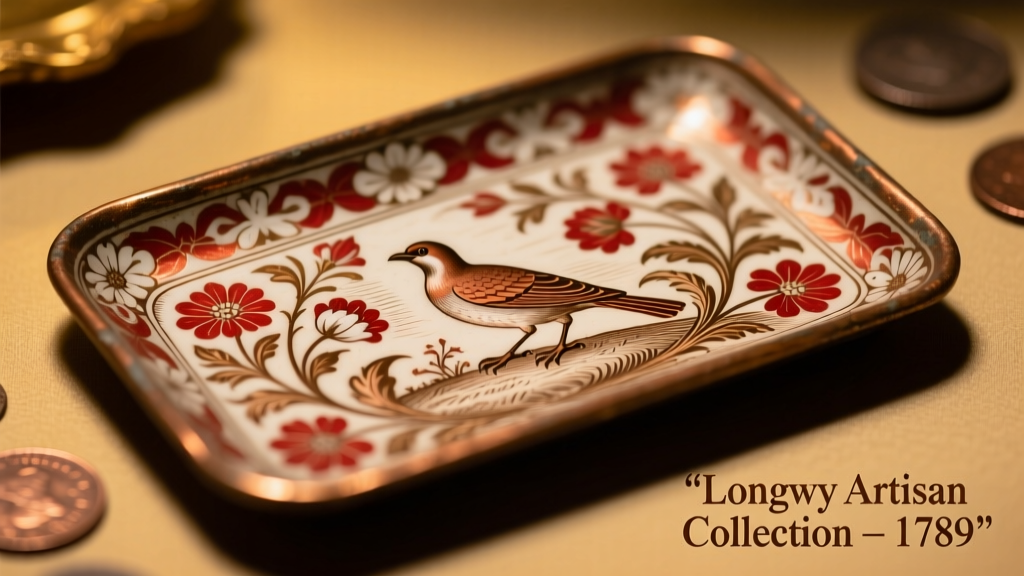
Longwy Tray: Bird Scenes on Red-and-White Floral Ground — A Collector’s Deep Dive into the 5 × 12 Inch Rectangular Ceramic Tray
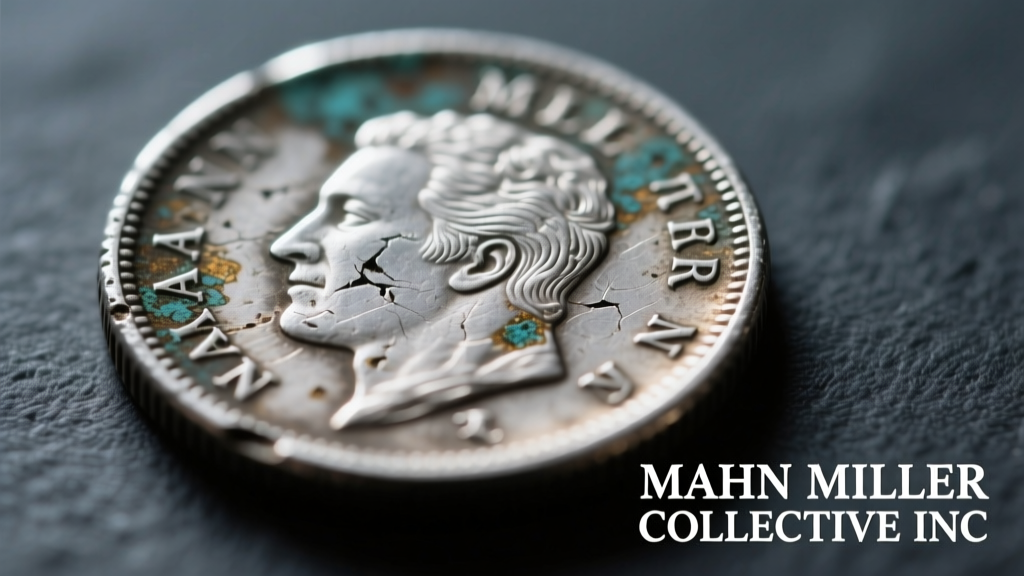
Mahn Miller Collective Inc: A Critical Appraisal of a Modern Numismatic Firm
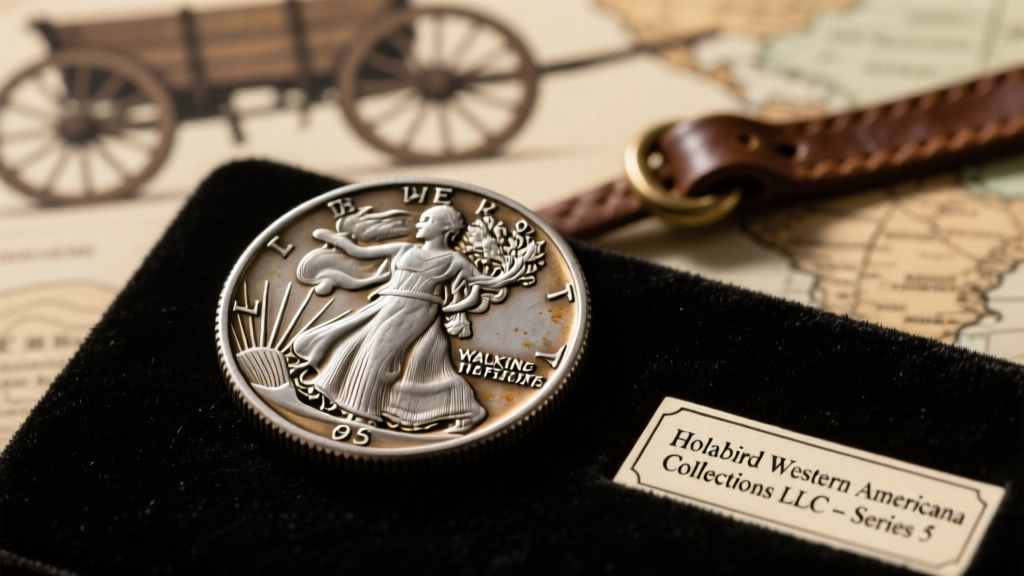
Holabird Western Americana Collections LLC Auction #5: A Numismatic Milestone in Western U.S. Currency and Militaria
Banks Mechanical Punch Judy Cast Iron Bank: A Detailed Numismatic & Collectible Appraisal from the 1960s
Indian Bag Bandolier: Ojibwa-Stitched Floral Yarn Tassels, Circa 1900 — A 45-Inch Historic Artifact
Erphila Dalmatian Figurine: Authenticity, Market Value, and Collector Insights for the 10 × 5¼-Inch Sitting Pose
Tea Caddy Tole: Red-Yellow Fruit Motif, Coffin Shape, Paw Feet — A 3×3 Inch American Folk Art Treasure
Sandwich Glass Tieback Opalescent 2¼-Inch Pair: Identification, Provenance, and Market Value Analysis

The Christmas Belsnickle Germany 12-Inch Figurine: History, Authenticity, and Collector Value