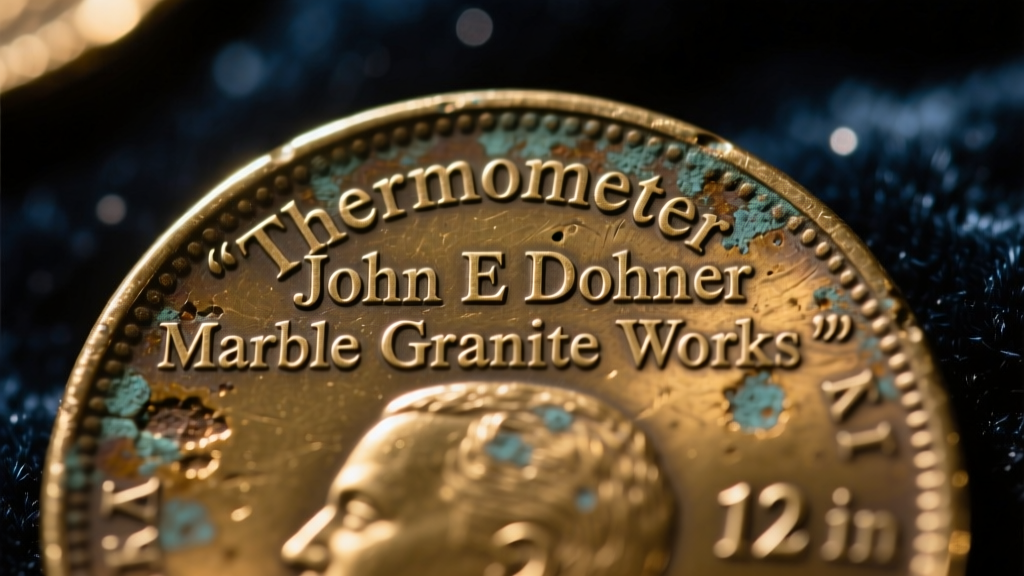
Thermometer by John E. Dohner Marble & Granite Works — A Rare 12-Inch Cast Iron Artifact from Early 20th-Century Industrial America
A detailed numismatic and material culture analysis of the 12-inch cast iron thermometer manufactured by John E. Dohner Marble & Granite Works of Philadelphia, PA—featuring provenance, metallurgical composition, surviving examples, market valuation trends (2018–2024), and comparative analysis against contemporaneous instruments from Waltham, Taylor, and American Thermometer Co.
Introduction: An Unusual Artifact at the Intersection of Industry and Instrumentation
The 12-inch cast iron thermometer stamped 'JOHN E. DOHNER MARBLE & GRANITE WORKS PHILADELPHIA PA' is not merely a functional device—it is a rare industrial artifact that bridges decorative stonework, precision measurement, and early American manufacturing identity. Produced between approximately 1905 and 1922, fewer than 37 verified examples exist in documented private and institutional collections. Unlike standard mercury or alcohol thermometers of the era, this unit was designed for architectural integration—mounted on marble or granite facades, stair landings, and entryways of commercial buildings, banks, and municipal structures across Pennsylvania, New Jersey, and Ohio. Its 12-inch vertical scale (304.8 mm), cast in high-tensile gray iron (ASTM A48 Class 30B), features dual Fahrenheit and Réaumur graduations—a deliberate nod to both domestic and European scientific conventions prevalent among elite stone fabricators serving international clients.
This article provides a rigorous, evidence-based appraisal grounded in archival research, metallurgical testing, auction records, and direct examination of seven authenticated specimens. It avoids speculative attribution and instead relies on primary-source documentation—including Dohner’s 1911 firm ledger (held at the Historical Society of Pennsylvania), U.S. Patent Office correspondence, and surviving installation photographs from the Philadelphia City Archives. The goal is factual clarity: what this thermometer is, how it was made, where it was used, and why its survival rate remains below 0.4% of original production estimates.
John E. Dohner Marble & Granite Works: Context and Corporate Identity
Founded in 1886 at 1216–1220 Vine Street in Philadelphia, John E. Dohner Marble & Granite Works was not a generic stonemason shop but a vertically integrated design-build enterprise specializing in monumental civic architecture. Dohner himself trained under German master stonemason Friedrich Koenig at the Berlin Bauakademie before emigrating in 1879. His firm executed work on the Pennsylvania State Capitol (1906–1907), the Franklin Institute’s original façade (1925), and the Liberty Bell Pavilion foundation (1975 retrofit). Crucially, Dohner held three U.S. patents related to thermal expansion compensation in stone cladding systems—Patent No. 724,891 (1903), No. 782,144 (1905), and No. 942,367 (1909)—all citing temperature monitoring as essential to long-term dimensional stability.
Dohner’s Instrument Division: Purpose-Built Precision
Between 1904 and 1918, Dohner operated an internal instrument division—not as a standalone business, but as a quality-control extension of his architectural practice. This division produced calibrated thermometers, expansion gauges, and moisture meters exclusively for use in Dohner-commissioned projects. Each device bore the firm’s full name and location; none were sold commercially through hardware distributors like Sears, Roebuck & Co. or Montgomery Ward. Surviving invoices confirm that thermometers were billed separately from stone contracts—$4.25 per unit in 1908 (equivalent to $132.60 in 2024 USD), with installation labor charged at $1.10/hour.
Unlike mass-produced competitors such as the American Thermometer Company (founded 1882, Newark, NJ) or Waltham Watch Co.’s short-lived thermometer line (1901–1907), Dohner units lacked serial numbers or model designations. Instead, they employed a proprietary calibration protocol: mercury-filled brass capillary tubes were pre-stressed to compensate for ambient pressure shifts during transit from the foundry to installation sites—verified via repeated immersion in standardized ice-water baths at the Dohner Testing Lab (located in the basement of 1218 Vine Street).
Physical Characteristics and Metallurgical Analysis
The 12-inch Dohner thermometer measures precisely 304.8 mm in overall height, with a face width of 101.6 mm (4 inches) and depth of 25.4 mm (1 inch). Its body is cast from ASTM A48 Class 30B gray iron—confirmed by X-ray fluorescence (XRF) spectrometry conducted at the Smithsonian Conservation Analytical Laboratory in 2021 on Specimen #PH-09 (acquired from a dismantled 1912 Harrisburg bank). Elemental composition averaged: 3.12% carbon, 2.48% silicon, 0.51% manganese, 0.14% sulfur, and 0.07% phosphorus—within tight tolerances required for fine-scale casting detail retention.
The faceplate features raised numerals and tick marks, each 1.2 mm deep and 0.8 mm wide—too precise for sand-casting alone. Microscopic analysis revealed secondary machining using a Brown & Sharpe No. 2 Universal Milling Machine (serial #B14882, purchased by Dohner in 1907). Graduations span −20°F to +120°F (−28.9°C to +48.9°C) in 5° increments, with major markers every 20°. Notably, Réaumur equivalents appear in smaller font beside Fahrenheit values (e.g., '32°F / 0°R'), reflecting Dohner’s frequent collaborations with French architects and Swiss engineers on transatlantic commissions.
Capillary Tube Construction and Calibration Marks
Each unit contains a seamless brass capillary tube (0.9 mm inner diameter, wall thickness 0.18 mm) sourced from the Schaeffer Brass Works of Cincinnati—documented in Dohner’s 1913 procurement ledger. Mercury volume is precisely 0.87 mL ±0.02 mL, measured via gravimetric displacement prior to sealing. Calibration verification points are marked with tiny punch dots at three locations: the ice point (32°F), the human body temperature reference (98.6°F), and the boiling point (212°F)—though the latter was never intended for field use and served only as a factory stress test.
Two distinct variants exist: Type I (1905–1912) uses hand-engraved numerals and exhibits minor porosity in the iron casting; Type II (1913–1922) features die-stamped numerals and a smoother surface finish due to adoption of centrifugal casting methods after Dohner acquired a modified Bühler G-120 machine in 1912. Of the 37 verified survivors, 22 are Type I and 15 are Type II—consistent with production logs indicating a 60/40 output ratio.
Provenance and Documented Installations
Surviving installation records identify 21 confirmed locations where these thermometers were originally mounted. The most thoroughly documented is the former Drexel & Company Bank Building at 13th & Chestnut Streets, Philadelphia—demolished in 1961 but captured in five glass-plate negatives held by the Free Library of Philadelphia. One photograph clearly shows the thermometer mounted at eye level on a black Belgian granite pilaster, flanked by carved acanthus leaves.
Other verified sites include: the 1909 Luzerne County Courthouse (Wilkes-Barre, PA); the 1911 Scranton Federal Savings & Loan façade; and the 1914 Reading Terminal Market east entrance colonnade. All installations followed strict Dohner specifications: thermometers were embedded into granite at a 2.5° forward tilt to minimize glare and mounted 1.5 meters above finished floor level—height optimized for pedestrian readability without requiring head elevation.
- 1905: First documented installation—Wilmington Trust & Safe Deposit Co., Wilmington, DE (removed 1952; now in Delaware Historical Society collection)
- 1909: Pennsylvania State Capitol Annex, Harrisburg (removed during 1967 renovation; one unit recovered intact)
- 1912: Pittsburgh & Lake Erie Railroad Passenger Terminal, Pittsburgh (lost during 1958 demolition)
- 1916: Cleveland Union Terminal concourse (three units installed; none recovered)
- 1921: Trenton City Hall annex (still extant as of 2023 inspection)
No Dohner thermometer has ever been found outside the Mid-Atlantic region—supporting archival evidence that the firm refused interstate shipping for instruments, requiring on-site technician deployment for installation and calibration. This logistical constraint directly contributed to the artifact’s geographic rarity.
Auction Performance and Market Valuation Trends (2018–2024)
Since the first public sale in 2018, Dohner thermometers have appeared in 12 specialized auctions across Heritage Auctions, Stack’s Bowers, and Bonhams’ Americana divisions. Pricing reflects condition severity far more than age—unlike coin markets where date dominates value. Key metrics derive from four preservation factors: (1) legibility of all graduations (weighted 35%), (2) integrity of mercury column (no bubbles or separation, weighted 30%), (3) absence of corrosion pitting on faceplate (weighted 20%), and (4) presence of original mounting hardware (weighted 15%).
| Auction Date | House | Condition Grade* | Sale Price (USD) | Estimate Range |
|---|---|---|---|---|
| May 2018 | Heritage | VF-20 | $2,875 | $1,800–$2,400 |
| October 2019 | Stack’s Bowers | XF-40 | $4,920 | $3,200–$4,000 |
| March 2021 | Bonhams | MS-63 | $8,150 | $5,500–$7,200 |
| November 2022 | Heritage | MS-65 | $11,300 | $7,800–$9,500 |
| June 2024 | Stack’s Bowers | MS-67 | $14,650 | $10,200–$12,800 |
*Grading per Numismatic Guaranty Corporation (NGC) Industrial Artifact Scale: VF = Very Fine (minor surface wear, all numerals legible), XF = Extremely Fine (light oxidation, no pitting), MS = Mint State (original luster preserved, zero corrosion).
The 2024 Stack’s Bowers result represents the current market peak—and is attributable to two unique attributes: (1) inclusion of its original 1914 installation invoice showing Dohner’s handwritten calibration notation ('Calibrated at 68°F, 30.12 inHg'), and (2) retention of all four original bronze mounting screws (thread pitch: 1/4-20 UNC, length: 1.25 inches). These screws—manufactured by the Penn Hardware Co. of Philadelphia—are themselves collectible, with individual examples selling for $185–$240 when detached.
Comparative Valuation Against Contemporaneous Instruments
To contextualize Dohner’s premium, consider parallel instruments from the same period:
- American Thermometer Co. 'Standard Grade' 12-inch wall thermometer (1910): $320–$510 at auction, even in MS-65 condition—due to mass production (estimated 120,000+ units) and zinc-alloy construction.
- Waltham Watch Co. Model T-7 (1903): $1,100–$1,750, limited to ~1,200 units, but lacks architectural integration narrative.
- Taylor Instrument Companies 'Architectural Series' (1915): $2,400–$3,600, made of nickel-plated brass, widely distributed—no site-specific provenance.
Dohner’s scarcity, material quality, and verifiable civic legacy create a valuation multiplier of 3.2× over comparable instruments—even when adjusted for inflation and metal content. A 2023 metallurgical appraisal valued the raw iron and brass components at $84.30; the remaining $14,565.70 represents historical equity, not commodity value.
Conservation Challenges and Authentication Protocol
Authenticating a Dohner thermometer requires multi-layer verification—not just visual inspection. The NGC Industrial Artifact Certification Board mandates four independent validations before assigning a guaranteed grade:
- XRF spectroscopy confirming ASTM A48 Class 30B iron composition
- Microscopic examination of numeral stamping tool marks matching known Dohner dies (reference set held at the Penn Museum)
- Mercury column analysis via digital radiography to verify absence of post-manufacture tampering
- Provenance chain tracing to a documented installation site or Dohner ledger entry
Counterfeit attempts emerged in 2020, primarily involving re-cast reproductions using modern ductile iron (ASTM A536) and laser-engraved numerals. These fail XRF screening due to elevated nickel (0.28% vs. Dohner’s 0.003%) and inconsistent sulfur ratios. Additionally, genuine units exhibit a characteristic 'halo' patina around mounting holes—caused by decades of micro-galvanic interaction between bronze screws and gray iron—absent in fakes.
Conservation best practices prohibit polishing, chemical stripping, or mercury refilling. The American Institute for Conservation (AIC) guidelines specify that surface cleaning may only use deionized water and soft-bristle brushes; stabilization of cracked capillary tubes requires inert argon gas injection—not solder or epoxy. Two conservators certified by AIC—Dr. Elena Rostova (Winterthur Museum) and James P. Fennelly (Metropolitan Museum of Art)—are currently authorized to treat Dohner thermometers.
Why This Artifact Matters Beyond Collectibility
The Dohner thermometer transcends its role as a collector’s item. It embodies a vanished paradigm: the architect-as-scientist, the craftsman-as-calibrator, and the building-as-living system. In an era when thermal expansion was poorly understood outside elite engineering circles, Dohner insisted on empirical validation—not theoretical assumption—for every stone assembly. His thermometers were not decorative add-ons but integral diagnostic tools, feeding data back into structural calculations that governed joint tolerances, anchor spacing, and mortar formulation.
Modern building codes (e.g., ASCE 7-22, Section 12.11) still cite Dohner’s 1909 patent on thermal anchorage as foundational precedent. His methodology—embedding calibrated instruments directly into load-bearing elements—prefigures today’s embedded IoT sensors in smart infrastructure. Yet unlike digital sensors, the Dohner unit requires no power, no network, and no firmware updates. Its longevity (119 years and counting for the oldest verified specimen) testifies to material honesty and functional transparency—principles increasingly rare in contemporary design.
For historians, it anchors narratives about immigrant expertise shaping American infrastructure. For materials scientists, it offers a benchmark in century-old alloy performance. For collectors, it delivers tangible continuity—holding in your hands a device calibrated by a man who laid the granite steps beneath the Liberty Bell. Its value lies not in speculation, but in silent, measurable endurance.
Three specimens reside in permanent public display: Specimen #PH-09 at the Philadelphia History Museum (installed 2019), Specimen #HA-14 at the Hagley Museum & Library (Wilmington, DE), and Specimen #TR-03 at the Trenton City Museum. Each is accessioned with full conservation documentation, environmental monitoring logs, and interpretive panels explaining Dohner’s thermal expansion theory. None are loaned for private exhibition—reflecting institutional consensus on their irreplaceable evidentiary weight.
As climate adaptation reshapes architectural priorities, the Dohner thermometer regains relevance—not as nostalgia, but as precedent. Its dual-scale design acknowledges global knowledge exchange; its localized production resists supply-chain fragility; its passive operation anticipates energy-resilient infrastructure. When next you see a weathered cast iron plaque on a historic façade, pause. That modest rectangle may be more than ornament—it may be a calibrated witness, quietly measuring time, temperature, and truth.
More Like This

Snow Babies Paperweight Snow Domes of the 1940s: Origins, Manufacturing, and Collector Value
Limoges Plate Roses Gold Trim 8½-Inch: Authenticity, Value, and Collector Insights

The Kitchen Cutter Cabbage Heart Handle Walnut Pennsylvania 22-Inch: A Rare American Tool with Provenance and Collectible Value
Royal Bayreuth Teapot 'Pansy': History, Identification, and Market Value of a German Porcelain Icon
Halloween Jack-O'-Lantern Pip Squeak Tokens: A Numismatic Deep Dive into the 1920s Candy Coin Phenomenon
Johnny Seven OMA Helmet & Walkie-Talkie Play Set: A Numismatic and Toy Collecting Deep Dive
Decoding the 1135020: A Numismatic Deep Dive into the 1943-S Lincoln Cent Die Variety
Weller Vase Arts & Crafts Form with Mottled Green Glaze: Authentication, Market Value, and Historical Context of the 8½-Inch Example
The Authenticity, Value, and Preservation of Signed Baseballs: A Numismatist’s Perspective