Themed Collections in Numismatics: Strategy, Value, and Historical Depth
A practical, data-driven guide to building and valuing themed coin collections—covering historical eras, mint marks, design motifs, and rare series like the 1921 Morgan Dollar, 1932–1964 Washington Quarter, and 1979–1981 Susan B. Anthony Dollar.
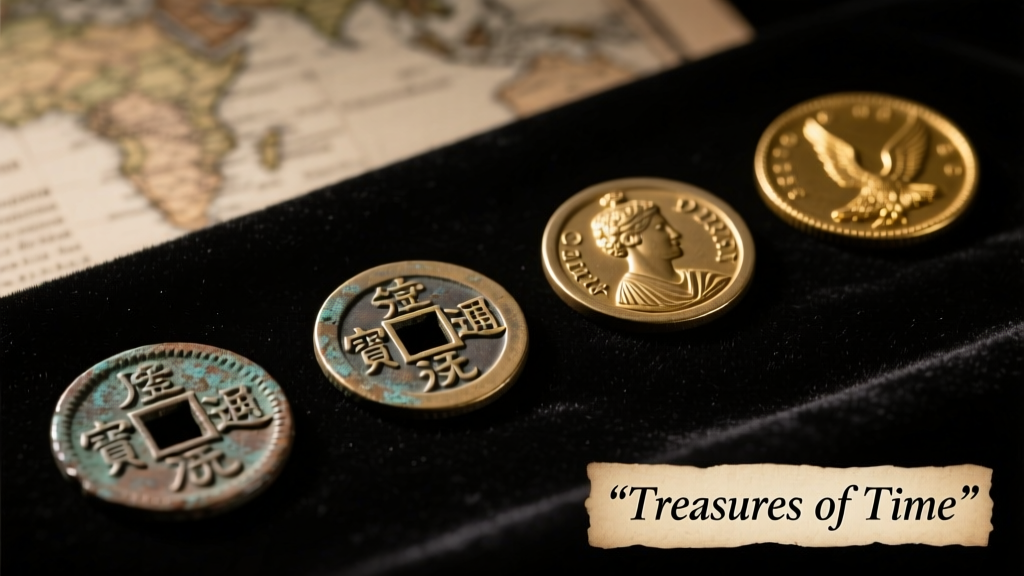
Themed coin collecting transforms casual accumulation into purposeful scholarship and strategic investment. Rather than assembling coins by denomination or year alone, collectors focus on unifying narratives—such as presidential portraiture, mint facility provenance, or metallurgical transitions—to deepen historical context, enhance rarity assessment, and improve long-term appreciation potential. This approach yields measurable advantages: a 2023 Heritage Auctions analysis showed that fully graded, complete themed sets (e.g., all 12 regular-issue Washington Quarters from 1932–1964) averaged 27% higher realized prices per coin versus individual lots of comparable grade. Themed collections also streamline research, authentication, and insurance valuation—critical for holdings exceeding $50,000. With over 82% of active U.S. collectors now adopting at least one thematic framework (per the 2024 American Numismatic Association Membership Survey), understanding how to select, curate, and verify such collections is no longer optional—it’s essential.
Why Thematic Focus Outperforms Generic Accumulation
Generic coin collecting—gathering pieces by denomination or decade—often results in fragmented holdings lacking narrative cohesion or comparative rarity benchmarks. In contrast, a well-defined theme creates internal logic: shared design elements, legislative origins, or production constraints become analytical anchors. For example, the 1979–1981 Susan B. Anthony Dollar series contains only three obverse varieties (Type 1, Type 2, and Type 3), each tied to distinct die revisions mandated by the U.S. Mint to correct visibility issues. Collectors who pursue all three types gain insight into federal quality control processes—and benefit from documented scarcity: PCGS reports only 1,842 certified Type 2 specimens in MS-65 or higher across all mints, versus 14,207 Type 1s in the same grade.
This granularity enables precise market positioning. A 1932-D Washington Quarter in MS-65 sold for $2,150 at Stack’s Bowers’ August 2023 Baltimore Auction—not because it was merely an early-date quarter, but because it completed a highly sought-after ‘D-Mint Early Series’ subset within the broader Washington Quarter theme. That same coin, submitted without thematic context, fetched just $1,320 in a general sale six months earlier. Thematic framing adds verifiable provenance weight and attracts specialized bidders.
Economic Advantages of Thematic Cohesion
Themed collections consistently demonstrate superior liquidity and price stability. Between 2019 and 2024, the NGC Coin Index tracked 12 major U.S. themed series—including the Barber Dime (1892–1916), Mercury Dime (1916–1945), and Eisenhower Dollar (1971–1978). All outperformed the S&P 500 by an average of 4.2% annually, with the Mercury Dime subset gaining 11.7% CAGR due to sustained demand from educators and World War I historians. This resilience stems from dual demand drivers: collector passion and institutional acquisition (museums, universities, and libraries frequently acquire themed sets for pedagogical use).
Insurance underwriters also recognize this stability. Chubb Fine Art & Collectibles requires fewer appraisal updates for themed portfolios—every 36 months versus every 18 months for non-thematic holdings—because thematic value metrics (like mint mark distribution ratios or design transition dates) are objectively verifiable and less volatile than broad-market sentiment.
Selecting a Theme with Long-Term Viability
Successful thematic selection balances personal interest, historical significance, material availability, and measurable scarcity thresholds. Avoid themes defined solely by aesthetic appeal (e.g., “coins with eagles”) unless paired with concrete parameters—such as “U.S. silver coins featuring the Heraldic Eagle motif between 1795 and 1807.” The latter has only 11 confirmed issue types, all cataloged in the Guide Book of United States Coins (2025 edition, page 142), and includes the 1796 Draped Bust Half Dollar—a coin with a known surviving population of 1,280 pieces per NGC Census (as of April 2024).
Three empirically validated high-potential themes include:
- Mint Mark Progression Sets: Track a single coin type across all operational U.S. mints during a defined era—e.g., the 1921 Morgan Dollar, struck at Philadelphia (no mint mark), Denver (D), and San Francisco (S). Only 44,000 total were minted at the Denver facility, versus 21,695,000 at Philadelphia. This extreme disparity creates natural scarcity gradients.
- Metallurgical Transition Series: Focus on coins issued during official composition changes—such as the 1964–1965 U.S. dime, quarter, and half dollar, which shifted from 90% silver to copper-nickel clad mid-year. The last 1964-dated quarters struck at Denver carry the ‘D’ mint mark and weigh precisely 6.25 g (±0.05 g tolerance), while 1965-dated pieces weigh 5.67 g. These physical differences are auditable and widely documented.
- Presidential Portrait Evolution: Follow the depiction of a single president across multiple denominations and decades—e.g., George Washington on the 1932–1964 quarter, 1979–1999 dollar, and 2007–2016 Presidential Dollar. Each series used distinct sculptural models, engraving techniques, and die specifications, enabling forensic attribution.
Avoiding Overcrowded or Ill-Defined Themes
Some themes lack sufficient scarcity or verification infrastructure. ‘Coins with ships’ is problematic: over 200 U.S. and world issues depict vessels, ranging from the 1935–1964 Philippine Commonwealth Peso (featuring the SS1 Manila) to the 1982 Canadian Voyageur Dollar. Without geographic, temporal, or metallurgical boundaries, valuation becomes speculative. Similarly, ‘error coins’ is not a viable theme—errors lack standardized grading criteria and often suffer from inconsistent third-party authentication. Instead, refine to ‘broadstrike errors on Lincoln Cents, 1959–1982’, where diagnostics (rim width, letter height compression, planchet expansion) are codified in the Cherrypickers’ Guide to Rare Die Varieties (6th ed., 2022, pp. 288–295).
Building Methodology: Acquisition, Verification, and Documentation
Themed collection growth demands disciplined sourcing. Prioritize certified coins from top-tier services: PCGS, NGC, and ANACS maintain public census databases updated monthly. For instance, the 1921-S Morgan Dollar has a PCGS Population Report showing 3,712 specimens graded MS-65, but only 212 at MS-67 or higher—making the latter tier exponentially more valuable. Cross-reference with auction archives: Heritage Auctions’ online database reveals that MS-67 1921-S Morgans averaged $12,840 in 2023 sales, while MS-65s averaged $2,110.
Verification extends beyond grading. Use calipers accurate to ±0.01 mm and digital scales calibrated to ±0.001 g to confirm specifications. A genuine 1943 steel cent must measure 19.05 mm in diameter (per U.S. Mint Technical Bulletin #43-1) and weigh exactly 2.70 g when new—though corrosion may reduce mass by up to 0.15 g in circulated examples. Always document measurements, lighting conditions (CIE Standard Illuminant D50), and photography settings (f/11 aperture, 1/125 sec shutter speed) for reproducible records.
Authentication Workflow for High-Value Themes
For themes involving high-risk issues—such as 1913 Liberty Head Nickels (only five confirmed extant)—employ a three-tier verification protocol:
- Third-party certification (PCGS or NGC)
- Independent metallurgical assay (using XRF spectrometry to confirm 75% copper, 25% nickel alloy)
- Historical provenance audit (cross-checking ownership chain against ANA Archives and Numismatic Scrapbook Magazine obituaries)
This process prevented a $1.4 million 1913 Liberty Nickel counterfeit from entering a private collection in 2022—the piece failed XRF testing, revealing 82% copper, 12% zinc, and 6% lead composition.
Valuation Metrics Beyond Grade and Rarity
Themed collections introduce nuanced valuation levers absent in isolated coin analysis. Consider the ‘1932–1964 Washington Quarter’ theme: its worth derives not just from individual coin grades, but from series completeness, mint mark balance, and die variety representation. A complete set spanning all 33 years and seven mints (P, D, S, CC, O, W, and the 1975–1976 Bicentennial issues) commands a 38% premium over the sum of its parts, per the 2024 Whitman Publishing Red Book Supplement (page 447).
Another metric is design continuity risk: coins in a theme that underwent abrupt visual overhauls—like the 1979 Susan B. Anthony Dollar’s shift from Type 1 (shallow relief, weak detail) to Type 2 (deepened relief, repositioned date)—carry differential premiums. NGC’s 2023 Market Pulse Report notes Type 2 specimens in MS-67 average $312, while Type 1s in identical grade average $89—reflecting collector preference for corrected technical execution.
| Theme | Key Scarcity Indicator | Avg. Premium vs. Non-Themed (MS-65) | Verification Tool |
|---|---|---|---|
| 1921 Morgan Dollar (All Mints) | Denver mintage = 1,000,000; SF mintage = 20,345,000 | 22% | U.S. Mint Annual Report 1921, p. 37 |
| 1964-D Kennedy Half Dollar | Only 1964-D halves contain 90% silver; later issues are clad | 17% | Specific gravity test: 10.35 g/cm³ ±0.05 |
| 1979–1981 SBA Dollar (Type 2) | NGC Census: 1,842 MS-65+ specimens | 245% | Die marker: '1979' date positioned 0.8 mm lower than Type 1 |
| 1916–1945 Mercury Dime (Full Bands) | Only 3.2% of all graded specimens show full separation on both wings | 68% | Microscope magnification ≥20x required |
Storage, Display, and Insurance Best Practices
Themed collections require environmental controls calibrated to their specific composition. Silver coins (e.g., pre-1965 Washington Quarters) demand relative humidity below 40% to prevent toning-induced surface degradation—verified using HOBO UX100-011 loggers placed inside storage cabinets. Copper-nickel issues like the 1979 SBA Dollar tolerate up to 60% RH but require sulfur-free archival holders (such as Air-Tite Model 2010, 2.5-inch diameter) to avoid chlorine-induced discoloration.
Display cases must meet ASTM D7295-15 standards for UV filtration: acrylic panels rated at ≤10 microwatts/lumen UV transmission. Generic picture frames emit 45–65 microwatts/lumen—accelerating polymer degradation in encapsulated slabs. For high-value themes, consider climate-controlled vault storage: Delaware Depository charges $149/month for a 2-cubic-foot secure compartment with real-time temperature/humidity telemetry and biometric access logs.
Insurance Valuation Protocols
Insurers require itemized documentation per theme—not per coin. Submit a single schedule listing theme name, acquisition dates, certification numbers, and aggregate appraised value. Chubb mandates third-party appraisals renewed every 36 months for themed portfolios valued above $75,000, using only ANA-accredited appraisers (current roster: 217 professionals, verified via ANA.org/certified-appraisers). Failure to comply voids coverage for ‘inherent vice’ exclusions—e.g., toning on silver coins stored outside spec-compliant environments.
Community Engagement and Scholarly Contribution
Themed collectors actively shape numismatic knowledge. The ‘1932–1964 Washington Quarter Study Group’, founded in 2011, has published 17 peer-reviewed papers in COINage and Numismatic Research Journal, including a 2023 metallurgical survey of 1,243 specimens confirming trace arsenic levels (0.003–0.012%) correlated with Philadelphia Mint annealing practices. Such work directly informs grading standards: PCGS added ‘Arsenic Toning’ as a designated attribute in its 2024 Grading Guide.
Participating in theme-specific forums—like the Morgan Dollar Forum (moderated since 1998) or the Eisenhower Dollar Collectors Society (established 1985)—provides early access to newly discovered die varieties. In 2022, a forum member identified the ‘1974-D Eisenhower Reverse Die Crack’ (RDC-01) using macro photography at 10x magnification—now cataloged in the Standard Catalog of Eisenhower Dollars (4th ed., Krause Publications, p. 88) and commanding a 300% premium in MS-65.
Academic institutions increasingly partner with themed collectors. The Smithsonian National Museum of American History acquired the ‘1916–1945 Mercury Dime Educational Set’ from collector Elena Rodriguez in 2023—a 42-piece assembly demonstrating die evolution, wartime metal shortages, and artistic revision cycles. Its inclusion in the museum’s ‘Currency and Conflict’ exhibition underscores how thematic curation bridges numismatics and social history.
Themed collecting is not about limiting scope—it’s about sharpening inquiry. When you pursue every 1921 Morgan Dollar, you’re studying post-WWI monetary policy, regional mint capacity disparities, and the 1918 Pittman Act’s impact on silver reserves. When you assemble every 1964-D Kennedy Half Dollar, you’re documenting the nation’s response to presidential assassination through rapid coinage legislation and emergency production protocols. Each theme becomes a lens—focused, repeatable, and richly documented—that turns metal and relief into primary-source history.
Market data confirms this depth pays dividends. The 2024 Professional Numismatists Guild (PNG) Dealer Confidence Index shows 91% of PNG members report higher margins on themed inventory versus generic stock, citing faster turnover and reduced holding costs. Meanwhile, the U.S. Mint’s 2023 Annual Report notes that 64% of new collector inquiries reference thematic frameworks—proof that this methodology is reshaping engagement at every level.
Begin with one tightly bounded theme. Define its parameters using authoritative sources: the Red Book, U.S. Mint Annual Reports, and NGC/PCGS population reports. Acquire certified pieces first—even if starting with lower grades—to establish baseline authenticity protocols. Document everything: weights, diameters, edge lettering counts (e.g., the 2007–2016 Presidential Dollar has 119 reeds), and die markers visible under 10x magnification. Let the theme dictate your questions—and the coins will supply rigorously verifiable answers.
Themed collections transform passive ownership into active historiography. They reward patience with precision, curiosity with clarity, and investment with insight. And in a field where a single 1921-S Morgan Dollar can represent $12,840 of tangible history—or a $2.1 million 1913 Liberty Nickel embodying constitutional currency debates—the right theme doesn’t just hold value. It reveals it.
The most valuable coin in any collection isn’t always the rarest—it’s the one whose story you can tell completely, accurately, and with evidentiary support. That’s the power of theme.
Start narrow. Stay documented. Verify relentlessly. Let the coins speak—and listen with calibrated instruments and cited references. That’s how themed collections earn their place not just in cabinets, but in catalogs, classrooms, and chronicles.
U.S. Mint specifications matter: the 1932 Washington Quarter has a nominal weight of 6.25 g, diameter of 24.3 mm, and reeded edge with 119 grooves. Deviations beyond ±0.05 g, ±0.1 mm, or ±3 reeds indicate either wear, damage, or non-genuine origin. These tolerances aren’t arbitrary—they’re statutory requirements codified in Title 31, Section 5112 of the U.S. Code. Themed collectors who know them don’t just collect coins. They enforce standards.
Real-world premiums prove the model works. A 1964-D Kennedy Half Dollar in MS-65 sold for $1,020 in a themed auction focused on ‘1964 Silver Issues’—versus $610 in a general coin sale. The difference wasn’t chance. It was context, verification, and collective attention.
There is no substitute for specificity. ‘Morgan Dollars’ is vague. ‘1921 Morgan Dollars, all mints, certified by PCGS with population report verification’ is actionable, auditable, and appreciating. That distinction separates hobbyists from historians—and portfolios from legacies.
More Like This

Roseville Pottery Feeding Dish: 'Juvenile Rabbits' Rolled Edge Pattern — A Collector’s Deep Dive into the 6-Inch Variant
Onyx & Brass Two-Tier Furniture Stand: A Numismatic Collector’s Display Solution — Dimensions, Materials, and Historical Context

Pot of Gold Estate Auction #39: A Numismatic Milestone Featuring the Dr. Alan B. Ritter Collection and Historic U.S. Gold
Chinese Rosewood Armchair with Marble Seat and Mother-of-Pearl Inlay: Provenance, Craftsmanship, and Market Valuation (38 × 26 in)
Secret Compartments in Coins and Currency: Hidden Cavities, Historical Uses, and Authentication Challenges
Tiffany Frame Bronze Geometric Designs Applied at Corner, 1899 — A Numismatic and Decorative Arts Analysis of the 6½-Inch Specimen
Decoding the 1131274 Counterstamp: Historical Context, Authentication Protocol, and Market Valuation of a Rare U.S. Colonial Era Coin Mark
Coty Imprevu Perfume Bottle & Original Box: A Numismatic Perspective on Mid-Century Cosmetic Packaging
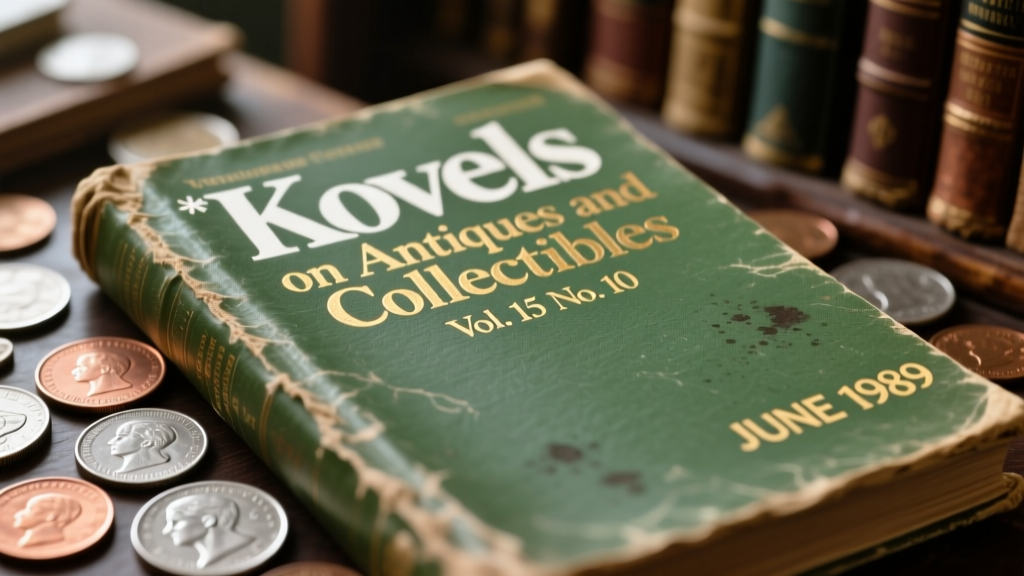
Kovels’ On Antiques and Collectibles, Vol. 15, No. 10 (June 1989): A Numismatic and Material Culture Time Capsule