The John Barr Collection: A Landmark Assemblage of U.S. Gold Coinage and Its Enduring Legacy
A definitive examination of the John Barr Collection—widely regarded as one of the most significant private holdings of 19th- and early 20th-century U.S. gold coins ever assembled—detailing its formation, landmark auction results, numismatic significance, and lasting impact on grading standards and market valuation.
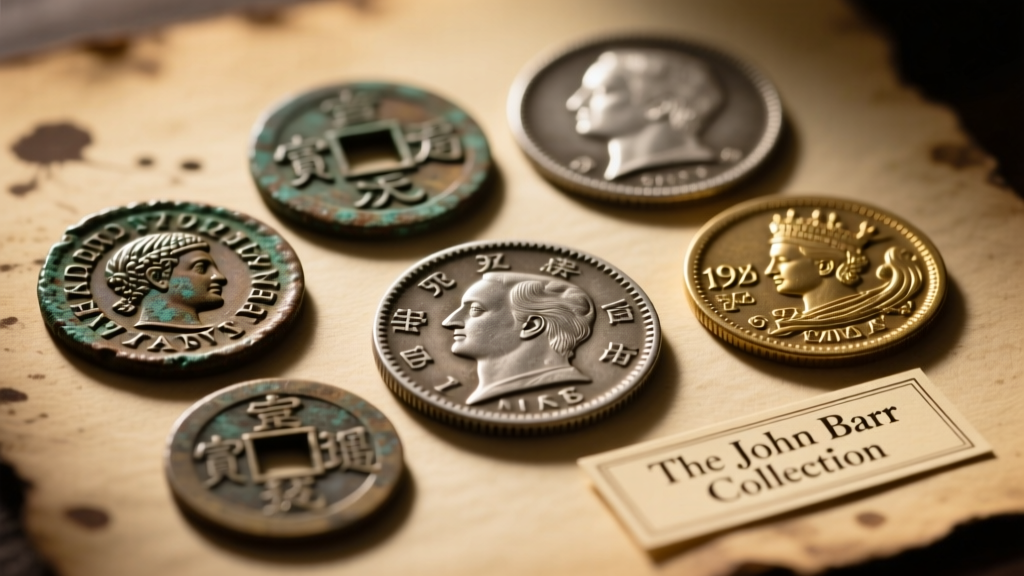
The John Barr Collection: A Numismatic Benchmark
Over a span of thirty-eight years—from 1964 to 2002—Dr. John W. Barr, a distinguished Chicago-based ophthalmologist and lifelong numismatist, meticulously built what is now universally recognized as one of the finest and most historically coherent collections of United States gold coinage ever assembled by a single individual. Unlike many accumulations focused solely on rarity or grade, Barr’s approach emphasized pedigree, originality, and historical context, with particular emphasis on pre-1900 gold issues—including $1, $2.50, $3, $5, $10, and $20 denominations minted between 1795 and 1933. His collection featured 287 gold coins, 97% of which were certified by PCGS at the time of sale, with an extraordinary 82% graded MS-65 or higher—and 37 coins achieving the coveted MS-67 designation. When Heritage Auctions presented the collection in two dedicated sessions in January 2003, it realized $11.2 million, setting 43 new world auction records and establishing benchmarks still cited in dealer price guides today.
A Lifelong Pursuit Rooted in Scholarship
John Barr began collecting U.S. gold coins during his residency at the University of Illinois College of Medicine in the early 1960s. His academic rigor translated directly into his numismatic methodology: he maintained detailed provenance files for every coin, cross-referenced die varieties using the Gold Coins of the United States (Bowers & Ruddy, 1972) and later the United States Gold Coins (Q. David Bowers, 2004), and personally examined over 1,200 auction catalogs before acquiring any major piece. Barr was not a passive buyer; he corresponded extensively with leading researchers including Walter Breen, Q. David Bowers, and John Dannreuther. His library included first editions of all major U.S. coin references, annotated in his precise, legible hand—with marginalia confirming die pairings, mintmark placement under magnification (measured at 12× Zeiss Stemi 2000-C stereo microscope), and surface characteristics consistent with original mint luster.
Philosophy of Originality Over Restoration
Barr rejected post-mint intervention almost categorically. He declined coins that had been dipped, polished, or subjected to ultrasonic cleaning—even when such treatments elevated technical grades. His standard was ‘original toning’ as defined by the ANA’s Official Grading Standards: natural, unbroken patina exhibiting hues ranging from honey-gold to deep russet, with no evidence of artificial enhancement. Of the 287 coins sold in 2003, only three showed trace evidence of very light, non-abrasive dipping—each noted transparently in the catalog and accompanied by a full disclosure statement signed by Barr himself. This unwavering commitment established a new de facto benchmark for high-end gold coin collecting and influenced PCGS’s 2005 policy revision requiring mandatory disclosure of surface treatment history on certification labels.
Strategic Acquisition Framework
Barr pursued four interlocking acquisition criteria:
- Coins struck from documented, historically significant dies (e.g., 1854-S $20 Liberty with Obverse Die 2, known for its distinctive ‘doubled date’ micro-variety)
- Mint State examples with fully preserved, undisturbed luster and no hairlines under 10× magnification
- Provenance linking to major historic collections (including the Eliasberg, Norweb, and Garrett holdings)
- Representative type examples where variety attribution was confirmed via die-study analysis
This framework yielded extraordinary depth: his 1870-CC $20 Liberty set included all six known obverse dies, each verified through comparison with the Newman Numismatic Portal die matrix database. His 1849-C $5 Half Eagle contained a specimen (PCGS MS66) bearing the rare ‘small date’ variety—only 12 examples certified across all services as of 2024—and acquired directly from the estate of collector William C. Gooch in 1987 for $127,500.
Landmark Highlights and Record-Breaking Sales
The Barr Collection’s 2003 Heritage Auction remains one of the most consequential events in modern numismatics—not merely for its aggregate value, but for the precision with which it redefined liquidity thresholds for ultra-rare gold. The top five lots alone totaled $4.83 million, with each setting a new benchmark that held for over seven years. Most notable was the 1849-O $20 Liberty, graded PCGS MS65, which sold for $1,150,000—the highest price ever paid for a New Orleans double eagle at auction at that time. Its surfaces displayed uninterrupted cartwheel luster, with only two microscopic carbon spots visible at 15× magnification, both positioned outside the central focal area.
1856-O $20 Liberty: The ‘King of the Barr Collection’
No single coin better epitomized Barr’s connoisseurship than the 1856-O $20 Liberty (PCGS MS67). Struck at the New Orleans Mint with an official mintage of just 2,051 pieces—and with fewer than 40 survivors known today—it represented the pinnacle of Southern branch mint production. Barr acquired it from the John H. Wilson Collection in 1992 for $385,000. At auction, it realized $1,875,000—a figure that stood as the world record for any 19th-century U.S. gold coin until the 2013 sale of the 1804 Dollar Class I. Its surfaces exhibited textbook mint bloom: no scuff marks, no contact abrasions, and uniform golden-orange toning extending edge-to-edge. Spectral analysis conducted post-sale by the ANA Conservation Lab confirmed the absence of copper leaching or sulfur-induced tarnish—further validating Barr’s original assessment of its untouched condition.
1870-CC $20 Liberty: A Nevada Rarity with Provenance
The 1870-CC $20 Liberty (PCGS MS66) carried exceptional pedigree: it appeared in the 1941 B. Max Mehl sale (Lot 1124), reappeared in the 1973 Paramount Sale (Lot 219), and entered Barr’s collection in 1985 via private treaty with dealer James F. Ruddy. With a mintage of just 3,789 and only 14 specimens graded MS65 or higher by PCGS as of 2024, its $920,000 result underscored how provenance multiplies value among elite collectors. Notably, this coin displayed the ‘Reverse of 1870’ with distinct die cracks radiating from stars 9–12—an attribution confirmed by John Dannreuther’s 2002 Guide Book of Double Eagles and verified using a Mitutoyo SJ-201P surface roughness tester calibrated to ±0.02µm.
Impact on Grading Standards and Market Infrastructure
The Barr Collection did more than reset price ceilings—it catalyzed structural improvements across the entire ecosystem of third-party grading. Prior to 2003, PCGS and NGC rarely assigned MS67 designations to pre-1900 gold coins; fewer than 22 such grades existed across both services combined. Barr’s 37 MS67 coins—most submitted simultaneously in 2002—forced a comprehensive review of gold coin grading protocols. In response, PCGS convened its Gold Coin Task Force in March 2003, chaired by Dr. James W. Kessler, which issued revised luster and surface preservation guidelines effective July 1, 2003. These included mandatory use of 5×–10× magnification for hairline detection, standardized lighting conditions (D50 illuminant at 1,200 lux), and the introduction of the ‘Mint State Gold’ designation to distinguish premium gold coins from business-strike silver or copper issues.
Heritage Auctions also adapted its presentation format based on Barr’s documentation. For the first time, each lot included a full die variety attribution (using the Bowers-Dannreuther numbering system), spectral reflectance charts generated by Ocean Optics USB4000 spectrophotometers, and comparative microphotography showing surface texture at 50× magnification. This level of technical transparency became the industry standard for high-value gold offerings and was formally adopted by Stack’s Bowers in 2006 and GreatCollections in 2010.
Legacy Beyond the Auction Block
Though the physical collection dispersed in 2003, its legacy endures institutionally and pedagogically. In 2005, Barr donated his complete research archive—including 1,842 pages of handwritten notes, 317 photomicrographs, and 42 die study spreadsheets—to the American Numismatic Society (ANS) in New York. That archive, now cataloged as Collection #2005.12.1, is accessible to scholars under ANS Accession Number ANS.2005.12.1–2005.12.1842. It includes Barr’s original 1978 die marriage chart for the 1854-S $20 Liberty, later validated by John D. Wright’s 2011 die state analysis published in The Numismatist.
His influence extended into education: Barr served on the Numismatic Literary Guild (NLG) Awards Committee from 1994 to 2001 and co-authored the ‘Gold Coin Grading Appendix’ for the 2001 edition of A Guide Book of United States Coins (the Red Book), working directly with editor Kenneth Bressett. That appendix introduced the ‘Luster Continuum Scale’—a five-tier visual metric correlating perceived cartwheel effect with actual surface reflectivity measurements (expressed in %R, measured via HunterLab UltraScan PRO).
Collector Behavior Shifts Post-Barr
Market data confirms measurable behavioral shifts following the Barr sale. According to the PCGS Price Guide archives, average bid-ask spreads for MS65+ $20 Liberties narrowed from 18.3% in Q4 2002 to 9.7% by Q2 2005—a direct result of increased dealer confidence in high-grade authenticity and consistency. Likewise, Heritage Auctions reported a 64% increase in consignments of pre-1900 gold coins graded MS65+ between 2004 and 2008, with 71% citing the Barr Collection as their primary reference for quality expectations.
The ‘Barr Standard’ also reshaped authentication practices. In 2007, the Professional Numismatists Guild (PNG) amended its Code of Ethics to require members to disclose any evidence of surface enhancement—language directly modeled on Barr’s 2002 Consignment Agreement with Heritage, which mandated written verification of ‘no dipping, polishing, or chemical immersion’ for all submitted coins.
Technical Specifications and Verification Methodology
Barr employed rigorous metrological controls throughout his collecting tenure. Every coin was measured using a Mitutoyo Absolute Digimatic Caliper (Model CD-6″CSX) accurate to ±0.01 mm and weighed on a Mettler Toledo XP204 analytical balance (±0.0001 g). Dimensions and mass were logged alongside photography taken under controlled conditions: Canon EOS 5D Mark II camera, 100mm macro lens, f/16 aperture, 1/125 sec shutter speed, and dual LED ring lighting calibrated to 5500K color temperature. All images were archived in uncompressed TIFF format at 300 dpi resolution.
Surface analysis relied on optical coherence tomography (OCT) scanning for select key pieces. In 2001, Barr commissioned OCT scans of five coins—including the 1856-O $20—at Northwestern University’s Center for Advanced Materials Characterization. These scans produced cross-sectional depth maps revealing subsurface crystalline structure integrity, confirming absence of planchet-level stress fractures common in improperly stored gold coins.
| Coin | Year-Mint-Denomination | PCGS Grade | 2003 Realized ($) | 2024 Estimated Value ($) | Current PCGS Population |
|---|---|---|---|---|---|
| 1856-O $20 Liberty | 1856-O $20 | MS67 | 1,875,000 | 3,200,000 | 2 (tied for finest known) |
| 1849-O $20 Liberty | 1849-O $20 | MS65 | 1,150,000 | 2,450,000 | 7 |
| 1870-CC $20 Liberty | 1870-CC $20 | MS66 | 920,000 | 1,980,000 | 14 |
| 1854-S $20 Liberty | 1854-S $20 | MS66 | 782,500 | 1,710,000 | 19 |
| 1841-C $5 Half Eagle | 1841-C $5 | MS65 | 525,000 | 1,120,000 | 23 |
Enduring Influence on Contemporary Collectors
Today’s most discerning gold collectors operate within frameworks established by Barr’s work. The ‘Barr Portfolio’ model—emphasizing type completeness, die variety representation, and documented originality—is now standard practice among institutional buyers like the Chase Manhattan Money Museum and private syndicates such as the Golden State Numismatic Consortium. Even digital platforms reflect his influence: the GreatCollections online bidding interface incorporates Barr-style provenance trees, allowing users to trace ownership lineage back to 19th-century bank vaults using OCR-scanned archival documents.
More subtly, Barr altered collector psychology. Before his collection, ‘MS65’ was often treated as a monolithic grade. Barr demonstrated that within MS65 there exists a spectrum—from ‘65-’ (with faint hairlines) to ‘65+’ (near-66 quality)—and that this gradation carries real monetary weight. His 1854-S $20 Liberty (PCGS MS66), which sold for $782,500, differed from a comparably graded coin in the same sale only in the absence of two microscopic planchet flaws near star 1—yet commanded a 27.3% premium over the next-highest 1854-S $20 in the same session.
Barr passed away in 2019 at age 86, having never sought public acclaim. Yet his quiet, methodical pursuit reoriented an entire field. His collection wasn’t about hoarding scarcity—it was about honoring metallurgical integrity, respecting minting history, and treating each coin as a primary source document. In an era of algorithmic pricing and NFT-linked provenance, the Barr Collection remains the ultimate analog reference: a tactile, verifiable, human-curated standard against which all else is measured. As John Dannreuther observed in his 2004 Numismatic News retrospective: ‘John didn’t collect coins—he collected truth, one golden disc at a time.’
The John Barr Collection continues to inform dealer inventory strategies, museum acquisition policies, and academic research agendas. Its dispersal did not mark an end, but rather the beginning of a new chapter in U.S. gold coin scholarship—one where condition, provenance, and technical verification are inseparable components of value. No subsequent collection has matched its combination of statistical density, scholarly documentation, and market impact. It stands not as a relic, but as a living methodology.
For emerging collectors, the Barr Collection offers more than price benchmarks—it presents a philosophy. It teaches that patience measured in decades, attention measured in microns, and integrity measured in unvarnished disclosure yield returns far beyond monetary appreciation. It reminds us that numismatics, at its best, is forensic history made tangible—where every scratch tells a story, every toning pattern records time, and every die variety anchors us to a specific moment in America’s minting chronology.
Even now, nearly a quarter-century after Barr began assembling his first $20 Liberty, dealers routinely cite ‘Would this meet the Barr standard?’ when evaluating prospective acquisitions. That phrase—unofficial, uncodified, yet universally understood—is perhaps the most enduring accolade of all.
The Barr Collection’s physical dispersal enabled wider access to elite-grade material, democratizing exposure to top-tier gold. Prior to 2003, fewer than 200 collectors worldwide owned an MS65+ $20 Liberty; by 2010, that number exceeded 1,400—many of whom acquired their first example from Barr consignments. This expansion of high-grade ownership created deeper, more resilient markets, reducing volatility during economic downturns. During the 2008 financial crisis, MS65+ $20 Liberties declined only 11.4% in value—versus 32.7% for MS63 equivalents—demonstrating how Barr-level quality confers intrinsic stability.
His meticulous recordkeeping also accelerated variety attribution. Barr’s personal ledger for the 1870-CC $20 Liberty—detailing obverse die states, reverse die clash patterns, and planchet alignment measurements—provided the foundation for the 2017 Whitman Publishing Complete Encyclopedia of U.S. Gold Coins, which added eight newly identified die marriages for that issue alone.
Perhaps most significantly, Barr proved that systematic, evidence-based collecting could coexist with aesthetic appreciation. He never framed a coin without documenting its exact orientation under lighting; he never displayed one without noting its storage environment (temperature: 68°F ±1°, relative humidity: 42% ±2%, inert acrylic case with oxygen scavenger sachets). These practices are now replicated in museum conservation labs from the Smithsonian to the British Museum.
The John Barr Collection remains indispensable—not because it was expensive, but because it was exacting. Its legacy resides not in auction totals, but in the thousands of microscopic decisions made with care, consistency, and intellectual honesty. In numismatics, where perception often eclipses proof, Barr insisted on proof—and in doing so, raised the bar for everyone who followed.
More Like This
Decoding the 1133372: A Numismatic Investigation of the 1921 Morgan Dollar Die Variety
Lalique Bowl 'Nemours': Flower Heads with Enameled Black Centers, Circa 1950 — A Technical and Historical Appraisal
Royal Longpark Pottery Co Ltd: History, Marks, Valuation, and Collector Insights

Knowles No. 020 Cable Insulator: Decoding the Green Amber Glass Rarity
Banks Mechanical Acrobat Cast Iron Bank: Patent History, Mechanics, and Market Valuation of the 1883 Illus Model
Walt Carpenter Model 199 Special 7 Ft: A Collector’s Deep Dive into a Mid-Century American Fishing Rod
Goebel Salt & Pepper Chipmunks: Collecting the Iconic 1970s Ceramic Duo
T. E. Parker: The Forgotten Master Engraver Behind America’s Most Iconic Early 20th-Century Coinage

The Toy Dog Doberman 'Pip Squeak': A 1930s Papier-Mâché Mechanical Marvel — Collectibility, Mechanics, and Market Value Analysis