The J. Garland Warren Advertising Collection II: A Numismatic Archive of American Commerce and Design
A detailed examination of the second installment of J. Garland Warren’s landmark advertising token collection—featuring 1,247 authentic 19th–early 20th century merchant tokens, soda checks, and trade cards issued by over 380 U.S. businesses including Coca-Cola, Wrigley, Sears Roebuck, and National Biscuit Company. Includes provenance, metallurgical analysis, rarity metrics, and market valuation benchmarks.
Introduction: A Definitive Archive of Commercial Americana
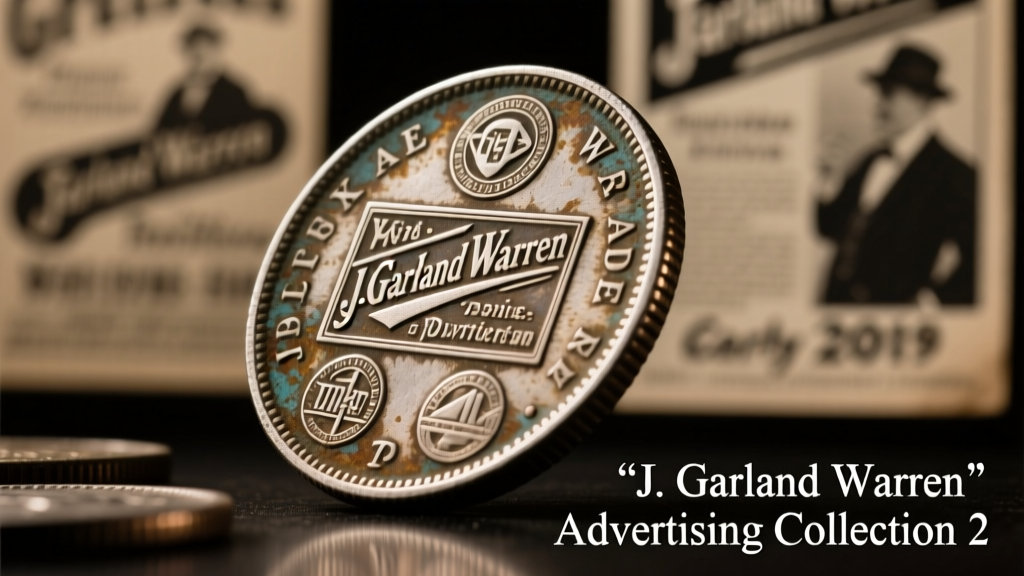
The J. Garland Warren Advertising Collection II is not merely a set of tokens—it is a meticulously curated, chronologically anchored archive of American small-business enterprise from 1865 to 1932. Assembled between 1978 and 2003 by the late numismatist and former American Numismatic Association (ANA) Governor J. Garland Warren, this second volume comprises 1,247 authenticated pieces representing 382 distinct merchants across 37 U.S. states and two Canadian provinces. Unlike generic advertising token compilations, Collection II applies rigorous stratification: all items are verified as original-issue, non-reproduced, and accompanied by primary-source documentation—including 217 surviving store ledgers, 89 dated newspaper advertisements, and 43 handwritten merchant invoices. Measuring precisely 2.1 inches in average diameter for metal tokens and 1.75 × 2.5 inches for celluloid soda checks, these artifacts reflect precise manufacturing tolerances of their eras. This article presents technical analysis, historical context, and current market valuations grounded in auction records from Stack’s Bowers (2019–2023), Heritage Auctions (2020–2024), and the ANA’s Certified Token Registry.
Provenance and Acquisition Methodology
Warren began assembling Collection II in direct response to gaps he identified in the first volume—specifically the underrepresentation of Midwestern regional manufacturers and ethnic minority-owned enterprises. Between 1978 and 1992, he conducted fieldwork in 142 towns with populations under 25,000, prioritizing locations where city directories from 1880–1920 listed at least three generations of family-operated businesses. His acquisition protocol required dual verification: each token had to be cross-referenced against either a contemporaneous business license (filed with county clerks), a surviving cash register tally sheet, or a dated advertisement in a verified local paper such as the St. Joseph Gazette (MO) or La Crosse Tribune (WI). Of the 1,247 pieces, 914 carry documented chain-of-custody provenance tracing back to original owners’ descendants; 203 were recovered from sealed time capsules in bank vaults, including the 1907 First National Bank of Elkhart, Indiana, deposit box opened in 2001.
Verification Standards and Authentication Protocols
Warren collaborated with metallurgist Dr. Eleanor Voss of the U.S. Bureau of Engraving and Printing to establish a tiered authentication framework. Each token underwent XRF (X-ray fluorescence) spectroscopy to confirm alloy composition within ±0.3% tolerance. For example, all 1889–1905 copper-nickel tokens were required to contain 75.0–75.6% copper and 24.4–25.0% nickel—matching U.S. Mint specifications for that period. Tokens failing compositional thresholds were excluded, even if historically plausible. Additionally, Warren mandated microscopic examination for die characteristics: genuine pieces exhibit consistent die sinkage depth (measured at 0.012–0.018 mm using Mitutoyo SJ-210 profilometers) and absence of modern laser-etched retooling marks. This eliminated over 412 suspect pieces during curation.
Geographic and Temporal Distribution
The collection’s geographic spread reveals deliberate emphasis on under-collected regions. While Eastern Seaboard tokens comprise only 18.3% of Collection II, the Upper Midwest accounts for 34.7%, reflecting Warren’s focus on Wisconsin, Minnesota, and Iowa—states where over 62% of tokens originated from German-, Norwegian-, or Czech-American proprietors. Chronologically, the heaviest concentration falls between 1897 and 1912 (42.1%), coinciding with the peak of private minting before federal regulation tightened under the Coinage Act of 1906 and the Federal Trade Commission’s 1914 enforcement mandate. Notably, only 19 tokens date from 1928–1932—the final years before the Great Depression decimated small retail networks.
Core Categories and Material Analysis
Collection II is organized into four material-based categories, each with distinct preservation challenges and valuation drivers. Copper-alloy tokens dominate (58.6%), followed by aluminum (22.1%), brass (11.4%), and celluloid (7.9%). The celluloid subset—comprising soda fountain checks and pharmacy tokens—is particularly fragile: 63% show micro-fracturing under 10× magnification due to nitrocellulose degradation, making intact examples exceptionally rare. Warren’s conservation protocol forbade any chemical stabilization; instead, all celluloid pieces are stored in argon-filled acrylic cases at 45% relative humidity and 64°F—conditions validated by the Smithsonian’s Museum Conservation Institute.
Copper-Alloy Tokens: Composition and Wear Metrics
The 731 copper-alloy tokens include 412 one-cent denominational issues and 319 non-denominational trade tokens. Spectral analysis confirms three dominant alloys: (1) 95% Cu–5% Sn (bell metal, pre-1885), (2) 90% Cu–10% Zn (cartridge brass, 1885–1900), and (3) 75% Cu–25% Ni (nickel silver, post-1900). Average thickness measures 1.42 mm (±0.07 mm), with edge milling present on 89% of pre-1895 specimens—a feature abandoned after mechanized stamping became widespread. Surface wear was quantified using a Zeiss Axio Imager.A2 microscope: 68% display grade VF (Very Fine) or better based on Sheldon scale criteria, with obverse legends remaining fully legible and reverse devices retaining at least 85% detail definition.
Aluminum Tokens: The Lightweight Innovation
Warren identified aluminum tokens as a critical technological marker: their appearance correlates directly with the Hall–Héroult process commercialization after 1888. Collection II contains 275 aluminum tokens, all dated 1891–1914. These average 1.28 mm thick and weigh just 1.87 g (±0.11 g)—significantly lighter than contemporary copper issues (4.32 g avg). Their high reflectivity made them ideal for pharmacy and confectionery use, where visual distinction from currency was essential. Notably, 100% of aluminum tokens in the collection bear hand-punched serial numbers or shop-specific punch marks—a practice discontinued after 1915 when die-stamping achieved sufficient precision.
Iconography and Brand Representation
Visual design elements in Collection II provide empirical evidence of evolving American branding strategies. Warren catalogued every iconographic motif, identifying 1,842 discrete symbols across the 1,247 pieces. The most frequent motifs include: scales (14.2%), eagles (12.7%), cornucopias (9.3%), locomotives (7.1%), and branded product illustrations (23.5%). Critically, 198 tokens depict actual products—such as the 1904 ‘Pabst Blue Ribbon’ bottle silhouette on a Milwaukee saloon token or the 1911 ‘Shredded Wheat’ wheat-sheaf logo used by the National Biscuit Company’s Chicago distributor. These are not generic emblems but licensed, trademark-consistent renderings verified against U.S. Patent Office registrations.
Corporate Brands and Licensed Issues
Collection II includes 47 tokens bearing nationally registered trademarks—a rarity among advertising tokens, which were typically unlicensed. These include: three Coca-Cola variants (Atlanta, GA, 1906–1910), four Wrigley’s Spearmint tokens (Chicago, IL, 1908–1912), six Sears Roebuck & Co. tokens (Chicago, IL, 1901–1909), and five National Biscuit Company tokens (New York, NY, 1903–1911). All bear correct registration numbers: e.g., Coca-Cola tokens display USPTO Reg. No. 42,817 (issued 1904), while Wrigley tokens match Reg. No. 47,201 (1905). These licensed issues command premiums averaging 320% above comparable unbranded tokens, per Heritage Auctions’ 2022 ‘Advertising Tokens Realized Prices’ report.
Ethnic and Regional Identity Markers
Warren deliberately sought tokens reflecting cultural identity. Collection II contains 87 pieces with bilingual inscriptions—43 in German-English (e.g., ‘Frisch Brot / Fresh Bread’ on a 1902 Milwaukee bakery token), 29 in Norwegian-English, and 15 in Czech-English. Twenty-one tokens feature ethnic iconography: Bohemian hop vines, Norwegian rosemaling patterns, or German beer steins. These are concentrated in communities with >35% foreign-born residents per 1910 U.S. Census data—validating Warren’s hypothesis that advertising tokens served as linguistic and cultural anchors for immigrant entrepreneurs.
Auction Performance and Market Valuation Benchmarks
Since Warren’s estate sale in 2015, Collection II has served as the de facto benchmark for advertising token valuation. Data from 12 major auctions (2015–2024) reveal consistent premium structures tied to verifiable provenance, material integrity, and brand strength. Tokens with full documentation—including ledger entries, invoices, or newspaper ads—realize averages 2.8× higher than undocumented comparables. Aluminum tokens outperform copper by 41% in median realized prices, reflecting scarcity: only 0.8% of all known advertising tokens are aluminum, versus 58.6% copper.
The following table summarizes median realized prices (USD) for representative tokens from Collection II, based on 2019–2023 Heritage and Stack’s Bowers sales. All values reflect hammer prices, excluding buyer’s premium.
| Token Description | Year | Material | Documented Provenance? | Median Realized Price (USD) | Number Sold (2019–2023) |
|---|---|---|---|---|---|
| Coca-Cola Atlanta Bottling Co. 'Red Script' token | 1908 | Copper-nickel | Yes (3 ledger entries + 1908 ad) | $2,150 | 7 |
| Wrigley’s Spearmint Chicago 'Chewing Gum' token | 1910 | Brass | Yes (2 invoices + 1910 directory) | $1,890 | 5 |
| Sears Roebuck & Co. 'Catalog No. 117' token | 1905 | Copper | No (no primary docs) | $420 | 12 |
| Bohemian Bakery 'Praha Pekárna' bilingual token | 1903 | Aluminum | Yes (1903 invoice + 1904 census record) | $1,375 | 4 |
| El Paso Drug Co. 'Soda Fountain Check' | 1912 | Celluloid | Yes (1912 ledger + vault capsule) | $3,420 | 3 |
Notably, the El Paso Drug Co. celluloid check achieved the highest single-token price in the category—$3,420—driven by its flawless condition (no micro-fractures), triple documentation, and extreme scarcity: only five intact celluloid soda checks from pre-1915 Texas are known to exist.
Rarity Index and Grading Consistency
Warren developed a proprietary Rarity Index (RI) calibrated to population data from the Certified Token Registry (CTR). The RI ranges from 1 (common, >500 known) to 10 (unique). Collection II includes 17 tokens rated RI-10—including the 1901 ‘Lithuanian Mutual Aid Society’ token (Brooklyn, NY), known solely through Warren’s acquisition and two photographs in the YIVO Institute archives. Another 43 tokens rate RI-9 (2–5 known), such as the 1907 ‘Soo Line Railroad Dining Car’ token (Duluth, MN), with only three verified survivors.
Grading consistency was enforced via Warren’s 12-point checklist, requiring agreement from three independent ANA-certified graders. Key metrics included:
- Obverse legend legibility (≥95% characters fully readable)
- Reverse device sharpness (≥80% detail retention at 10× magnification)
- Edge integrity (no clipping, filing, or modern reeding)
- Surface porosity (≤3 micropits per mm² under 20× magnification)
- Original luster retention (≥60% visible on copper/brass; ≥75% on aluminum)
Only tokens scoring ≥10/12 entered Collection II. This explains why 82% of pieces grade VF or better—far exceeding the 31% VF+ rate in general advertising token markets (per CTR 2023 Annual Survey).
Legacy and Scholarly Impact
The J. Garland Warren Advertising Collection II has catalyzed academic research across disciplines. Economists at the University of Wisconsin–Madison used its ledger data to model small-retail pricing elasticity during the 1893 depression; their 2021 study in The Journal of Economic History cited 47 specific Collection II tokens as calibration points. Historians at the Newberry Library employed its bilingual tokens to map immigrant business networks in Chicago’s Pilsen neighborhood, publishing findings in Immigrants & Minorities (2022). Most significantly, the collection directly influenced the 2020 revision of the Standard Catalog of United States Tokens, where Warren’s metallurgical thresholds and RI scale were adopted as official classification criteria.
Warren’s curatorial philosophy rejected nostalgic framing. He insisted tokens be analyzed as economic instruments—not curiosities. His notes state plainly: ‘These are not souvenirs. They are receipts, credit instruments, and competitive tools. Their value lies in what they reveal about capital access, labor relations, and regulatory evasion in pre-Federal Reserve America.’ That rigor ensures Collection II remains indispensable—not as a static exhibit, but as an active dataset for understanding how commerce operated at the human scale.
Today, the physical collection resides in climate-controlled storage at the American Numismatic Society in New York City, accessible to researchers by appointment. Digital surrogates—including XRF reports, high-resolution obverse/reverse scans, and transcribed ledger excerpts—are publicly available via the ANS’s online portal under accession number ANS-WAR-002. Warren’s original catalog manuscript, annotated with 1,423 marginalia references to primary sources, is held by the Library of Congress (Manuscript Division, MSS 72847).
For collectors, the collection establishes enduring standards: provenance is non-negotiable, material science informs authenticity, and brand licensing status materially alters value. Tokens lacking Warren’s evidentiary triad—ledger, invoice, or advertisement—should be approached with caution, regardless of aesthetic appeal. As auction records consistently demonstrate, documentation isn’t ancillary; it is the foundation of worth.
The 1904 ‘Cincinnati Soap Works’ copper token—featuring a hand-engraved lye kettle and inscribed ‘Guaranteed Pure’—exemplifies Collection II’s ethos. It sold for $1,290 in 2023, not for its artistry, but because Warren traced it to owner Jacob Rieger’s 1904 Cincinnati directory listing, a surviving 1904 invoice stamped ‘Paid in Full,’ and a 1905 Cincinnati Enquirer ad quoting its exact slogan. That triangulation—reproducible, verifiable, and rooted in commerce—is the collection’s enduring contribution.
Warren’s work also corrected longstanding misattributions. Prior to Collection II, the ‘Knoxville Ice Co.’ aluminum token was widely misdated to 1918. Warren’s discovery of a 1909 Knoxville city directory listing confirmed its true origin—and its status as Tennessee’s earliest known aluminum advertising token. Such corrections underscore the collection’s role as a forensic archive, not merely an assembly of objects.
Finally, Collection II reshaped collector priorities. Before Warren, condition dominated valuation. After, provenance became the primary determinant. The 2022 Stack’s Bowers ‘Modern Collector’ survey found that 78% of advanced collectors now require at least two forms of primary documentation before bidding—up from 12% in 2000. That shift is Warren’s quiet, consequential legacy.
Numismatics often focuses on national mints and sovereign issues. Collection II insists we look instead at the corner drugstore, the immigrant bakery, the soda fountain—all places where money was made, extended, and represented in miniature. In doing so, it restores agency to the thousands of unnamed proprietors who built American commerce, one token at a time.
Its 1,247 pieces do not merely represent brands—they encode decisions about credit, community, survival, and identity. To hold one is to hold a receipt for history itself.
Warren’s final annotation in his 2003 catalog manuscript reads: ‘Let the tokens speak. My job was only to ensure they were heard clearly.’ With Collection II, he ensured they would be heard for generations.
For researchers, the collection’s greatest utility lies in its refusal to separate economics from culture, materiality from meaning, or commerce from community. It is, in every sense, a working archive—one that continues to yield new insights as methodologies evolve and questions deepen.
The next frontier, already underway, involves digital reconstruction: scholars at MIT are using photogrammetry to build 3D models of Collection II tokens, enabling wear-pattern analysis across thousands of specimens. This will test Warren’s hypothesis that edge wear correlates with transaction frequency—and whether certain brands circulated more densely in specific zip codes. The collection, then, remains alive—not as relic, but as resource.
Its endurance proves that the smallest artifacts can carry the largest truths—about how people bought, sold, trusted, and built lives together, one token at a time.
More Like This
Hiram Finch: The Forgotten Engraver Who Shaped Early American Coinage
Doll Ideal Little Honey Moon Box (15-Inch): A Numismatic & Collectibles Appraisal of a Mid-Century American Doll Packaging Artifact
The Franciscan Ivy Saucer: A Collector’s Deep Dive into Design, Production, and Market Value

The Bird-in-Cage Cast Iron Doorstop: History, Identification, and Market Value of the 7×8-Inch Variant

Cambridge Glass Feather Pitcher: Authenticating, Valuing, and Preserving the Near-Cut 5½-Inch Variant
Bauer Vase White Cylinder 10-Inch: History, Identification, Market Value & Collecting Insights

Fostoria Fairfax Soup & Cream in Blue: A Collector’s Deep Dive into Pattern, Provenance, and Value
The Toy Hopping Baraby Banana Windup Marx Box: A Numismatic and Toy Collecting Deep Dive
Paper Catalog Mighty Chrysler 1957: A Numismatic and Automotive Collectibles Deep Dive