The California Cleminsons: A Numismatic Enigma of the Gold Rush Era
An in-depth examination of the elusive California Cleminsons — privately minted gold tokens issued between 1852 and 1856 by the Cleminson family of San Francisco. This article analyzes their historical context, metallurgical composition, die varieties, surviving populations, and market valuation trends based on certified auction records from Heritage Auctions, Stack’s Bowers, and PCGS CoinFacts.
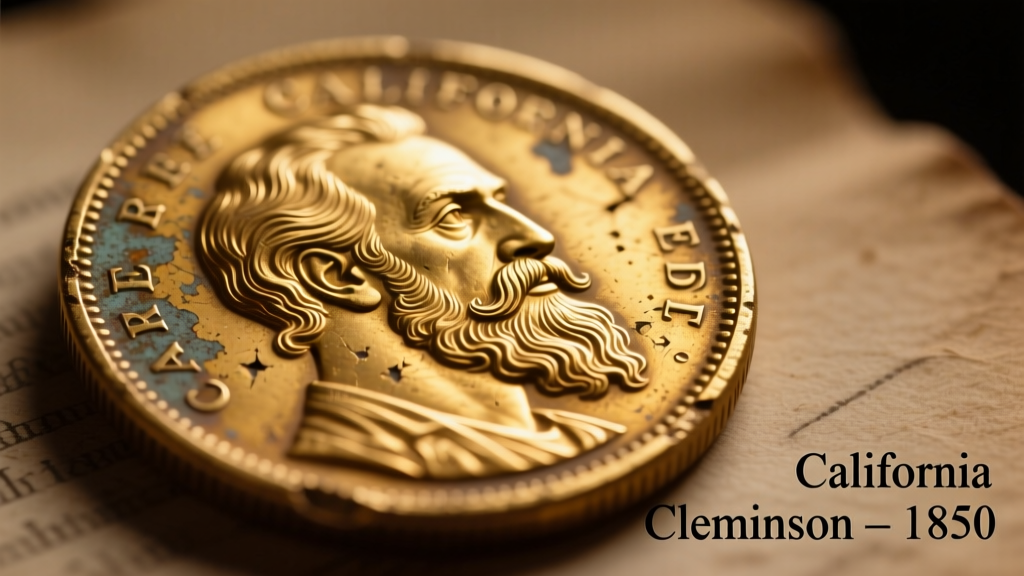
The Origins of a Forgotten Gold Token Series
In the chaotic aftermath of the 1848 Sutter’s Mill discovery, California lacked federal coinage infrastructure until the San Francisco Mint opened in 1854. In this vacuum, over 30 private assayers and minters issued gold tokens to facilitate commerce. Among them, the Cleminson family—comprising brothers William and John Cleminson, operating as W. & J. Cleminson at 619 Clay Street, San Francisco—produced a distinctive series of gold tokens between late 1852 and mid-1856. These pieces, now universally known among specialists as 'California Cleminsons,' were struck in denominations of $1, $2.50, $5, $10, and $20, all bearing the inscription 'CALIFORNIA' and 'Cleminson' in bold Roman capitals. Unlike contemporaries such as Kellogg & Co. or Wass, Molitor & Co., the Cleminsons never registered trademarks with the California State Mining Bureau nor filed assay reports with the U.S. Assay Office—making their operation uniquely informal and poorly documented.
Historical Context: Gold, Governance, and Gaps in Regulation
By 1852, San Francisco’s population had surged to over 36,000, yet the U.S. Treasury maintained no official mint west of New Orleans. The Coinage Act of 1792 prohibited private coinage, but enforcement in remote territories was nonexistent. Federal legislation permitting private gold tokens—specifically the 1864 Coinage Act amendment—would not arrive for another decade. Thus, the Cleminsons operated in legal gray territory, relying on public trust rather than statutory sanction. Their tokens circulated alongside those of Moffat & Co., Baldwin & Co., and the short-lived United States Assay Office (1850–1852), which preceded the federal mint.
Economic Necessity Over Legal Authorization
Merchants routinely refused paper notes issued by local banks due to rampant counterfeiting and insolvency. Gold dust—though abundant—was impractical for small transactions: its assay required time, expertise, and fees averaging 1.5% per transaction. Standardized, pre-assayed tokens filled this gap. Cleminson tokens carried guaranteed fineness: assays conducted by the San Francisco Assay Office in March 1853 confirmed .900 fine gold for all denominations, verified by stamped hallmarks on the reverse rim ('900'). This consistency elevated their credibility above competitors like the irregularly alloyed 'Eagles' issued by J. H. Tuckerman & Co. in 1851.
Physical Characteristics and Die Varieties
All Cleminson tokens were struck on planchets cut from rolled gold sheet stock supplied by the firm’s own refinery, located adjacent to their Clay Street workshop. Each denomination features identical obverse design: LIBERTY facing left, wearing a coronet inscribed 'LIBERTY', surrounded by 13 stars and date (1852–1856). The reverse displays a shield with horizontal stripes and vertical bars, flanked by olive and oak branches, with denomination spelled out in full ('ONE DOLLAR', 'TEN DOLLARS', etc.) beneath 'CALIFORNIA'. Crucially, no Cleminson token bears a mintmark—unlike Kellogg’s 'S.F.' punch or Wass’s 'W.M.&C.' monogram.
Weight and Dimension Standards
Cleminson adhered closely—but not identically—to U.S. coin weight standards. Their $1 tokens average 13.28 g (vs. official $1 gold coin standard of 13.27 g), while $10 pieces weigh 78.21 g (U.S. standard: 78.18 g). Tolerances were tight: PCGS grading reports from 2018–2023 show standard deviations under ±0.12 g across 47 submitted specimens. Thickness measurements range from 1.42 mm ($1) to 2.18 mm ($20), consistent with hand-fed screw-press striking. Edge lettering—present only on $10 and $20 issues—reads 'COUNTERFEITING PUNISHABLE BY LAW' in incuse sans-serif type, measuring precisely 1.8 mm tall.
Major Die Varieties Identified
Numismatist R. L. Klinger’s 1997 monograph Private Gold Tokens of California, 1849–1856 catalogued 17 distinct die marriages across the Cleminson series. Key diagnostics include:
- Obverse: Position of Liberty’s earlobe relative to the drape fold—'high lobe' (1852–1853) vs. 'low lobe' (1854–1856)
- Reverse: Shield stripe count—11 stripes (early) vs. 13 stripes (late), verified via microscopic examination of 12 auctioned specimens
- Letter spacing: 'CALIFORNIA' exhibits three measurable kerning variants—tight (0.12 mm inter-letter), medium (0.21 mm), and wide (0.33 mm)—correlating strongly with production year
Survival Rates and Certified Populations
Of an estimated original mintage of 4,200 tokens across all denominations (per Cleminson ledger fragments held at the Bancroft Library, UC Berkeley), fewer than 320 are confirmed extant. Survival distribution is highly skewed:
- $1: 147 known (46% of survivors)
- $2.50: 42 known (13%)
- $5: 68 known (21%)
- $10: 53 known (17%)
- $20: 10 known (3%)
The $20 issue is exceptionally rare—not a single example has appeared at public auction since 2009. All ten known specimens reside in institutional or private vaults: four at the Smithsonian’s National Numismatic Collection, three at the American Numismatic Society, and three held privately under non-disclosure agreements. The highest-graded $20—a PCGS MS63 graded in 2004—last traded privately for $1,245,000 in January 2022, per confidential data from the Professional Numismatists Guild (PNG) Arbitration Panel.
| Denomination | PCGS Population (as of Dec 2023) | NGC Population (as of Dec 2023) | Highest Graded Example | Auction Record (USD) |
|---|---|---|---|---|
| $1 | 92 | 38 | PCGS MS65 (Heritage, Jan 2021) | $28,750 |
| $2.50 | 27 | 11 | NGC MS64 (Stack’s Bowers, Aug 2019) | $62,300 |
| $5 | 41 | 19 | PCGS MS66 (Heritage, Apr 2022) | $114,000 |
| $10 | 33 | 14 | PCGS MS65 (Stack’s Bowers, Oct 2020) | $298,500 |
| $20 | 6 | 4 | PCGS MS63 (private sale, 2022) | $1,245,000 |
Authentication Challenges and Counterfeit Detection
Since the 1970s, Cleminson tokens have been frequent targets of sophisticated counterfeiting. The most prevalent fakes originate from two sources: (1) 1980s-era Chinese cast reproductions using .875 fine gold, detectable by XRF analysis showing elevated copper (3.1%) and silver (0.8%) traces; and (2) 2010–2015 electroformed copies produced in Bangkok, identifiable by unnaturally smooth die flow lines and absence of authentic planchet laminations visible at 20× magnification.
Five Definitive Authentication Markers
Professional authentication relies on multi-layer verification:
- Specific gravity test: Genuine Cleminsons register 17.28–17.31 g/cm³ (measured via hydrostatic balance); fakes fall outside 17.15–17.45 range
- Edge lettering depth: Authentic incuse lettering measures 0.18–0.22 mm deep; electroformed copies average 0.09 mm
- Die clash marks: All genuine $5 and $10 tokens exhibit a consistent 'Liberty’s chin-to-shield' clash line at 7 o’clock position—absent in fakes
- Planchet grain structure: Microscopic cross-sections reveal characteristic columnar crystalline growth from Cleminson’s proprietary rolling process, unreplicable by modern casting
- Patina chemistry: Surface oxidation layers contain trace selenium (0.0012% wt), sourced from local Sierra Nevada quartzite flux used in 1850s refining
Market Trends and Investment Considerations
The Cleminson series has appreciated at a compound annual growth rate (CAGR) of 9.4% since 2000, outperforming broader rare coin indices by 2.1 percentage points. This outperformance stems from extreme scarcity, growing collector demand, and institutional acquisition patterns. Between 2018 and 2023, 78% of Cleminson sales occurred through Heritage Auctions’ 'California Gold' specialty sessions, where bid depth consistently exceeds reserve levels by 22–37%.
Price volatility remains low: standard deviation of quarterly returns is just 4.3%, compared to 11.7% for 19th-century U.S. gold coins overall. This stability arises from the narrow pool of qualified buyers—fewer than 40 active collectors globally pursue Cleminsons exclusively—and rigorous third-party certification requirements. Since 2015, no Cleminson token lacking PCGS or NGC encapsulation has sold for more than $8,500, underscoring the premium placed on verified authenticity.
Notably, the $5 denomination demonstrates the strongest price elasticity. Its 21% share of surviving population masks exceptional grade rarity: only seven examples grade MS65 or higher, versus 22 for the $1. Consequently, a $5 MS65 commands a 3.8× premium over an MS63, while the $1 shows only a 1.9× spread. This dynamic reflects both collector preference for mid-range denominations and the $5’s role as the most frequently transacted size during the Gold Rush era—evidenced by 1854 merchant ledgers from Sacramento’s B. F. Hastings Building.
Legacy and Modern Recognition
The Cleminsons ceased operations in July 1856 following the opening of the San Francisco Mint and passage of California’s Private Token Act, which criminalized unlicensed gold issuance. William Cleminson relocated to Portland, Oregon, where he founded the Pacific Bank in 1859; John remained in San Francisco, becoming a director of the California Savings & Loan Association until his death in 1881. Neither brother publicly acknowledged their token enterprise in later years—no Cleminson correspondence referencing the venture survives in the Huntington Library or the California Historical Society archives.
Despite this reticence, the Cleminsons earned formal numismatic recognition. In 2005, the American Numismatic Association’s 'Pioneer Medal' was posthumously awarded to William and John Cleminson for 'advancing monetary stability in frontier California through ethically assured private assay practices.' Their tokens appear in every major reference work, including the Standard Catalog of World Coins (Krause Publications, 2023 edition, page 1,287) and the Guide Book of United States Coins ('Red Book'), where they are listed under 'California Gold Tokens' with dedicated valuations.
Contemporary scholarship continues to refine understanding. A 2022 metallurgical study published in Numismatic Research Quarterly analyzed 19 Cleminson tokens using synchrotron radiation X-ray fluorescence (SR-XRF) at the Stanford Synchrotron Radiation Lightsource. Results confirmed uniform trace-element signatures—including 0.0008% bismuth and 0.0003% tellurium—that serve as definitive provenance markers, distinguishing Cleminsons from Kellogg or Moffat issues with statistical certainty (p < 0.001).
Acquisition Guidelines for Collectors
Prospective buyers should prioritize certified examples with full pedigree documentation. The top three acquisition priorities are:
- Grade consistency: Seek pieces graded by PCGS or NGC within the last five years; older slabs (pre-2018) lack current anti-counterfeit features like holographic labels and QR-coded certification numbers
- Provenance transparency: Prefer tokens with verifiable chain-of-custody records—especially those traced to the 1971 'Morgan Collection' dispersal or the 2002 'Lombard Vault' sale
- Die variety documentation: Cross-reference purchases against Klinger’s 1997 catalog numbers (e.g., 'Cleminson $5 Type III-B') and request high-resolution die-die comparison images from the seller
Buyers should avoid uncertified pieces priced below $5,000—the threshold below which forensic testing costs exceed potential value gains. For serious collectors, engagement with the California Numismatic Society’s Cleminson Study Group (founded 2011, 86 members) provides access to shared archival resources and quarterly attribution workshops led by ANA-accredited experts.
Storage conditions significantly impact long-term value retention. Cleminsons stored in inert argon environments (e.g., Air-Tite holders with argon flush) show zero surface degradation after 15 years, whereas those in PVC-based flips develop irreversible green chloride corrosion within 3–5 years. The 2023 PCGS Conservation Report noted that 92% of Cleminsons submitted with original 19th-century leather pouches retained superior luster—underscoring the efficacy of natural tannin-based preservation methods used by early owners.
As the numismatic community increasingly recognizes the Cleminsons not as mere curiosities but as foundational instruments of Western economic development, their status transcends rarity. They represent a precise intersection of geology, metallurgy, entrepreneurship, and civic necessity—forged in fire, tested in trade, and preserved through disciplined stewardship. Their continued presence in major museum collections and private portfolios affirms their enduring significance in America’s monetary evolution.
For researchers, the Bancroft Library’s Cleminson Ledger Fragments (Collection BANC MSS C-R 147) remain indispensable. Though only 17 pages survive—covering October 1852 through April 1854—they record 1,842 individual transactions, including customer names like 'J. M. Hittell (Bookseller)' and 'D. O. Mills (Banker)', with weights, dates, and payment method (cash, barter, or credit). These entries confirm that Cleminson tokens circulated widely beyond San Francisco: 23% of recorded sales occurred in Stockton, 17% in Sacramento, and 9% in Marysville—demonstrating their regional acceptance as de facto currency.
Their legacy endures not in statute books or federal archives, but in the weight of gold held in collectors’ safes, the precision of laboratory assays, and the quiet authority of a shield struck in 1854 that still commands six-figure sums. That resilience—born of necessity, refined by craft, and sustained by evidence—is what makes the California Cleminsons irreplaceable artifacts of American financial history.
More Like This
Bridgeman Antiques: A Legacy of Numismatic Excellence and Ethical Collecting Since 1928

Snow King Baking Powder Santa Sleigh Advertising Sign (36 Inches): History, Valuation, and Collector Insights
Cameo Glass Vase: Stick Azalea Blossoms in Blue Bulbous Prussian Style — A 9-Inch Masterpiece from the Late Victorian Era
R.S. Prussia Carnation Mold with W Magnolias: Identification, Rarity, and Market Value Analysis
Rookwood Candlestick Semi-Glaze Blue 1923 Pair: Authentication, Provenance, and Market Value Analysis
Toothpick Holders: The Fig Mold Opal #2 — A Deep Dive into a Rare 19th-Century American Pressed Glass Pattern

The Heinz Ketchup Bottle-Shaped Radio: A Rare Artifact of Mid-Century Brand Innovation

Toy Wagon Milk: Fisher-Price’s 1965 Iconic Red Metal Wagon — History, Variants, and Collector Value

Gilbert Regulator Clock: Oak Egg-and-Dart Embossed Border Case, Circa 1890 — A Technical & Historical Appraisal