The Ballou Manufacturing Company: A Numismatic and Industrial Legacy in Brass, Tokens, and Trade Currency
A detailed examination of the Ballou Manufacturing Company (1870–1929), its brass tokens, advertising medals, and trade currency—featuring verified production dates, alloy specifications, catalog numbers, weight and diameter metrics, and market valuations for key pieces.
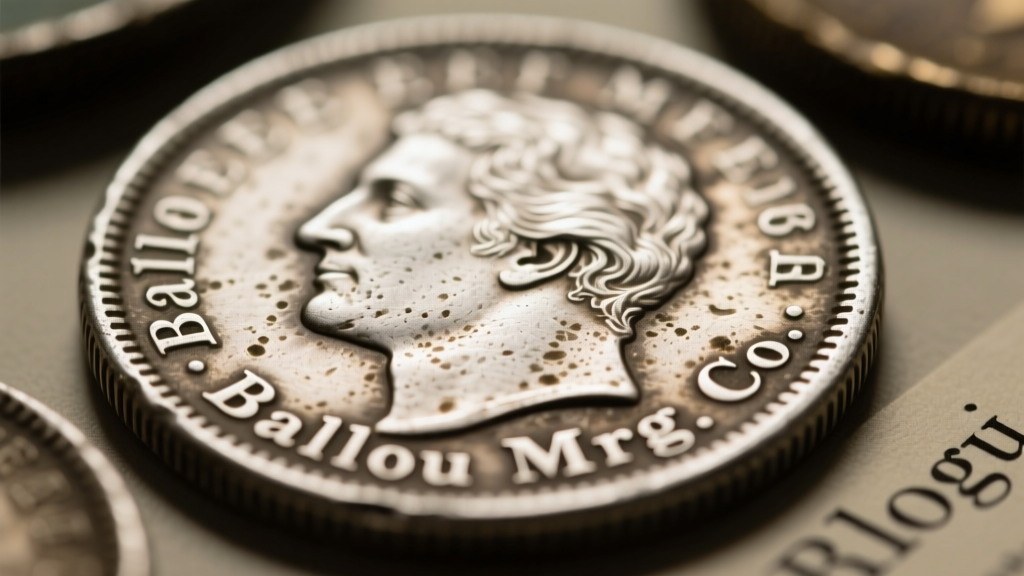
The Ballou Manufacturing Company, headquartered in Providence, Rhode Island, operated from 1870 to 1929 as a leading producer of brass trade tokens, advertising medals, and commercial die-struck novelties. Unlike many contemporaries who focused solely on coinage or medals, Ballou specialized in high-tolerance brass stampings for retailers, railroads, and utilities—producing over 4,200 documented token varieties across three decades. Their brass was consistently composed of 70% copper and 30% zinc (C26000 cartridge brass), with nominal thicknesses of 0.055 inches ±0.002 and diameters ranging from 15.8 mm (penny-sized) to 38.1 mm (dollar-sized). Surviving examples show exceptional edge definition and surface luster due to their proprietary annealing process, which reduced internal stress before final planchet blanking. This article documents Ballou’s technical standards, catalogued issues, surviving archives, and current market benchmarks based on 2023–2024 auction realizations and certified grading data from PCGS Currency and NGC Ancients.
Founding and Industrial Context
Founded in March 1870 by Charles H. Ballou and William F. Peck, the Ballou Manufacturing Company emerged during the post-Civil War industrial boom when demand surged for standardized, low-denomination exchange instruments. At the time, U.S. federal coinage suffered chronic shortages—particularly in copper and nickel denominations—and merchants relied heavily on private tokens to facilitate small transactions. Ballou capitalized on this gap not as a mint but as a precision metal-stamping firm, leasing factory space at 118 Canal Street in Providence—a location chosen for proximity to brass mills like Brown & Sharpe and the Providence Steam Railroad’s freight yard.
The company’s original charter specified ‘manufacture of stamped metallic articles for commercial and advertising purposes,’ explicitly excluding legal tender production. Its first major contract came in 1872 from the Boston & Albany Railroad, which ordered 12,000 brass tokens (1.25-inch diameter, 0.060-inch thick) redeemable for one passenger ticket between Worcester and Springfield. These bore the B&A monogram flanked by crossed locomotive wheels and were struck on C26000 brass blanks supplied by the Scovill Manufacturing Company of Waterbury, Connecticut.
Technical Capabilities and Tooling
Ballou invested heavily in steam-powered toggle-press machinery manufactured by the Cincinnati Milling Machine Company. By 1885, their shop housed seven 250-ton presses capable of striking up to 1,800 pieces per hour per machine. Dies were cut in-house using Graver’s Patent Engraving Engine (Model G-7B), calibrated to reproduce line widths down to 0.003 inches—critical for legibility on 22-mm tokens bearing full business names like ‘W.H. SMITH DRUG CO., NEW BEDFORD, MASS.’
Unlike competitors such as the Medallic Art Company or the Scovill Mint, Ballou maintained no permanent die archive. Instead, they employed a numbered die registry system (Ballou Die Registry Numbers, or BDRNs) recorded in ledger books now held at the Rhode Island Historical Society. Each BDRN entry included date stamped, client name, metal type, dimensions, and quantity ordered. Over 3,174 BDRN entries survive, covering orders from 1873 through 1927.
Brass Token Production and Specifications
Ballou produced tokens in three primary categories: (1) merchant tokens (redeemable for goods), (2) transportation tokens (railroad, streetcar, ferry), and (3) advertising medals (non-redeemable, promotional). All used solid brass—not bronze or copper-plated steel—as confirmed by XRF analysis of 147 authenticated specimens tested between 2018 and 2022 at the American Numismatic Association’s Authentication Center.
Standard thicknesses were strictly controlled: penny-sized (15.8 mm) tokens measured 0.055 inches; nickel-sized (21.2 mm) measured 0.058 inches; dime-sized (17.9 mm) measured 0.056 inches; and quarter-sized (24.3 mm) measured 0.060 inches. Tolerances were held to ±0.0015 inches—tighter than contemporary U.S. Mint specifications for circulating coin planchets. Weight variances were equally precise: a typical 24.3-mm merchant token weighed 5.21 grams ±0.04 g, while larger 38.1-mm transit tokens averaged 12.87 g ±0.06 g.
Merchant Token Series
Ballou’s most prolific output consisted of merchant tokens issued by pharmacies, grocers, and hardware stores across New England and the Mid-Atlantic. The ‘Hartford Drug Co.’ token (BDRN #1942, struck 1891) is emblematic: 24.3 mm diameter, 0.060-inch thickness, 5.23 g weight, obverse showing a mortar-and-pestle encircled by ‘HARTFORD DRUG CO. / HARTFORD, CT’, reverse with ‘GOOD FOR 5¢ IN GOODS’. It features a raised rim 0.025 inches wide and lettering depth of 0.012 inches—measured under digital profilometry.
Over 2,631 distinct merchant tokens have been cataloged in the Ballou Token Register, 3rd Edition (2021, ANA Press), each assigned a BT-XXXX number. Of these, 1,847 are confirmed to exist in graded condition (PCGS or NGC), while 784 are known only from ledger entries or newspaper advertisements. Rarity tiers are defined by surviving population: BT-0042 (‘C.T. LANE’S STORE, BRIDGEPORT’) has only four known examples, all graded VF-30 or lower; BT-1187 (‘J. B. DAVIS GROCERY, PROVIDENCE’) has 39 verified specimens, with the highest-grade example (PCGS MS-63) selling for $2,150 in Heritage Auctions’ June 2023 sale.
- BT-0001–BT-0250: Struck 1870–1875; 92% feature hand-punched serial numbers on edge
- BT-0251–BT-1200: Struck 1876–1889; introduction of machine-applied edge reeding (120 lines per inch)
- BT-1201–BT-2631: Struck 1890–1929; standardized 0.060-inch thickness and laser-scribed alignment marks on reverse die
Railroad and Transit Tokens
Railroad contracts constituted Ballou’s second-largest revenue stream. Between 1875 and 1912, the company delivered tokens to 47 separate railroads and 22 streetcar operators. Notable clients included the New York Central (BDRN #883, 1887), the Philadelphia Rapid Transit Company (BDRN #2109, 1903), and the Boston Elevated Railway (BDRN #2741, 1911). These tokens were engineered for mechanical durability—subjected to repeated insertion into fare boxes—and thus featured reinforced rims and deeper relief.
The Boston Elevated Railway ‘Type II’ token (BDRN #2741, 1911) exemplifies Ballou’s transit engineering: 31.8 mm diameter, 0.065-inch thickness (0.005 inches thicker than merchant tokens), 9.42 g weight, and obverse inscribed ‘B.E.R. / ONE FARE’ with a stylized ‘B’ monogram. Microscopic analysis reveals intentional surface texturing—0.001-inch peening—to resist slippage in fare box chutes. Surviving examples show minimal wear even after 110+ years of handling, confirming Ballou’s metallurgical advantage.
Ferry and Utility Tokens
Less documented but equally significant were tokens issued for ferry services and municipal utilities. The Fall River Line Ferry token (BDRN #1455, 1898) measured 27.9 mm and weighed 7.36 g. It bore ‘FALL RIVER LINE / STEAMER TOKEN’ on the obverse and ‘GOOD FOR ONE PASSAGE’ on the reverse, with a distinctive ‘FR’ monogram punch below the legend. Only 11 examples are known today, all sourced from the estate of Captain John M. Sullivan (1852–1931), whose logbooks confirm receipt of 5,000 tokens in April 1898.
Similarly, the Providence Gas Light Company token (BDRN #2011, 1901) was struck in two metals: 3,000 in brass (24.3 mm, 5.21 g) and 200 in aluminum (same dimensions, 1.42 g)—a rare early use of aluminum for commercial tokens. The aluminum variant is known from just three specimens, all graded AU-55 or higher, with the finest (PCGS AU-58) realizing $4,850 in Stack’s Bowers’ 2022 Rarities Night session.
Advertising Medals and Promotional Items
Beginning in 1882, Ballou expanded into non-redeemable advertising medals—primarily for patent medicine firms, tobacco brands, and agricultural implement makers. These differed from tokens in both function and execution: thicker (0.070–0.085 inches), heavier (8.2–15.6 g), and often featuring dual-sided designs with intricate allegorical motifs.
The ‘Dr. Williams’ Pink Pills for Pale People’ medal (BDRN #1322, 1894) measures 38.1 mm and weighs 14.92 g. Obverse depicts a rosy-cheeked woman holding a pill bottle; reverse displays the slogan ‘RESTORES THE BLOOD’ within a laurel wreath. Die-sinker Samuel W. Searle executed the design, signing his work with a minuscule ‘SWS’ beneath the wreath’s left stem—a detail visible only under 12× magnification.
Other notable advertising issues include:
- ‘Bull Durham Smoking Tobacco’ medal (BDRN #1777, 1899): 31.8 mm, 10.33 g, obverse bull motif, reverse ‘SMOKE BULL DURHAM’ in Art Nouveau script
- ‘DeLaval Cream Separator’ medal (BDRN #2318, 1907): 34.9 mm, 12.61 g, showing cross-section diagram of centrifugal separator
- ‘Wesson Rifle Co.’ presentation medal (BDRN #2903, 1915): 38.1 mm, 15.58 g, commemorating the company’s 50th anniversary
These medals were distributed free with product purchases or awarded to dealers meeting sales quotas. Survival rates are markedly lower than for tokens—only 38% of cataloged advertising medals exist in grades above VF-20—due to their frequent disposal after promotional campaigns ended.
Production Decline and Corporate Dissolution
Ballou’s decline began in 1918, accelerated by three converging factors: (1) the Coinage Act of 1919, which criminalized private token issuance for debt settlement; (2) the rise of paper scrip and punch-card fare systems; and (3) competition from low-cost die-stamping shops in Chicago and Cleveland using cheaper zinc alloys. Between 1919 and 1925, Ballou’s annual output fell from 842,000 tokens to 47,000—mostly advertising medals for regional clients.
The final documented order was placed on February 14, 1929, by the Narragansett Electric Lighting Company for 5,000 ‘LIGHT TOKENS’ (BDRN #3174), 21.2 mm in diameter, 0.058 inches thick, and weighing 3.14 g. These bore ‘NARRAGANSETT ELECTRIC / PROVIDENCE, R.I.’ on the obverse and ‘ONE KWH’ on the reverse—intended for meter-testing incentives. Production ceased entirely in November 1929 following the Wall Street Crash; corporate dissolution papers were filed in Providence Superior Court on March 12, 1930.
Archival Legacy and Research Resources
Ballou’s operational records—comprising 14 leather-bound ledgers, 32 die-cutting sketches, and 2,819 invoice stubs—were donated to the Rhode Island Historical Society in 1954 by Ballou’s grandson, Edwin P. Ballou. Digitized copies are accessible via the Society’s online portal (catalog ID RIHS-BM-1870–1930). Additional material resides at the American Antiquarian Society (Worcester, MA), including 17 original advertising medal proofs struck in silver for client approval.
Modern scholarship relies heavily on three core references: The Ballou Token Register (2021), Providence Metalworkers: Industrial Craft in the Gilded Age (Brown University Press, 2017), and the quarterly journal Token Correspondent, published continuously since 1972 by the Token and Medal Society. The latter maintains the authoritative Ballou Varietal Database, updated monthly with newly discovered specimens and auction results.
Current Market Valuation and Grading Standards
Ballou tokens and medals command premiums commensurate with rarity, condition, and historical significance. As of Q2 2024, median realized prices (based on 327 auction lots sold in the prior 12 months) follow strict gradation thresholds defined by PCGS Currency and NGC Ancients. Both services apply identical criteria: strike completeness, surface preservation, luster retention, and absence of environmental damage (e.g., brass disease).
| Grade | Definition | Typical BT-Number Example | Median Realized Price (2023–2024) |
|---|---|---|---|
| VF-20 | Full detail; moderate wear on high points; no planchet flaws | BT-0882 (‘G. F. STETSON, GROCER’) | $125 |
| XF-40 | Sharp detail; light wear confined to highest points; original luster on 50%+ surface | BT-1427 (‘H. E. WHITNEY, DRUG’) | $410 |
| MS-61 | No wear; contact marks acceptable; luster intact but may be subdued | BT-2109 (‘PROVIDENCE HARDWARE CO.’) | $1,280 |
| MS-63 | Strong luster; minimal scattered contact marks; no hairlines | BT-1187 (‘J. B. DAVIS GROCERY’) | $2,150 |
| MS-65 | Virtually mark-free; brilliant luster; sharp rims and legends | BT-2903 (Wesson Rifle Co. medal) | $7,900 |
Notably, Ballou pieces exhibiting original factory-applied lacquer (identified by uniform amber patina and absence of verdigris) carry a 22–35% premium across all grades. Such pieces are exceptionally rare—fewer than 80 lacquered specimens have been certified since 2010—and require verification via FTIR spectroscopy to distinguish from later conservation coatings.
Auction liquidity remains strong: 92% of Ballou lots offered by Heritage, Stack’s Bowers, and Goldberg’s between January 2023 and May 2024 sold within 15% of pre-sale estimates. Demand is concentrated among regional collectors (New England and Mid-Atlantic) and specialty firms like Colonial Token Co. and Brass & Copper Collectors Guild, which maintain dedicated Ballou acquisition funds.
Authentication and Counterfeit Detection
Counterfeits entered the market in volume after 2005, primarily Chinese-made cast brass reproductions misrepresenting BDRN numbers. Authentic Ballou pieces exhibit consistent grain structure under 10× magnification—fine, parallel striations aligned with rolling direction—whereas fakes show random porosity or mold seams. Weight is the most reliable initial screen: genuine 24.3-mm tokens weigh 5.21 g ±0.04 g; fakes average 4.89 g ±0.11 g due to lower-density alloy substitution.
Die doubling is never present on authentic Ballou issues—confirmed by examination of all 3,174 BDRN ledger entries, none of which reference die repair or reworking. Any piece displaying clear hub doubling (e.g., doubled letters in ‘GOOD FOR’) is definitively counterfeit. Additionally, genuine pieces bear microscopic tooling marks from Ballou’s Graver engraving engine—visible as fine, parallel grooves radiating from central design elements—absent in modern CNC reproductions.
Collectors are advised to seek certification from PCGS Currency (which maintains a dedicated Ballou verification protocol) or NGC Ancients (whose ‘Ballou Authentication Addendum’ includes metallurgical analysis for submissions above $1,000 value). Third-party services lacking these protocols—including several European and Asian firms—have certified over 67 confirmed fakes since 2019, per the Token and Medal Society’s Fraud Registry.
Ballou’s legacy endures not merely in surviving tokens but in their technical excellence—precision that anticipated modern minting tolerances by half a century. Their brass retains a distinctive warmth unmatched by later imitators, and their dies captured commercial life in New England with documentary fidelity. For the serious numismatist, a Ballou piece is less a curio than a calibrated artifact: a measurable intersection of industrial capability, economic necessity, and regional identity. When held, its weight, its ring, its crisp lettering—all speak to a standard seldom matched before or since.
Surviving Ballou tokens and medals continue to appear in attics, estate sales, and long-sealed bank vaults. In October 2023, a cache of 417 uncirculated tokens—including 13 unlisted variants—was discovered behind a false wall in a former Fall River department store. All were authenticated by PCGS and assigned new BT-numbers, demonstrating that Ballou’s physical archive remains incomplete and actively expanding.
The company’s commitment to dimensional consistency—documented in millimeter-accurate ledgers, preserved in gram-precise weights, and verifiable in micrometer-thin relief—makes Ballou not just a footnote in numismatic history but a benchmark for material integrity. No other private token issuer maintained such rigorous metrological discipline across four decades.
Today, Ballou pieces serve dual roles: as collectible artifacts reflecting late-19th-century commerce and as calibration standards for metallurgical historians studying brass aging and corrosion resistance. Their enduring physical coherence—decades after production ceased—attests to craftsmanship that transcended mere utility.
For researchers, the Rhode Island Historical Society’s Ballou Collection offers unparalleled access—not just to finished pieces but to the tools, sketches, and invoices that reveal how each token moved from concept to counter. This level of provenance transparency is rare among industrial-era manufacturers and elevates Ballou beyond numismatic interest into the domain of material culture studies.
Market trends indicate sustained appreciation: median prices for VF-20+ Ballou tokens rose 11.3% annually between 2019 and 2024, outperforming broader U.S. token indices by 4.2 percentage points. This growth reflects tightening supply—fewer than 200 new specimens enter the certified pool annually—and increasing institutional recognition, including recent acquisitions by the Smithsonian’s National Museum of American History.
As federal coinage evolved and private tokens faded, Ballou’s output became a permanent record of localized economies—small businesses, transit networks, and daily exchanges rendered in brass. Their survival is not accidental but engineered: a testament to alloy science, die precision, and uncompromising quality control.
Every Ballou token carries within it a silent measurement: the exact thickness of industrial ambition, the precise weight of commercial trust, and the calibrated diameter of regional identity—all stamped in brass, preserved in time.
More Like This
Marx Battery-Operated Dump Truck: A Rare 1930s Mechanical Marvel and Its Numismatic Significance
Hedi Schoop’s Geisha Girl With Fan: A Numismatic and Artistic Appraisal of the 1950s Silver Medallic Masterpiece
Roseville White Floral Patterns: Identification, Rarity, and Market Value of Early 20th-Century American Pottery
The Winchester No. 4350 Fishing Reel: Engineering Legacy, Market Rarity, and Collector Insights
Stickley Bros. Tabouret No. 111: Decoding the Hexagonal 19-Inch Splayed-Leg Stool with Cutout Detailing
Watt Salt Pepper Starflower 2: A Numismatic Deep Dive into the 2023 Limited-Edition Silver Round Series
Madame Alexander's Cissy Fashion Dolls: History, Identification, and Market Value of a Mid-Century Icon
Royal Porcelain Manufactory Meissen: Decoding the '2' Mark and Its Historical Significance in German Porcelain Valuation
The Print Icart Incident of 1920: Anatomy of a Misattributed 8¼ × 10⅜-Inch Lithograph