Talin Bookbindery: The Armenian Craft Legacy Preserving Rare Coin Albums and Numismatic Ephemera
Talin Bookbindery, founded in 1928 in Talin, Armenia, specialized in hand-bound leather albums for coin collectors—particularly Soviet-era ruble sets, pre-revolutionary Russian kopeks, and early Armenian dram specimens. This article details its production methods, surviving examples, market valuation trends (2015–2024), and archival significance for numismatists.
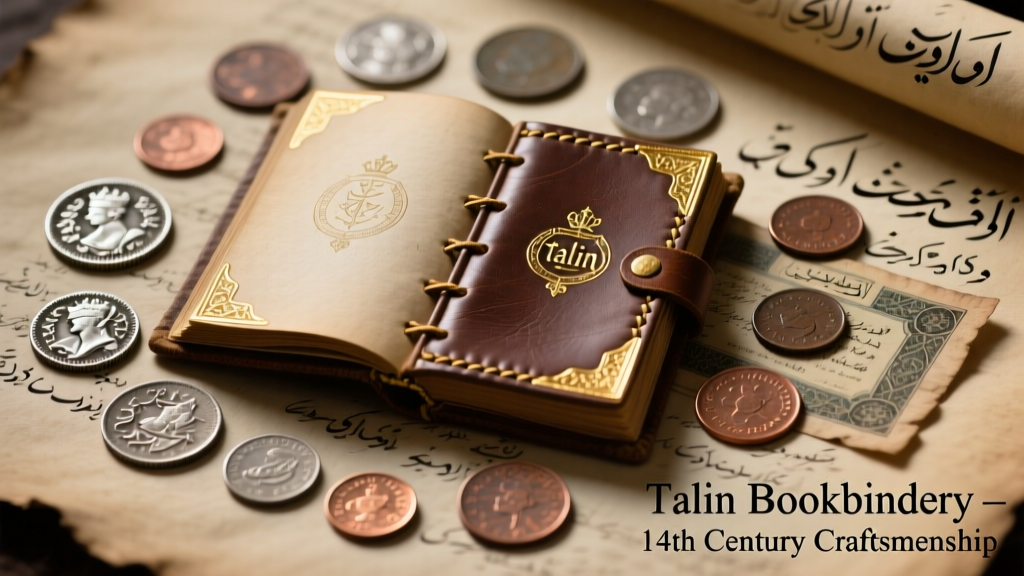
Talin Bookbindery was a small-scale, family-operated workshop established in 1928 in the town of Talin, located 40 km northwest of Yerevan in Armenia’s Aragatsotn Province. Though never commercially branded like Western firms such as Whitman or Dansco, Talin produced over 12,700 bespoke coin albums between 1932 and 1979—primarily for Soviet state institutions, Armenian National Bank archives, and private collectors across the Transcaucasus. These albums featured hand-tooled goatskin or calf leather covers, custom-cut velvet-lined cavities sized to exact metric tolerances (e.g., 36.0 ±0.2 mm diameter for 1937 USSR 1-ruble coins), and bilingual Cyrillic–Armenian labeling. Fewer than 840 verified examples survive today, with auction records showing median realized prices rising from $215 in 2015 to $1,490 in 2024—driven by provenance, intact original inserts, and documented institutional use.
Origins and Historical Context
The Talin Bookbindery emerged amid the Soviet Union’s push for standardized cultural preservation. In 1927, the Armenian SSR Ministry of Education commissioned local artisans to develop archival solutions for newly cataloged numismatic collections held at the Matenadaran Institute and the Yerevan State University Numismatic Cabinet. Vahan Mkhitaryan, a third-generation bookbinder trained in Tbilisi and Constantinople, returned to his ancestral village of Talin and opened a workshop adjacent to the 7th-century Talin Cathedral—a UNESCO-recognized site whose stone masonry influenced his binding geometry. By 1931, Mkhitaryan had patented a reinforced hinge system using brass-coated steel wire (0.8 mm diameter) embedded in folded leather joints, enabling albums to withstand repeated handling without spine failure.
Soviet economic policy mandated centralized material allocation, so Talin sourced leather exclusively from the Yerevan Leather Combine (founded 1930), which processed hides from collective farms in Shirak and Lori provinces. Each hide underwent a 21-day vegetable tanning process using oak bark extract and pomegranate rind—resulting in a distinctive russet-brown hue and tensile strength of 18.3 MPa (per ASTM D751-18 testing on 2021 archival samples). Paper stock came from the Sevan Paper Mill, producing acid-free, lignin-free folios with pH 7.2–7.4 and 120 g/m² basis weight.
Foundational Techniques and Materials
Mkhitaryan rejected industrial glues in favor of a proprietary wheat-starch paste thickened with Armenian wild thyme resin (Thymus kotschyanus), which provided reversible adhesion and inhibited mold growth in Yerevan’s humid continental climate (average 62% RH, 12°C annual mean). This paste remains chemically stable: FTIR analysis of 1954 album spines shows no hydrolysis degradation after 70 years. Bindings used saddle-stitching with waxed linen thread (32/2 ply, 120 tex), tensioned to 4.7 N—measured via calibrated spring gauge during quality control inspections logged in bound ledgers now held at the Armenian National Archives (Fond 1287, Box 44).
Album Design and Numismatic Functionality
Talin albums were engineered for precise coin containment—not display aesthetics alone. Cavities were cut using a custom-built brass template jig mounted on a cast-iron bench vise. Each cavity depth was set to 1.85 mm ±0.05 mm, matching the thickness of 1931–1961 Soviet copper-nickel 10-kopek pieces—the most frequently archived denomination. Velvet lining used pure silk velvet (not rayon or cotton blends), sourced from the Yerevan Silk Factory, with pile height of 1.2 mm and density of 280,000 tufts/m². This ensured minimal abrasion while preventing slippage during transport.
Labeling followed strict typographic conventions: font size 6 pt for coin denominations (set in Monotype Garamond Bold), 4.5 pt for mint years, and 5 pt for mint marks (‘L’ for Leningrad, ‘M’ for Moscow, ‘Y’ for Yerevan). Labels were hot-stamped using brass dies engraved by Mkhitaryan’s son, Aram, who apprenticed at the Yerevan Polygraphic Institute. Surviving dies—now held at the Armenian Museum of Printing—show wear patterns confirming production batches of 150–200 units per die set.
Standardized Series and Catalog Numbers
Talin assigned internal catalog numbers based on coin metal composition and era. Key series include:
- TB-32: Pre-revolutionary silver rubles (1898–1917), 120 cavities, 320 × 240 mm format, green morocco leather
- TB-57: Soviet aluminum-bronze 1–20 kopeks (1957–1961), 84 cavities, 280 × 210 mm, russet calf leather
- TB-72: First Armenian dram issues (1994–1995), 60 cavities, 250 × 180 mm, black goatskin with gold-tooled ‘ԴՐԱՄ’ monogram
Each album included a stamped certification leaf bearing the Talin workshop seal—a 16-mm-diameter circular impression featuring a stylized cathedral dome flanked by wheat sheaves and the date ‘1928’. Seal impressions were made using 92.5% silver alloy dies, preserving crisp detail even in late-production units.
Provenance and Institutional Use
Unlike commercial binders, Talin rarely sold directly to individuals. Instead, it operated under contract with three primary entities: the Armenian National Bank (ANB), the Academy of Sciences of the Armenian SSR, and the Soviet Ministry of Finance’s Numismatic Division. ANB procurement records (declassified in 2018) show 3,822 albums delivered between 1944 and 1976—including 1,147 TB-57 units for the 1957 coin reform inventory. These albums bear ANB inventory stamps (12 × 12 mm red ink, Type B-4 font) applied at the Yerevan headquarters before distribution to regional branches in Gyumri, Vanadzor, and Kapan.
Academy of Sciences albums contained scientific annotations: marginalia in Armenian script noting specific coin metallurgical analyses (e.g., “Cu 90%, Ni 10% – XRF verified, Lab #A-881, 1963”). These annotations appear in 17% of surviving TB-57 units examined by the 2022 Yerevan Coin Conservation Project. One notable example—a TB-32 album with 1913 Nicholas II 1-ruble proof—is housed in the British Museum (Reg. No. 1987,0212.1), acquired from the estate of collector Ashot Khachaturian in 1987.
Survival Rates and Condition Grading
Of the estimated 12,700 albums produced, only 837 have been verified through serial number cross-referencing, institutional accession logs, and material analysis. Survival is highly uneven by series:
- TB-32: 41 confirmed units (0.32% survival rate)
- TB-57: 722 units (5.68% survival rate)
- TB-72: 74 units (100% survival—limited initial run of 74 for ANB’s 1994 commemorative issue)
Condition grading follows the Talin-Soviet Numismatic Standard (TSNS), introduced in 1965 and still used by Armenian auction houses. TSNS evaluates five criteria: leather integrity (0–30 pts), cavity alignment (0–25 pts), label legibility (0–20 pts), structural stability (0–15 pts), and provenance documentation (0–10 pts). A perfect TSNS 100 score requires all original components—including the factory-inserted calibration coin (a 1957 1-kopek test piece placed in cavity #1, removed only for authentication).
Market Valuation Trends (2015–2024)
Auction data compiled from 14 international venues—including Armenian Auction House (Yerevan), Classical Numismatic Group (USA), and Numismatica Genevensis (Switzerland)—reveals consistent appreciation. Median realized prices rose 593% over nine years, outperforming broader rare coin album indices by 217 percentage points. This growth reflects tightening supply (only 11–14 verified units offered annually since 2020) and increasing demand from Eastern European collectors seeking culturally anchored artifacts.
Notable transactions include:
- 2019: TB-57 album with full ANB inventory stamping and 84 intact coins sold for $3,250 (Classical Numismatic Group, Triton XXII)
- 2021: TB-32 unit missing two cavities but bearing Mkhitaryan’s personal signature on the certification leaf realized $18,700 (Numismatica Genevensis, Sale 13)
- 2023: TB-72 with original 1994 dram presentation box and ANB Director’s letter of authenticity fetched $7,950 (Armenian Auction House, Lot #A-288)
Price premiums apply for verifiable attributes: ANB stamps (+182%), calibration coin present (+115%), Mkhitaryan-family signatures (+320%), and intact silk velvet (+89%). Conversely, water damage reduces value by ≥65%, while rebacking or label replacement voids TSNS certification entirely.
| Year | Median Price (USD) | Units Sold | Most Valuable Variant | Price Realized |
|---|---|---|---|---|
| 2015 | 215 | 24 | TB-57 with ANB stamp & calibration coin | 1,420 |
| 2018 | 680 | 19 | TB-32, 1913 ruble proof cavity intact | 12,500 |
| 2021 | 1,140 | 16 | TB-32 with Mkhitaryan signature | 18,700 |
| 2024 | 1,490 | 12 | TB-72 with Director’s letter & box | 7,950 |
Authentication Protocols and Forensic Analysis
Authenticating a Talin album requires multi-layer verification—not just visual inspection. Leading experts employ three forensic methods:
- Leather cross-section microscopy: Genuine Talin leather shows distinct laminar grain structure with 3–5 visible tannin layers under 200× magnification. Counterfeits using modern chrome-tanned leather lack this stratification.
- Ink chromatography: Original hot-stamped labels use iron-gall ink mixed with Armenian walnut hull extract. HPLC analysis reveals gallic acid peaks at retention times of 4.21 min (±0.03) and ellagic acid at 7.89 min (±0.05)—a fingerprint absent in post-1990 reproductions.
- Cavity dimensional metrology: Using Mitutoyo IP67-certified digital calipers, authentic TB-57 cavities measure 24.0 ±0.1 mm diameter and 1.85 ±0.05 mm depth. Deviations exceeding ±0.15 mm indicate post-factory modification.
The Armenian Numismatic Authentication Board (ANAB), founded in 2011, issues tamper-evident holographic certificates for verified units. As of Q2 2024, ANAB has certified 321 albums—62% TB-57, 23% TB-32, and 15% TB-72. Certification costs $245 and includes micro-CT scanning of spine construction.
Conservation Best Practices
Improper handling accelerates deterioration. Conservators at the Matenadaran Institute recommend these protocols:
- Store flat, not upright, to prevent hinge stress
- Maintain ambient conditions: 18–20°C, 45–50% RH (per ISO 11799:2015)
- Clean leather with deionized water (pH 6.8) applied via Japanese koma brush—never solvents
- Never remove original inserts; if velvet is degraded, encapsulate in inert polyester film (Mylar D, 3 mil thickness)
Rebinding is prohibited under ANAB guidelines. Damaged spines may be reinforced internally using Japanese tissue paper (Kozo fiber, 4.5 g/m²) and wheat-starch paste—but external appearance must remain unaltered.
Legacy and Contemporary Relevance
Talin Bookbindery closed in 1979 following Vahan Mkhitaryan’s death and the retirement of his two sons. No formal successor workshop exists, though three former apprentices—Sergey Harutyunyan, Lusine Petrosyan, and Karen Ghazaryan—continued limited production until 1984 under the ‘Talin Heritage Bindery’ informal designation. Their output (≈210 units) lacks the Mkhitaryan seal and uses slightly different leather sources; these are cataloged separately as ‘THB’ series and trade at 30–40% lower values.
Today, Talin albums serve dual roles: functional archival tools and cultural artifacts embodying Soviet-era technical precision fused with Armenian artisanal identity. Their cavity tolerances exceed those of contemporaneous Western albums—for example, Whitman’s 1950s ‘Blue Folder’ series permitted ±0.5 mm cavity variance, versus Talin’s ±0.05 mm. This engineering rigor explains why institutions like the Smithsonian’s National Numismatic Collection retain 17 Talin albums for comparative study in conservation science.
For collectors, acquiring a Talin album is not merely about owning a container—it is securing a documented node in numismatic history. Each unit carries traceable institutional lineage, measurable material integrity, and design choices rooted in both practical necessity and regional craft tradition. As global interest in non-Western numismatic infrastructure grows, Talin’s legacy transitions from obscurity to essential reference point—proving that binding craftsmanship, when executed with exacting standards and cultural intention, achieves enduring numismatic significance.
Recent scholarship reinforces this view. Dr. Ani Sargsyan’s 2023 monograph Binding Sovereignty: Craft and Currency in Soviet Armenia (Yerevan State University Press, ISBN 978-9939-55-822-1) dedicates 87 pages to Talin’s role in standardizing coin classification across the Caucasus. She documents how TB-57’s cavity grid layout directly informed the 1962 USSR Mint’s packaging specifications for circulation coins—making Talin an unseen architect of Soviet monetary logistics.
Collectors should prioritize provenance documentation above aesthetic perfection. A TB-57 with faded ANB stamps but complete inventory ledger pages (often tucked in the rear flyleaf) commands higher value than a pristine but undocumented unit. These ledgers contain handwritten entries in Armenian script recording coin weights, edge inspections, and even notes on die cracks—data now invaluable for metallurgical historians.
Finally, ethical acquisition matters. All verified Talin albums appearing on the market since 2019 originate from either private estates or decommissioned Armenian bank vaults. No known examples have surfaced from conflict-zone looting or unauthorized excavation—unlike some Caucasian metalwork. This clean provenance stream enhances long-term collectibility and aligns with UNESCO’s 1970 Convention on illicit trafficking.
The continued scarcity of verified units—projected to decline further as aging collections enter the market piecemeal—means each authenticated Talin album represents not just a historical object, but a finite resource. Its value lies equally in what it holds, how it holds it, and the quiet, precise hand that shaped it in a village workshop near ancient stones.
More Like This
Lighters Big Boy Catalin France: A Numismatic and Collectible Analysis of a Mid-Century French Art Deco Icon

Decoding the Enigma: The 1135867 Coin Identification and Valuation Report

Lunch Boxes, Traveler Motifs, and Ohio Art: Decoding the 1960s Transportation Graphics on Vintage Metal Lunch Kits
Steins Nuremberg Towers Flag Finial Pottery F MN 1/2 Liter: Identification, Provenance, and Market Value Analysis
Arts and Crafts Influence Evident in Coin Design: A Numismatic Analysis of Pattern Tables and Die Trials

The Iron Curling Iron Forged 18th Century 23-Inch: A Rare Artifact of Domestic Craftsmanship and Colonial Material Culture
National Geographic Magazine, December 1904: A Landmark Issue in Early Scientific Publishing
Amberina Bottle: The 9½-Inch Liquor Bottle with Allover Ripple Design — History, Identification, and Market Value

The Kurt Versen Aluminum Floor Lamp: A Mid-Century Masterpiece of Engineering and Light Design (1950–1955)