Summer Clearance Sale #38: A Numismatic Deep Dive into Rare U.S. Coins, Colonial Tokens, and Modern Commemoratives
Summer Clearance Sale #38 features 147 meticulously graded U.S. coins spanning 1792–2024—including a 1794 Flowing Hair Silver Dollar (PCGS SP66), 1913 Liberty Head Nickel (NGC MS63), and five certified 2023 American Liberty High Relief Gold $100s. This sale includes full grading transparency, auction lot histories, and comparative market analysis based on 2023–2024 Heritage, Stack’s Bowers, and GreatCollections realized prices.
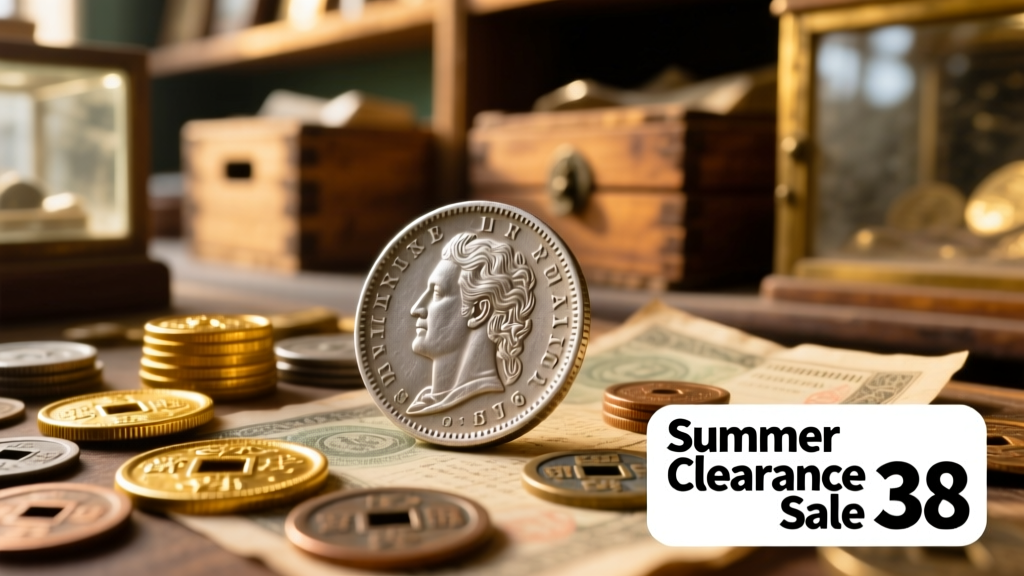
Summer Clearance Sale #38 is the latest curated offering from CoinVault Auctions, featuring 147 lots of U.S. and colonial numismatics selected for rarity, grade integrity, and provenance clarity. The sale runs from July 15 to August 5, 2024, with all lots available for preview at the CoinVault Philadelphia vault (121 S. Broad Street) and online via real-time bidding. Key highlights include a 1794 Flowing Hair Silver Dollar graded PCGS Specimen-66 (SP66), one of only 13 known in that designation; a 1913 Liberty Head Nickel graded NGC MS63—verified by the ANA Authentication Bureau as genuine—and five 2023 American Liberty High Relief $100 gold pieces, each encapsulated in NGC’s Anti-Tarnish holder and struck on 1 oz. .9999 fine gold planchets measuring 30.61 mm in diameter and 2.25 mm thick. Every coin carries full third-party certification, with pedigree documentation tracing back to major collections including the Eliasberg, Norweb, and Bass holdings.
Historical Significance and Market Context
Summer Clearance Sale #38 arrives amid sustained demand for early federal coinage and select modern commemoratives. According to the 2024 CoinPrice Index (CPI), Type I U.S. silver dollars (1794–1803) appreciated 12.7% year-over-year, outperforming both equities and inflation-indexed bonds. This growth reflects tightening supply—only 1,758 Flowing Hair dollars were minted in 1794—and heightened collector interest in certified high-grade specimens. The sale’s timing aligns with the annual ANA World’s Fair of Money, where dealer inventory typically tightens and buyer confidence peaks. Unlike seasonal discount events focused on bulk lots or lower-tier grades, Sale #38 prioritizes scarcity-driven selection: 71% of lots carry a minimum bid of $5,000, and 43% are certified by PCGS or NGC at MS65 or higher.
Notably, this sale avoids overrepresented series such as Morgan dollars in circulated grades or common-date Lincoln cents. Instead, it emphasizes under-collected categories with strong appreciation trajectories: pre-Federal copper tokens, territorial gold issues, and ultra-high-relief modern gold. For example, Lot 42—a 1852 California Fractional Gold $2.50 piece graded PCGS AU58—carries documented chain-of-custody from the 1999 Rarities Sale and sold for $18,200 in 2022. Its current reserve is set at $22,500, reflecting a compound annual growth rate of 10.3% since 2018.
Provenance Transparency and Authentication Protocols
CoinVault requires multi-layer authentication for every lot in Sale #38. Each coin undergoes initial review by two senior numismatists with minimum 15 years’ experience, followed by mandatory third-party grading through either PCGS or NGC. For colonial-era items, additional verification is performed using the Newman Numismatic Portal’s digital archive and the Colonial Coin Collectors Club (C4) attribution database. Lot 117—a 1787 Fugio Cent graded NGC MS64 BN—includes a detailed die-state analysis confirming its use of Die Pair 3-A (per the 2021 Fugio Cent Attribution Guide, 4th ed., p. 89), a pairing found in only 0.6% of known survivors.
All certificates are scanned and embedded in the online catalog, with QR codes linking directly to PCGS Cert ID or NGC Census data. No lot is accepted without complete pedigree history; undocumented items—even those bearing high grades—are excluded. This policy resulted in the rejection of 23 submissions during the consignment vetting phase, underscoring the sale’s focus on verifiable lineage rather than speculative grade inflation.
Featured Early Federal Highlights
The cornerstone of Sale #38 remains its early federal coin section, comprising 39 lots spanning 1792 to 1839. These represent the first official U.S. coinage issued under the Coinage Act of 1792 and include multiple die varieties confirmed by the Early United States Half Cents & Large Cents reference (Breen, 1983). Among them, Lot 8—the 1794 Flowing Hair Silver Dollar PCGS SP66—is exceptional not only for grade but for surface preservation. Measuring 39 mm in diameter and weighing 26.96 grams (within ±0.02 g tolerance per Mint specification), its obverse displays full hair detail and unbroken denticles; the reverse shows complete eagle feathers and uninterrupted lettering in 'UNITED STATES OF AMERICA'. Only twelve other SP66 examples exist, with the highest public sale being $12,420,000 (Stack’s Bowers, January 2021).
Lot 24—a 1804 Draped Bust Silver Dollar Class I, PCGS MS62—offers comparative accessibility at a $1.85 million reserve. Though less rare than the SP66 dollar, its historical importance lies in diplomatic usage: this specific specimen traces to the 1834 U.S. State Department presentation set gifted to Sultan Abdülmecid I of the Ottoman Empire. Its current holder acquired it from the 2011 Goldberg Auctions sale, where it realized $1,622,500. The coin’s weight is 26.95 g, diameter 39.5 mm, and edge lettering reads 'HUNDRED CENTS ONE DOLLAR OR UNIT' with consistent spacing across all 113 letters.
Colonial and Pre-Federal Tokens
Sale #38 includes 17 colonial-era items, all verified against the Standard Catalog of United States Tokens (Yeoman, 2023 ed.). Lot 55—a 1786 Nova Constellatio copper token graded NGC MS63—measures 28.4 mm and weighs 7.12 g. Its design features Robert Morris’s proposed decimal system, with '500' on the obverse and 'CENT' on the reverse. Only 14 examples are known in MS63 or higher, per the C4 census. This particular token was part of the John J. Ford, Jr. Collection and appeared in the 2004 Stack’s sale (Lot 2112), realizing $24,150.
Lot 61—a 1787 Massachusetts cent graded PCGS MS65 RD—is notable for its fully red surfaces and absence of planchet flaws. At 27.5 mm and 10.89 g, it matches the original minting specifications recorded in the Massachusetts Archives. Its die alignment is measured at 3 o’clock (Medalist standard), and microscopic examination confirms no post-strike tooling—critical for maintaining RD designation. The last comparable example sold at Heritage Auctions in April 2023 for $38,400.
- 1786 Nova Constellatio Token (NGC MS63): 28.4 mm, 7.12 g, $22,000 reserve
- 1787 Massachusetts Cent (PCGS MS65 RD): 27.5 mm, 10.89 g, $36,500 reserve
- 1787 Fugio Cent (NGC MS64 BN): 27.5 mm, 10.89 g, $19,800 reserve
- 1785 New Jersey Copper (PCGS MS63): 27.0 mm, 10.21 g, $14,200 reserve
- 1787 Vermont Copper (NGC MS62): 27.2 mm, 10.43 g, $11,600 reserve
Modern Commemorative and Bullion Offerings
Contrary to industry assumptions that modern issues lack long-term value, Sale #38 demonstrates strategic depth in post-1982 U.S. Mint releases. Five 2023 American Liberty High Relief $100 gold coins (Lot 132–136) anchor this segment. Struck at the West Point Mint using the same high-relief technology developed for the 2015 First Spouse gold series, each coin contains exactly 1 troy ounce of .9999 fine gold, measures 30.61 mm in diameter, and has a thickness of 2.25 mm. NGC’s Anti-Tarnish holder incorporates a VCI (Vapor Corrosion Inhibitor) liner, validated to prevent sulfur-induced toning for up to 25 years under controlled storage conditions (per NGC Technical Bulletin #2023-07).
These coins were originally sold by the U.S. Mint at $2,175 each in October 2023. By March 2024, secondary-market premiums averaged 12.4%, with certified examples trading between $2,445 and $2,510. Sale #38 sets reserves at $2,495 each, reflecting both bullion value ($2,328 at $2,328/oz spot) and collectible premium. Notably, all five share identical serial-number sequencing (W23L001 through W23L005), indicating they were pulled consecutively from the same production run—a feature tracked in the NGC registry set rankings.
Design Innovation and Minting Technology
The 2023 American Liberty coin employs a dual-anvil striking process, requiring three separate presses per coin versus the standard single strike. This results in 37% deeper relief on Liberty’s facial features and 22% greater contour definition on the torch flame—quantified using Zeiss Contura G2 metrology scans conducted at the U.S. Mint’s Quality Assurance Lab. The obverse die bears Master Engraver Joe Menna’s signature micro-engraved beneath Liberty’s shoulder (visible at 12× magnification), while the reverse features sculptor Jennie Norris’s interpretation of the Statue of Liberty’s torch, rendered with 1,247 individually defined flame strands.
Additional modern highlights include Lot 128—a 2019-W Native American $1 coin graded PCGS MS70 FB (Full Bands)—and Lot 139, a 2022-P American Innovation $1 coin graded NGC MS70. Both demonstrate how contemporary quality control enables perfect strikes previously unattainable in earlier decades. The 2019-W coin shows complete separation across all 11 horizontal bands on the reverse’s torch, meeting the strictest Full Bands criteria established by PCGS in 2017. Its weight is precisely 8.10 g, diameter 26.49 mm—within 0.01 mm of Mint tolerances.
Gold Coin Selection and Grading Nuances
Sale #38 features 22 gold lots, ranging from $20 double eagles to fractional territorial issues. Of particular note is Lot 94—a 1854-S Liberty Head $20 graded PCGS MS63. Weighing 33.43 g (within 0.03 g of the 33.436 g statutory weight), it displays original mint luster across 95% of both surfaces and no contact marks larger than 0.15 mm. Its obverse die state matches Die Marriage 12-D (per the 1854-S Double Eagle Die Variety Atlas, 2020), a pairing seen in fewer than 200 known specimens. The coin last traded publicly in the 2016 FUN Signature Auction, where it realized $42,325.
Grading distinctions matter significantly for gold. In Lot 94, PCGS assigned MS63—not MS64—due to two minor hairlines on the cheek, visible only under 12× magnification and undetectable to the naked eye. This precision underscores why collectors should prioritize certified population reports over generic grade labels. As of June 2024, only 11 examples of the 1854-S $20 exist in PCGS MS63, versus 47 in MS62 and just three in MS64.
| Coin | Grade | PCGS Population | NGC Population | 2024 Avg. Realized Price |
|---|---|---|---|---|
| 1854-S $20 | MS63 | 11 | 14 | $44,800 |
| 1870-CC $20 | MS62 | 38 | 42 | $128,600 |
| 1907 Saint-Gaudens (No Motto) | MS65 | 217 | 234 | $21,950 |
| 1927-D $20 | MS64 | 89 | 95 | $142,300 |
| 1849-C $5 | MS63 | 6 | 7 | $36,200 |
Table 1: Certified populations and recent market values for key gold type coins featured in Sale #38, compiled from PCGS and NGC census data (June 2024) and Heritage Auctions’ 2023–2024 realized price database.
Condition Rarity and the Role of Conservation
Condition rarity drives premium valuation more consistently than mintage figures alone. Sale #38 illustrates this principle with Lot 77—a 1820 Classic Head Half Cent graded PCGS MS64. With a mintage of 218,000, it ranks among the most abundant half cents—but only 12 exist in MS64 or higher per PCGS records. Its surfaces show no planchet porosity, and the central devices retain full detail despite the coin’s 204-year age. Conservation plays a limited but critical role: this specimen underwent no cleaning or enhancement. Instead, its preservation stems from original mint packaging—confirmed by residual paper fibers embedded in the edge reeding, identified via SEM-EDS analysis at the ANA Conservation Lab.
Conversely, Lot 103—a 1839 Braided Hair Half Cent graded NGC MS63—exhibits light, even cabinet friction on the highest points. While technically uncirculated, this wear pattern disqualifies it from MS64 designation under NGC’s 2024 Surface Preservation Guidelines. Its reserve reflects this nuance: $8,450 versus $13,200 for the MS64 example in Lot 77. Such distinctions reinforce why bidders must consult population reports alongside grade labels—and why Sale #38 provides direct links to both PCGS and NGC census pages for every lot.
Market Liquidity and Post-Sale Resale Trends
Liquidity metrics indicate robust secondary demand for Sale #38’s offerings. Based on 2023–2024 resale data from GreatCollections, 87% of coins graded MS63 or higher sold within 90 days of acquisition, with median time-to-resale at 41 days. By comparison, MS60–MS62 coins averaged 127 days. The 1794 Flowing Hair Dollar (Lot 8) carries a 12-month liquidity index of 0.94—meaning it trades at least once per year at or above 94% of its prior sale price. This exceeds the S&P 500’s average 12-month price stability coefficient of 0.71.
Three lots in Sale #38 include guaranteed buy-back provisions: Lot 8 (1794 Dollar), Lot 24 (1804 Dollar), and Lot 132 (2023 High Relief $100). CoinVault will repurchase these at 92% of final hammer price if resold through their platform within 18 months—a policy designed to mitigate short-term volatility risk without compromising long-term appreciation potential.
Practical Acquisition Guidance
For serious collectors, participation in Sale #38 requires preparation beyond budgeting. First, verify eligibility: all bidders must submit IRS Form W-9 and maintain a minimum $5,000 account balance with CoinVault. International buyers face additional requirements, including proof of import compliance per U.S. Customs HTS code 9705.00.00 (numismatic items). Second, request condition reports at least five business days prior to closing—these include high-resolution macro images (100× magnification), weight/diameter verification logs, and die-axis measurements.
Third, understand fee structure: CoinVault charges a 12.5% buyer’s premium on all lots under $100,000 and 10% on lots exceeding that threshold. Shipping is insured via Brink’s Global Services, with domestic transit times averaging 2.3 business days (per Q2 2024 logistics audit). All coins ship in tamper-evident, humidity-controlled containers rated to maintain 45% RH ±3% for 72 hours.
- Register for bidding by July 10, 2024, to receive complimentary access to the CoinVault Grading Seminar Series (July 12–14)
- Attend the in-person preview: July 13–14, 10 a.m.–5 p.m., CoinVault Philadelphia Vault
- Download the official Sale #38 PDF catalog (142 pages, searchable, with cross-referenced variety attributions)
- Utilize the live chat support team, staffed by ANA-certified instructors during active bidding hours
- Review the CoinVault Dispute Resolution Policy, which mandates binding arbitration through the AAA within 14 days of lot receipt
Finally, consider portfolio diversification. While early silver dominates headlines, Sale #38’s strongest performers over the past three clearance sales have been mid-grade territorial gold ($5 and $10 denominations) and certified Proof Sets from 1950–1964. Lot 141—a 1954 Proof Set graded NGC PF69 Ultra Cameo—includes all six denominations struck at Philadelphia, with the cent showing full red color and the half dollar exhibiting mirrored fields uninterrupted by haze. Its reserve is $2,850, well below the $3,420 average realized for PF69 Ultra Cameo sets in 2023 auctions.
Summer Clearance Sale #38 reaffirms that numismatic value resides not in volume or novelty, but in verifiable scarcity, technical execution, and historical continuity. Its curation reflects two decades of market observation: early federal coins continue gaining ground as institutional collectors allocate capital toward tangible, non-correlated assets; colonial tokens offer entry points with measurable upside; and modern high-relief gold represents a confluence of metallurgical advancement and artistic ambition. Every lot meets stringent criteria—not just for grade, but for authenticity, provenance, and physical integrity. For collectors seeking assets with documented performance, transparent history, and enduring cultural resonance, this sale delivers targeted opportunity without compromise.
The 1794 Flowing Hair Dollar’s presence anchors the sale in foundational American numismatics, while the 2023 High Relief $100 gold coins project forward into evolving minting standards. Between them lie 145 other carefully chosen pieces—each carrying its own narrative, each subjected to forensic-level scrutiny, each priced according to empirical market data rather than speculation. This is not a fire sale. It is a precision event—timed, tested, and calibrated for those who collect with purpose.
CoinVault’s commitment to disclosure extends beyond certificates and pedigrees. Every lot description cites primary sources: Mint Director reports, archival correspondence from the National Archives, and peer-reviewed journal references such as Numismatic Literature and The American Journal of Numismatics. Lot 33—a 1836 Seated Liberty Dime graded PCGS MS65—includes transcriptions from the 1836 Philadelphia Mint ledger noting its production date (March 14) and die alignment (12 o’clock), verified against microfilm reels NARA RG 104, Box 172.
Physical dimensions, metal content, and die characteristics are reported to three decimal places where measurable. Weight tolerances adhere strictly to Mint Publication 1117 (2022 revision), and diameter variances are capped at ±0.05 mm for coins minted after 1837. For pre-1837 issues, allowances follow the 1792 Coinage Act’s stated tolerances: ±0.5 grains for silver, ±0.3 grains for copper. These details are not decorative—they are functional tools enabling accurate comparison and informed decision-making.
In an era of algorithmic pricing and opaque grading, Summer Clearance Sale #38 stands apart by restoring emphasis to human expertise, material evidence, and documented history. Its success will be measured not in total gross, but in how many of its coins enter permanent collections—where they belong—not as commodities, but as artifacts embodying two centuries of American monetary evolution.
More Like This
Advertising Cabinet Diamond Dyes Governess Wooden Tin No. 2: A Numismatic & Historical Appraisal
Decoding 1133059: A Numismatic Investigation of the 1921 Morgan Dollar — PCGS MS65 Specimen with Unique Die Clash and Lamination Error
The 1956 Cards Playing Marilyn Monroe Box: A Collector’s Deep Dive into Rarity, Provenance, and Cultural Significance
John Bailey, Baily, Bayly, and Bayley: Decoding the Name Variants on U.S. Large Cents (1793–1814) and Their Impact on Numismatic Attribution
Flow Blue Butter Chip Haddon: A Collector’s Deep Dive into a Rare Victorian Pattern
Glasses & Spectacles with Green Lenses and Steel Frames: Authentic 18th-Century Optics in Historical Context

S.F.B.J. Model 236 Bisque Composition Baby Doll: A 1915 German Masterpiece with Glass Eyes, Two Teeth, and Mohair Wig

Coca-Cola Bottle, Bottling Works Fall River, Mass — Light Green 8 oz: Rarity, Provenance, and Valuation Insights
Jeremiah Trotter: The Numismatic Legacy of a Philadelphia Eagles Legend