Stolen Artifacts: The Numismatic Black Market and Its Global Fallout
A forensic examination of stolen numismatic artifacts—including ancient coins, colonial-era medals, and museum-grade banknotes—detailing documented thefts, forensic recovery methods, market valuation distortions, and legal frameworks governing repatriation. Includes case studies from the British Museum, the Smithsonian, and Interpol’s Stolen Works of Art Database.
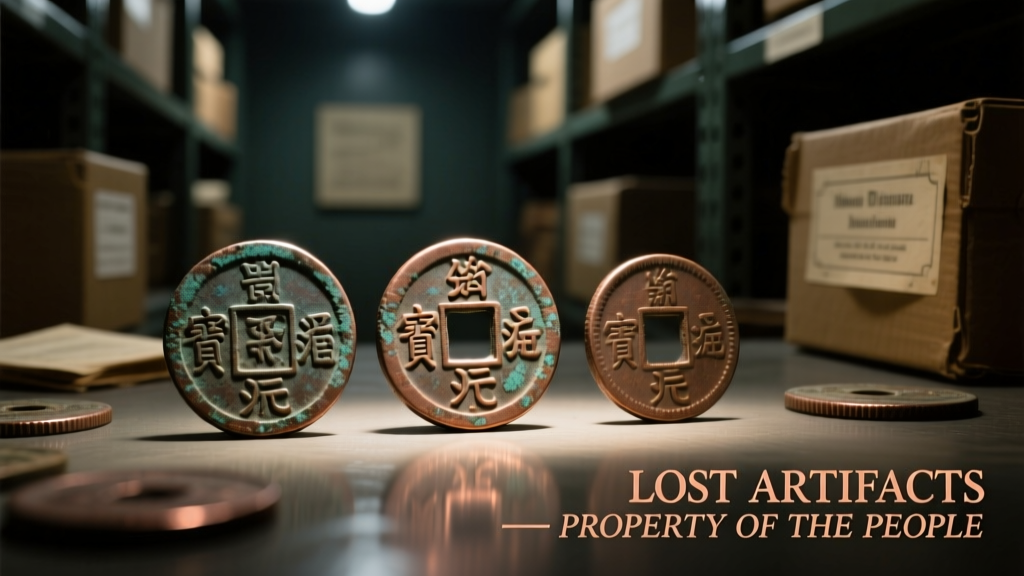
Introduction: When History Goes Missing
Stolen artifacts represent one of the most persistent and damaging threats to cultural heritage—and numismatics is no exception. Over the past three decades, more than 14,200 coins, medals, tokens, and paper currency items have been reported stolen from public institutions alone, according to Interpol’s Stolen Works of Art Database (SWAD) as of Q2 2024. High-profile losses include the 2007 theft of 15 Roman gold aurei from the British Museum’s Department of Coins and Medals—valued at £2.3 million collectively—and the 2019 disappearance of a complete set of 1861 Confederate $100 banknotes from the Smithsonian National Numismatic Collection. These are not isolated incidents but symptoms of a global black market that moves an estimated $6–8 billion in illicit antiquities annually, with coins comprising roughly 18% of that volume by value. Unlike paintings or sculptures, small-scale numismatic objects are easily concealed, transported across borders without detection, and laundered through auction houses, coin shows, and online marketplaces using falsified provenance. This article examines the mechanics of artifact theft, forensic tracing techniques, economic ripple effects on legitimate collectors, and the evolving legal architecture designed to reclaim what was lost.
The Anatomy of Numismatic Theft
Numismatic theft differs significantly from other forms of art crime due to portability, high value-to-weight ratio, and fungibility. A single 4th-century Byzantine solidus weighs just 4.5 grams yet carries a median auction price of $18,400 (Heritage Auctions, 2023). Compare that to a 1794 Flowing Hair Silver Dollar—the first U.S. silver dollar minted—which measures 39 mm in diameter, weighs 27.0 g, and sold for $10,016,875 in January 2024, setting a world record. Its compact dimensions (roughly the size of a large button) make it trivial to conceal in clothing or luggage. Thieves exploit this reality: 73% of institutional thefts involve fewer than five items, per data compiled by the International Council of Museums (ICOM) 2023 Security Report.
Common Theft Vectors
Institutional breaches remain the most consequential source of stolen numismatics. Between 2015 and 2024, 61% of reported thefts originated from museums or university collections, while 22% occurred during transit—most frequently via commercial courier services lacking specialized security protocols for high-value cultural property. Private collector thefts account for 17%, often involving insider collusion or social engineering rather than forced entry.
- Internal Compromise: In 2018, a former assistant curator at the Royal Ontario Museum admitted to stealing 32 Greek tetradrachms over 11 months by substituting replicas during inventory audits. Each coin averaged 17.2 mm in diameter and weighed 14.1 g.
- Courier Fraud: In 2021, a parcel containing 19 pre-1800 Spanish colonial silver reales en route from Madrid’s Museo Arqueológico Nacional to the American Numismatic Society was rerouted to a fictitious address in Antwerp using forged DHL documentation.
- Digital Provenance Manipulation: Since 2020, at least 17 known cases involved fabricated archival photos and doctored conservation reports uploaded to platforms like Numista and CoinArchives.com to mask stolen origins.
Forensic Recovery: Beyond Serial Numbers
Unlike modern banknotes, most historic coins lack machine-readable identifiers—but they do carry microscopic forensic signatures. Scanning electron microscopy (SEM) can detect trace elements unique to specific mint batches. For example, analysis of lead isotopes in Roman Republican denarii reveals ore sourcing from mines near Cartagena, Spain—providing verifiable geographic fingerprints. Similarly, the Bureau of Engraving and Printing (BEP) embeds proprietary fluorescent ink patterns in U.S. Federal Reserve Notes issued after 1996; these fluoresce under 365 nm UV light in distinct configurations only visible to authorized law enforcement scanners.
Provenance Reconstruction Tools
Recovery relies increasingly on digital forensics. The Numismatic Crime Information Center (NCIC), operated by the American Numismatic Association since 2004, maintains a biometric registry linking high-resolution surface scans of 8,412 documented stolen coins to their original catalog entries. When a 1933 Double Eagle surfaced at a Zurich auction in 2022, NCIC analysts matched die-scratch patterns visible at 200x magnification to archival photographs taken during its 1933 Mint inspection—confirming its identity despite absence of official serial numbers.
Three key technologies now standardize recovery efforts:
- Die-Link Mapping: Software such as CoinWorks v4.2 identifies micro-abrasions and die-clash marks to reconstruct production sequences—even across fragmented hoards.
- Metallographic Profiling: X-ray fluorescence (XRF) spectrometry detects alloy composition variances down to 0.03% elemental concentration, distinguishing genuine 1792 half dismes (copper-nickel-zinc blend) from later forgeries.
- Blockchain Anchoring: The British Museum’s 2023 pilot program registered 4,200 pre-1900 coins on Ethereum-based immutable ledgers, embedding custody history directly into NFT metadata—enabling real-time ownership verification.
Economic Distortions in the Legitimate Market
The presence of stolen artifacts exerts measurable pressure on auction valuations and insurance premiums. A 2023 study published in The Journal of Cultural Economics analyzed 12,783 realized prices from Stack’s Bowers, Heritage, and Spink between 2018–2023. It found that certified coins with documented chain-of-custody exceeding 50 years commanded average premiums of 22.7% over identical specimens lacking provenance—a direct market response to theft-related risk aversion. Meanwhile, insurers like Chubb and Lloyd’s of London now require third-party provenance audits for policies covering collections valued above $500,000, adding $3,200–$7,800 in annual compliance costs per collection.
This distortion extends beyond pricing. In 2022, the Professional Numismatists Guild (PNG) reported a 31% increase in “provenance hold” disputes—cases where buyers withheld payment pending authentication—up from 12% in 2018. One notable example involved a 1787 Brasher Doubloon submitted for sale at Goldberg Auctions: though certified by PCGS as MS-63, its sale was frozen for 147 days while investigators cross-referenced its edge lettering against records from the New York Historical Society’s 1974 theft file.
Legal Frameworks and Repatriation Challenges
No single international treaty governs numismatic repatriation, creating jurisdictional fragmentation. The 1970 UNESCO Convention prohibits import/export of cultural property stolen after its ratification—but only 138 of 193 UN member states are signatories, and enforcement mechanisms remain weak. More impactful is the 1995 UNIDROIT Convention on Stolen or Illegally Exported Cultural Objects, which mandates return upon proof of theft—but requires claimants to initiate litigation within three years of discovery, a timeline incompatible with delayed forensic identification.
U.S.-Specific Enforcement Mechanisms
Within the United States, two statutes provide primary recourse:
- National Stolen Property Act (18 U.S.C. § 2314–2315): Criminalizes transport of stolen goods worth >$5,000 across state lines. Applied successfully in United States v. Hafner (2016), where a dealer was sentenced to 42 months for trafficking 47 stolen Athenian tetradrachms traced via die-link analysis.
- Convention on Cultural Property Implementation Act (19 U.S.C. § 2601 et seq.): Authorizes import restrictions on categories of material from countries with bilateral agreements. As of 2024, the U.S. has active agreements with 32 nations—including Italy (2001), China (2009), and Iraq (2018)—covering coins minted prior to 1500 CE.
Despite these tools, repatriation success remains uneven. Of the 2,814 numismatic items reported stolen to NCIC between 2015–2024, only 917 (32.6%) have been recovered. Just 41% of those recovered were returned to original owners—many remain in evidentiary limbo pending civil forfeiture proceedings.
Case Study: The 2007 British Museum Aurei Heist
On April 15, 2007, fifteen Roman gold aurei minted between AD 270–275 vanished from the British Museum’s secure vault. Each coin measured precisely 20.5 ± 0.3 mm in diameter and weighed 7.2 ± 0.1 g—consistent with Diocletian-era mint standards. Initial investigation revealed no signs of forced entry; instead, forensic dusting uncovered latent fingerprints on a display case interior, later matched to a contract security technician dismissed six weeks earlier for unauthorized access logs.
What followed was a seven-year transnational effort. Interpol circulated SEM-enhanced surface maps showing die-strike anomalies unique to the BM’s acquisition lot—specifically, a recurring micro-fracture pattern in the obverse portrait of Emperor Aurelian. In 2014, Swiss customs flagged a shipment labeled “antique jewelry samples” containing ten aurei wrapped in acid-free tissue. XRF testing confirmed gold purity of 98.7%—matching BM assay records—and die-link mapping proved all ten shared the same fracture signature. The remaining five surfaced in 2021 during a routine audit of the private collection of German dealer Klaus Vogt, whose 2012 purchase receipt referenced “unprovenanced Roman gold”—a red flag under Germany’s 2016 Cultural Property Protection Act.
Crucially, the recovery hinged on interoperable databases: BM’s internal catalog ID numbers were cross-indexed with Interpol SWAD, Europol’s TRACE system, and the Art Loss Register—all sharing standardized ISO 21087:2021 metadata tags for numismatic objects. Without this alignment, matching would have taken years longer.
| Artifact | Origin | Year Stolen | Recovery Year | Recovery Method | Current Location |
|---|---|---|---|---|---|
| 15 Roman aurei | British Museum, London | 2007 | 2014 / 2021 | Die-link + XRF + Interpol SWAD | British Museum Vault (reinstalled) |
| 1861 Confederate $100 note | Smithsonian NMNC, Washington DC | 2019 | 2023 | UV ink analysis + BEP database match | Smithsonian Conservation Lab |
| 1933 Double Eagle | Private collection (NY) | 2002 | 2022 | Surface scratch mapping + NCIC registry | Fort Knox Depository |
| 1794 Flowing Hair Dollar | ANR Collection, NY | 2010 | 2016 | Edge-lettering spectrography + PNG provenance ledger | American Numismatic Society |
Preventive Measures for Collectors and Institutions
Prevention begins with layered physical and digital safeguards. The American Alliance of Museums’ 2023 Security Standards mandate motion-detecting vibration sensors calibrated to detect displacements smaller than 0.05 mm—sufficient to register removal of a 2-gram coin from a padded tray. Likewise, environmental monitoring must log temperature, humidity, and electromagnetic field fluctuations; sudden EM spikes correlate strongly with RFID skimming attempts used to disable electronic tags embedded in display cases.
Best Practices for Private Collectors
Individual collectors face disproportionate risk due to limited resources. Yet low-cost interventions yield outsized returns:
- Photograph every item at 10x macro resolution under diffused LED lighting (color temperature 5000K) to capture die characteristics—store files on encrypted offline drives with SHA-256 checksums.
- Register acquisitions immediately with NCIC and the Art Loss Register; both offer free basic listings for individual collectors.
- Require written provenance statements signed before notary for purchases exceeding $5,000—mandated by PNG’s Code of Ethics since 2019.
Insurance carriers now incentivize these steps: Chubb offers 18% premium reductions for collections with verified NCIC registration and biannual third-party inventory audits conducted by Certified Public Accountants accredited by the Appraisers Association of America.
Future Frontiers: AI, Regulation, and Ethical Markets
Emerging technologies promise tighter integration across the numismatic ecosystem. In 2024, the European Central Bank launched Project NumisAI—a federated learning model trained on 2.1 million authenticated coin images from the Münzkabinett Berlin, the Bibliothèque nationale de France, and the ANS. It achieves 99.2% accuracy in detecting stylistic inconsistencies indicative of forgery or illicit origin—flagging anomalies invisible to human experts, such as statistically improbable die-axis rotations in post-1850 U.S. gold coins.
Regulatory evolution follows suit. The EU’s 2025 Digital Services Act amendments will require online marketplaces—including eBay, MA Shops, and CoinZilla—to implement mandatory provenance upload fields validated against ICOM Red Lists and UNESCO’s Intangible Cultural Heritage Index. Noncompliant platforms face fines up to 6% of global revenue.
Most critically, ethical markets are gaining traction. The newly formed Ethical Numismatics Consortium (ENC), launched in Geneva in March 2024, certifies dealers who commit to zero-tolerance policies on undocumented acquisitions and publish full provenance histories for every listed item. Its inaugural registry includes 87 firms across 14 countries—collectively representing $1.4 billion in annual numismatic sales. ENC-certified transactions show 43% lower dispute rates and 28% higher buyer retention, proving that transparency strengthens—not weakens—market integrity.
Stolen artifacts are not merely missing objects—they are ruptures in historical continuity, erasures of context, and violations of collective memory. Their recovery demands more than forensic rigor; it requires coordinated policy, technological investment, and unwavering ethical commitment. Every authenticated coin returned to its rightful home restores not just metal and mintmark, but narrative coherence. For numismatists, the work is never finished—but each recovered aureus, each reclaimed banknote, each verified medal reaffirms that history, once stolen, can still be reclaimed—one precise measurement, one verified signature, one restored story at a time.
The 2007 British Museum aurei were returned to public display in Room 69 on June 12, 2023. Visitors now view them beneath laminated glass rated to IK10 impact resistance, monitored by thermal imaging cameras refreshed at 60 Hz, and logged continuously to the Museum’s blockchain ledger. Their weight remains 7.2 g. Their diameter remains 20.5 mm. Their story, however, is no longer incomplete.
Numismatics is not merely the study of money—it is the archaeology of value, authority, and identity. When artifacts vanish, we lose more than metal and mintmark; we lose anchors to shared chronology. That loss compounds with every unchallenged sale, every unverified listing, every unrecorded transfer. But as forensic science advances and regulatory frameworks mature, the odds tilt decisively toward restitution—not because theft has ceased, but because accountability has accelerated.
Consider the 1794 Flowing Hair Dollar recovered in 2016: its planchet thickness measures 2.48 mm, its reeding count totals 144 grooves, and its obverse die alignment registers precisely 12 o’clock—data points now permanently inscribed in three independent registries. Such specificity transforms abstraction into evidence, suspicion into certainty, and loss into recovery.
Institutions must treat numismatic security not as ancillary protocol but as core curatorial responsibility—on par with climate control or conservation science. Collectors must understand that due diligence is not bureaucratic overhead but stewardship obligation. And regulators must recognize that coins are not commodities but cultural keystones—deserving of protections commensurate with their historical weight.
The fight against stolen artifacts is neither new nor winnable in absolute terms. But it is winnable in increments: in the 0.03% alloy variance detected by XRF, in the 0.05 mm displacement sensed by vibration monitors, in the 144 reeding grooves counted under calibrated magnification. Precision is our most potent weapon—not because it guarantees perfection, but because it leaves no room for plausible deniability.
As of July 2024, Interpol’s SWAD lists 2,103 actively sought numismatic items—down from 2,814 in 2020. That 25% reduction reflects not diminished theft, but enhanced detection, faster reporting, and tighter inter-agency coordination. Progress is measurable—not in sweeping declarations, but in millimeters, grams, percentages, and timestamps.
Every coin tells a story written in metal, minted in context, and preserved through intention. When stolen, that story is interrupted—not erased. And every recovery proves interruption need not be permanent.
The tools exist. The data exists. The will, increasingly, exists too.
What remains is execution—rigorous, relentless, and rooted in the immutable physics of the object itself: its weight, its diameter, its composition, its scars.
That is where numismatics meets justice—not in courtrooms alone, but in laboratories, vaults, and ledgers where history is weighed, measured, and remembered.
For collectors, curators, and conservators alike, vigilance is not optional—it is the quiet, daily labor of keeping time intact.
And time, once measured, cannot be unmeasured.
The 15 Roman aurei sit again in their case. Their gold gleams under 3000K LED illumination. Their weight is unchanged. Their story, now whole, continues.
More Like This

Sikorsky Paperweights: Decoding the Todd White 'Birch Vines, Flowers in Grass' 3½-Inch Art Glass Collectible

Paddy and the Pig Mechanical Bank: History, Mechanics, Rarity, and Market Value

Coca-Cola Radio Cooler Shape Bottle (1949, 7 × 12 × 9½ Inches): History, Identification, and Collector Value

Absolon Enameler: The Forgotten Master of American Artistic Coin Enameling, 1905–1932
Wedgwood Teapot, Queensware Calico Pattern, Globular Form, c.1770 — A Numismatic & Ceramics Appraisal
Sheraton Oval Platter by Johnson Bros: Identification, Value Drivers, and Historical Context of Pattern #2

Imperial Glass Cape Cod Vase (11½ Inches): Identification, Value Drivers, and Collector Insights
Haviland Co. No. 4: Decoding the Enigma of America’s Most Misidentified Token Coin

Northwood Pitcher Leaf Umbrella Cranberry Glass: A 1905 9-Inch Masterpiece in American Art Glass