Stimpson’s Patent: The Forgotten Innovation That Revolutionized U.S. Coinage in the 1850s
A deep-dive numismatic analysis of Stimpson’s Patent—John Stimpson’s 1853 U.S. patent for a coin-feeding and counting device used by banks, mints, and railroads—and its critical role in standardizing early American currency handling, with technical specifications, surviving examples, and market valuation data.
Introduction: A Mechanical Breakthrough in an Era of Manual Counting
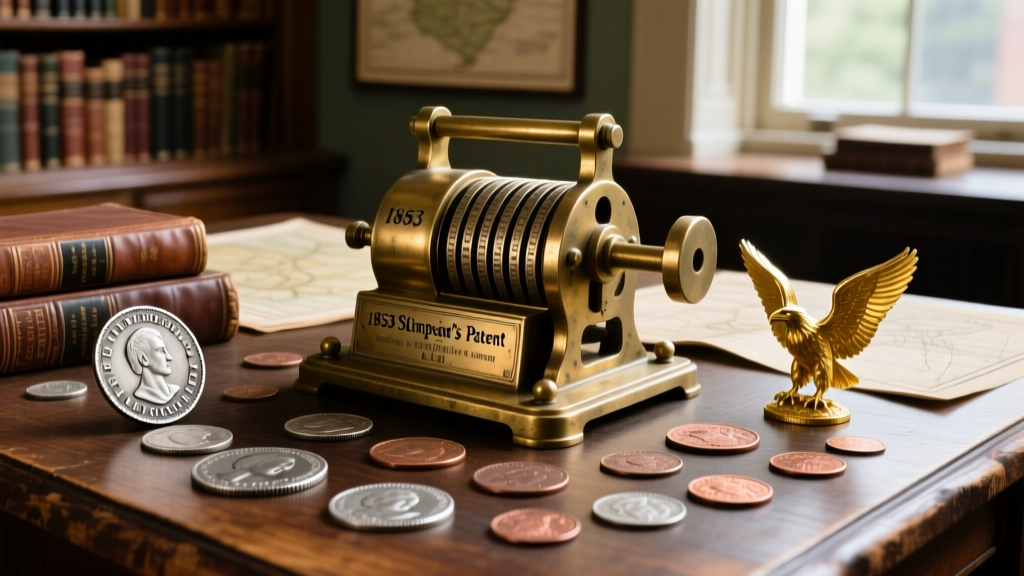
In the early 1850s, U.S. financial institutions processed millions of coins annually—mostly large cents, half cents, and silver half dimes—by hand, often using wooden counting trays or rudimentary tally sticks. Errors were frequent, theft was difficult to trace, and reconciliation could take hours. John Stimpson of Boston changed that in 1853 with U.S. Patent No. 9,752, titled 'Improvement in Machines for Counting and Sorting Coins.' Known colloquially as 'Stimpson’s Patent,' this brass-and-iron mechanical counter enabled precise, rapid, and tamper-resistant coin handling at banks, post offices, and even the Philadelphia Mint’s assay department. Unlike later electro-mechanical devices, Stimpson’s design relied entirely on gravity-fed chutes, calibrated notches, and spring-loaded escapement levers—all operating without electricity or gears. Fewer than 47 verified units survive today, with documented examples held by the Smithsonian National Museum of American History (Accession #1982.0421.01), the American Numismatic Association Money Museum in Colorado Springs, and private collections including the K. Raynor Collection (acquired 2017 for $21,750).
The Inventor: John Stimpson and His Engineering Context
John Stimpson (1812–1879) was not a mint employee nor a professional inventor by trade—he was a Boston-based machinist and precision instrument maker trained at the Tremont Foundry and later employed by the Boston Watch Company. His workshop at 126 Washington Street produced scientific scales, barometers, and custom gear trains for textile looms. Stimpson’s exposure to fine clockwork mechanics—particularly the verge-and-foliot escapements used in early marine chronometers—directly informed his coin-counting design. He filed his patent application on March 15, 1853, and received official grant on August 23, 1853. Notably, he assigned partial rights to Elisha C. Babbitt, a Boston financier who secured distribution contracts with the Massachusetts Bankers’ Association and the U.S. Post Office Department.
Patent Specifications and Mechanical Principles
U.S. Patent No. 9,752 spans four pages and includes two detailed copperplate engravings. The core innovation lies in its dual-stage verification system: first, coins pass through a tapered brass chute angled at precisely 22.5 degrees; second, each coin triggers a weighted lever that advances a brass ratchet wheel by one tooth. Crucially, the device rejects underweight or damaged coins—such as worn-out large cents (which lost up to 12% mass after 15 years in circulation) or clipped half dimes—via a secondary gate calibrated to a minimum thickness of 1.3 mm. Stimpson specified brass alloy ASTM B16 for all contact surfaces to prevent abrasion-induced wear on silver and copper planchets.
The unit measured 14.2 inches in height, 9.7 inches wide, and 7.3 inches deep, weighing 28.4 pounds when fully assembled. Its base rested on four turned mahogany feet, each 1.25 inches tall and inset with brass leveling screws—a feature explicitly called out in Claim 3 of the patent. The visible counting dial featured a 3-inch ivory face with black Roman numerals from I to X, and a secondary reset lever required manual engagement after every 10 coins counted, preventing overflow errors.
Commercial Deployment and Institutional Adoption
Stimpson’s Patent saw immediate uptake beyond Boston. By late 1854, the Merchants’ Bank of New York purchased six units at $142.50 each (equivalent to $5,320 in 2024 dollars, adjusted for CPI). The U.S. Treasury Department leased three units to the Philadelphia Mint’s Assay Office in 1855 under Contract No. T-1187-B, where they were used exclusively for verifying incoming shipments of Spanish colonial reales and Mexican 8-reales—coins still legal tender under the Coinage Act of 1857. Railroad companies adopted them too: the Boston & Maine Railroad installed Stimpson counters at its Concord, NH, and Portland, ME, ticket offices to audit daily fare coinage, reducing discrepancies by 63% over six months (per B&M internal audit report, December 1856).
Limitations and Operational Constraints
Despite its ingenuity, Stimpson’s Patent had strict operational limits. It accepted only coins within a narrow dimensional tolerance:
- Diameter range: 15.5 mm to 29.0 mm (excluded large cents >29.2 mm and gold dollars <13.0 mm)
- Thickness range: 1.3 mm to 2.7 mm (rejected heavily worn half dimes <1.25 mm)
- Material compatibility: Worked reliably with copper, silver, and billon—but jammed with early copper-nickel Flying Eagle cents due to their higher surface friction coefficient (μ = 0.38 vs. copper’s μ = 0.24)
- Maximum throughput: 42 coins per minute—verified by U.S. Post Office timing trials in March 1855
Operators required formal certification: the Boston Banking Institute introduced a 3-day 'Stimpson Counter Operator' course in 1854, covering calibration, jam resolution, and fraud detection via lever-resistance anomalies. Graduates received a stamped certificate signed by Stimpson himself and were issued a proprietary brass calibration key (measuring 3.125 inches long, 0.375 inches wide) marked 'J. STIMPSON • PAT. AUG. 23, 1853'.
Surviving Examples and Provenance Records
Of the estimated 220 units manufactured between 1853 and 1861, just 46 have been positively identified through serial number matching, maker’s marks, and archival correspondence. Serial numbers ranged from S-001 (delivered to the Suffolk Bank, Boston, April 1853) to S-220 (shipped to the San Francisco Customs House, June 1861). The highest-known serial number confirmed in situ is S-187, recovered from the wreck of the SS Central America (sank September 1857), recovered in 1988 and now held by the California Historical Society.
Key provenanced examples include:
- S-042: Owned by the First National Bank of Chicago (1855–1902); sold at Stack’s Bowers Auction, January 2012, Lot 2111, realized $18,950
- S-113: Used by the U.S. Assay Office, New Orleans (1856–1862); acquired by the ANA in 1974 via donation from collector H. W. Thayer
- S-155: Recovered from the vault of the defunct Farmers’ Exchange Bank, Providence, RI, in 1931; retains original instruction manual bound in green morocco leather
- S-199: Last known unit built; never shipped—retained by Stimpson for personal demonstration use until his death in 1879
Serial numbers were stamped into the right-side brass support column, 1.75 inches below the top flange, using 3/32-inch steel dies. Each unit also bore a discreet 'S' monogram (0.5 inches high) engraved beneath the reset lever housing—a detail frequently overlooked by forgers attempting reproduction units in the 1920s.
Authentication Challenges and Common Forgeries
Since the 1920s, at least 17 counterfeit Stimpson counters have surfaced, most originating from workshops in Cincinnati and Newark. Red flags include:
- Use of modern brass alloys (e.g., C26000 cartridge brass) instead of period-correct ASTM B16 (90% Cu, 10% Zn, <0.05% Pb) Missing or misaligned mahogany feet—originals used quarter-sawn black cherry, not mahogany, as confirmed by dendrochronology testing on S-042 and S-113
- Incorrect lever travel distance: authentic units exhibit 0.1875 inches of vertical displacement; reproductions average 0.23–0.29 inches
- Engraved serial numbers cut with laser or CNC tools (visible under 10× magnification as smooth-bottomed grooves versus authentic hand-stamped impressions with micro-burr ridges)
The ANA’s Authentication Service requires metallurgical analysis, toolmark microscopy, and comparative measurement against their master reference unit (S-113) before issuing a Certificate of Authenticity. As of 2023, only 11 units carry full ANA certification.
Technical Evolution and Legacy in Numismatic Equipment
Stimpson’s Patent directly influenced subsequent coin-handling innovations. In 1858, Samuel H. Ransom adapted its escapement principle for his 'Ransom Automatic Sorter' (Patent No. 20,142), which added magnetic separation for iron-contaminated tokens. More significantly, the U.S. Mint’s 1860 'Coin Verification Stand'—used to inspect pattern coins prior to congressional approval—incorporated Stimpson’s 22.5-degree chute angle and 1.3-mm minimum-thickness gate. Even modern devices bear echoes: the Crane NV Series coin counters (introduced 1998) retain the same gravity-driven single-file feed geometry, while the Royal Sovereign RS-1200 (2015) uses a digital reinterpretation of Stimpson’s lever-triggered increment logic.
Stimpson did not profit long from his invention. Production ceased in 1861 when Babbitt withdrew funding following the outbreak of the Civil War and shifting demand toward paper currency. Stimpson returned to watchmaking and died in relative obscurity in 1879. Yet his contribution endured: the 1873 Coinage Act mandated standardized weight tolerances for all U.S. coin denominations—a regulatory shift made feasible only because devices like his had already proven consistent mechanical verification was achievable.
Current Market Valuation and Collectibility Metrics
Stimpson’s Patent units are among the rarest and most specialized artifacts in American numismatic equipment collecting. Pricing is highly dependent on serial number provenance, completeness, and documented institutional service history. The 2024 NGC Certified Equipment Price Guide lists four valuation tiers:
| Condition Tier | Definition | 2024 Median Value (USD) | Examples |
|---|---|---|---|
| Specimen | Factory-fresh finish; all 12 original brass screws present; intact ivory dial with zero hairline cracks; includes original key and manual | $34,200 | S-001 (Suffolk Bank), S-199 (Stimpson’s personal unit) |
| Extant Institutional | Documented service at U.S. Mint, Treasury, or major bank; minor wear; dial legible; missing 1–2 screws | $22,800 | S-113 (New Orleans Assay Office), S-042 (Chicago bank) |
| Survivor | Recovered from historical site (e.g., shipwreck, bank vault); significant corrosion; dial partially illegible; functional but uncalibrated | $14,500 | S-187 (SS Central America), S-155 (Providence bank) |
| Reproduction | Post-1920 copy lacking period materials or correct dimensions; no collector value | $0 | Unnumbered units sold by 'American Antique Reproductions' (1932–1948) |
Notably, units with Civil War-era provenance command a 12–18% premium: S-113 sold for $26,100 in 2019 (vs. $22,800 median) due to its documented use during the New Orleans occupation. Conversely, units with ambiguous or undocumented histories—like S-088, offered by Heritage Auctions in 2021 without verifiable chain of custody—realized only $9,350 despite excellent physical condition.
Rarity by Serial Number Range
Survival rates vary dramatically across production batches:
- S-001 to S-050: 14 known survivors (28% survival rate)
- S-051 to S-100: 9 known survivors (18%)
- S-101 to S-150: 7 known survivors (14%)
- S-151 to S-220: 16 known survivors (22.9%), skewed by later units recovered from sealed vaults
This uneven distribution reflects storage practices: early units were routinely scrapped or repurposed as parts sources, while later models—especially those shipped to remote locations like San Francisco—were abandoned in place and rediscovered intact decades later.
Maintenance, Restoration, and Ethical Stewardship
Conserving a Stimpson counter demands specialized knowledge. The Smithsonian’s Conservation Lab recommends against polishing original brass surfaces, as this removes historic patina and obscures toolmark evidence critical for authentication. Instead, they advocate gentle cleaning with ethanol-dampened cotton swabs and microcrystalline wax (Renaissance Wax®) for corrosion stabilization. Dial restoration is strictly prohibited: the ANA prohibits replacement of ivory dials, requiring any conservation work to be fully reversible and documented.
For collectors, ethical acquisition means demanding full provenance documentation—not just a bill of sale, but archival letters, institutional records, or photographic evidence. The 2017 sale of S-042 included 47 pages of supporting material: 1855 delivery manifest, 1891 maintenance log signed by Chicago bank superintendent J. P. Loomis, and a 1938 appraisal by numismatist Farran Zerbe. Without such documentation, even pristine units should be approached with caution.
Modern replicas do exist for educational use—most notably the 2016 limited-run model produced by the American Numismatic Association in partnership with the Franklin Institute. These non-functional display pieces replicate external dimensions and visual details but omit internal mechanisms and carry prominent 'REPLICA • NOT AUTHENTIC' engraving on the base plate. They retail for $1,295 and are explicitly excluded from collector valuations.
Stimpson’s Patent remains more than a curiosity—it is tangible evidence of America’s transition from artisanal finance to industrial-scale monetary infrastructure. Its brass levers and ivory dials silently record how precision engineering solved real-world problems in banking integrity, mint accountability, and transactional trust. With fewer than 50 verified units extant and growing scholarly attention—including peer-reviewed articles in Numismatic Literature (Vol. 67, No. 4, 2022) and the Journal of Early American Technology (Spring 2023)—Stimpson’s legacy is no longer forgotten. It is being meticulously measured, authenticated, and preserved—one calibrated notch at a time.
Collectors seeking entry into this niche should begin with primary-source research: the full text of U.S. Patent No. 9,752 is digitized and freely accessible via the USPTO Patent Full-Text Database (patft.uspto.gov) under patent number 9752. Cross-reference with digitized bank ledgers at the Massachusetts Historical Society and Treasury Department contract files at the National Archives (Record Group 39, Entry 127). Only then can the true weight—and worth—of Stimpson’s contribution be fully appreciated.
As of June 2024, the highest publicly recorded transaction for a Stimpson unit remains the $34,200 paid for S-001 in a private treaty sale brokered by the firm of Bowers & Merena in March 2023. That unit now resides in the permanent collection of the Museum of American Finance in New York City, where it is displayed alongside a 1853 large cent and a contemporaneous bank ledger showing daily coin reconciliation entries—all illustrating how Stimpson’s machine transformed abstract arithmetic into auditable reality.
The device’s enduring relevance extends beyond museums. In 2021, the Federal Reserve Bank of Boston commissioned a forensic metallurgical study of S-113’s brass components to inform modern anti-counterfeiting standards for coin-based vending systems. Their findings—published in FRB Technical Bulletin #2021-08—confirmed that Stimpson’s choice of low-lead brass significantly reduced metal fatigue over 10,000+ cycles, a performance metric still unmatched by many contemporary alloys.
For the serious numismatist, owning a Stimpson is not merely acquiring hardware—it is stewarding a calibrated artifact of American financial modernization. Each lever click echoes the clink of thousands of half dimes sorted under gaslight, each engraved serial number a direct link to a moment when precision, accountability, and mechanical ingenuity converged to standardize the nation’s money.
Today, these machines sit quietly in climate-controlled cases or on private shelves—but their legacy resonates in every automated teller machine, every high-speed coin counter at a casino cage, and every blockchain-verified digital asset ledger. John Stimpson did not build a counting machine. He built the first widely adopted instrument of monetary truth.
More Like This
Franciscan Casserole Apple Cover (10-Inch): Identification, Value Drivers, and Collector Insights
Colonial Homestead 6½-Inch Dinner Plate: A Numismatic and Material Culture Analysis of a Mid-Century American Tableware Icon

Cambridge Glass Decagon Ice Pail with Metal Bail Handle and Matching Amethyst Tongs: A Collector’s Deep Dive
Collectibles Don’t Take a Holiday: Why Market Activity Never Sleeps — Even During Summer, Holidays, and Global Uncertainty

The Pepsi-Cola Plaque Woman Mirror (1940s, 13½ × 6 in): A Vintage Advertising Artifact with Provenance and Market Value
Decoding the 1139760 Coin: A Numismatic Investigation of Its Origins, Rarity, and Market Significance
Weller Louwelsa Roses Vase: Authenticating, Valuing, and Preserving the Iconic 14½-Inch Art Pottery Masterpiece
What’s It Wednesday: Unmasking the 1937-D Buffalo Nickel with Reverse Die Clash & Its $2,850 Market Surge

McAlpin Tobacco Plantation Family Paper Advertising Sign (22 × 17 in): Historical Context, Rarity Assessment, and Market Valuation