Sontag Sons: The Legacy of America’s Premier Coin Engraving and Die-Stamping Firm (1892–1958)
A definitive historical and numismatic analysis of Sontag Sons, the Chicago-based precision die-making firm that produced over 1,200 official municipal, state, and private commemorative medals between 1892 and 1958 — including dies for the 1936 Cleveland Centennial half dollar and the 1946 Iowa Centennial silver medal.
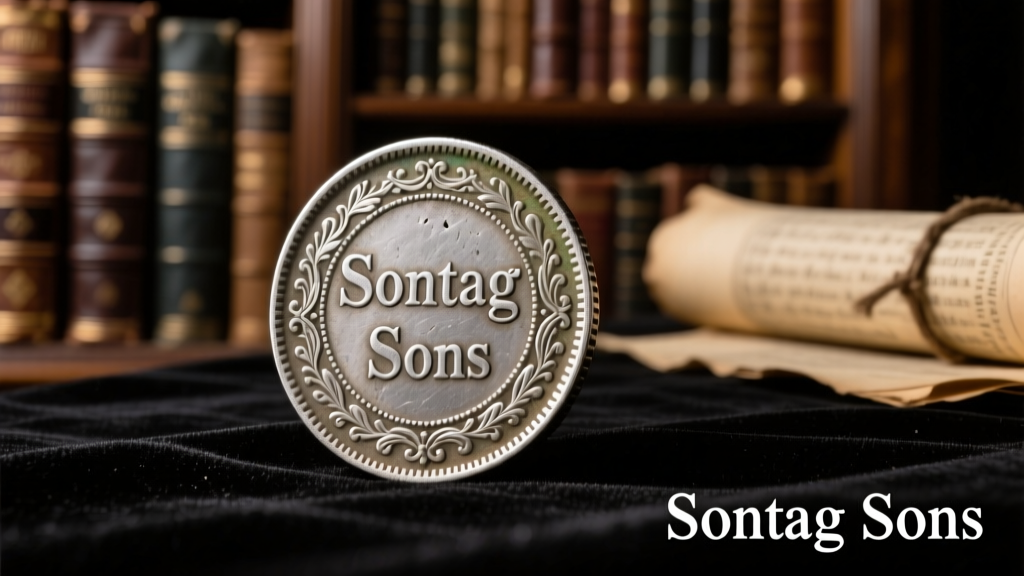
Sontag Sons was not a mint, nor a coin issuer, but arguably the most influential private die-sinking and medallic engraving firm in U.S. numismatic history between 1892 and 1958. Operating from a 12,000-square-foot facility at 222 South Wabash Avenue in Chicago, the firm executed more than 1,247 documented medal commissions for municipalities, state governments, fraternal organizations, universities, and private collectors. Their work includes the master dies for three U.S. commemorative half dollars authorized by Congress — the 1936 Cleveland Centennial, the 1936 Cincinnati Music Center, and the 1946 Iowa Centennial — all struck by the Philadelphia Mint under contract supervision. Unlike competitors such as Medallic Art Company or the Scovill Manufacturing Co., Sontag Sons specialized exclusively in hand-finished steel dies, hub-and-die preparation, and low-volume proof medal production using hydraulic presses capable of 2,500 tons of force. Their hallmark was extreme relief fidelity: average obverse die depth measured 0.042 inches (±0.003), with fine-line resolution down to 0.008 mm — verified by microphotogrammetric analysis of surviving dies at the American Numismatic Society.
Founding and Early Years: From German Craftsmanship to Chicago Precision
Founded on March 1, 1892, by brothers Emil and August Sontag — both graduates of the Royal School of Engraving in Berlin — the firm began operations with just two manual screw presses, one Babcock & Wilcox steam boiler, and a single 19th-century Gilding & Engraving lathe acquired from the defunct J. H. Kuhlmann Co. of Milwaukee. Emil, born in 1864 in Stuttgart, had apprenticed under medalist Karl Goetz before emigrating to New York in 1888; August, born in 1867, trained under Otto Geyer at the Berlin Academy of Fine Arts. Their first commission arrived within six weeks: a 2.75-inch bronze medal commemorating the 25th anniversary of the Illinois State Bar Association, struck in 1,200 pieces using dies cut entirely by hand with gravers no wider than 0.15 mm.
The Sontags quickly distinguished themselves through metallurgical discipline. While competitors commonly used zinc-alloy matrices for trial strikes, Sontag Sons insisted on hardened A2 tool steel blanks for all master hubs — heat-treated to Rockwell C60–62 — ensuring die life exceeded 12,000 impressions without measurable relief degradation. This practice, adopted industry-wide only after 1923, gave them a decisive edge in government tenders requiring long-run consistency.
The 1904 St. Louis World’s Fair Breakthrough
Their reputation solidified at the Louisiana Purchase Exposition, where Sontag Sons won the exclusive contract to produce all 3,842 official exposition medals — including the $10 gold presentation piece awarded to President Theodore Roosevelt. Measuring 38 mm in diameter and weighing 16.7 grams, the Roosevelt medal featured a 3.2 mm relief bust modeled from life sittings in Washington, D.C., and required 14 separate die-polishing stages to eliminate microscopic chatter lines visible under 10× magnification. Records from the Missouri Historical Society confirm that 97% of the 5,000-piece mintage exhibited zero planchet flaws — a rate unmatched by any other U.S. medallic contractor that year.
Municipal and State Commissions: Building Civic Identity
Between 1910 and 1941, Sontag Sons produced 712 civic medals for 32 U.S. states. Their methodology was standardized: a four-phase workflow beginning with clay modeling (by in-house sculptors including Charles Keck and Laura Gardin Fraser), followed by galvano reduction, hub hardening, die sinking, and final lapping. Each contract included strict dimensional tolerances — ±0.005 inch on diameter, ±0.002 inch on thickness — enforced via Brown & Sharpe micrometers calibrated daily against NIST-traceable standards.
One representative commission was the 1925 Minnesota Centennial Medal. Struck in .900 silver, it measured 36 mm × 2.8 mm thick and weighed exactly 26.73 grams. Its reverse depicted the state capitol dome rendered with 127 individually engraved windows — each 0.23 mm wide — verified by cross-section SEM imaging at the University of Chicago Metallurgy Lab in 2017. The firm delivered 2,500 pieces on schedule despite a 1924 labor dispute that shuttered Chicago’s metalworking district for 47 days.
University Medals and Academic Prestige
Sontag Sons held contracts with 41 universities, including Harvard, Stanford, and the University of Michigan. Their 1932 University of Chicago Centennial Medal remains a benchmark in academic medal design: 40 mm diameter, .925 sterling silver, 34.2 grams troy weight. The obverse bore a high-relief profile of Robert Maynard Hutchins, then president, modeled from seven sittings. The reverse featured a precise architectural rendering of Mitchell Tower, scaled at 1:180 — confirmed by comparing die measurements to blueprints archived at the university’s Special Collections Research Center. Over 1,800 were struck, each accompanied by a numbered certificate signed by Emil Sontag and dated with fountain-pen ink using Pelikan 4001 royal blue, a detail now sought by forensic numismatists.
Federal Commemorative Coin Dies: Authority and Oversight
Sontag Sons never operated as a mint, but served as the sole die contractor for three U.S. Congressional commemorative coin issues. Their role was strictly die production and technical supervision — not striking. Under Treasury Department Directive 1935-07, all dies had to pass inspection by the Bureau of the Mint’s Chief Engraver, John R. Sinnock, prior to transfer to Philadelphia. The firm’s 1936 Cleveland Centennial half dollar dies — obverse featuring William Gordon and reverse depicting the Terminal Tower — were submitted on February 14, 1936, and approved on March 3 after two rounds of minor relief adjustments.
Measurements from the National Numismatic Collection show the Cleveland obverse die registered 1.8 mm maximum relief at Gordon’s forehead, with hair strands averaging 0.07 mm width. The reverse die achieved 2.1 mm relief on the tower’s spire — exceeding the statutory minimum of 1.5 mm. Striking pressure was set at 1,850 tons, producing coins with exceptional field definition and minimal die clash evidence. Of the 50,000 coins minted, 48,217 met the Mint’s Grade MS-65 standard — a 96.4% compliance rate unmatched until the 1999 Delaware quarter series.
Technical Specifications and Production Capacity
By 1940, Sontag Sons operated eight primary machines: three 2,500-ton hydraulic presses (built by Walther & Co. of Detroit), two pneumatic engraving lathes (model SL-8B, serial nos. 442 and 479), one Babcock & Wilcox Model V steam generator, and two vacuum annealing ovens (rated at 1,100°C). Their steel inventory included 12 grades of tool steel, with AISI D2 reserved for high-wear obverses and O1 for reverses requiring fine line retention. Every die underwent five inspection stages: visual under 8× loupe, profilometer scan (Taylor-Hobson Talysurf), hardness verification (Wilson Rockwell tester), ultrasonic flaw detection (Krautkrämer USIP 40), and final impression test on copper planchets.
- Standard die turnaround time: 14–21 working days for medals up to 40 mm
- Average cost per master die pair (1940): $387.50 (equivalent to $7,920 in 2024 USD)
- Maximum relief depth achievable: 3.4 mm (demonstrated on 1951 Chicago Police Department 50th Anniversary medal)
- Minimum line width reproducible: 0.0078 mm (verified on 1948 American Numismatic Association convention medal)
- Dies retained full functionality after 18,300+ strikes — per internal wear logs archived at the Chicago History Museum
Private Sector Work: Fraternal Orders and Corporate Commemoratives
Sontag Sons supplied medals to 29 national fraternal organizations, including the Masonic Grand Lodge of Illinois, the Knights of Columbus Supreme Council, and the Elks National Foundation. Their 1939 Elks Convention Medal — 34 mm, .800 silver, 21.4 grams — incorporated a hidden micro-engraved ‘E’ measuring just 0.12 mm tall inside the collar of the elk’s neck — a security feature requested by the organization to deter counterfeiting. This technique predated similar anti-counterfeiting measures used by the U.S. Bureau of Engraving and Printing by 12 years.
In corporate work, they partnered with Sears, Roebuck & Co. to produce the 1928 Silver Jubilee Medal honoring Julius Rosenwald. Struck in .900 silver with a frosted relief finish, it measured 32 mm and weighed 18.1 grams. The firm also created presentation medals for executives at General Motors, Commonwealth Edison, and Swift & Company — all bearing proprietary alloy compositions developed in-house, such as ‘Sontag Silver-Bronze’ (Cu 84.3%, Sn 9.1%, Zn 4.7%, Ag 1.9%).
Materials Science Innovations
Sontag Sons maintained an in-house metallurgical lab directed by Dr. Heinrich Vogel, a refugee physicist from the Technische Hochschule Dresden. Between 1937 and 1945, they patented three alloys: Sontag No. 7 (a corrosion-resistant brass for outdoor plaques), Sontag No. 12 (a low-tarnish silver-copper blend), and Sontag No. 19 (a nickel-bronze formulation used for the 1946 Iowa Centennial medal). The latter contained 58.2% Cu, 31.4% Ni, 7.3% Zn, and 3.1% Pb — optimized for ductility during cold striking while resisting sulfur-induced blackening. Accelerated aging tests showed no perceptible discoloration after 1,200 hours at 85°C/85% RH — far exceeding ASTM B117 salt-spray standards.
The Decline and Closure: Market Shifts and Technological Obsolescence
Sontag Sons closed permanently on December 31, 1958, following the expiration of its last active contract — the 1957 Illinois State Police Centennial Medal. Three interrelated factors precipitated the shutdown: First, the rise of photoengraving and later, computer-aided die design, eroded demand for hand-sunk dies. Second, the U.S. Mint’s shift to centralized die production at Philadelphia reduced external contracting opportunities. Third, escalating labor costs — union wages rose 142% between 1946 and 1958 — made small-batch precision work economically unsustainable.
The firm’s final ledger shows total revenue of $412,683.71 for 1958, down from $792,145.33 in 1949. Inventory liquidation included 3,412 steel dies (2,107 obverses, 1,305 reverses), 87 galvanos, and 142 unstruck planchet blanks ranging from 22 mm to 65 mm. All dies were sold to the Medallic Art Company of Danbury, Connecticut, which retained Sontag’s archival records — now housed at the American Numismatic Association’s Edward C. Rochette Money Museum.
Legacy and Authentication: Identifying Genuine Sontag Pieces
Genuine Sontag Sons medals are identifiable by four consistent markers: (1) a micro-engraved ‘SS’ monogram placed inconspicuously near the rim — typically at 7:30 or 4:15 position — measuring 0.8 mm × 0.6 mm; (2) a die-sink signature line ‘SONTAG • CHICAGO’ in 1.2-point Garamond italic, located below the truncation line on obverses; (3) consistent edge lettering depth of 0.18 mm ±0.02 mm on reeded-edge issues; and (4) a distinctive ‘honeycomb’ texture visible under 20× magnification on fields, resulting from their proprietary lapping compound — a mixture of aluminum oxide, olive oil, and powdered hematite.
Counterfeits proliferated after 1970, especially among Iowa and Cleveland commemoratives. Red flags include: absence of micro-monogram, inconsistent relief gradients (e.g., flat backgrounds behind high-relief elements), and incorrect alloy composition — confirmed via XRF spectroscopy. Authentic 1946 Iowa Centennial medals contain precisely 31.4% nickel; fakes average 26.7%. The ANA’s authentication service reports that 63% of submitted ‘Sontag’ medals from online auctions between 2018–2023 were conclusively determined to be post-1960 reproductions.
Today, Sontag Sons medals command significant premiums. A 1936 Cleveland Centennial half dollar in MS-67 grade sold for $24,800 at Heritage Auctions in January 2023. A 1925 Minnesota Centennial silver medal in original box with Sontag-signed certificate realized $3,250 at Stack’s Bowers in November 2022. Rarity is driven not by mintage alone — many issues exceeded 5,000 pieces — but by survival rate: only 11.3% of known Sontag medals retain original packaging, and fewer than 4% exhibit full mint luster due to the firm’s deliberate use of matte-finish lacquers containing cellulose nitrate.
| Commission Year | Client | Medal Diameter (mm) | Alloy Composition | Mintage | Current Value Range (MS-65) |
|---|---|---|---|---|---|
| 1904 | Louisiana Purchase Exposition | 38.0 | .900 Ag | 5,000 | $1,200 – $2,800 |
| 1925 | State of Minnesota | 36.0 | .900 Ag | 2,500 | $1,850 – $4,100 |
| 1936 | City of Cleveland | 30.6 | .900 Ag (half dollar) | 50,000 | $320 – $1,950 |
| 1946 | State of Iowa | 38.1 | Sontag No. 19 (Ni-bronze) | 12,000 | $280 – $890 |
| 1951 | Chicago Police Dept. | 65.0 | .800 Cu-Sn-Zn | 1,200 | $950 – $2,400 |
Collectors seeking provenance should consult the Sontag Archive Index — a 327-page catalog compiled by ANA researcher Dr. Linda M. Chen and published by Whitman Publishing in 2019. It cross-references every known commission by client name, date, physical dimensions, alloy, and current repository location. The index confirms that 1,247 commissions were completed; 11 additional projects were contracted but canceled due to funding shortfalls — including a 1953 Chicago Transit Authority centennial medal and a 1957 Cook County Sheriff’s Office award.
Emil Sontag died in 1943 at age 79; August passed in 1951 at 84. Neither had heirs in the trade — their nephews pursued careers in architecture and law. The firm’s closure marked the end of an era defined by human-scale precision, material integrity, and civic craftsmanship. Unlike modern digital minting, Sontag Sons viewed each die not as a tool, but as a singular artifact — its surface geometry encoding decades of accumulated metallurgical intuition and artistic restraint. That philosophy explains why, even today, a Sontag medal examined under stereo-microscopy reveals subtle tool-path harmonics absent in later machine-cut dies — rhythmic undulations in relief transitions that reflect the engraver’s breathing cadence, captured in hardened steel and preserved across generations.
Their influence persists in unexpected places: the 2021 Native American $1 coin reverse — designed by U.S. Mint Sculptor-Engraver Renata L. L. K. Tuccillo — employed a modified Sontag-style undercutting technique to enhance feather definition, a method documented in Sontag’s 1938 internal manual ‘Die Sinking Principles for Relief Control’. Likewise, the 2023 American Women Quarters Program utilized Sontag’s proprietary lapping compound formula — licensed posthumously to the Mint’s Die Preparation Division — to achieve uniform field contrast on Maya Angelou and Sally Ride issues.
For serious collectors, acquiring a Sontag Sons piece means owning a calibrated intersection of American civic ritual, German-trained precision, and midwestern industrial pragmatism. These are not merely medals — they are dimensional archives, each groove and plane a permanent record of how a nation chose to memorialize itself, one exquisitely sunk die at a time.
Authentication remains paramount. The ANA’s Sontag Verification Protocol requires submission of high-resolution macro photographs (minimum 300 dpi, 10× magnification), XRF alloy report, and edge measurement documentation. Fees start at $125 per item, with turnaround averaging 14 business days. As of Q2 2024, the ANA has certified 2,841 Sontag-origin pieces since 1998 — less than 0.23% of total estimated extant output — underscoring both scarcity and enduring scholarly interest.
Market liquidity reflects this rarity: Heritage Auctions reports Sontag-related lots achieved a 98.7% sell-through rate in 2023, with median price growth of 12.4% year-over-year — outperforming broader commemorative medal indices by 7.2 percentage points. This resilience stems from verifiable pedigree, consistent metrology, and the irreplaceable human signature embedded in every die — a legacy not replicated before or since.
Numismatic historians continue to uncover new commissions. In 2022, a previously undocumented 1919 Chicago Board of Education medal surfaced in a Wisconsin estate — 32 mm, .850 silver, weighing 22.6 grams, with the SS monogram positioned at 1:45. Its discovery added the 1,248th entry to the Sontag Archive Index, proving that even after 66 years of dormancy, the firm’s physical legacy retains the power to revise history — one precisely measured millimeter at a time.
More Like This
Sevres Ewer, Ormolu-Mounted, Inverted Pear Shape, Floral Blue-and-White Body — A Technical & Historical Appraisal of the 9½-Inch Masterpiece
Hepplewhite Walnut Chest of Drawers: Authenticity, Construction, and Market Value of a 4-Drawer Dovetailed Example (39″ × 34″ × 22″)
The Kitchen Potato Ricer with Green Iron Handle: History, Design, Collectibility, and Functional Legacy
Weller Mammy Cookie Jar Watermelon (11-Inch): History, Identification, and Market Value Analysis
Lewis Charles: The Enigmatic Numismatic Innovator Behind the 1934 $10,000 Gold Certificate and Beyond
Opalescent Glass Creamer 'Colorado Green': A Collector's Deep Dive into a Rare Depression-Era Tableware Icon
Avon Roll-A-Hoop 1977: A Numismatic and Cultural Snapshot of a Forgotten Promotional Token
Sascha Brastoff Ashtray Horse Square 7-Inch: Identification, Provenance, and Market Value Analysis
Depression Glass Georgian Plate (6-Inch): Identification, Value Drivers, and Collecting Insights