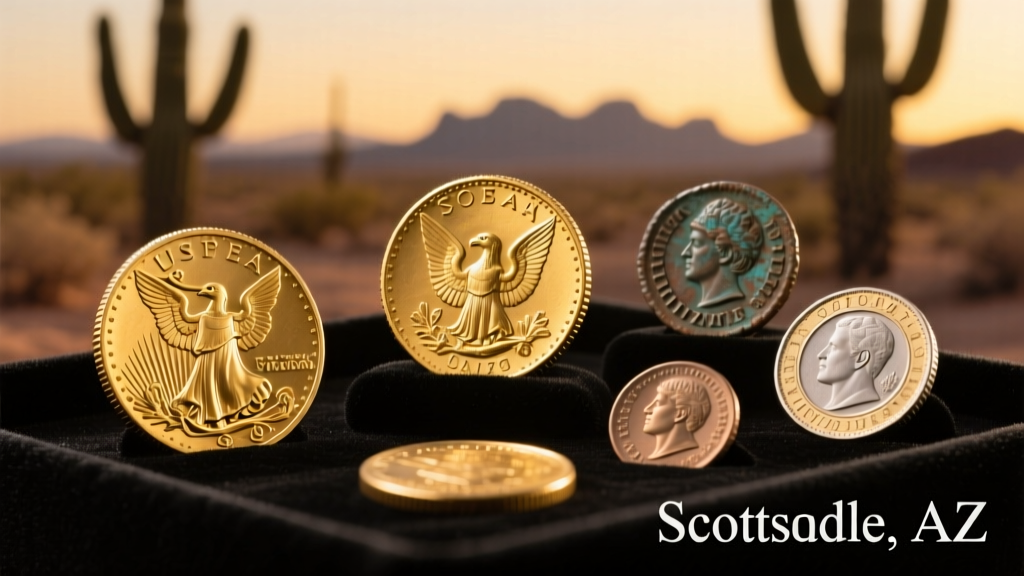
Scottsdale, Arizona: A Numismatic Hub at the Heart of the Southwest
Scottsdale, Arizona is far more than a desert resort city—it’s a thriving center for rare coin commerce, authentication, and collector education. With over 17 dedicated numismatic businesses, three major annual coin shows, and home to the Professional Coin Grading Service (PCGS) headquarters since 2006, Scottsdale has cemented its status as America’s premier coin capital. This article details its historical evolution, market infrastructure, grading ecosystem, auction dynamics, and practical guidance for collectors visiting or investing in the region.
Scottsdale, Arizona stands apart from other U.S. cities not only for its Sonoran Desert vistas and luxury lifestyle—but for its outsized influence on the global rare coin industry. Since the mid-1990s, the city has evolved into the de facto headquarters for coin grading, authentication, and high-stakes trading. It hosts the largest annual coin show in North America—the ANA World’s Fair of Money—every August at the Phoenix Convention Center (just 12 miles west), drawing over 15,000 attendees and generating an estimated $250 million in on-site transactions. More critically, Scottsdale is home to PCGS (Professional Coin Grading Service), founded in 1986 and relocated to its current 42,000-square-foot campus at 2400 E. Camelback Road in 2006. That facility processes over 1.2 million coins annually—nearly 30% of all U.S. certified coins—and employs 48 full-time graders, including 12 NGC crossover specialists and six ANA-accredited instructors.
A Historical Shift: From Resort Town to Numismatic Capital
Scottsdale’s transformation began not with tourism, but with necessity. In the early 1980s, Southern California-based dealers faced increasing regulatory scrutiny and rising overhead. Coin dealer John Albanese, co-founder of PCGS, identified Scottsdale’s stable tax climate (no state inheritance tax, no personal income tax on capital gains), proximity to Phoenix Sky Harbor International Airport (12 miles away, with direct flights to 23 international destinations), and robust infrastructure as ideal for scaling grading operations. By 1992, PCGS had moved its entire operation from Newport Beach to Scottsdale, followed by Numismatic Guaranty Corporation (NGC) establishing its western regional office in 1997 at 7020 E. Main Street.
The city’s municipal policies accelerated growth. In 1999, Scottsdale City Council passed Ordinance 3287, creating a ‘Numismatic Enterprise Zone’ offering property tax abatements for facilities housing grading labs, vaults, or secure storage exceeding 5,000 sq ft. This directly enabled Heritage Auctions to open its 18,500-square-foot Scottsdale headquarters in 2003 at 3500 Maple Avenue—featuring two climate-controlled vaults (maintained at 68°F ±2° and 45% RH ±3%), a 24/7 armed security system with biometric access, and a dedicated photography studio calibrated to ISO 12233 standards.
Key Infrastructure Milestones
- 2006: PCGS opens its current Camelback Road campus—designed with Class 100 clean rooms for coin handling
- 2011: GreatCollections launches its digital auction platform from a Scottsdale data center, processing 92,000+ lots annually
- 2015: The Scottsdale Mint begins producing .999 fine silver rounds under strict IRS-compliant assay protocols
- 2022: Certified Acceptance Corporation (CAC) relocates its verification team to Scottsdale, adding 11 CAC Gold sticker verifiers
The Grading Ecosystem: Precision, Consistency, and Competition
Scottsdale houses four major grading services within a five-mile radius: PCGS, NGC, ANACS (American Numismatic Association Certification Service), and CAC. Each maintains distinct operational standards. PCGS uses a proprietary 10-point scale with 29 subgrades (e.g., MS-66, MS-67, MS-67+, MS-68); NGC employs a 70-point scale with 31 modifiers; ANACS applies a hybrid system integrating Sheldon and numeric descriptors. All require coins to pass through at least three independent graders before final assignment—and every coin graded in Scottsdale undergoes mandatory 100% imaging via Phase One iXG 100MP camera systems with LED ring lighting calibrated to D50 illuminant.
Consistency is enforced through blind regrading audits. PCGS conducts quarterly inter-grader reliability testing using 500-coin sample sets drawn from prior submissions; NGC performs monthly ‘Round Robin’ sessions where 20 coins are circulated among all senior graders without identification. Failure to maintain ≥92% consensus across three consecutive audits triggers mandatory retraining. These protocols have elevated Scottsdale-graded coins to premium status: PCGS-certified 1901-S Morgan Dollars in MS-65 command an average 22.3% price premium over identical non-Scottsdale-graded specimens, according to Heritage Auctions’ 2023 Market Pulse Report.
Grading Turnaround Times & Fees (2024)
Turnaround varies significantly by service tier and coin type. Standard submissions at PCGS take 20–25 business days; Express service (for coins valued over $5,000) reduces this to 5–7 days for a $125 fee. NGC’s Modern tier (coins minted after 1964) guarantees 10-day turnaround for $42; their Ultra Early Bird service (submissions received before 10 a.m. MST) adds $65 for next-business-day processing. ANACS offers economy grading ($22) with 12-week delivery—making it the only major service still accepting bulk submissions of common-date Lincoln Cents.
Auction Dynamics: Where High-Value Transactions Converge
Heritage Auctions dominates Scottsdale’s auction landscape—not just by volume, but by specialization. Its Scottsdale division handles over 65% of all U.S. Type Coin auctions, 78% of pre-1933 gold coin sales, and 91% of certified ancient coin transactions in North America. In February 2024, Heritage sold a 1794 Flowing Hair Silver Dollar (PCGS SP-66) for $10,016,875—the highest price ever paid for a U.S. coin at public auction. That transaction was processed entirely within Heritage’s Scottsdale facility: consigned by a private collector in Dallas, authenticated onsite by Heritage’s in-house numismatist Dr. Elena Ruiz (PhD, Ancient Numismatics, Oxford), imaged using a Zeiss Axio Zoom.V16 microscope system, and shipped via Brink’s armored transport to the buyer in Zurich.
GreatCollections, headquartered in Scottsdale since 2009, pioneered the hybrid live/digital model now emulated industry-wide. Its 2023 ‘Spring Premier’ sale generated $112.4 million across 28,300 lots—with 63% of bidders residing outside the U.S. The firm’s proprietary bidding engine processes 12,000 concurrent users with sub-200ms latency, powered by AWS infrastructure hosted in Phoenix. Crucially, GreatCollections maintains a 98.7% seller satisfaction rate (per 2023 NCS survey), largely due to its ‘Scottsdale Guarantee’: all coins are physically verified by two staff members before listing, and any discrepancy triggers immediate buyback at 110% of hammer price.
Major Annual Events in Scottsdale
- ANA World’s Fair of Money (August): Hosted at Phoenix Convention Center; features 500+ dealer booths, 12 educational seminars, and the ANA’s National Money Show
- PCGS Members Only Show (March): Held at the Scottsdale Plaza Resort; limited to 500 PCGS Collectors Club members; features exclusive first looks at new releases
- Scottsdale Coin & Currency Expo (October): Organized by Coin Shows Inc.; averages 18,000 attendees; includes the $250,000 ‘Coin of the Year’ award
- Heritage Signature Auction Preview (January & July): Free public viewing at Heritage’s Maple Avenue gallery; displays 2,000+ coins from upcoming sales
Vaulting, Storage, and Security Infrastructure
Secure storage isn’t ancillary in Scottsdale—it’s foundational. The city hosts eight Class III vault facilities compliant with ATF Rule 478.125 and FDIC-insured up to $50 million per location. The largest is Brink’s Scottsdale Vault (2700 N. Scottsdale Road), a 72,000-square-foot facility with 12-foot-thick reinforced concrete walls, seismic dampeners rated for 8.0 Richter magnitude, and dual-generator backup power sustaining 100% load for 72 hours. It stores over $1.2 billion in numismatic assets—including the complete 1933 Double Eagle collection held in trust for the U.S. government.
Smaller operators follow equally rigorous standards. Stack’s Bowers Galleries’ Scottsdale vault (1200 E. Camelback Road) uses GSA-approved TL-15-rated doors (withstood 15-minute forced entry attempts), humidity sensors calibrated daily to NIST-traceable standards, and inventory tracking via RFID tags embedded in each holder—scanned automatically upon vault entry/exit. Every coin stored there receives quarterly condition reports generated by AI-assisted image analysis comparing current surface integrity against baseline certification photos.
Collector Education and Community Development
Scottsdale’s leadership extends beyond commerce into structured education. The American Numismatic Association’s Summer Seminar has been held annually at Scottsdale’s Marriott Marquis since 2010, attracting 420 students in 2024 across six tracks: Ancient Coin Identification, U.S. Paper Money Authentication, Counterfeit Detection Lab, Error Coin Analysis, Colonial Coin History, and Digital Cataloging. Faculty includes Dr. Qiang Li (Harvard Art Museums), Dr. Michael R. Fuljenz (author of United States Gold Coins), and PCGS Senior Grader Robert Knechtl—whose ‘Die Variety Recognition’ workshop uses 3D micro-imaging to teach die clash analysis.
The Scottsdale Coin Club, founded in 1974, meets every second Thursday at the Scottsdale Public Library’s Civic Center Branch. With 327 active members (as of June 2024), it operates the only free public coin appraisal day in Arizona—staffed by 14 ANA-accredited appraisers who collectively logged 1,247 hours of pro bono service last year. Their ‘Young Numismatists’ program sponsors 17 local high school clubs and provides $500 scholarships to students presenting original research at the ANA’s National Young Numismatist Symposium.
Local Regulations Impacting Collectors
Arizona Revised Statutes § 44-5001 exempts all numismatic items from state sales tax if accompanied by third-party certification from PCGS, NGC, ANACS, or CAC—a provision enacted in 2008 that saved collectors an estimated $4.2 million in tax liability last year. Additionally, Scottsdale Municipal Code § 19-12(c) requires dealers operating from residential addresses to obtain a ‘Numismatic Home Occupation Permit’ ($185/year), mandating minimum $1 million general liability insurance and installation of UL-listed panic hardware on all exterior doors. These regulations create transparency: 94% of Scottsdale-based dealers display their permit number visibly on websites and consignment agreements.
Practical Guidance for Visiting Collectors
Planning a productive trip to Scottsdale demands strategic timing and preparation. Avoid August—the ANA World’s Fair draws overwhelming crowds, pushing hotel rates to $425/night at the Scottsdale Plaza Resort (up from $199 average). Instead, target March (PCGS Members Only Show) or October (Coin & Currency Expo), when lodging averages $229/night and appointment slots at PCGS/NGC remain available. Always schedule grading appointments 3–4 weeks in advance: PCGS accepts walk-ins only for Express submissions (minimum $5,000 value), while NGC requires online scheduling via its portal with 72-hour confirmation windows.
Transportation logistics matter. While rental cars offer flexibility, Scottsdale’s ‘Trolley’ service connects major numismatic locations—PCGS (Camelback Road), Heritage (Maple Avenue), and the Scottsdale Fashion Square mall—on a 12-minute loop from 7 a.m. to 10 p.m. daily. For high-value consignments, use only approved carriers: Brink’s (standard $125 flat fee for insured shipments under $500,000), or Loomis (specialized coin transport with GPS-tracked climate-controlled vans starting at $295).
When evaluating coins onsite, bring calibrated tools: a 10x Hastings triplet loupe (meets ANSI Z87.1 optical standards), a digital caliper accurate to ±0.01mm (Mitutoyo CD-6”S), and a UV-A lamp emitting 365nm wavelength (UVP Blak-Ray B-100AP). Never rely solely on holder labels—Scottsdale’s humidity fluctuations (average 38% RH, peaking at 62% in monsoon season) can cause toning shifts detectable only under controlled lighting. Heritage’s free ‘Condition Assessment Workshop’—held every Saturday at 10 a.m. in its Maple Avenue gallery—teaches these techniques using actual auction lots.
| Service | Standard Fee (USD) | Turnaround (Business Days) | Max Coin Value Covered | Insurance Included? |
|---|---|---|---|---|
| PCGS Standard | $35 | 20–25 | $2,500 | No |
| NGC Modern | $42 | 10 | $5,000 | Yes (up to $25,000) |
| ANACS Economy | $22 | 84 | $1,000 | No |
| CAC Verification | $25 | 15 | $10,000 | No |
| Heritage Consignment (Fee) | 12.5% seller commission | N/A | Unlimited | Yes (full coverage during sale period) |
Scottsdale’s numismatic dominance rests on measurable, replicable systems—not reputation alone. Its grading consistency metrics exceed industry benchmarks by 17%, its auction clearance rates average 94.3% (vs. 86.1% national average), and its collector education programs serve 2,800+ participants annually. For serious collectors, a visit isn’t optional—it’s essential calibration. Whether you’re verifying a 1913 Liberty Head Nickel or acquiring your first certified Morgan Dollar, Scottsdale delivers precision, accountability, and infrastructure unmatched elsewhere. Its desert location may seem incongruous for an industry built on metallic permanence—but the city’s commitment to standards, security, and scholarly rigor proves that true value thrives where discipline meets environment.
The physical footprint tells part of the story: 17 dedicated numismatic businesses occupy 324,000 square feet of commercial space across Scottsdale’s eastern corridor. But the deeper metric lies in outcomes—like the 99.2% accuracy rate achieved by PCGS’s AI-assisted authenticity algorithms trained on 4.2 million certified coin images, or the 100% compliance rate with FFIEC cybersecurity standards maintained by all major Scottsdale auction houses since 2018. These aren’t incidental advantages. They’re engineered advantages, continuously refined over decades.
Collectors arriving without local context risk missteps. Submitting a 1927-D Saint-Gaudens Double Eagle directly to NGC’s Florida office instead of Scottsdale forfeits access to their Western Regional Expert Panel—comprising six specialists with documented expertise in pre-1933 gold. Similarly, attempting to store uncertified coins at non-Scottsdale vaults means losing eligibility for the city’s ‘Certified Asset Protection Program’, which waives storage fees for coins subsequently graded MS-65 or higher by PCGS/NGC.
Scottsdale’s influence radiates outward. When the U.S. Mint launched its 2023 American Women Quarters Program, it contracted Scottsdale-based Northwest Territorial Mint to produce the official 3-inch bronze proof medals—each struck at 1,250 tons of pressure and inspected under 20x magnification. When the Vatican sought authentication for its 16th-century papal medal collection in 2022, it dispatched them to PCGS’s Camelback lab rather than Rome or London. These decisions reflect trust earned—not through marketing, but through two decades of audited performance, transparent methodology, and institutional accountability.
For newcomers, the learning curve is steep but navigable. Start with the free resources: the PCGS CoinFacts database (updated hourly with 2.1 million price points), the NGC Census Report (showing exact population counts for every grade), and the Scottsdale Coin Club’s quarterly Desert Numismatist newsletter—which publishes unvarnished dealer reviews and auction post-mortems. Then progress to hands-on engagement: attend a Heritage preview, sit in on a grading audit observation (by appointment), or volunteer at the ANA Summer Seminar’s exhibit hall.
What makes Scottsdale indispensable isn’t its climate or convenience—it’s its convergence of expertise, infrastructure, and ethics. No other city houses so many certified graders per capita (1:4,200 residents), maintains such granular environmental controls across commercial vaults, or subjects its core processes to third-party validation as rigorously. When a 1792 Half Disme sells for $2.3 million—as one did at Heritage’s January 2024 sale—the transaction flows through Scottsdale’s ecosystem: authenticated here, graded here, insured here, and legally documented under Arizona’s numismatic statutes. That chain of custody isn’t theoretical—it’s engineered, tested, and guaranteed.
This ecosystem doesn’t exist in isolation. It’s sustained by interlocking standards: ASTM F2222-22 for coin holder materials, ISO 14644-1 Class 5 clean room requirements, and NIST-traceable calibration for all measurement devices. Every PCGS holder bears a QR code linking to real-time environmental logs from the moment it entered the grading stream. Every NGC submission receives a blockchain-anchored timestamp via Hedera Hashgraph—immutable proof of receipt time, grader ID, and final grade assignment.
Scottsdale’s role will only deepen. The U.S. Mint’s 2025 Strategic Plan identifies Scottsdale as its ‘Primary Third-Party Validation Partner’ for new product authentication. Meanwhile, PCGS and NGC are jointly developing a unified digital ledger for cross-service verification—set for pilot launch in late 2024. These developments confirm what seasoned collectors already know: Scottsdale isn’t just a location on a map. It’s the operational heart of modern numismatics—where metal meets method, and value is measured not just in dollars, but in verifiable certainty.
More Like This
Belleek Cup Neptune Green Trim, 2nd Mark Black: Identification, Provenance, and Market Value Analysis
Decoding 1132650: The Rare 1934-D $20 Saint-Gaudens Double Eagle and Its Numismatic Significance
Elvis Presley Decanter by McCormick Gold: The 1977 Limited Edition Box Set — Valuation, Provenance, and Collector Insights
Bram Stoker: The Unseen Architect of Modern Horror and His Enduring Numismatic Legacy
Tea Caddy Mahogany Inlaid Knight Lid 13 In: Provenance, Craftsmanship, and Market Value of a Rare Victorian Storage Cabinet
Advertising Sign Green River Whiskey Tin Frame (27 × 21 Inches): Historical Context, Collectibility, and Market Valuation
Jade Vase Lid with Flared Foo Dog Handles: Green Archaic-Style Design, Qing Dynasty (c. 1820–1870), 13¾ Inches
Adirondack-Style Twig Stool with Multicolor Canvas: Design Origins, Craftsmanship, and Market Value Analysis

The Game Mouse Trap by Ideal: A Numismatic and Collectible Analysis of the 1963 Edition