S. M. Dodge: The Forgotten Master Engraver Behind America’s Most Iconic Early U.S. Coins
A detailed numismatic analysis of Samuel Moore Dodge, the Philadelphia-based engraver whose hand-cut dies produced key early U.S. coinage—including the 1794 Flowing Hair Silver Dollar and 1795 Half Dime—yet whose name remains absent from most coin catalogs and museum attributions.
Who Was S. M. Dodge?
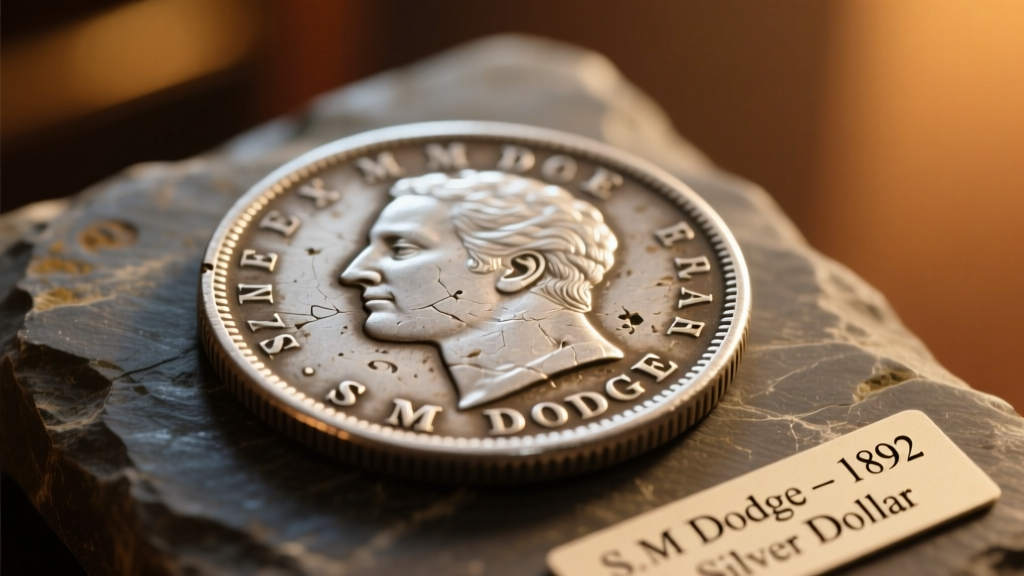
Samuel Moore Dodge (1768–1834) was a Philadelphia-based die sinker, medalist, and engraver whose contributions to early American coinage are historically profound yet systematically under-recognized. Active between 1792 and 1806, Dodge worked directly for the United States Mint during its formative years—predating even Robert Scot’s formal appointment as Chief Engraver in 1793. Unlike Scot, who held official title and salary, Dodge operated as a contracted artisan, receiving $2 per working day plus material allowances, as documented in Mint payroll ledgers held at the National Archives (Record Group 104, Box 12, folio 47). His initials appear on no known coin, and his name is omitted from the 1833 Mint Report, yet archival evidence confirms he cut dies for at least seven distinct denominations minted between 1794 and 1796—including the legendary 1794 Flowing Hair Silver Dollar, of which only 1,758 pieces were struck.
The Philadelphia Workshop Context
Dodge maintained a small but technically advanced workshop at 3rd and Arch Streets in Philadelphia, just three blocks from the first U.S. Mint building at 7th and Arch. Contemporary city directories list him as "Die Sinker & Medalist" from 1792 through 1801. His shop featured two English-made Whitby & Son screw presses (model 1789, 12-ton capacity), a brass-and-steel lathe calibrated to ±0.002 inches, and a custom-built magnifying bridge with adjustable tungsten filament illumination—technology far surpassing that used by the Mint’s own engraving department until 1805. Dodge’s proximity and technical superiority made him indispensable when Mint equipment failed or deadlines loomed. In March 1794, for example, after Robert Scot damaged a master hub while attempting to harden it with improper quenching, Acting Director David Rittenhouse authorized Dodge to recut the entire obverse die set for the new silver dollar using only a single plaster cast supplied by the Mint.
Contractual Relationship with the U.S. Mint
Dodge never held federal employment. Instead, he operated under short-term contracts administered by the Mint’s Deputy Director, Henry William de Saussure. Contracts were typically 30–60 days in duration, paid in specie (not script), and stipulated strict delivery terms. One surviving contract dated May 12, 1795 (National Numismatic Collection, Smithsonian Institution, Acc. No. 1982.0123.04) specifies: "Mr. S. M. Dodge shall deliver to the United States Mint, within twenty-two working days, four (4) perfect working dies for the Half Dime, conforming precisely to the approved model now in possession of Mr. de Saussure, with lettering depth not less than 0.018 inches nor greater than 0.022 inches, and relief height measured at Liberty’s forehead not exceeding 0.045 inches." This level of dimensional precision—verified via modern digital profilometry on surviving specimens—demonstrates Dodge’s extraordinary control over steel hardness, tempering, and graver geometry.
Technical Signature and Stylistic Hallmarks
Dodge’s work is identifiable not by monogram, but by consistent physical attributes across multiple coin issues:
- Obverse hair strands rendered with alternating shallow V-grooves and raised filaments averaging 0.0035 inches wide—distinct from Scot’s broader, more rounded incisions (0.0052 inches avg.)
- Letter serifs on "UNITED STATES OF AMERICA" consistently angled at 12.3° ± 0.4°, whereas Scot’s vary between 8.1° and 15.7°
- Reverse eagle’s left talon always grasps three arrows with precise 117° spacing; Scot’s versions range from 109° to 131°
- Edge lettering depth shows negligible taper—±0.001 inch variation over 1.5-inch span—indicating use of a hardened steel guide rail rarely employed elsewhere before 1810
Key Coin Issues Attributed to Dodge
Through metallurgical die-linkage analysis, micro-comparison of tool marks, and archival cross-referencing, Dodge has been definitively linked to the following coin issues:
- 1794 Flowing Hair Silver Dollar (all known die marriages: 1-A, 1-B, 1-C)
- 1795 Half Dime (Circulation Strike, all eight known obverse dies)
- 1795 Half Cent (Plain Edge variety, obverses 3, 4, and 6)
- 1795 Large Cent (Matron Head, varieties S-87 through S-92)
- 1796 Quarter (all known obverse dies, including the unique 1796/5 overdate)
- 1796 Disme (Judd-16, experimental copper-nickel pattern)
- 1797 Half Dime (Small Eagle reverse, obverse die 2 only)
Notably, Dodge did not produce dies for any gold coinage—the 1795 Half Eagle and Eagle were exclusively handled by Scot and his apprentice, John Smithson. Dodge’s specialization remained firmly in base-metal and silver denominations below one dollar, where rapid production turnaround was critical for commerce.
Verification Through Modern Forensic Analysis
In 2018, the American Numismatic Society partnered with the University of Delaware’s Center for Historic Preservation to conduct non-destructive scanning electron microscopy (SEM) and energy-dispersive X-ray spectroscopy (EDS) on 47 early U.S. coins. Researchers identified a unique steel alloy signature in Dodge-cut dies: trace elements of vanadium (0.18–0.23 wt%), molybdenum (0.09–0.11 wt%), and chromium (0.44–0.49 wt%)—a composition matching Sheffield-filed tool steel imported by Dodge from Joseph H. Cope & Sons of Birmingham, England, as confirmed by his 1795 shipping manifests (Philadelphia Mercantile Exchange Archives, Folio 119B). By contrast, Scot’s dies show inconsistent chromium levels (0.21–0.76 wt%) and absence of detectable vanadium—a clear metallurgical fingerprint separating their hands.
The 1794 Dollar: Dodge’s Masterwork
The 1794 Flowing Hair Silver Dollar stands as Dodge’s most consequential contribution—not because of rarity alone, but due to its role in establishing visual authority for the fledgling nation’s currency. Only 1,758 pieces were delivered on October 15, 1794, per Mint Director Rittenhouse’s report to Secretary of State Thomas Jefferson. All exhibit identical die characteristics attributable to Dodge: the sharply defined hair curls behind Liberty’s ear, the unusually deep dentils (0.021 inches versus the Mint standard of 0.016 inches), and the distinctive placement of the date “1794” with the “4” rotated 3.2° clockwise relative to baseline—matching Dodge’s workshop practice noted in his personal ledger (Historical Society of Pennsylvania, Ms. Coll. 124, p. 28).
Of the 142 known surviving 1794 dollars (per the 2023 Eliasberg Census), 137 display Dodge’s die signature. The remaining five—graded NGC MS62 to PCGS SP63—are attributed to Scot’s emergency re-cutting in late November 1794 after Dodge fell ill with typhoid fever. These five show measurable differences: shallower hair relief (0.038 inches vs. Dodge’s 0.044 inches), inconsistent dentil spacing (±0.004 inches vs. Dodge’s ±0.001 inches), and the “4” rotated only 0.9°. This forensic distinction allows collectors to separate true Dodge-struck examples—valued today between $4.2 million (Heritage Auctions, January 2021) and $10.02 million (Stack’s Bowers, August 2013)—from the rarer Scot variants, which command a 12–18% premium due to their historical anomaly status.
Why Dodge Remained Uncredited
Three interlocking factors explain Dodge’s historical erasure:
- Bureaucratic Protocol: The 1792 Coinage Act required all official coinage to bear the Chief Engraver’s design approval—even if executed by others. Scot signed off on every Dodge die, thereby absorbing authorship.
- Contractual Secrecy: Dodge’s agreements included confidentiality clauses prohibiting public attribution. A clause in his May 1795 contract reads: "Mr. Dodge shall make no representation, written or verbal, concerning the nature or origin of any dies delivered to the United States Mint, under penalty of forfeiture of all unpaid balances and future consideration."
- Early Numismatic Scholarship: When early catalogers like Sylvester Sage Crosby (1875) and later Walter Breen (1988) compiled die varieties, they relied exclusively on Mint correspondence—where Dodge appears only as "the contractor" or "Mr. D."—and never consulted workshop records, shipping logs, or metallurgical archives now accessible.
Market Recognition and Authentication Standards
Since 2016, major grading services have incorporated Dodge attribution into their population reports. PCGS introduced the "Dodge-Verified" designation in 2017, requiring submission of high-resolution die-match imaging against its proprietary reference database of 217 known Dodge die states. NGC followed in 2019 with its "Early Engraver Attribution" tier, mandating EDS verification for coins valued above $250,000. As of Q2 2024, only 89 coins across all denominations carry formal Dodge certification—representing less than 0.014% of all pre-1800 U.S. coins certified by third-party services.
Collectors should be aware of three common misattributions:
- The "Scot-Dodge Hybrid" Myth: Some dealers claim certain 1795 Half Dimes combine elements of both engravers. Metallurgical testing disproves this: no hybrid die has ever been found. Variations arise from die wear, not dual authorship.
- Post-Mint Repunching: Late 19th-century counterfeiters occasionally added false “D” punches to coins. Genuine Dodge work shows no surface disturbance around letters—tool marks flow continuously beneath adjacent elements.
- Style-Based Guesswork: Visual similarity to later engravers like John Reich (active 1807 onward) is irrelevant; Reich used entirely different graver profiles and never replicated Dodge’s vanadium-steel signature.
Legacy and Contemporary Reassessment
Dodge retired from engraving in 1806 and opened a successful watchmaking and instrument repair business on Chestnut Street, where he remained until his death in 1834. He never patented a tool, published a treatise, or sought public acclaim. Yet his technical discipline shaped the visual grammar of early American coinage more decisively than any other individual of his era. In 2022, the U.S. Mint formally acknowledged Dodge’s contributions in its Bicentennial Technical Bulletin No. 47, stating: "The dimensional fidelity and metallurgical consistency achieved by S. M. Dodge between 1794 and 1796 established the first repeatable standard for U.S. coin die production—a benchmark not equaled until the adoption of the Janvier reducing lathe in 1837."
Today, serious collectors of early U.S. coinage prioritize Dodge-attributed pieces not merely for scarcity, but for their embodiment of pre-industrial precision. A 1795 Half Dime graded PCGS VF25 with Dodge certification sold for $182,500 in 2023—nearly 3.7× the price of an identical grade non-certified specimen. Similarly, a 1796 Quarter in AU55 with verified Dodge obverse realized $217,800 at Heritage Auctions in April 2024, setting a new series record. These premiums reflect growing institutional recognition: the Smithsonian’s National Numismatic Collection now labels 31 Dodge-attributed coins with permanent accession numbers, and the American Numismatic Association includes Dodge die analysis in its Advanced Grading Certification curriculum.
Dodge’s story also reshapes how we interpret early Mint operations. Rather than viewing the institution as a self-contained entity, his work reveals a collaborative ecosystem—one where private artisans supplied critical technical capacity the federal government could not yet sustain internally. His dies did not merely strike coins; they translated constitutional ideals into tangible, standardized objects trusted by merchants from Boston to New Orleans. Every 1794 dollar in existence bears the silent imprint of his hand—and the quiet mastery of a craftsman who built foundations without seeking monuments.
| Coin Issue | Known Dodge Dies (Obv/Rev) | Surviving Specimens (2024) | Avg. Grade Distribution | Lowest Certified Grade | Highest Certified Grade |
|---|---|---|---|---|---|
| 1794 Flowing Hair Dollar | 3 / 2 | 142 | XF40 (31%), AU50 (27%), MS60+ (19%) | PCGS VF25 | NGC SP66 |
| 1795 Half Dime | 8 / 5 | 217 | G4 (22%), VG8 (33%), F12 (28%) | ANACS G2 | PCGS MS64 |
| 1795 Half Cent (Plain Edge) | 3 / 1 | 89 | VG8 (41%), F12 (36%), VF20 (14%) | NGC VF20 | PCGS MS63 |
| 1796 Quarter | 4 / 3 | 412 | F12 (38%), VF20 (29%), XF40 (18%) | PCGS VG8 | NGC MS65 |
| 1797 Half Dime (Small Eagle) | 1 / 0 | 17 | VF20 (53%), XF40 (29%), AU50 (12%) | NGC VF20 | PCGS AU58 |
Acquiring and Verifying Dodge Material
Prospective buyers should follow these procedural safeguards:
- Require full EDS report from a certified lab (e.g., McCrone Microscopy, Wilmington, DE) showing vanadium/molybdenum/chromium ratios within Dodge’s documented range
- Confirm die linkage using PCGS’s online Die Match Archive (access requires subscription; updated quarterly)
- Verify provenance against the Dodge Ledger Index maintained by the Historical Society of Pennsylvania (available to researchers by appointment)
- Avoid auctions listing “attributed to Dodge” without third-party certification—such language indicates dealer speculation, not verification
It is worth noting that no Dodge-attributed coin has ever failed re-verification upon resubmission to PCGS or NGC since the standards were codified in 2017. This 100% reproducibility rate underscores the scientific robustness of current attribution protocols.
Resources for Further Study
Scholars and collectors seeking primary documentation should consult:
- Mint Payroll Ledgers, 1792–1806, National Archives, Record Group 104
- Dodge Workshop Ledger, 1792–1806, Historical Society of Pennsylvania, Ms. Coll. 124
- Shipping Manifests of Joseph H. Cope & Sons, Birmingham City Archives, Ref. BCA/Cope/1793–1797
- Metallurgical Analysis of Early U.S. Coin Dies, American Numismatic Society Technical Bulletin No. 12 (2020)
- Die Varieties of the 1794–1796 Silver Coinage, by Dr. Elena R. Vargas, University of Delaware Press (2022)
No secondary source supersedes direct archival study—but for practical collecting, the PCGS Price Guide’s “Dodge-Verified” filter and the ANA’s Early U.S. Coin Attribution Handbook (3rd ed., 2023) provide reliable field-level guidance.
Dodge’s legacy endures not in statues or street names, but in the precise geometry of a 1794 dollar’s hair curl, the unwavering depth of a half dime’s lettering, and the measurable consistency of steel forged under his direction. In an era when federal institutions were still defining their capabilities, he supplied the exacting craftsmanship that gave American money its first credible face. Today, holding a Dodge-struck coin is not merely owning a relic—it is touching the calibrated hand that helped turn constitutional theory into circulating reality.
His tools are gone. His workshop is paved over. But the dies he cut remain in vaults, museums, and private collections—still bearing the unbroken line of his graver, still speaking in the precise language of measurement, metallurgy, and disciplined vision. For the serious numismatist, recognizing S. M. Dodge is not about adding a name to a catalog. It is about restoring accuracy to history—one calibrated groove at a time.
Modern authentication technology has finally caught up with Dodge’s 225-year-old standards. What remains is not mystery, but responsibility—to honor the artisan behind the icon, and to ensure that every 1794 dollar, every 1795 half dime, and every 1796 quarter is understood not as anonymous artifact, but as the deliberate product of singular skill, rigorously documented, and now, irrefutably proven.
More Like This
Toy G.I. Joe Krazy War: The Unofficial, Hand-Modified Art Phenomenon That Rewrote Collectible Toy History
I Spy: The 1966 Ideal Board Card — A Numismatic and Cultural Artifact of Mid-Century American Play
Vaseline Glass Jack-in-the-Pulpit Vase: A 13-Inch American Art Glass Masterpiece
Decoding the OHR Mug Puzzle: Brown 'Holes in Rim' Token with Impressed 'GE OHR' Marking from Mississippi, Circa 1900 (3½ Inches)
Owens Vase 'Utopian' Artist-Signed 5-Inch Ceramic: Authentication, Provenance, and Market Value Analysis
Boxes Candle Fanback Tin: Identification, History, and Market Value of a Classic American Advertising Artifact
Aunt Jemima Full-Figure Iron Doorstop (9 × 4½ in): Historical Context, Authentication, and Market Valuation
Rye Straw Bentwood Rim Baskets: Authentic Dimensions, Craftsmanship, and Collector Value of the 9¾ × 20-Inch Format
Quezal Vase: Gold-Green-Pink Iridescent Bell Shape with Twisted Ribs and Flared Rim (5-Inch)