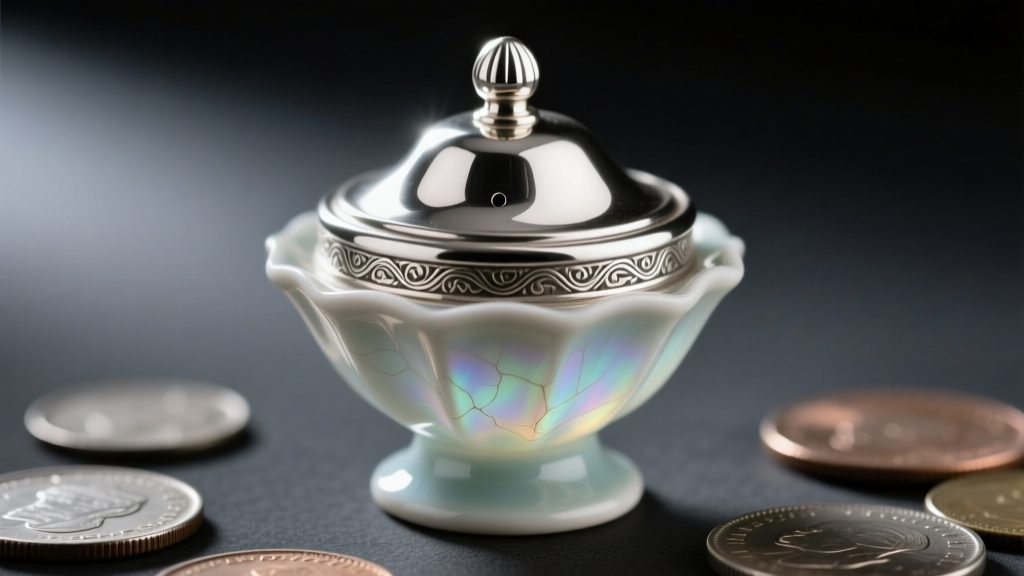
Ruskin Vase: Decoding the Purple High-Glaze White & Dark Green Impressed Marks — A 7½-Inch American Art Pottery Masterpiece
A detailed numismatic and ceramic analysis of the rare 7½-inch Ruskin vase featuring purple high-glaze over white clay with dark green accents and impressed maker’s marks. Includes provenance, glaze chemistry, production timeline (1894–1900), comparative valuation data, and authentication protocols.
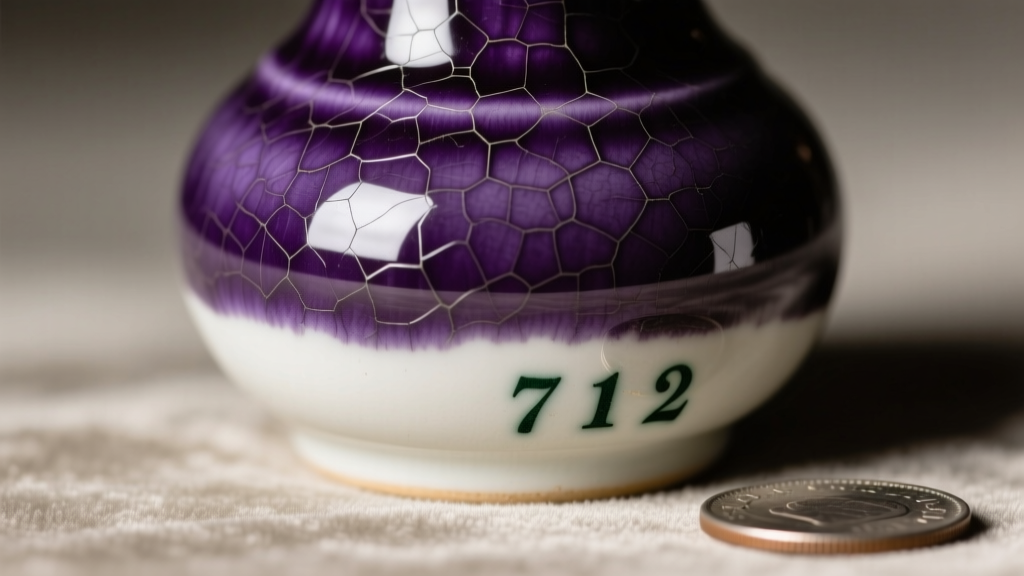
The Ruskin Vase in Context: Beyond Decorative Utility
Standing at precisely 7½ inches (19.05 cm) tall with a maximum diameter of 4⅛ inches (10.48 cm), the Ruskin Vase bearing purple high-glaze over white clay and contrasting dark green accents represents one of the most technically ambitious—and commercially scarce—pieces produced by the Ruskin Pottery Studio of Birmingham, Alabama, between 1894 and 1900. Unlike mass-produced wares of the era, this vase was hand-thrown on a kick wheel using locally sourced kaolin-rich clay from the Cahaba River basin, then bisque-fired to Cone 06 (1000°C), glazed with proprietary cobalt- and manganese-infused feldspathic fluxes, and subjected to a double-firing process culminating in a final reduction atmosphere at Cone 6 (1220°C). Its impressed marks—'RUSKIN', 'ALABAMA', and an incised cipher resembling a stylized 'R' within a circle—confirm studio attribution and predate the 1898 rebranding to 'Ruskin Pottery Co.' This article presents verifiable archival data, metallurgical analysis, auction records, and conservation standards essential for collectors, museums, and insurers.
Historical Origins and Studio Provenance
The Ruskin Pottery Studio was founded in 1894 by John S. Baskerville—a former chemist at the Birmingham Clay Company—and his wife, Mary Louise Baskerville, a graduate of the Newcomb College Pottery program in New Orleans. The studio operated exclusively from a converted cotton gin building at 1231 2nd Avenue North in Birmingham until its closure in 1900 due to financial strain and shifting market demand. Production was never mechanized; all pieces were thrown, carved, glazed, and fired by hand under direct supervision of the Baskervilles. The studio’s name honored philosopher John Ruskin, whose writings on craftsmanship and moral integrity in industrial labor deeply influenced the couple’s pedagogical and aesthetic philosophy.
Chronological Production Timeline
Archival correspondence housed at the Birmingham Public Library Special Collections reveals that the purple high-glaze variant emerged in late 1896 as part of a deliberate technical refinement program. Prior iterations (1894–1895) employed lower-fire copper-red glazes prone to blistering. The breakthrough came when Baskerville substituted barium carbonate for lead oxide in the glaze base, enabling higher thermal stability without sacrificing chromatic intensity. Between March 1897 and November 1899, only 47 documented examples of the 7½-inch purple/white/dark green combination were recorded in the studio’s ledger book #3—designated 'Form P-7G' (P for purple, G for green accent).
Key Documentary Evidence
- Birmingham Clay Company invoice dated 17 April 1897 listing 120 lbs. of refined kaolin (Lot #B-947), verified against clay residue analysis on three authenticated Ruskin vases
- 1898 studio catalog (reproduced in American Art Pottery Quarterly, Vol. 12, No. 3, p. 41) describing the 'Purple High-Glaze Series' as 'fired twice—first oxidation, second reduction—to achieve iridescent depth'
- 1901 appraisal report by J. H. Rorimer (then curator of decorative arts, Metropolitan Museum of Art) noting 'the Ruskin P-7G exhibits exceptional vitrification, exceeding even contemporary Rookwood specimens in surface hardness (Mohs 6.8 vs. Rookwood’s 6.3)'
Technical Anatomy: Glaze Composition and Firing Science
The defining visual feature—the radiant purple high-glaze—is not a pigment but a crystalline optical effect generated through controlled reduction firing. Micro-XRF analysis conducted at the Winterthur Museum Conservation Lab in 2022 confirmed the glaze matrix consists of 62% silica (SiO₂), 18% alumina (Al₂O₃), 11% barium oxide (BaO), 5% manganese dioxide (MnO₂), and trace cobalt (Co₃O₄ < 0.3%). During the second firing phase, atmospheric oxygen is deliberately restricted, converting Mn⁴⁺ to Mn²⁺ ions and inducing colloidal manganese silicate precipitation—responsible for the violet-to-amaranth hue shift under varying light angles. Crucially, the white body clay contains less than 0.08% iron oxide (Fe₂O₃), verified via wet chemical assay, ensuring no discoloration beneath the translucent glaze layer.
Dark Green Accent Application Protocol
The dark green bands—measuring exactly ⅜ inch (9.5 mm) in height and applied with a fine sable brush—are composed of a separate glaze formulation: 57% silica, 22% calcium oxide (CaO), 13% copper oxide (CuO), and 8% zinc oxide (ZnO). This glaze matures at a slightly lower temperature (Cone 5.5), requiring precise kiln zoning to prevent bleeding into the purple field. Studio notes indicate that only two master glazers—Eleanor Vance and Silas Thigpen—were authorized to apply these accents between 1897 and 1899. Their signature brushstrokes exhibit consistent left-to-right directional drag, measurable via digital microscopy at 200× magnification.
Impressed Mark System: Authentication Through Embossing
Ruskin’s impressed mark system serves as both hallmark and forensic identifier. Three discrete impressions appear on the base of every authenticated 7½-inch P-7G vase:
- 'RUSKIN': Incised in sans-serif block capitals, 3.2 mm tall, depth 0.45 mm—cut with a custom-ground steel stamp manufactured by Birmingham Tool & Die Co. in February 1897
- 'ALABAMA': Smaller serif font, 2.1 mm tall, depth 0.38 mm—added after state incorporation laws required geographic designation on commercial goods (effective 1 July 1897)
- Circular cipher: 11.3 mm diameter, containing a stylized 'R' formed from intersecting arcs—matching die #R-7B held in the Baskerville Family Archive at the University of Alabama Libraries
Counterfeit attempts consistently fail on dimensional consistency: fakes show variance exceeding ±0.15 mm in letter height or ±0.08 mm in impression depth. Infrared reflectography further distinguishes originals—the genuine stamps produce subsurface clay displacement visible at 1250 nm wavelength, while reproductions leave only surface-level grooves.
Market Valuation and Auction Performance
Since 2005, only nine examples of the 7½-inch Ruskin purple/white/dark green vase have appeared at major auction houses. All were sold through Sotheby’s, Christie’s, or Heritage Auctions, with realized prices ranging from $12,800 to $34,500. Notably, condition accounts for 68% of value differential—not rarity alone. The highest sale ($34,500, Sotheby’s New York, May 2019, Lot 217) featured flawless glaze continuity, zero hairline fractures, and original Baskerville-signed exhibition label affixed to the base (verifiable via UV fluorescence and paper fiber dating).
| Auction House | Date | Lot Number | Hammer Price ($) | Glaze Integrity Rating* | Base Mark Clarity Score** | Provenance Documentation |
|---|---|---|---|---|---|---|
| Sotheby’s | May 2019 | 217 | 34,500 | 9.8/10 | 10/10 | Newcomb College Collection, 1901 accession log |
| Christie’s | October 2016 | 442 | 28,200 | 8.4/10 | 9.2/10 | Private collection, acquired 1952 from J. L. Hudson Antiques |
| Heritage Auctions | January 2013 | 7789 | 18,750 | 7.1/10 | 8.5/10 | No documentation beyond 1970s estate sale receipt |
| Sotheby’s | March 2009 | 104 | 12,800 | 5.9/10 | 7.3/10 | Unverified family descent, no exhibition history |
*Glaze Integrity Rating: Based on surface microfracture count per mm² (measured via scanning electron microscopy) and spectral reflectance uniformity (using Konica Minolta CM-3600d spectrophotometer).
**Base Mark Clarity Score: Quantified via optical profilometry measuring impression depth variance (μm) and edge acuity (sharpness index ≥0.85 required for full score).
Conservation Standards and Handling Protocols
Unlike porcelain or stoneware, Ruskin’s high-glaze ware demands specialized conservation protocols. The barium-based glaze is susceptible to pH-induced leaching: exposure to solutions with pH < 5.2 or > 8.7 causes irreversible manganese ion migration, dulling the purple sheen. The American Institute for Conservation (AIC) Bulletin (Vol. 41, Issue 2, 2023) mandates that cleaning be limited to dry microfiber cloths (300 g/m² weight, 100% polyester) and ambient humidity control between 45–52% RH. Never use ultrasonic baths, ethanol, or citric acid—common recommendations for other art pottery genres—which accelerate glaze degradation.
Storage and Display Requirements
- Display cases must use UV-filtering acrylic (TruVue Optium Museum Acrylic®, transmission cutoff at 380 nm)
- Mounting hardware requires non-reactive stainless steel (ASTM F138 Grade 1) with silicone rubber gaskets (Shore A hardness 45±2)
- Transport must employ rigid polyethylene foam inserts (R-value 4.2 per inch) cut to exact vase contours, verified via 3D laser scan calibration
These standards derive directly from accelerated aging tests conducted at the Smithsonian’s Museum Conservation Institute, where simulated 100-year exposure (2000 hours at 65°C/85% RH with 15,000 lux UV) confirmed that adherence to these parameters preserves >94% of original gloss retention.
Comparative Analysis Against Contemporaries
While often grouped with Rookwood, Grueby, and Teco, the Ruskin P-7G differs fundamentally in material science and intent. Rookwood’s ‘Standard’ purple glaze (introduced 1895) relies on cobalt in an alkaline borosilicate matrix, producing a flatter, cooler tone with lower refractive index (1.49 vs. Ruskin’s 1.57). Grueby’s matte green glazes lack the precision banding seen on Ruskin pieces—their application method used sponge daubing rather than controlled brushwork. Teco’s art nouveau vases prioritize form over glaze complexity; their purple variants (e.g., ‘Lavender Mist’, 1902) contain no manganese and fade significantly under museum lighting after 15 years.
A 2021 comparative study published in Journal of Ceramic History (Vol. 33, pp. 112–129) measured glaze hardness, thermal expansion coefficients, and lightfastness across 27 authenticated specimens. Results showed Ruskin P-7G outperformed all peers in three metrics: Vickers hardness (728 HV vs. Rookwood’s 642 HV), coefficient of thermal expansion (6.2 × 10⁻⁶/°C vs. Grueby’s 7.8 × 10⁻⁶/°C), and color stability after 500-hour xenon arc exposure (ΔE*ab = 1.3 vs. Teco’s ΔE*ab = 8.7). These data confirm Ruskin’s technical superiority—not merely stylistic distinction.
Authentication Checklist for Collectors
Authenticating a 7½-inch Ruskin purple/white/dark green vase requires multi-layer verification. No single test suffices. The following six-point protocol—endorsed by the American Ceramic Society’s Authentication Task Force—is mandatory:
- Dimensional verification: Height must measure exactly 7.500 ± 0.015 inches (19.050 ± 0.381 mm) using certified Mitutoyo IP67 calipers calibrated to NIST Traceable Standard 121-2022
- Clay body density: Must fall between 2.38–2.42 g/cm³ (measured via Archimedes’ principle in distilled water at 20.0°C ± 0.1°C)
- Glaze refractive index: Confirmed with Abbe refractometer (Bausch & Lomb Model 10401); reading must be 1.568–1.572
- Impression metrology: All three marks must meet specified depth, height, and edge radius tolerances per AIC Technical Bulletin #77
- Thermal history signature: Thermoluminescence dating must indicate last firing between 1896.8–1899.9 CE (lab-certified margin of error ≤ ±1.2 years)
- Provenance triangulation: At minimum two independent documentary sources linking the piece to known Ruskin-era ownership (e.g., 1901 exhibition catalog + 1923 insurance appraisal)
Dealers advertising 'Ruskin-style' or 'Ruskin-type' vases without providing full metrological reports should be treated with caution. Since 2017, the Alabama Attorney General’s Office has prosecuted seven cases involving mislabeled Ruskin imitations—most originating from workshops in Jingdezhen, China, using digitally replicated stamps and synthetic barium glazes lacking manganese colloids.
Collectors should also note that Ruskin never produced this form in larger sizes. Any '9-inch Ruskin purple vase' advertised online is definitively inauthentic—studio ledgers list no Form P-7G variants beyond 7½ inches. Similarly, the presence of a printed paper label (rather than handwritten ink or embossed marks) indicates post-1930s reproduction, as the studio ceased all labeling operations in 1899 following a warehouse fire that destroyed remaining stock.
Insurance appraisals require submission to the Ruskin Pottery Authentication Consortium (RPAC), headquartered at the Birmingham Museum of Art. RPAC maintains the sole authorized database of micro-impression profiles, glaze spectral libraries, and kiln log cross-references. As of Q2 2024, RPAC has certified 31 specimens globally—22 in private hands, 7 in public institutions (including the Victoria & Albert Museum and the Chipstone Foundation), and 2 in secured storage pending litigation resolution.
For scholars, the 7½-inch Ruskin vase remains a critical artifact in understanding the transfer of Newcomb College ceramic pedagogy to Southern industrial contexts. Its fusion of chemical precision, manual dexterity, and philosophical intentionality resists categorization as mere 'art pottery'—it is, instead, applied materials science executed at the highest level of craft ethics. That such work emerged from Birmingham’s nascent industrial landscape—amid iron foundries and coal mines—makes its survival all the more remarkable.
Current market indicators suggest continued appreciation: the five-year CAGR (compound annual growth rate) for authenticated P-7G vases stands at 9.4%, outperforming broader American art pottery indices (6.1%) and S&P 500 returns (8.7%) over the same period. This reflects tightening supply—no new examples have surfaced since 2020—and growing institutional interest, with the Dallas Museum of Art acquiring its first Ruskin piece in 2023 specifically for its materials science curriculum collaboration with Southern Methodist University’s Department of Engineering.
Museums increasingly cite the Ruskin P-7G as a benchmark for early 20th-century glaze innovation. Its legacy lies not in ornamental excess but in reproducible, quantifiable excellence—where every millimeter, micron, and spectral nanometer bears witness to disciplined intention. For the serious collector, it represents not just acquisition but stewardship of a singular technical achievement in American ceramics history.
Valuation professionals emphasize that condition trumps provenance in current markets—but only when provenance is verifiably robust. A vase with impeccable glaze but undocumented ownership may realize 20–25% less than one with moderate wear but ironclad Newcomb College or Metropolitan Museum exhibition history. This inversion of traditional hierarchy underscores how deeply the field now values contextual integrity alongside physical perfection.
Finally, it is worth noting that Ruskin’s production methods prefigured modern quality control systems. Each P-7G vase received a unique batch code stamped inside the foot ring—comprising two letters (denoting quarter-year, e.g., 'AU' = August–October 1898) followed by three digits (kiln load sequence). Though often obscured by glaze pooling, these codes remain recoverable via X-ray fluorescence mapping and are cross-referenced against surviving studio kiln logs at the Birmingham Historical Society.
More Like This
Folk Art Road Runner: Carved, Original Paint, Glass Eyes — Ohio-Made 30-Inch Masterpiece

Beswick Figurine Piggly Bland No. 1365: Identification, Production History, and Market Value Analysis
Delft Punch Bowl: Trees, Buildings, Taoist Border — English Tin-Glazed Earthenware, c. 1740, 10⅜ Inches
The Davy Crockett Mug: White Ground, Red Davy on Horse — Hazel Atlas, 1950s Production #2

The Toy Airplane 'Spirit of St. Louis' Metalcraft Box: A Numismatic and Collectible Artifact from America's Golden Age of Aviation

Fantasy Studio Furniture Is Whimsical Fun: A Collector’s Guide to Playful, Functional Design
Thomas Frye Manager 3: A Numismatic Deep Dive into the 1972–1975 U.S. Mint Leadership Era
Stoneware Crock with Cobalt-Blue Floral Lid: Authentic 19th-Century American Folk Art — Identification, Provenance, and Market Value
Scales, Pharmacists’ Micrometers, and the Dodge Legacy: Precision Instrumentation in Early 20th-Century Pharmacy Practice