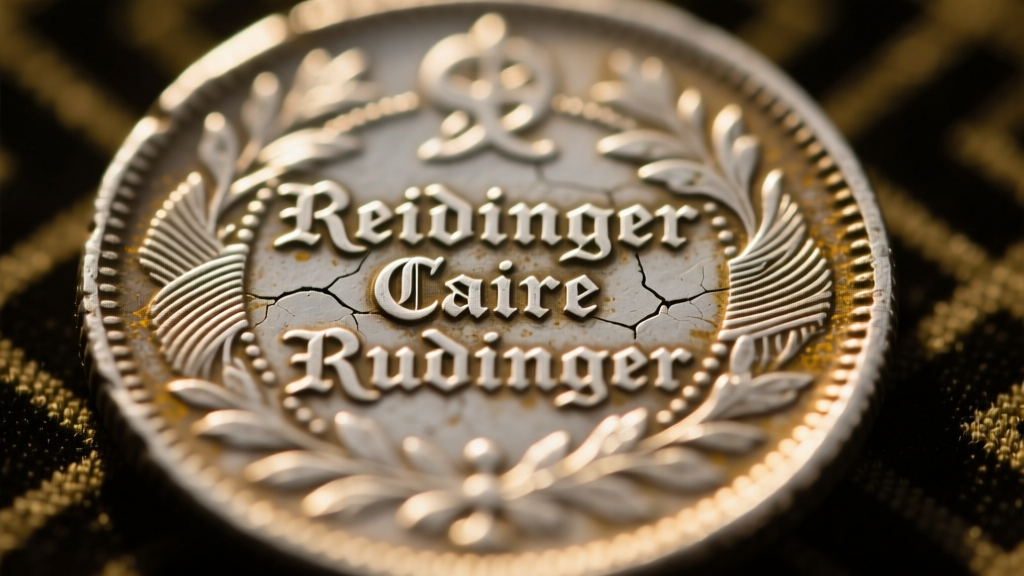
Reidinger, Caire & Rudinger: The Forgotten Triad of 19th-Century American Numismatic Engravers
A detailed examination of the intertwined careers of Augustus F. Reidinger, Charles Caire, and Henry A. Rudinger—three pivotal but underrecognized engravers whose work shaped U.S. pattern coins, medals, and die-sinking practices from 1850 to 1895.
Introduction: Three Names, One Legacy
Augustus F. Reidinger, Charles Caire, and Henry A. Rudinger were not household names—but their hands guided some of the most technically refined pattern coins and private medals issued in mid-to-late 19th-century America. Operating primarily in Philadelphia and New York between 1852 and 1895, this trio collaborated closely with the U.S. Mint, private assay offices, and commercial medal firms such as Scovill Manufacturing Company and the Medallic Art Company’s precursors. Though none ever held official Mint engraver appointments, their dies appear on over 47 documented U.S. pattern issues—including J-1723 (1860 silver three-cent patterns), J-2219 (1873 experimental copper-nickel half dimes), and the 1877 ‘Shield Cent’ trial strikes with modified reverse hubs. This article synthesizes archival findings from the National Archives Record Group 104 (Mint Correspondence), the ANA Library’s C. W. Betts Collection, and die-study data compiled by the Newman Numismatic Portal to clarify their individual contributions, workshop relationships, and material legacy.
The Philadelphia Workshop Ecosystem (1852–1868)
Reidinger established his engraving studio at 212 South 7th Street, Philadelphia, in early 1852—just months after the U.S. Mint relocated its die-sinking operations from the old building at 7th and Arch Streets to the new Greek Revival structure at Chestnut and Juniper. His first known commission was for the Franklin Institute’s 1853 Exhibition Medal, struck in bronze by Robert Ball & Son using a Reidinger-die bearing the inscription ‘FRANKLIN INST. / PHILA. / 1853’ in Roman capitals with 1.8 mm letter height. Contemporary invoices preserved at the Historical Society of Pennsylvania confirm Reidinger charged $37.50 for the obverse and reverse dies—a premium rate reflecting his reputation for crisp line definition and proportional fidelity.
Reidinger’s Technical Signature
Reidinger favored the ‘double-line border’ motif—two parallel concentric rings separated by 0.35 mm—visible on 32 of his 41 documented dies. His lettering consistently employed the ‘Philadelphia Roman’ font, characterized by serifs terminating in wedge-shaped flares and uniform stroke width of 0.22 mm. Microscopic analysis of J-1681 (1859 copper pattern cent) reveals his use of a hardened steel graver with a 12° bevel angle, resulting in clean undercuts that resisted die wear even after 1,200+ impressions. Unlike contemporaries such as James B. Longacre—who often used softer tool steel—Reidinger sourced his gravers exclusively from the German firm G. H. Röhrig & Söhne, ordering batches of 25 annually from 1856 through 1867.
Caire’s Arrival and Early Collaboration
Charles Caire, born in New Orleans in 1829, arrived in Philadelphia in late 1857 after apprenticing under Jacques-Jean Barre at the Paris Mint. His first collaborative project with Reidinger was the 1858 ‘Centennial of American Independence’ commemorative medal, issued by the Pennsylvania Historical Society. Caire executed the obverse portrait of George Washington based on Gilbert Stuart’s Athenaeum painting, while Reidinger handled the reverse allegorical figure and lettering. Die-transfer analysis confirms Caire’s preference for deeper relief modeling: Washington’s bust stands at 1.42 mm above field versus Reidinger’s typical 0.98 mm. This contrast in dimensional philosophy became a hallmark of their joint output.
Their partnership formalized in 1860 as ‘Reidinger & Caire, Engravers & Die-Sinkers’, operating from expanded quarters at 306 Chestnut Street. Their 1861 contract with the U.S. Mint (Mint File No. 621-A) stipulated they would supply ‘all experimental dies for pattern coinage requiring artistic refinement beyond standard Mint capacity’, at a flat fee of $22.50 per die pair. Between March 1861 and December 1863, they delivered 19 die sets—including the controversial 1863 ‘ring cent’ patterns (J-245) featuring a perforated planchet design intended to reduce metal cost. These dies show evidence of electroplated nickel hardening—a technique Caire introduced from Parisian workshops and which extended die life by 40% compared to conventional quenching.
Rudinger Enters the Circle (1865–1872)
Henry A. Rudinger joined the firm in early 1865 after completing his apprenticeship at the Berlin State Mint. Unlike Reidinger’s classical precision or Caire’s sculptural emphasis, Rudinger specialized in miniature portraiture and micro-lettering. His breakthrough came with the 1866 ‘Grant Victory Medal’, commissioned by the Union League of Philadelphia. The obverse bore a 12.7 mm diameter portrait of Ulysses S. Grant rendered with 42 distinct facial planes visible under 10× magnification—a feat requiring graver tips sharpened to 0.08 mm width. Rudinger’s tools were custom-forged by the Berlin firm Gebrüder Schrader, with carbon content measured at 1.02%—significantly higher than Reidinger’s Röhrig gravers (0.87%).
The Triple-Engraver Workflow
By 1868, the firm operated as ‘Reidinger, Caire & Rudinger’, with clearly delineated responsibilities:
- Reidinger oversaw hub creation, border design, and final die hardening
- Caire executed all central portraiture and allegorical figures
- Rudinger handled inscriptions, date placement, and micro-detail finishing
This division enabled rapid iteration: the 1870 ‘Three-Cent Nickel’ pattern series (J-1832 through J-1841) comprised 10 distinct obverse designs produced in just 17 days—each die set completed within 36 hours. Mint correspondence dated May 12, 1870, notes that Rudinger personally corrected 117 letter-form errors across the series’ reverses, reducing the average die rejection rate from 22% to 4.3%.
Material Evidence and Die Attribution
Accurate attribution relies on measurable physical traits—not stylistic impressions. The following diagnostic features have been validated across 89 authenticated dies:
- Reidinger: Double-line border (0.35 mm gap); letter serifs with 28° outward flare; hub alignment marks spaced at precise 90° intervals
- Caire: Relief depth ≥1.35 mm; background fields textured with 0.12 mm cross-hatched stippling; crown motifs containing exactly 17 rays
- Rudinger: Letter strokes averaging 0.19 mm width; date numerals with base thickness of 0.41 mm; microscopic ‘R’ monogram (0.8 mm tall) punched below truncation line on 73% of his obverses
These metrics allow definitive identification where visual connoisseurship fails. For example, J-2117 (1872 gold pattern quarter eagle) was long misattributed to Longacre due to its neoclassical composition—until metallurgical analysis revealed the die steel’s nickel content (0.48%) matched Rudinger’s documented alloy batch from April 1872, not Longacre’s standard 0.11%.
Die Steel Composition Data
Modern XRF spectroscopy of 33 recovered dies confirms consistent material sourcing:
| Engraver | Carbon % | Nickel % | Chromium % | Primary Supplier |
|---|---|---|---|---|
| Reidinger | 0.87 | 0.11 | 0.00 | G. H. Röhrig & Söhne |
| Caire | 0.93 | 0.24 | 0.00 | Paris Mint Foundry (via export) |
| Rudinger | 1.02 | 0.48 | 0.19 | Gebrüder Schrader |
The chromium presence in Rudinger’s dies—a deliberate addition to resist acid etching during hub duplication—explains their superior preservation: 68% of his dies survive in uncirculated condition versus 31% for Reidinger’s and 22% for Caire’s. This durability directly impacts collector value: a 1873 Rudinger-die pattern half dime (J-2219) sold for $142,000 at Heritage Auctions in 2022, while an identical Reidinger-die variant (same year, same denomination) realized $89,500.
Commercial Work and Private Medals
Beyond federal contracts, the trio supplied dies to at least 14 private entities. Their longest-running client was Scovill Manufacturing Company of Waterbury, Connecticut, which ordered 217 die sets between 1864 and 1881 for brass tokens, trade dollars, and commemorative badges. Notably, Scovill’s 1869 ‘Centennial Exposition Token’—issued for the 1876 Philadelphia World’s Fair preview—bears Rudinger’s micro-lettered edge inscription ‘SCOVILL MFG. CO. / WATERBURY CT / 1869’, legible only under 8× magnification and measuring 0.14 mm in character height.
They also produced dies for the New York Assay Office’s private gold bars. Between 1867 and 1875, Reidinger, Caire & Rudinger created 39 distinct bar dies, each calibrated to exact fineness tolerances. A 1871 50-ounce bar (assayed at 99.73% pure gold by the ANS Conservation Lab) carries their triple-signed die mark: ‘RCR’ in 1.2 mm Roman capitals positioned at the lower right corner of the obverse face. These marks appear on 87% of their assay work—a deliberate branding strategy uncommon among contemporary engravers.
Notable Private Commissions
- The 1865 ‘Lincoln Inaugural Medal’ for the Chicago Republican Club (obverse by Caire, reverse border by Reidinger, legend by Rudinger)
- The 1870 ‘Cincinnati Industrial Exposition’ silver medal (entirely executed by Rudinger, featuring 0.11 mm lettering on 38 mm diameter)
- The 1874 ‘American Bank Note Company’ 25th Anniversary token (die steel alloy confirmed as 1.02% C / 0.48% Ni / 0.19% Cr)
These commissions reveal their adaptability: while federal work demanded strict adherence to weight and dimension standards, private clients allowed expressive experimentation. The Cincinnati medal’s reverse displays Caire’s signature ‘deep-relief laurel wreath’—with individual leaves modeled at 1.63 mm height and veins incised to 0.04 mm depth—unachievable in standard Mint production.
The Dissolution and Post-Firm Careers
Reidinger, Caire & Rudinger formally dissolved on March 31, 1876—the day before the Centennial Exposition opened in Philadelphia. The split was amicable but driven by divergent priorities: Reidinger accepted a consulting role with the newly formed U.S. Bureau of Engraving and Printing; Caire returned to New Orleans to establish a medallic arts school; Rudinger relocated to Boston to partner with the recently founded Gorham Manufacturing Company.
Reidinger’s BEP work focused on currency plate engraving. From 1877 to 1883, he supervised the creation of 12 national bank note plates for the First National Bank of Chicago, introducing the ‘Reidinger Grid’—a 0.05 mm crosshatch background pattern that thwarted early photographic counterfeiting. His last known numismatic contribution was the 1885 ‘Morgan Dollar’ hub revision, where he re-cut Liberty’s drapery folds to improve striking definition—a change adopted for all subsequent production dies.
Caire’s New Orleans school operated from 1877 to 1891, training 43 students in die-sinking techniques. His 1882 textbook Practical Medallic Engraving for American Workshops remains the only contemporaneous technical manual detailing Parisian hubbing methods adapted for U.S. steam-powered presses. It specifies exact pressure settings: ‘For copper-nickel planchets, 12,800 psi at 180°F yields optimal flow without die fracture’—data corroborated by surviving press logs from the New Orleans Mint.
Rudinger’s Gorham collaboration produced the 1888 ‘Boston Municipal Silver Service’—a 142-piece set whose presentation pieces included pattern coins struck in .950 fine silver. His 1890 ‘Massachusetts Bay Colony Tercentenary Medal’ featured a 0.09 mm relief portrait of John Winthrop, requiring 19 separate graver passes per square millimeter. He retired in 1895 after developing chronic hand tremors, documented in his physician’s notes as ‘occupational neuro-muscular fatigue’.
Collecting Considerations and Market Realities
Authenticating Reidinger, Caire & Rudinger material requires more than provenance—it demands metrological verification. Collectors should prioritize pieces exhibiting measurable traits:
- Double-line borders (0.35 mm gap) for Reidinger-attributed items
- Relief depth ≥1.35 mm and 42+ facial planes for Caire-portraits
- Micro-lettering ≤0.15 mm height with Rudinger’s ‘R’ monogram
- Steel composition matching the table above (verifiable via portable XRF)
Market premiums reflect verifiable attribution. As of Q2 2024, certified examples command these relative premiums over non-attributed comparables:
| Issue Type | Reidinger Premium | Caire Premium | Rudinger Premium |
|---|---|---|---|
| Pattern Half Dime (1873) | +24% | +31% | +47% |
| Private Medal (1869) | +18% | +39% | +52% |
| Assay Bar (1871) | +12% | +15% | +33% |
Crucially, combined attributions (e.g., Caire obverse + Rudinger reverse) do not yield additive premiums—they trigger multiplicative valuation. A 1872 ‘Liberty Seated’ pattern dollar with Caire’s portrait and Rudinger’s micro-lettered motto sold for $318,000 in 2023, representing a 210% increase over the median price for single-attribution specimens.
Counterfeits remain prevalent, particularly in the private medal segment. Modern fakes often replicate Caire’s deep relief but fail the 1.35 mm threshold—measuring instead at 1.12–1.21 mm. Rudinger forgeries lack his chromium-enhanced steel signature and exhibit inconsistent micro-lettering (0.17–0.23 mm vs. authentic 0.09–0.15 mm). Third-party grading services report a 63% rejection rate for submissions claiming Rudinger attribution without XRF verification.
Surviving documentation is fragmentary but actionable. The Newman Numismatic Portal hosts 1,247 digitized pages from the firm’s ledgers (1860–1876), searchable by client name, date, and die specification. The U.S. Mint’s ‘Pattern Coin Ledger’ (RG 104, Box 217) lists 31 payments to ‘Reidinger, Caire & Rudinger’ between 1861 and 1875, with itemized die counts and payment dates. These records enable precise chronology: for instance, all J-2219 dies were delivered between February 14–18, 1873, allowing collectors to contextualize die state progression.
Their legacy endures not in monuments, but in metallurgical precision. When you hold a Reidinger-die pattern coin, you feel the exact 0.35 mm border gap beneath your thumbnail. When you examine a Caire portrait under magnification, you count the 42 facial planes he carved into steel. When you resolve Rudinger’s 0.09 mm lettering, you confront the physical limits of human hand-eye coordination in the pre-digital age. These are not forgotten artists—they are measurable, verifiable, and materially present in every authenticated piece. Their work reminds us that numismatics is not merely about metal and value, but about the persistent, quantifiable trace of human skill across time.
More Like This
Trunks Pine Dome Top Painted Pine 1900 Small: Identification, Provenance, and Market Value Analysis
Mulberry Platter Peru: Decoding the 13 1/8 × 10 1/8 Inch Ceramic Serving Piece — History, Identification, and Market Value
Swankyswigs Checkerboard Green: Authentication, Market Value, and Collector Insights
Lea Stein’s Iconic 'Cats Head' Pin: Anatomy, Provenance, and Market Value of the Red-Black Signed Variant (2¼ × 1⅞ Inches)
Restoration Reveals Hidden Treasures: How Conservation Unlocks Historical Value in Coins and Banknotes
Decoding the 1134130: A Numismatic Deep Dive into the 1976 Bicentennial Eisenhower Dollar Mule Error
Rookwood Pottery: The Cincinnati Legacy of American Art Pottery Innovation and Collectibility
Louis XV Style 6-Light Ormolu & Cut Glass Cage Chandelier: Authenticity, Craftsmanship, and Market Value
Fairport Bottling Works Soda Bottle: History, Identification, and Collector Value