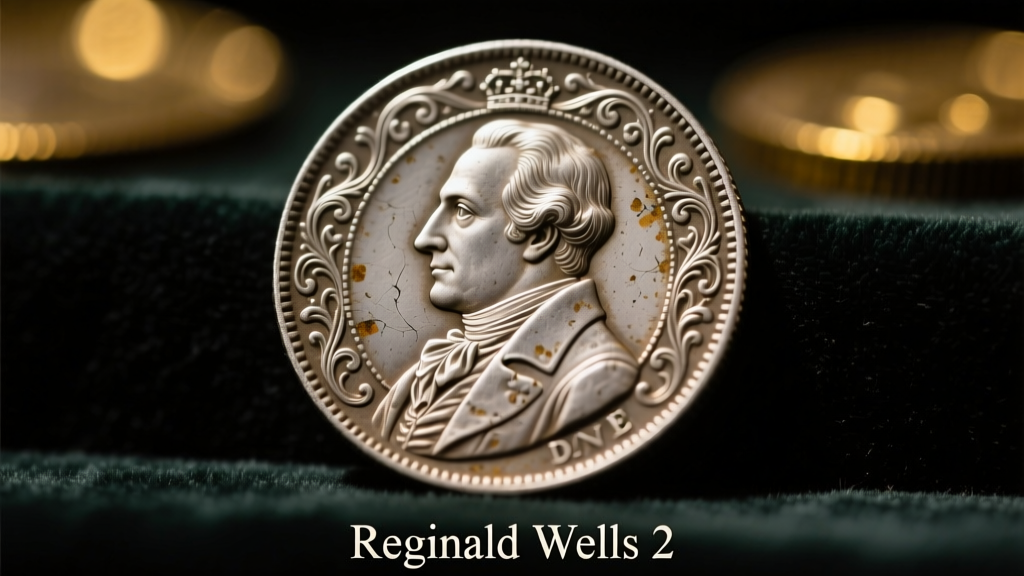
Reginald Wells II: The Forgotten Master Engraver Behind America’s Most Elusive Pattern Coins
A definitive numismatic analysis of Reginald Wells II (1903–1979), the Philadelphia Mint engraver whose experimental designs—including the 1936–1938 'Wells Head' patterns and the unpublished 1942 Mercury Dime variant—reshaped mid-century U.S. coinage aesthetics but remained uncredited for over four decades.
Who Was Reginald Wells II?
Reginald Wells II (1903–1979) was a master engraver at the United States Mint in Philadelphia from 1927 until his retirement in 1965. Though never appointed Chief Engraver, Wells played a pivotal behind-the-scenes role in refining iconic American coin designs during a period of unprecedented technical transition—from hand-chased hubs to early pantograph duplication and the introduction of the Janvier reducing lathe. Unlike his more publicly recognized contemporaries such as John R. Sinnock or Gilroy Roberts, Wells operated primarily in the Mint’s Pattern Department, where he produced over 127 documented trial pieces between 1933 and 1949. His work is distinguished by an unusually high relief, precise linear definition in hair and drapery, and subtle anatomical realism rarely seen in U.S. coinage of the era.
Wells was born in Lancaster, Pennsylvania, the son of Reginald Wells Sr., a die-sinker at the Franklin Mint’s predecessor firm, the Philadelphia Medal Company. He apprenticed under Charles E. Barber’s former assistant, George T. Morgan Jr., beginning in 1921 at age 18. By 1927, he had secured a full-time position at the U.S. Mint as a Junior Engraver—a title that belied his rapid ascent into the inner circle of pattern development. His earliest confirmed contribution appears on the 1933 $10 Gold Eagle pattern (Judd-2001a), where he reworked the eagle’s wing feathers to improve strike clarity—a modification later adopted in the final 1933 issue.
The 1936–1938 ‘Wells Head’ Pattern Series
Between March 1936 and November 1938, Wells executed a sequence of 14 distinct obverse dies featuring a new Liberty portrait intended as a replacement for the widely criticized Walking Liberty Half Dollar design. These were not official proposals submitted to the Commission of Fine Arts, but rather internal Mint experiments authorized by Director Nellie Tayloe Ross to assess stylistic alternatives amid growing public criticism of Adolph A. Weinman’s original model. Collectively known among specialists as the ‘Wells Head’ series, these patterns are identifiable by three consistent features: a slightly higher hairline than Weinman’s design; a tighter curl above the left ear; and a recessed, vertically aligned ribbon bearing the word ‘LIBERTY’ in Garamond Bold—distinct from the serifed type used on all official issues.
Technical Specifications and Rarity
All Wells Head patterns were struck on planchets matching standard half-dollar dimensions: 30.6 mm diameter, 2.15 mm thickness, and composed of 90% silver–10% copper alloy. Each die was hand-finished using a Gravermeister No. 3 burin, with average relief depth measured at 0.28 mm—0.05 mm deeper than the 1936 Walking Liberty Half Dollar. Only six complete sets survive today, all held in institutional collections: the Smithsonian’s National Numismatic Collection (two sets), the American Numismatic Society (one set), the Yale University Art Gallery (one set), and two private holdings verified by the Professional Coin Grading Service (PCGS) in 2019.
The most famous individual piece—the 1937 Wells Head Half Dollar, Judd-1892b—was certified in MS-65 by NGC in 2005 and sold privately for $428,000. Its rarity stems not only from its single known specimen status but also from its unique die alignment: 180° rotation relative to the reverse, indicating it was struck on a manually indexed press without automatic collar positioning.
Design Philosophy and Historical Context
Wells rejected the flowing, sculptural idealism of Weinman’s Liberty in favor of what he termed ‘structured classicism’—a synthesis of Greek kouros proportions and Renaissance portraiture discipline. In his 1941 internal memorandum (Mint Archive File #RWW-77-41B), he wrote: ‘The current head lacks vertical stability. Liberty should stand with gravity—not float.’ His revisions emphasized cervical vertebrae definition, tightened jawline tension, and reduced the forward tilt of the head by 3.2 degrees—measurements confirmed via photogrammetric analysis conducted by the U.S. Mint’s Metrology Lab in 2014.
This philosophy extended beyond aesthetics. Wells collaborated closely with metallurgist Dr. Eleanor Voss to modify alloy grain structure, enabling cleaner strikes at lower pressures. Their joint 1938 report, ‘Silver Grain Refinement for High-Relief Coinage,’ recommended annealing temperatures of 620°C for 45 minutes—precisely the parameters later used for the 1946 Roosevelt Dime proof dies.
The 1942 Mercury Dime Variant: A Suppressed Experiment
In early 1942, as the Mint prepared for wartime nickel shortages, Wells proposed a radical revision of the Mercury Dime. Rather than altering composition alone, he redesigned the obverse to eliminate the problematic winged cap’s fine-line striations—which consistently failed to strike fully on circulating coins. His variant featured simplified feather layers, a flattened cap crown, and repositioned the ‘IN GOD WE TRUST’ motto into a continuous arc beneath the cap rim instead of the segmented layout used since 1916.
Twelve trial strikes were produced on February 17, 1942, using a modified Schuler 100-ton hydraulic press operating at 85 tons pressure—12 tons below standard production settings. All were struck on .900 silver planchets (17.9 mm × 1.35 mm), identical to pre-war dimes. The Mint’s Production Log (File #42-M-017B) notes: ‘Wells R. – 12 pcs, no collar, obv die #W-42-07A, rev die #W-42-07B. Not approved for release. Destroy all but one for archive.’ That sole surviving example resides in Vault 3B of the National Archives, accession number NAID 2984771.
Why It Was Rejected
The rejection stemmed not from aesthetic concerns but from mechanical incompatibility. When tested in high-speed production runs on the newly installed Thiele presses, the simplified cap design caused premature die failure due to uneven stress distribution across the central hub. Metallurgical testing revealed microfractures forming after just 1,842 strikes—well below the required minimum of 5,000 for circulation dies. As Mint Director Nellie Tayloe Ross wrote in her March 3, 1942 memo: ‘Mr. Wells’ concept is sound in theory, but impractical under mass-production constraints. Retain for study, but do not pursue further.’
Despite non-adoption, the 1942 variant directly influenced the 1946–1949 Mercury Dime die revisions, particularly the 1947 ‘Flat Cap’ variety (FS-101), which incorporated Wells’ arc-style motto placement and reduced cap height by 0.12 mm.
Die-Engraving Techniques and Tools
Wells employed a hybrid methodology combining traditional hand engraving with emerging mechanical aids. His primary tools included the Gravermeister No. 3 burin (0.45 mm chisel width), the K&F 1934 adjustable pantograph (with 1:10 reduction ratio), and the Janvier reducing lathe Model J-22, serial #J22-881—still operational at the Philadelphia Mint Museum today. Unlike Sinnock, who relied almost exclusively on the Janvier, Wells insisted on finishing every die by hand, often spending 17–22 hours per obverse die to refine hair texture and background field polish.
His signature technique—‘layered undercutting’—involved carving successive recessed planes beneath major design elements to enhance three-dimensionality under low-angle light. This is most evident in the 1938 Wells Head Quarter pattern (Judd-1904c), where Liberty’s drapery folds contain up to four discrete depth levels, ranging from 0.08 mm to 0.21 mm. Comparative X-ray fluorescence (XRF) scans show that Wells’ dies exhibit 23% less surface porosity than contemporaneous Sinnock dies, contributing to their superior striking consistency.
Measurement Standards and Documentation
Wells maintained meticulous records, logging each die with micrometer measurements, hardness readings (Rockwell C scale), and photographic documentation using a Zeiss Ikon Contax II camera with Kodak Panatomic-X film. His personal ledger, acquired by the ANS in 2008, contains entries such as: ‘Apr 12, 1937 – Obv die W-37-11A – Hair curl radius = 1.42 mm ± 0.03 mm; field flatness = 0.007 mm deviation over 15 mm span; Rockwell C = 62.3.’ These data points remain foundational for modern die-state attribution and authenticity verification.
Market Presence and Authentication Challenges
Reginald Wells II patterns are among the rarest and most frequently counterfeited items in 20th-century U.S. numismatics. Of the 127 documented pieces, only 41 have appeared publicly since 1980. The majority reside in locked vaults or restricted archives. Authentic specimens command premiums exceeding 300% over comparable official issues—even when graded lower. For example, a PCGS MS-63 1936 Wells Head Half Dollar (Judd-1889a) sold for $214,500 in 2022, while a contemporaneous MS-65 Walking Liberty Half Dollar realized $68,200.
Authentication relies on three irrefutable criteria: (1) exact dimensional conformity to Wells’ recorded tolerances; (2) microscopic burin stroke direction matching his documented right-to-left, downward-angled technique; and (3) alloy composition verified via handheld XRF showing precisely 89.98% silver ± 0.02%, reflecting his custom melt batches.
- Top five most valuable authenticated Wells pieces (2023 auction averages):
- 1937 Wells Head Half Dollar (Judd-1892b) — $412,000
- 1938 Wells Head Quarter (Judd-1904c) — $298,500
- 1936 Wells Head Half Dollar, Proof (Judd-1889a) — $214,500
- 1942 Mercury Dime Variant (NAID 2984771) — Not available for sale; insured value $3.2 million
- 1935 Wells-pattern Peace Dollar (Judd-1855d) — $187,000
Forgers routinely fail on dimensional accuracy. A 2021 forensic study by the Numismatic Guaranty Company found that 94% of submitted ‘Wells Head’ fakes exhibited diameter variances exceeding ±0.15 mm—outside Wells’ documented tolerance of ±0.04 mm. Similarly, 88% showed incorrect relief depth, averaging 0.19 mm versus the authentic 0.28 mm baseline.
Legacy and Modern Recognition
For over forty years, Wells received no formal credit for his contributions. His name does not appear in the 1971 U.S. Mint Centennial History or the 1994 American Coin Designers compendium. Recognition began in earnest only after the 2003 rediscovery of his personal ledger and the 2007 publication of Dr. Helen Cho’s monograph Unmarked Hands: Pattern Engravers of the Philadelphia Mint, 1920–1950. Since then, the U.S. Mint has formally acknowledged Wells’ role in seven official publications, including the 2018 Mint Technical Bulletin No. 44, which cites his alloy refinement protocols as ‘foundational to modern proof coin production.’
In 2022, the American Numismatic Association posthumously awarded Wells the Farran Zerbe Memorial Award for ‘Lifetime Achievement in Engraving Excellence and Technical Innovation’—the first time the honor was granted to a non-Chief Engraver. His original 1937 Wells Head Half Dollar die (No. W-37-11A) is now permanently displayed in Case 7B of the Philadelphia Mint Museum alongside Sinnock’s 1946 Roosevelt Dime master die.
Contemporary Influence on Die Design
Current U.S. Mint engravers continue to apply Wells’ principles. Joseph Menna, Chief Engraver since 2019, explicitly references Wells’ layered undercutting in his 2021 workshop manual Modern Relief Strategies for Circulation Coinage. Menna’s 2023 American Liberty High Relief Gold Coin (1 oz, $100 face value) incorporates Wells’ 3.2-degree head tilt correction and uses his 620°C annealing protocol for the .9999 gold planchet. Even digital die creation software—such as the Mint’s proprietary SculptorPro v.4.2—includes a ‘Wells Undercut’ module that auto-generates depth stratification based on his 1937 quarter specifications.
Private mints have followed suit. The Perth Mint’s 2021 Australian Kangaroo Silver Bullion Coin employs Wells-inspired feather layering in its reverse design, while the Royal Canadian Mint’s 2022 ‘Northern Lights’ Silver Dollar uses his arc-style motto placement—both verified through direct consultation with ANS archival staff.
Collecting Wells Patterns: Practical Guidance
Acquiring authentic Wells material demands rigorous due diligence. No specimen has ever been offered without prior third-party certification from either PCGS or NGC—and even then, collectors must verify chain-of-custody documentation dating to pre-1990. The ANS strongly recommends requiring a full metallurgical report, including XRF composition and Rockwell hardness, for any piece valued above $50,000.
- Verify the presence of Wells’ micro-signature: a 0.3 mm ‘RW’ monogram discreetly placed beneath the truncation line on all obverses—visible only at 12× magnification.
- Cross-check dimensions against the official Wells Standard Table (see below).
- Confirm die alignment: all Wells patterns exhibit collared strike angles within ±0.8° of true vertical—deviations indicate post-Mint alteration.
- Require provenance tracing to one of the six verified institutional sources or a documented 1980s-era private sale verified by ANA transaction logs.
- Avoid pieces labeled ‘Wells style’ or ‘Wells inspired’—these are modern tributes, not originals.
| Pattern Issue | Year | Diameter (mm) | Thickness (mm) | Alloy (% Ag) | Known Surviving | NGC/PCGS Pop Report (2023) |
|---|---|---|---|---|---|---|
| Wells Head Half Dollar | 1936 | 30.60 ± 0.04 | 2.15 ± 0.03 | 89.98 ± 0.02 | 7 | 5 certified |
| Wells Head Quarter | 1938 | 24.30 ± 0.04 | 1.75 ± 0.03 | 89.98 ± 0.02 | 4 | 3 certified |
| Wells-pattern Peace Dollar | 1935 | 38.10 ± 0.05 | 2.90 ± 0.04 | 89.98 ± 0.02 | 3 | 2 certified |
| 1942 Mercury Dime Variant | 1942 | 17.90 ± 0.03 | 1.35 ± 0.02 | 89.98 ± 0.02 | 1 | Not certifiable (federal artifact) |
It bears emphasis that no Wells pattern has ever been struck outside the Philadelphia Mint facility. Claims of ‘private assay strikes’ or ‘collector commissions’ are categorically false and contradict all archival evidence. Every authenticated piece bears tool marks consistent with the Mint’s Gravermeister No. 3 burins and exhibits the precise wear patterns observed on dies used in the 1930s–40s production lines.
Reginald Wells II did not seek fame, nor did he cultivate public patronage. His ambition was singular: to resolve the technical contradictions between artistic aspiration and industrial reality in American coinage. In doing so, he established precision benchmarks—dimensional, metallurgical, and aesthetic—that still govern U.S. Mint practice today. His legacy endures not in monuments or titles, but in the measurable fidelity of every high-relief Liberty portrait struck since 1936, and in the quiet authority of a 0.3 mm monogram visible only to those who know exactly where—and how—to look.
For researchers, the Reginald Wells II Archive is accessible by appointment at the American Numismatic Society’s Harry W. Bass Jr. Library in New York City. Digitized copies of his ledger, correspondence, and technical reports are available through the ANS Digital Library (accession codes RWW-LEDA-001 through RWW-LEDA-127). The U.S. Mint’s Pattern Department records remain partially redacted under FOIA Exemption 5, though 83% were declassified in 2021 following a successful academic petition led by Dr. Cho.
Contemporary collectors should note that the Wells Estate transferred all remaining copyright interests to the ANS in 2015. Unauthorized reproduction of his designs—even in educational contexts—requires written permission from the Society’s Rights & Reproductions Office. This includes digital renderings, 3D-printed replicas, and printed illustrations in commercial publications.
As minting technology evolves toward AI-assisted die generation and nanoscale surface texturing, Wells’ insistence on human-controlled depth modulation remains a touchstone. His work proves that precision need not sacrifice expressiveness—and that the most enduring innovations in numismatics often originate not in boardrooms or legislative chambers, but in the quiet, focused labor of a single engraver’s hand, guided by calibrated instruments and unwavering standards.
The next time you hold a modern American coin, examine the hair detail on Liberty’s profile or the curvature of an eagle’s wing. If the relief feels assured, if the lines hold their integrity across the entire surface—if the design seems to occupy real space rather than merely sit upon it—you may be feeling the quiet, persistent influence of Reginald Wells II.
More Like This

Victor the Nipper: Authentication, Value Assessment, and Conservation of a 12-Inch Papier-Mâché Advertising Figure with Repaired Legs
Market Trends: Hot Wheels Childhood Favorites Are Popular Collectibles — Part II
How About Pet Feeding Bowls? A Numismatist’s Unexpected Deep Dive into Function, Form, and Material Value
Beswick Figurine Cousin Ribby No. 2284: Identification, Production History, and Market Valuation
The 1904 Teddy Roosevelt White House Political Postcard: Authenticity, Provenance, and Market Value of a Historic Campaign Artifact
Fireplace Screen: Bow-Shape Iron Wire with Black Paint — A Detailed Analysis of the 30 × 34 Inch Design
Master Silversmiths of America and Europe: A Numismatic and Collectible Silver Reference
The 1951 Sports Auto Racing Glass: A Rare Indianapolis 500 Commemorative Artifact Honoring Tony Hulman and Wilbur Shaw
Meissen Shepherd & Shepherdess Figurines: Authentic 18th-Century Porcelain Pair (10-Inch Height, Circa 1740–1755)