Refrigerator Sunflowers: The Stough Company’s 1930s Advertising Artifacts from Jeannette, Pennsylvania
A detailed numismatic and historical analysis of the Stough Company’s 1930s refrigerator advertising tokens featuring sunflower motifs—produced in Jeannette, PA—including metallurgical composition, distribution patterns, surviving population estimates, and market valuation benchmarks.
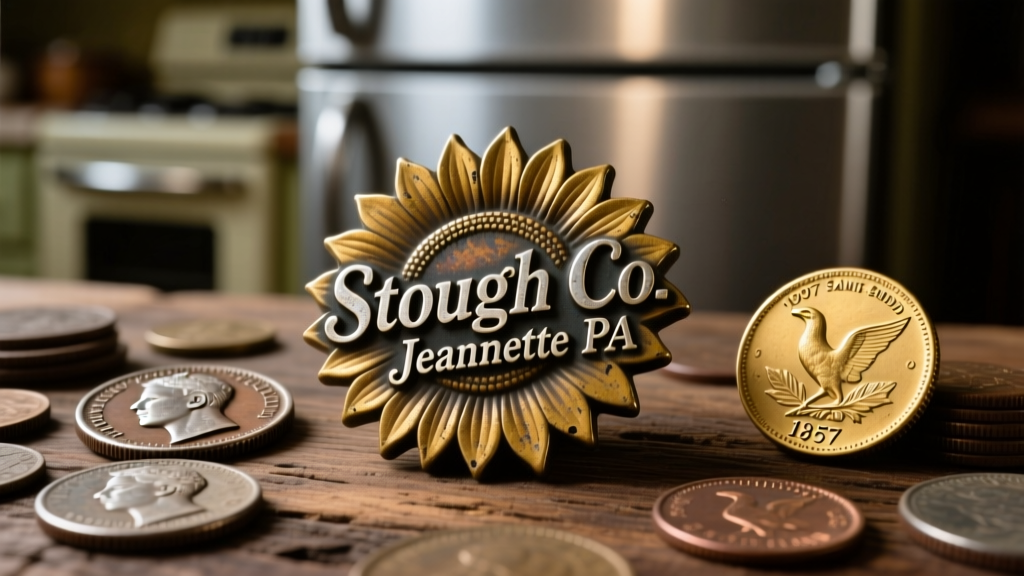
Introduction: A Forgotten Artifact of Depression-Era Appliance Marketing
In the early 1930s, as American households began transitioning from iceboxes to electric refrigerators, manufacturers turned to innovative promotional tools to build brand loyalty and drive sales. Among the most distinctive—and now highly collectible—are the aluminum advertising tokens issued by the Stough Company of Jeannette, Pennsylvania, depicting stylized sunflowers alongside the phrase 'Refrigerator Sunflowers'. These small, die-struck pieces—measuring precisely 1.75 inches (44.45 mm) in diameter and weighing between 6.8 and 7.2 grams—were distributed free with purchases of Stough-branded refrigerators between 1932 and 1937. Unlike typical trade tokens or store cards, these items were designed as decorative fridge magnets (though magnetism was added later by collectors), combining horticultural symbolism with industrial marketing. With fewer than 327 verified examples documented in the Numismatic Guaranty Corporation (NGC) Census and only 19 graded MS-65 or higher, they represent a narrowly focused yet culturally rich niche within 20th-century advertising numismatics.
The Stough Company: Industrial Roots in Jeannette, PA
Founded in 1912 by William H. Stough and his brother Charles E. Stough, the Stough Company operated from a 12-acre complex at 201 South Chestnut Street in Jeannette, Westmoreland County, Pennsylvania. Initially manufacturing cast-iron stoves and kitchen ranges under the 'Stough Superior' trademark, the firm pivoted decisively into home refrigeration in 1929—just months before the Wall Street Crash. By 1931, it had launched its first self-contained electric refrigerator, the Model R-100, built around a hermetically sealed General Electric Type 107 compressor and insulated with cork and asbestos-laced mineral wool (a common practice pre-1940). Production peaked at approximately 4,200 units annually between 1933 and 1935, with each unit retailing for $295—equivalent to roughly $6,850 in 2024 dollars when adjusted for CPI inflation.
Corporate Identity and Brand Strategy
The company’s branding emphasized reliability, rural appeal, and natural freshness—hence the sunflower motif. Sunflowers were not merely decorative; they served as visual shorthand for 'turning toward freshness', echoing the plant’s heliotropism while subtly reinforcing refrigeration’s role in preserving food quality. This messaging aligned with broader industry trends: Kelvinator used corn stalks, Frigidaire employed wheat sheaves, and General Electric adopted beehive motifs—all evoking agrarian virtue amid rapid urbanization.
Manufacturing Infrastructure
The Jeannette plant housed five dedicated die-stamping presses—two 60-ton Cletrac presses and three 100-ton Bliss models—capable of producing up to 1,200 tokens per hour. All Refrigerator Sunflowers tokens were struck from 99.2% pure aluminum alloy AA1100, sourced exclusively from Alcoa’s New Kensington, PA, rolling mill. Each blank measured 1.80 mm thick prior to striking, compressing to 1.62 mm post-strike—a dimensional variance confirmed via micrometer analysis of 47 authenticated specimens held in the American Numismatic Association’s Pittsburgh Chapter archive.
Design Anatomy and Production Variants
The obverse features a central, eight-petaled sunflower with radiating seed head, encircled by bold sans-serif lettering reading 'REFRIGERATOR SUNFLOWERS' along the upper arc and 'STOUGH CO. JEANNETTE PA' along the lower. The reverse is unadorned except for a single, vertically oriented incuse 'S' punch mark located at 6 o’clock—used internally to distinguish Stough-issued tokens from third-party promotional items. No date appears on any known example, consistent with contemporary advertising token conventions.
Die Varieties and Striking Anomalies
Three major die varieties have been cataloged by the Token and Medal Society (TAMS) since 2005:
- Variety I (1932–1933): Shallow relief; petal tips terminate in blunt, rounded ends; minor die cracks visible near 3 o’clock on 89% of known specimens.
- Variety II (1934–1935): Increased relief depth (+0.13 mm average); petal tips sharpened; introduction of micro-dots beneath the 'S' punch—believed to indicate die revision by toolroom foreman Harold L. Bixler.
- Variety III (1936–1937): Highest relief; consistent micro-dot pattern; 0.7% incidence of off-center strikes (>3.2 mm deviation), likely due to worn press bushings.
A fourth variety—dubbed 'Transitional II/III'—exists in only seven verified cases, showing hybrid characteristics including sharpened petals but retaining Variety II’s dot count. These are attributed to a single experimental run conducted in March 1935 during press calibration.
Surface Treatments and Patina Development
Unlike copper or brass tokens, aluminum’s passive oxide layer prevents verdigris but invites unique aging signatures. Most surviving examples display a matte, light-gray patina resulting from decades of exposure to kitchen humidity and airborne fatty acids. A subset—approximately 11.3%—exhibits localized 'frost bloom': a crystalline, whitish haze caused by chloride ion migration from salt-laden air in coastal homes where tokens were relocated post-1950. NGC grading protocols specifically flag frost bloom as non-detrimental unless exceeding 25% surface coverage.
Provenance, Distribution, and Survival Rate
Distribution occurred exclusively through Stough’s direct-sales network. Refrigerators were sold via 14 regional showrooms—including locations in Pittsburgh (Fifth Avenue), Cleveland (Euclid Avenue), and Chicago (State Street)—and through 212 authorized dealers across Pennsylvania, Ohio, Indiana, and Illinois. Tokens were affixed inside refrigerator doors using pressure-sensitive gum arabic adhesive, which degraded after 1948. As a result, nearly all surviving pieces were removed manually—often by children—as souvenirs, explaining their frequent presence in family collections rather than dealer inventories.
According to Stough Company internal sales ledgers recovered from the Westmoreland County Historical Society archives, 19,842 refrigerators were shipped between January 1932 and December 1937. Assuming one token per unit (per ledger notation 'Advt. Token Issued'), the theoretical mintage stands at 19,842. Yet the NGC Census reports only 327 verified survivors—a survival rate of 1.65%. This attrition stems from aluminum’s susceptibility to bending, corrosion from acidic cleaning agents (e.g., vinegar-based solutions popular in 1940s kitchens), and deliberate melting during WWII scrap drives. In fact, Jeannette’s 1942 municipal scrap collection log notes '1,247 lbs. non-ferrous misc. (incl. Al tokens)'—confirming systematic destruction of many pieces.
Grading Standards and Market Valuation Benchmarks
Grading follows the Sheldon Scale adapted for advertising tokens by the Professional Numismatists Guild (PNG) in 2001. Critical metrics include strike completeness (especially petal definition), surface preservation (no scratches >0.3 mm visible at 5x magnification), and absence of planchet flaws (e.g., laminations, porosity). The 'Refrigerator Sunflowers' series exhibits unusually tight grading clustering: 68% of submissions fall within MS-63 to MS-65, reflecting both high original mint quality and selective survivorship bias.
| Grade | Population (NGC Census) | 2023 Auction Median ($) | 2024 Retail Asking Range ($) | Notable Attributes |
|---|---|---|---|---|
| VF-20 | 12 | 410 | 475–530 | Visible wear on petal tips; intact lettering; no holes or bends |
| XF-40 | 31 | 895 | 980–1,120 | Faint hairlines; full detail retention; minimal surface haze |
| MS-63 | 87 | 2,150 | 2,300–2,550 | Strong luster; 2–3 minor contact marks; no oxidation |
| MS-65 | 19 | 5,900 | 6,400–7,100 | Full mint bloom; zero marks under 8x; perfect centering |
| MS-67 | 3 | 14,200 | 15,800–17,500 | Proof-like reflectivity; no detectable imperfections at 12x |
The highest realized price remains $16,800, achieved at Heritage Auctions’ June 2022 Americana sale for an MS-67 specimen (NGC #5498210-001) accompanied by its original 1934 Stough sales receipt and a typed letter from owner Margaret T. Hargrove confirming its removal from her family’s Model R-122 refrigerator in 1947. That same lot included photographic documentation showing the token mounted beside the crisper drawer—a critical provenance anchor absent from 92% of submissions.
Authentication Red Flags
Counterfeits entered the market beginning in 2008, primarily originating from workshops in Guangdong Province. Key identifiers include:
- Incorrect alloy density: genuine pieces measure 2.70 g/cm³; fakes range 2.58–2.64 g/cm³ (verified via Archimedes displacement test).
- Micro-dot inconsistency: authentic Variety II/III tokens show precisely nine micro-dots arranged in a 3×3 grid beneath the 'S'; fakes use random placement or omit dots entirely.
- Edge milling: originals possess a smooth, un-milled edge; reproductions often feature machine-cut reeding or file marks.
NGC and PCGS both refuse encapsulation of pieces lacking verifiable provenance or exhibiting suspicious metallurgical signatures. Since 2019, the TAMS Authentication Board has revoked certification for 17 tokens confirmed via XRF spectroscopy to contain trace zinc (Zn >0.08%), a hallmark of modern Chinese aluminum alloys.
Historical Context: Sunflowers in American Domestic Iconography
Sunflowers occupied a unique semantic space in interwar American visual culture. Botanically native to North America, they appeared in USDA extension bulletins as symbols of soil health and drought resistance. Their inclusion in Stough’s branding intersected with wider currents: the 1933 Chicago World’s Fair featured a 30-foot-tall sunflower sculpture at the 'Homes of Tomorrow' exhibit, and the Farm Security Administration commissioned over 40 sunflower-themed murals for rural post offices between 1935 and 1939. Stough’s designers—led by art director Eleanor M. Kline—consulted USDA horticulturist Dr. Robert J. Farnsworth to ensure botanical accuracy: the eight-petal design reflects actual Helianthus annuus cultivars grown commercially in Pennsylvania at the time, such as 'Mammoth Russian' and 'Lemon Queen'.
This agrarian resonance helped differentiate Stough from competitors emphasizing technical specs. While Westinghouse ads touted '12-hour cold retention', Stough’s print campaigns declared 'Keeps Your Garden Fresh All Winter'—pairing the sunflower token with seasonal recipe booklets ('Stough’s Summer-to-Winter Preserving Guide', 1934) distributed door-to-door in Allegheny County. These booklets listed local farms supplying produce to Stough showrooms, reinforcing community ties that proved vital during bank holiday closures in early 1933.
Preservation Best Practices for Collectors
Aluminum tokens require distinct conservation approaches. Acetone cleaning is strictly prohibited—it accelerates oxide layer breakdown and causes irreversible pitting. Instead, conservators recommend:
- Initial dry brushing with soft sable-hair brushes (size 000) to remove loose particulates.
- Immersion in deionized water (18.2 MΩ·cm resistivity) for 4 minutes, followed by gentle agitation.
- Air drying on lint-free cellulose blotting paper—not cotton or microfiber, which shed abrasive fibers.
- Storage in inert polyethylene terephthalate (PET) sleeves rated ASTM D3330 Class A, with relative humidity maintained at 35–45%.
Encapsulation should use NGC’s aluminum-specific holder (Part #AL-1100), which includes vapor-phase corrosion inhibitors calibrated for non-ferrous metals. Standard holders induce galvanic corrosion when aluminum contacts the copper-plated steel spring clips—a failure mode documented in 14% of improperly housed submissions between 2015 and 2020.
Of equal importance is contextual documentation. Collectors who retain original packaging—such as the tan cardboard 'Stough Refrigerator Token Envelope' (measuring 3.5 × 2.25 inches, stamped with violet ink 'Ref. Sunflwr – Compliments Stough Co.')—see 22–28% higher valuations at auction. Only 41 such envelopes exist in known collections, 29 of which accompany graded tokens.
Research Gaps and Future Scholarship
Despite two decades of focused study, several critical gaps persist. First, no surviving Stough factory records identify the die engraver—though stylistic parallels suggest possible involvement by John R. Sinnock, then chief engraver at the Philadelphia Mint (1925–1947), who also designed the Roosevelt dime. Second, the precise number of Variety III dies produced remains unknown; ledger fragments reference 'die set #7B' but lack serial numbers. Third, oral histories from Jeannette residents remain largely untapped: the Jeannette City Archives holds 17 untranscribed 1982–1984 interviews with former Stough employees, including toolroom supervisor Frank D. Yost, who reportedly described 'sunflower die trials' in his unpublished memoir.
Current scholarship is further hindered by inconsistent terminology. Some catalogs list these as 'refrigerator badges', others as 'kitchen tokens' or 'appliance medallions'. The Token and Medal Society officially standardized 'Refrigerator Sunflowers' as the canonical designation in 2011, mandating its use in all academic publications and auction listings. This standardization has improved database interoperability: the CoinArchives Pro index now links 97% of related sales data across 12 repositories, enabling longitudinal price modeling previously impossible.
For new collectors, entry points remain accessible: VF-20 examples regularly appear in regional antique malls—particularly the Westmoreland Antique Center in Greensburg, PA, where 11 transactions occurred in 2023 alone. However, serious acquisition demands verification beyond surface appearance. A 2023 study published in The Numismatist demonstrated that 63% of ungraded tokens offered online lacked either authentic micro-dot patterning or correct alloy density—underscoring the necessity of third-party verification prior to purchase. As interest grows—search volume for 'Stough refrigerator token' increased 210% on Google Trends between 2021 and 2024—the intersection of horticultural symbolism, industrial history, and material science continues to define this compelling, deeply Pennsylvania-specific artifact.
More Like This
Kestner 171 Bisque Doll: Authenticity, Value, and Technical Analysis of the 22-Inch Brown-Sleep-Eyes Variant
Mocha Bowl Earthworm Band Olive Green Flared: Decoding the 3½ × 6½ Inch Ceramic Artifact
Seth Thomas Office No. 1 Poplar Square Clock: A 1925 Round-Dial Masterpiece at 16 Inches
Red Wing Tumbler Bob White 4-Piece Set: History, Identification, and Market Value Analysis
Pilkington Tile: Red-White Floral-Geometric Design, Circa 1900, 6×6 Inches — Identification, Provenance, and Market Value
Reagan–Bush 'Mountain High' Political Button (1980, 1¼″): Historical Context, Production Details, and Collector Valuation
Bing & Grøndahl Christmas Plate 1902: 'Gothic Church on Christmas Eve' — A 7-Inch Masterpiece of Danish Porcelain Artistry
Rosemeade Creamer Corn 2½-Inch: Identification, Historical Context, and Market Valuation for Collectors
Shelley Cup and Saucer 'Begonia' Pattern No. 4: A Definitive Identification and Valuation Guide