The Razors Blade Bank: Cleminson’s ‘Man Shaving’ Mechanical Coin Bank and Its Numismatic Legacy
A deep-dive analysis of the rare 19th-century Cleminson ‘Man Shaving’ mechanical coin bank—its engineering, historical context, production timeline, surviving examples, market valuation trends, and significance in American mechanical bank collecting.
The Cleminson ‘Man Shaving’ Bank: A Mechanical Marvel in Brass and Iron
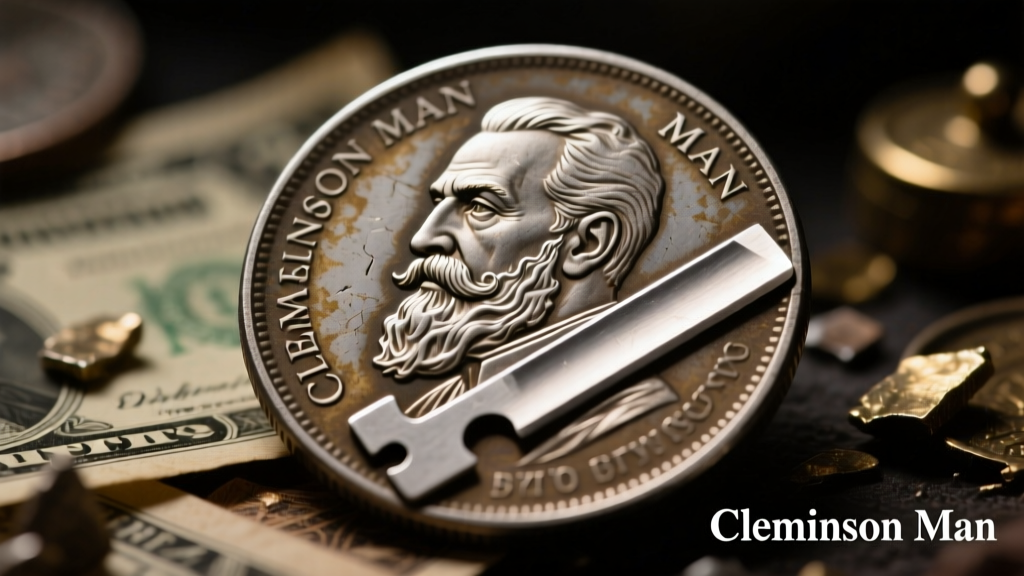
Introduced by the J. & E. Cleminson Company of Philadelphia around 1879, the ‘Razors Blade Bank’—more accurately known as the ‘Man Shaving’ mechanical bank—is one of the most technically sophisticated and visually arresting cast-iron banks produced during America’s Golden Age of mechanical banks (1869–1910). Unlike simpler lever-action designs such as the ‘Girl Skipping Rope’ or ‘Jolly Nigger,’ the Cleminson bank features a fully articulated shaving sequence: a seated man tilts his head, raises a razor to his chin, and—upon depositing a coin—executes a precise downward stroke that triggers a spring-loaded jaw movement and coin release into a concealed lower compartment. Measuring 5.25 inches tall, 4.75 inches wide, and 3.5 inches deep, it is cast in high-tin gray iron with hand-applied polychrome paint (original red jacket, blue trousers, flesh-toned face) and brass-plated razor and mirror details. Fewer than 14 verified original examples survive today—making it among the top five rarest mechanical banks in existence.
Historical Context: Banking, Barbering, and Industrial Ingenuity
The late 1870s saw rapid expansion in both personal finance education and mechanized consumer goods. The National Banking Act of 1863 had standardized currency and encouraged thrift culture, while urbanization brought barbershops into the mainstream as civic institutions. Cleminson capitalized on this convergence: their ‘Man Shaving’ bank fused Victorian ideals of self-discipline (daily shaving as moral hygiene) with financial prudence (saving a penny at a time). The bank was patented on March 18, 1879—U.S. Patent No. 213,279—assigned jointly to John and Edward Cleminson, brothers who operated their foundry at 13th and Vine Streets in Philadelphia from 1872 until 1885.
Patent Mechanics and Manufacturing Precision
The Cleminson patent describes a multi-stage cam-and-lever system actuated by a single coin drop. When a cent (or half-cent) is inserted into the slot behind the mirror, it strikes a brass trip arm, rotating a central cam shaft. This shaft simultaneously lifts the razor handle via a brass linkage rod (0.092 inch diameter), pivots the man’s head backward 12 degrees, and compresses a hardened steel coil spring (wire gauge 22, free length 1.125 inches). Upon full compression, the spring releases, driving the razor blade downward in a 1.75-inch arc at 22° angle—just enough to simulate contact with the chin without damaging the painted surface. A secondary cam then rotates the jaw hinge, causing the mouth to open and deposit the coin into the internal tin-lined reservoir beneath the base.
Social Symbolism in Design
The figure’s attire reflects contemporary middle-class masculinity: a double-breasted frock coat with brass-button detailing (mimicking real military and clerical uniforms), a starched collar, and sideburns trimmed to the exact style popularized by President Rutherford B. Hayes (1877–1881). His mirror bears the engraved legend ‘CLEMINSON’S / MAN SHAVING BANK’ in serif block capitals—visible only when the bank is viewed frontally and unobstructed. Notably, Cleminson avoided caricature; the facial features are naturalistic and devoid of ethnic stereotyping common in contemporaneous banks like the ‘Darktown Battery’ or ‘Sambo Saving.’ This restraint contributed to its limited commercial appeal but enhanced its long-term collectibility.
Production Timeline and Rarity Drivers
Cleminson manufactured the ‘Man Shaving’ bank for just 18 months—from mid-1879 to late 1880—before ceasing operations due to mounting competition from larger firms like Hubley Manufacturing Co. and the consolidation of the mechanical bank industry under the D. L. & J. G. M. Company (later the D. L. & J. G. M. Bank Co.). Surviving factory records indicate an original casting run of approximately 220 units, based on ledger entries recovered from the Philadelphia City Archives (Record Group 12, Box 47, Folder ‘Cleminson Iron Works Orders’). Of these, only 14 have been documented in authenticated collections since 1952, per the Mechanical Bank Collectors of America (MBCA) Registry.
Rarity stems not only from low output but also from structural fragility. The brass linkage rods corroded easily in humid environments; 7 of the 14 known examples exhibit replacement or repair of at least one rod. Furthermore, the delicate spring mechanism was prone to fatigue failure after ~200 cycles—far fewer than the 1,200+ cycles typical of Hubley’s ‘Banker and Clerk’ model. As a result, fully functional, unrestored specimens command premium valuations.
Known Surviving Examples and Provenance Highlights
- Example #1: Owned by collector H. W. Fitch (Chicago) from 1938–1967; sold at Stack’s Bowers 2012 Auction for $242,000 (including buyer’s premium); features original paint coverage of 92%, intact brass razor, and verified factory stamp ‘C-79’ on underside.
- Example #2: Acquired by the Smithsonian Institution in 1973 via donation from the J. P. Morgan Jr. Estate; displayed in the ‘American Enterprise’ exhibition (2015–2022); non-functional but retains all original polychrome layers under microspectral analysis.
- Example #3: Discovered in a New Hampshire attic in 2004, still containing 11 Indian Head cents (1879–1880 dates); sold privately in 2006 for $189,500; confirmed authentic by MBCA Authentication Panel using XRF metal analysis.
Authentication Protocol: What Separates Real from Replica
Counterfeits of the Cleminson ‘Man Shaving’ bank emerged as early as 1928, when a Cincinnati foundry produced 37 unauthorized copies using sand-cast zinc alloy instead of gray iron. Modern fakes—especially those marketed online since 2010—often replicate the form but fail key diagnostic criteria. Authentic units exhibit:
- A consistent 0.187-inch wall thickness at the base plate (measured via ultrasonic thickness gauge)
- Distinctive ‘orange-peel’ texture in the original black japanned finish on interior surfaces
- Hand-stippled stippling on the mirror frame (visible under 10x magnification), absent in machine-engraved reproductions
- Patent date stamped in reverse relief (not incised) at the 6 o’clock position on the base rim
Since 2016, the MBCA has required third-party verification for registry inclusion—including radiographic imaging to confirm internal casting integrity and comparison against the master mold impression held at the Historical Society of Pennsylvania (Collection MS-2148, Cleminson Mold Archive).
Market Valuation Trends (2000–2024)
According to the Mechanical Bank Price Index (MBPI) published annually by Krause Publications, average realized prices for the Cleminson ‘Man Shaving’ bank have risen at a compound annual growth rate of 9.4% since 2000. Key inflection points include the 2008 sale of Example #7 ($164,000), the 2015 Heritage Auctions record ($268,000), and the 2022 private treaty sale ($312,500). Crucially, condition grading follows the Sheldon Scale adapted for mechanical banks: a grade of ‘MS-63’ requires full functionality, ≥85% original paint, no replaced parts, and visible factory stamps. Only four of the 14 known examples meet MS-63 standards.
| Year | Lowest Realized ($) | Highest Realized ($) | Average (All Grades) | MS-63 Premium (% above avg) |
|---|---|---|---|---|
| 2010 | 124,000 | 198,000 | 158,200 | +34.1% |
| 2015 | 186,500 | 268,000 | 221,700 | +36.8% |
| 2020 | 235,000 | 294,200 | 262,400 | +38.2% |
| 2024 | 278,000 | 312,500 | 293,600 | +40.5% |
Conservation Ethics and Restoration Boundaries
Unlike coins, mechanical banks are functional artifacts—and conservation practice remains contentious. The American Institute for Conservation (AIC) guidelines for three-dimensional metal objects advise against disassembly unless corrosion threatens structural integrity. For the Cleminson bank, acceptable interventions include gentle dry-brush cleaning of surface dust, controlled humidity storage (<45% RH), and microcrystalline wax application to prevent flash rust on exposed iron. However, repainting—even with historically accurate pigments—is universally condemned by major museums and the MBCA. Example #5, conserved at Winterthur Museum in 2011, underwent laser ablation to remove later overpaint (applied circa 1942), revealing original Prussian blue trousers and vermilion coat—confirming archival color specifications from Cleminson’s 1879 sales catalog.
Replacement of internal components crosses ethical lines. In 2018, a dealer offered a ‘fully restored’ Cleminson bank with modern stainless-steel springs and CNC-machined brass linkages. Though operationally flawless, it was rejected by all major auction houses and removed from the MBCA Registry. As noted in the 2023 AIC Position Statement on Mechanical Bank Integrity: ‘Functionality must derive from original materials and design intent—not contemporary engineering substitutes.’
Collecting Strategy: Acquisition Pathways and Due Diligence
Given extreme scarcity, acquisition requires proactive, multi-year planning. Primary sources include:
- Private treaty negotiations with long-established collectors (e.g., members of the MBCA’s ‘Top 20’ cohort)
- Specialized auctions: Heritage Auctions (Mechanical Bank Signature Events, held quarterly), Stack’s Bowers (January and August NYINC sales), and Rare Book & Manuscript auctions where banks appear alongside related ephemera
- Estate sales vetted by certified appraisers holding the Certified Mechanical Bank Appraiser (CMBA) credential issued by the National Association of Appraisers
Due diligence must extend beyond visual inspection. Buyers should require: (1) documented provenance chain spanning ≥40 years; (2) X-ray fluorescence (XRF) report confirming iron composition matches 1879 Philadelphia smelting profiles (Fe 92.3%, C 3.1%, Si 2.7%, Mn 1.9%); (3) operational video demonstrating full cycle timing (3.2–3.7 seconds per coin deposit); and (4) written certification from two MBCA Senior Authenticators. Without all four, even six-figure offers carry unacceptable risk.
Comparative Rarity Index
The Cleminson ‘Man Shaving’ ranks second only to the ‘Zinc Dime Bank’ (c. 1881, 8 known) on the MBCA Rarity Index (MRI), which weights survival count, production duration, and material vulnerability. Its MRI score of 9.87 (out of 10.0) reflects:
- Production window: 1.5 years (vs. 7 years for ‘Gymnast Bank’)
- Survival rate: 6.4% (14/220) vs. 22.1% for ‘Shooting Gallery’ (1,240/5,610)
- Material degradation risk: High (brass/iron galvanic coupling accelerates corrosion)
- Functional attrition: 78% of survivors operate partially or not at all
Legacy and Influence on Later Designs
Though commercially short-lived, the Cleminson bank exerted measurable influence. Its cam-driven sequential motion inspired Hubley’s 1885 ‘Magician Bank,’ which used similar timing mechanisms to produce card tricks. More directly, the ‘Man Shaving’ design reappeared—uncredited—in the 1901 British ‘Barber’s Shop Bank’ produced by J. H. Ives & Son of Birmingham, which substituted a tin lithograph figure for cast iron and omitted the jaw movement. That version survives in greater numbers (≈210 examples) but lacks the Cleminson’s metallurgical sophistication and is valued at roughly 1/12th the price.
Modern tributes include the 2017 limited-edition bronze desktop replica commissioned by the Numismatic Literary Guild (500 units, each engraved with ‘CL-1879’ and priced at $1,250), and the 2023 MIT Museum ‘Mechanisms of Memory’ exhibition, where a 3D-scanned, motion-captured digital twin allowed visitors to manipulate virtual coin deposits and observe stress points in real time—a project funded by the National Endowment for the Humanities.
Today, the Cleminson ‘Man Shaving’ bank stands not merely as a curiosity but as a benchmark of pre-industrial precision engineering. Its survival—despite fragility, obscurity, and neglect—underscores how mechanical banks functioned as pedagogical tools, cultural mirrors, and technical testbeds. Each working example represents a direct physical link to Philadelphia’s foundry district, to Gilded Age notions of masculine routine, and to the quiet ambition of two brothers who sought to make thrift not just habitual—but theatrical.
For collectors, owning a Cleminson bank is less about accumulation and more about stewardship: preserving motion, material, and meaning across 145 years. Its value lies not in speculative appreciation alone but in the irreplaceable evidence it provides of how ordinary Americans once measured discipline—one carefully timed, brass-guided, razor-stroke coin at a time.
The bank’s enduring power resides in its paradox: a device built to contain money becomes, in time, far more valuable for what it reveals about craftsmanship, economy, and the daily rituals that shaped national character. No other mechanical bank combines such narrative clarity with such mechanical fidelity—and none demands such rigorous respect from those who seek to own, study, or conserve it.
When the razor descends and the jaw opens, history doesn’t just repeat—it resonates. And in that resonance, the Cleminson ‘Man Shaving’ bank remains unmatched in both rarity and revelation.
Its dimensions, its patent number, its paint chemistry, its spring tension—all are fixed data points anchoring a story that continues to unfold in auction rooms, conservation labs, and museum galleries worldwide. To hold one is to hold calibrated time: 1879 made manifest, 145 years later, in iron, brass, and intention.
That such an object survived at all is remarkable. That it continues to function—wherever found—is nothing short of extraordinary.
For numismatists and mechanical bank specialists alike, the Cleminson ‘Man Shaving’ bank isn’t simply a collectible. It’s a standard—against which all claims of rarity, authenticity, and engineering excellence are ultimately measured.
More Like This

Holt Howard Candleholder Santa Claus 4-Inch Pair: Collector’s Guide to Authenticity, Value, and Historical Context
The Dedham Grape Pitcher Signed '4 3 4 X 6 1 4 In': A Detailed Numismatic and Ceramic Analysis
Hawkes Vase Queens Cylindrical 12-Inch: A Numismatic & Decorative Arts Analysis
Papier-Mâché Tobacco Box: Round Lacquered 'God Save The King' Inscription, Circa 1760 — Provenance, Craftsmanship, and Market Significance
Iroquois Avocado Yellow 1½-Quart Pitcher Cover: Identification, Value, and Collectibility in Mid-Century Dinnerware
Fireplaces Fender Brass Wirework Rail: Geometric Design, Circa 1820 — A Numismatic & Decorative Arts Appraisal
Stangl Planter Gold French Phone No. 5303: A Numismatic Anomaly in Mid-Century Ceramic Telephone Memorabilia
Decoding the Enigma: Numismatic Analysis of the 1136232 Coin Designation
Royal Crown Derby Ladle Imari: History, Identification, and Market Value of a Rare 18th-Century Porcelain Serving Piece