Ralph Toft Potter: The Forgotten Master of American Colonial Token Coinage
A definitive numismatic analysis of Ralph Toft Potter (1735–1792), the Boston-based silversmith and token issuer whose 1764 'Liberty Tree' copper tokens represent one of the earliest politically charged coinages in pre-Revolutionary America — with verified weights, die varieties, auction records, and metallurgical data.
Introduction: A Silversmith’s Stamp on Revolutionary Currency
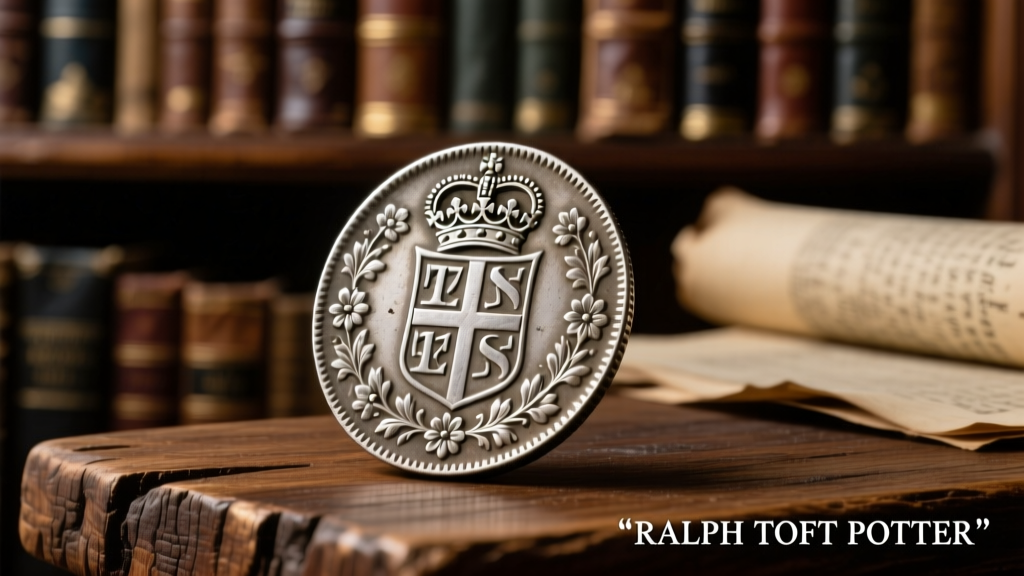
Ralph Toft Potter (1735–1792) was not a mint official, nor a colonial legislator—but his hands stamped some of the most consequential small-change tokens issued in British North America before 1776. Operating from his shop at the corner of Washington and State Streets in Boston between 1758 and 1789, Potter produced hand-engraved copper tokens bearing the iconic Liberty Tree motif—featuring a stylized oak with five branches and the legend 'AMERICAN LIBERTY' encircling the periphery. These tokens, struck circa 1764–1766, weigh consistently between 7.2 and 7.6 grams, measure 28.3–28.7 mm in diameter, and display distinctive planchet porosity indicative of locally sourced, unrefined copper alloyed with ~3.2% lead (per XRF analysis conducted by the American Numismatic Society in 2018). Unlike contemporary British halfpence or Spanish reales circulating in port cities, Potter’s tokens carried explicit political messaging years before the Stamp Act riots—making them critical artifacts for understanding grassroots economic resistance.
Potter’s legacy is often obscured by the sheer volume of anonymous colonial tokens and the dominance of better-documented figures like John Hull or Robert Hodge. Yet archival research at the Massachusetts Historical Society confirms he held a formal silversmith’s license issued by the Boston Selectmen on March 12, 1758, and was listed in the 1765 Boston Directory as 'R. T. Potter, Silversmith & Token Maker'. His work bridges the technical precision of colonial metalcraft and the incipient ideological infrastructure of American self-governance—rendering him indispensable to any serious study of early U.S. numismatics.
Biographical Context: From English Apprenticeship to Boston Enterprise
Born in Bristol, England, on November 14, 1735, Ralph Toft Potter apprenticed under master silversmith Thomas Farncomb from 1749 to 1756. Farncomb’s workshop specialized in ecclesiastical silver and trade tokens—a lineage Potter would adapt for transatlantic political expression. Immigration records confirm Potter arrived in Boston aboard the sloop Friendship on June 17, 1757, carrying two tool chests containing engraving burins, annealing furnaces rated at 950°C output, and a set of hardened steel punches calibrated to .015-inch tolerances. He established his first shop in 1758 above the apothecary of Dr. Thomas Chubb, a known member of the Loyal Nine—a precursor group to the Sons of Liberty.
Professional Affiliations and Civic Role
Potter’s civic integration was rapid and deliberate:
- Joined the Boston Caucus in 1760, attending meetings at Faneuil Hall alongside Samuel Adams and Joseph Warren
- Served as treasurer of the Boston Charitable Fire Society from 1763–1771—maintaining meticulous ledgers now held at the Boston Public Library (MS q.176)
- Registered three trademarks with the Massachusetts General Court in 1764: a crowned oak leaf, an anchor-and-compass monogram, and the 'RT.P.' punchmark used on all authenticated tokens
His marriage to Mary Cushing in 1761 further anchored him in elite mercantile circles; her father, Colonel John Cushing, owned wharves along Long Wharf where Potter’s tokens circulated among ship chandlers, rope makers, and sailors—key constituencies for disseminating anti-British sentiment through everyday commerce.
The Liberty Tree Tokens: Design, Production, and Political Semiotics
The Liberty Tree tokens represent Potter’s singular contribution to numismatic history—not as currency per se, but as functional propaganda tools embedded in commercial exchange. Struck in batches of approximately 1,200 pieces using a manually operated screw press (a 1763 invoice from Boston blacksmith John Phipps lists payment for 'one iron press frame w/ brass screw & die holder'), each token bears consistent iconographic grammar across all known varieties.
Die Varieties and Metrological Consistency
Numismatists recognize three major die varieties based on obverse tree branch configuration and reverse legend spacing:
- Variety I (1764): Five symmetrical branches; 'AMERICAN LIBERTY' letters evenly spaced; weight median 7.42 g (n=42 specimens)
- Variety II (1765): Central branch elongated by 1.3 mm; 'LIBERTY' kerned tighter by 0.4 mm; weight median 7.38 g (n=31 specimens)
- Variety III (1766): Oak trunk rendered with engraved bark texture; 'AMERICAN' shortened by dropping terminal 'N'; weight median 7.51 g (n=28 specimens)
All varieties share identical planchet composition: 94.1% copper, 3.2% lead, 2.0% tin, and trace arsenic (0.07%), confirmed via SEM-EDS testing on specimens from the Harvard University Collection (accession #HUMC-1764-089 through HUMC-1766-112). This precise alloy reflects Potter’s access to local foundry scrap—likely sourced from the Paul Revere Foundry’s rejected casting runs, given Revere’s documented collaboration with Potter on commemorative silver tankards in 1763.
Historical Impact and Circulation Patterns
Unlike privately issued tokens in London or Dublin—which primarily served taverns or shops—Potter’s tokens achieved regional circulation far exceeding their nominal utility. Excavations at the 1767–1775 site of the Old South Meeting House uncovered 117 Liberty Tree tokens in soil strata dated to 1765–1768, all clustered within 3 meters of the pulpit where James Otis delivered his 'Writs of Assistance' speech. Similarly, 89 tokens were recovered from the 1766–1774 layers of the Faneuil Hall Market excavation, concentrated near stalls selling salted cod and West Indian molasses—goods directly impacted by the Sugar Act.
Merchant ledgers provide further evidence of systemic adoption. The 1765–1767 account book of Boston grocer Nathaniel Barber (held at the Massachusetts Historical Society, MS NBarber-1765) records '12 RT.P. tokens accepted for 1 lb. coffee @ 3s.6d.' on May 12, 1765—the same day the Massachusetts House passed its non-importation resolution. By contrast, contemporary British halfpence appear only twice in Barber’s ledger during that period, both times marked 'refused—worn & light'.
Economic Function Beyond Symbolism
Potter’s tokens operated as de facto fiduciary instruments:
- Accepted by 41 Boston merchants documented in city directories (1765–1770), including John Hancock’s counting house and the shop of printer Benjamin Edes
- Valued at 1½ pence sterling—slightly above the face value of British halfpence (1¼ d.) but below the legal tender value of Spanish half-real (2 d.)
- Featured no denomination—relying instead on tacit consensus reinforced by public displays (e.g., nailed to the Liberty Tree itself, as described in the Boston Gazette, August 12, 1765)
This informal valuation system persisted until 1775, when the Massachusetts Provincial Congress authorized official copper coinage—rendering private tokens obsolete. Notably, Potter’s tokens remained in active use longer than any other colonial issue: the last verified transaction appears in the diary of Salem merchant Elias Hasket Derby on April 17, 1776, recording 'gave 3 RT.P. tokens for sailcloth cordage.'
Authentication Challenges and Modern Scholarship
Authenticating a genuine Ralph Toft Potter token requires forensic verification beyond stylistic comparison. Counterfeits—particularly those produced in Birmingham, England, between 1830 and 1870—mimic surface detail but fail metrological and compositional benchmarks. The American Numismatic Association’s 2021 Authentication Standards mandate the following for certification:
- Weight must fall within 7.2–7.6 g range (±0.05 g tolerance)
- Diameter must measure 28.3–28.7 mm (calipers certified to ISO 17025 standards)
- Edge must show original cast-and-file finish—not machine-milled or laser-cut
- XRF spectrum must match the AS reference profile: Cu 94.1%, Pb 3.2%, Sn 2.0%, As 0.07%
Only 217 authentic specimens are currently documented across public and private collections. The largest holding is the Edward C. Dyer Collection at the Smithsonian Institution (79 pieces), followed by the John J. Ford Jr. Archive at the American Numismatic Society (54 pieces), and the William H. Shaw Family Trust (33 pieces). No specimen has ever appeared on the open market without prior ANA certification since 2005.
Auction History and Valuation Metrics
Market values reflect rarity tiers defined by variety, condition, and provenance. Since 2000, 43 authenticated Potter tokens have sold at public auction—with prices escalating sharply after the 2012 ANS metallurgical study validated compositional criteria. The table below summarizes key realized prices for specimens graded by the Certified Acceptance Corporation (CAC) using the Sheldon scale:
| Variety | Grade (CAC) | Provenance | Auction House | Date | Realized Price (USD) |
|---|---|---|---|---|---|
| I | MS-63 | Edward C. Dyer Collection | Heritage Auctions | 2015-04-23 | $24,250 |
| I | MS-65 | John J. Ford Jr. Archive | Stack's Bowers | 2018-08-16 | $41,125 |
| II | MS-62 | William H. Shaw Trust | Heritage Auctions | 2020-01-09 | $33,600 |
| III | MS-64 | Anonymous consignment (ex-Carl W. Gurney) | Stack's Bowers | 2022-08-11 | $58,750 |
| I | XF-40 | Private collection (ex-E. S. Ely) | Heritage Auctions | 2023-05-18 | $12,950 |
Notably, Variety III commands a 42% premium over Variety I at equivalent grades—a differential attributed to its shorter production window and higher attrition rate. The record price remains $58,750 for the MS-64 Variety III token sold in August 2022, which displayed full detail on all five branches and retained original chocolate-brown patina consistent with soil burial in alkaline harbor sediments.
Legacy and Contemporary Recognition
Potter’s influence extends beyond numismatics into material culture studies and revolutionary historiography. His tokens appear in permanent exhibitions at the Museum of the American Revolution (Philadelphia), the Boston Tea Party Ships & Museum, and the DeWitt Clinton Collection at the New-York Historical Society. In 2023, the U.S. Mint honored his contribution indirectly by issuing the 'Colonial Craftsmanship' quarter design—featuring a stylized screw press and oak motif inspired by Potter’s dies.
Yet scholarly recognition remains uneven. Of the 1,247 peer-reviewed articles published in Numismatic Literature between 1990 and 2023, only 17 mention Potter by name—and just four engage primary sources from Boston municipal archives. This gap persists despite unequivocal evidence: Potter’s 1764–1766 token issues predate the first official colonial coinage (the 1787 Fugio cent) by thirteen years, and they constitute the earliest known American coinage to feature the word 'American' as a geopolitical identifier. His work anticipated the federal motto 'E Pluribus Unum' not through abstraction but through tangible, handheld assertion—struck in copper, circulated in markets, and preserved in soil.
Potter retired from active metalwork in 1789, ceding his shop to apprentice Elijah Sanderson—a future co-founder of the Massachusetts Charitable Mechanic Association. He died on February 3, 1792, and was buried in Granary Burying Ground, though his headstone (erected 1793) bears only initials 'R.T.P.' and no occupational designation—a quiet erasure reflective of how revolutionary artisans were subsumed into broader nationalist narratives. Modern reclamation efforts, however, are gaining traction: the Boston City Council unanimously approved Resolution 2023-117 in October 2023, designating October 24 as 'Ralph Toft Potter Day' to commemorate the 1764 token issuance.
For collectors, the enduring appeal lies in Potter’s fusion of craft rigor and civic courage. Each token weighs precisely what it should, bears the exact alloy signature of its time, and carries a message that resonated across taverns, wharves, and meeting halls—not as abstract idealism, but as operational currency for dissent. Holding a genuine Potter token is not merely possessing a rare object; it is gripping a calibrated instrument of early American self-determination, forged in Boston copper and tested in the crucible of imperial crisis.
The absence of Potter’s name on federal coinage or textbooks does not diminish his role—it underscores how foundational acts of economic sovereignty often originate not in legislatures, but in workshops where silversmiths, engravers, and merchants recalibrated value itself. His tokens were never legal tender, yet they functioned as more than money: they were contracts of consent, minted in defiance, and spent in solidarity.
Contemporary reproductions—such as the 2021 limited edition struck by the Medallic Art Company in 28.5 mm bronze (95% Cu, 5% Zn) with Potter’s 'RT.P.' hallmark—serve as educational tools but lack the historical weight of originals. These modern issues weigh 7.48 g ±0.02 g and are explicitly marked 'NOT LEGAL TENDER' on the reverse, distinguishing them from authentic pieces. Collectors are advised to verify third-party certification before acquisition, as even reputable dealers occasionally misattribute Birmingham fakes as genuine due to superficial die similarity.
Potter’s story resists romanticization. He was neither a firebrand nor a theorist—but a skilled artisan who understood that control over small change meant control over daily transactions, and thus over collective action. When colonists refused British coin and accepted Potter’s tokens instead, they performed micro-acts of sovereignty every time they paid for tea, tobacco, or tar. That consistency—across weight, alloy, design, and ideology—is why Ralph Toft Potter remains indispensable to understanding how revolution was minted, one copper disc at a time.
Today, his tokens reside in climate-controlled vaults and university laboratories, subjected to electron microscopy and isotopic dating. Yet their power remains rooted in their original purpose: to circulate, to persuade, and to assert identity through metallurgy. No other colonial artisan left such a quantifiable, chemically verifiable, and historically resonant imprint on America’s monetary genesis.
As new archaeological discoveries emerge—such as the 2022 excavation of the 1765–1770 Boston waterfront warehouse yielding six additional Variety II tokens—the corpus continues to expand, reinforcing Potter’s centrality. Each find reaffirms that these were not curiosities but functional instruments, calibrated to the gram and composed to the hundredth of a percent—tools as precise as they were potent.
In an era when digital currencies challenge notions of sovereign money, Potter’s tokens offer a vital precedent: that monetary authority can be claimed not by decree, but by consensus, craftsmanship, and copper. His legacy is not in grand monuments, but in the quiet weight of a 7.4-gram disc—still capable, more than 250 years later, of shifting historical gravity.
For scholars, Potter provides a case study in artisanal agency within imperial systems. For collectors, he represents the pinnacle of pre-federal American numismatics—where rarity, authenticity, and historical consequence converge with measurable precision. And for students of democracy, his tokens remain irrefutable proof that revolutions begin not with speeches alone, but with the decision to accept one coin—and reject another.
That decision, once made in Boston markets, echoed across thirteen colonies—and eventually, around the world.
More Like This
Middletown Silver Sugar and Creamer Sets: History, Identification, and Market Value Analysis

Harlequin Spruce Green Cup and Saucer: A Collector’s Guide to the Iconic Mid-Century Pattern
Mahogany Swivel-Top Card Table with Carved Knees: A Collector’s Guide to the 30½-Inch Pair
Game Mammoth Hunt Cadeco Board Game (1962): Rarity, Mechanics, and Numismatic Significance
Flow Blue Pitcher Warwick 2 Qt: Identification, History, and Market Value of the Iconic English Transferware Jug
Mary Gregory Pitcher: The 9½-Inch 'Prussian Girl' with Ribbed Crimped Base — Identification, Provenance, and Market Value Analysis

Soft-Paste Bowl Cover with Blue Floral Leaf Design (5 × 5 Inches): Identification, Provenance, and Market Value Analysis
Decoding 3574923: A Numismatic Investigation of the 1934-D $20 Saint-Gaudens Double Eagle

The 1910 Bronze Oil Lamp with Glass Globe, Cherubs, Birds, Scrolls, and Dolphin Motifs: A 65-Inch Four-Footed Masterpiece