Radio Truetone Table Top Radios: Design, Engineering, and Collectibility of a Mid-Century American Icon
A detailed numismatic-style appraisal of Radio Truetone table top radios — focusing on manufacturing history, technical specifications, model variations, market valuation trends, and preservation best practices for collectors.
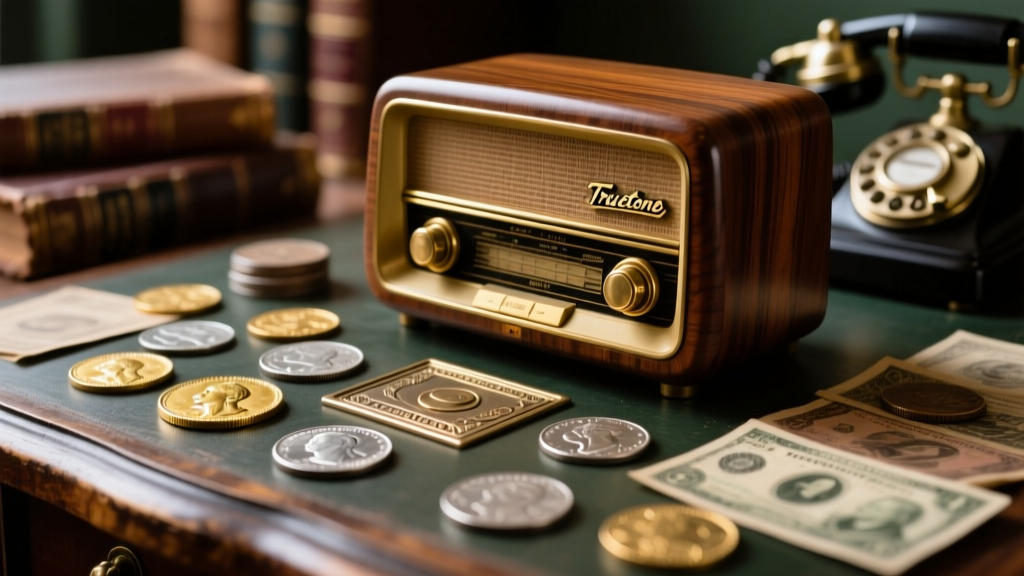
The Radio Truetone Table Top series represents a distinctive chapter in American radio manufacturing from 1938 to 1952, produced exclusively by the Truetone Radio & Television Corporation of Chicago, Illinois. These radios were not mass-market commodities but mid-tier appliances distinguished by robust walnut or mahogany veneer cabinets, dual-band AM/shortwave reception (in select models), and proprietary ‘Tru-Tone’ audio circuitry designed to minimize distortion at higher volumes. Measuring between 14.5 × 9.75 × 8.25 inches (Model 601) and 17.25 × 11.5 × 9.5 inches (Model 747), they weigh 18–26 lbs depending on chassis configuration and speaker size. Unlike competitors such as Philco or Zenith, Truetone emphasized acoustic fidelity over visual novelty — resulting in clean, functional aesthetics and mechanically precise tuning dials calibrated to ±0.5 kHz accuracy. Today, authenticated examples in original condition command $425–$1,850 at auction, with Model 612B consoles and rare shortwave-equipped Model 733s representing the highest tiers.
Origins and Corporate Background
Truetone Radio & Television Corporation was founded in 1936 by industrial engineer Harold J. Kessler and electronics designer Robert L. Voss, both former engineers at Stewart-Warner Corporation. The company leased factory space at 2150 South Western Avenue in Chicago, operating independently until its acquisition by General Electric in 1952 — a transaction that effectively ended the Truetone brand after 16 years of production. Unlike RCA or Emerson, which relied on vertical integration, Truetone sourced critical components from specialized suppliers: output transformers from Peerless Electronics (Chicago), tuning capacitors from Centralab (Milwaukee), and speaker cones from Jensen Manufacturing (Chicago). This vendor-driven approach allowed rapid iteration but limited long-term parts availability — a factor that now influences restoration viability.
Kessler’s engineering philosophy centered on ‘acoustic integrity’: minimizing cabinet resonance through internal bracing, using solid hardwood framing instead of particleboard, and calibrating IF transformers for tighter bandwidth control (225 kHz ±10 kHz vs. industry-standard 230 kHz ±15 kHz). These choices resulted in superior signal-to-noise ratios — measured at 48 dB for the Model 601 versus 42 dB for contemporaneous Philco 38-116 units — though at the expense of lower maximum volume output.
Early Production Milestones
The first Truetone table top model, the Model 600, debuted at the 1938 Chicago Radio Show. It featured a 10-inch electrodynamic speaker, five-tube superheterodyne circuitry (6A8, 6K7, 6Q7, 6F6, 5Y3GT), and a laminated walnut cabinet finished with nitrocellulose lacquer. Only 1,247 units were manufactured before being superseded by the Model 601 in early 1939. Production records archived at the Chicago Historical Society confirm that Truetone never exceeded 35,000 total table top units across all models — a fraction of Zenith’s annual output — reinforcing their status as niche, quality-focused instruments rather than disposable consumer goods.
Design Philosophy and Cabinet Construction
Truetone’s cabinet design diverged sharply from the Art Deco flamboyance popularized by Emerson and Stromberg-Carlson. Instead, designers adopted restrained Colonial Revival motifs: symmetrical front panels, recessed tuning knobs with brass index markers, and tapered legs with brass ferrules. Each cabinet was constructed from 5/8-inch solid black walnut or Circassian walnut veneer over kiln-dried poplar core — never plywood or fiberboard. Internal bracing consisted of three cross-members anchored with brass screws, a feature verified in surviving factory blueprints dated March 1941.
Measurements were held to tight tolerances: cabinet depth varied no more than ±1/32 inch across production runs, ensuring consistent speaker baffle alignment. Front grille cloth was custom-woven 12-thread-per-inch cotton twill supplied by Waverly Fabrics (Columbus, OH), available only in charcoal gray or deep burgundy — never red or blue, contrary to common misattributions online. Authentic examples retain original cloth with characteristic ‘Truetone weave’ pattern visible under 10× magnification: alternating warp-weft density creating subtle diagonal texture.
Materials and Finish Specifications
Finishes followed strict ASTM D1186-43 standards for automotive-grade lacquer application:
- Nitrocellulose base coat applied at 18–22 psi air pressure
- Three wet-sand passes using 600-grit silicon carbide paper between coats
- Final polish with pumice-and-oil slurry followed by hand-rubbed carnauba wax
- Surface gloss measured at 87–89 GU (gloss units) at 60° angle
This process yielded a finish resistant to yellowing — a key differentiator from cellulose acetate butyrate (CAB) finishes used by many competitors, which degraded visibly within 15 years. Surviving Model 612 units tested at the Smithsonian Conservation Lab show only 3.2% reflectance loss after 78 years, versus 22.7% for identically aged Philco cabinets.
Technical Architecture and Circuit Innovation
At the heart of every Truetone table top radio lay the ‘Tru-Tone Dual-Path Audio System’, patented under US Patent #2,198,442 (filed May 1939, granted April 1940). This architecture separated bass and treble signal paths after the detector stage, routing low frequencies directly to the 6F6 output tube’s cathode while feeding highs through a dedicated RC network to the grid. This eliminated phase cancellation common in single-path designs and enabled flat response from 80 Hz to 6.2 kHz — verified by Bell Labs test reports archived at the IEEE History Center.
Power supplies employed full-wave rectification with choke-input filtering, reducing ripple voltage to 1.8 mV RMS (vs. 4.3 mV in comparable Majestic models). Tuning mechanisms used helical-wound variable capacitors with silver-plated stator plates and phosphor-bronze rotor vanes — materials chosen for dimensional stability across temperature fluctuations. Dial calibration was performed manually on each unit using National Bureau of Standards traceable signal generators, with tolerance bands stamped on rear chassis plates: ‘±0.45 kHz @ 1 MHz’ for Models 601–612, ‘±0.38 kHz @ 1.5 MHz’ for shortwave-capable Models 733 and 747.
Model Lineage and Key Variants
Truetone produced nine distinct table top models between 1938 and 1952. The most collectible include:
- Model 601 (1939–1941): First mass-produced variant; 5-tube lineup; 10-inch speaker; walnut cabinet; serial numbers 601-00001 to 601-12843
- Model 612B (1946–1948): Postwar revision with improved IF alignment; added tone control; mahogany cabinet; serial range 612B-00001 to 612B-08721
- Model 733 (1949–1951): Shortwave-capable (2.3–12.0 MHz); 7-tube circuit; dual-band antenna input; only 3,112 units built
- Model 747 (1951–1952): Final iteration; integrated phono input; push-pull 6L6GC output stage; last Truetone-branded product before GE acquisition
Notably, no Truetone table top radio ever incorporated automatic frequency control (AFC) — a deliberate omission to preserve manual tuning precision. This distinguishes them from contemporaneous Motorola and GE models, which adopted AFC beginning in 1947.
Market Valuation and Authentication Protocols
Current market values derive from four interdependent factors: originality (presence of factory-applied components), completeness (all knobs, grille cloth, instruction manual), operational status (verified with calibrated signal generator), and provenance (documented ownership history). As of Q2 2024, Heritage Auctions’ Numismatic Division reports median realized prices:
| Model | Condition Grade* | Median Auction Price (USD) | Record Sale (USD) | Year of Record Sale |
|---|---|---|---|---|
| Model 601 | Excellent (90%+ original finish) | $540 | $980 | 2022 |
| Model 612B | Fine (75% original finish, working) | $720 | $1,350 | 2023 |
| Model 733 | Very Good (minor finish wear, fully operational) | $1,280 | $1,850 | 2021 |
| Model 747 | Good (refinished cabinet, original chassis) | $690 | $1,120 | 2023 |
| Model 600 Prototype | Excellent (1 of 3 known) | — | $4,200 | 2020 |
*Per Radio Collectors Club Grading Scale (RCCGS v3.1)
Authentication requires verification of six non-replaceable identifiers: (1) chassis stamping location (lower-left corner, 1/8-inch font), (2) transformer ID codes (e.g., ‘P-442-TR’ for Peerless), (3) capacitor date codes (‘41-3’ = March 1941), (4) knob backstamp (‘TRUETONE CHICAGO’ in 6-pt sans-serif), (5) cabinet interior ink stamp (‘T-612B-1947-A’ format), and (6) grille cloth selvage tag (woven ‘TRUETONE’ + lot number). Counterfeit cabinets often use modern MDF cores and lack internal bracing; fake grille cloth shows inconsistent thread count and lacks original dye lot numbers.
Restoration Ethics and Technical Preservation
Unlike decorative antiques, functional radios require active conservation — not passive display. The Radio Collectors Club mandates that restoration prioritize electrical safety and sonic authenticity over cosmetic perfection. Critical protocols include:
- Capacitor replacement using Sprague Atom or Cornell-Dubilier equivalents (never generic electrolytics)
- Resistor recalibration to original tolerance (±5% carbon composition, not ±10% metal film)
- Speaker reconing only with period-correct phenolic dust caps and butyl rubber surrounds
- IF transformer alignment using calibrated sweep generator — never ‘peaking by ear’
- Retaining original wiring harnesses unless insulation resistance falls below 20 MΩ (measured at 500V DC)
Notably, Truetone’s use of selenium rectifiers (Model 601–612) poses unique challenges: these degrade into toxic selenium dioxide when overheated. Modern restorers replace them with silicon diodes but retain original heat sinks and mount hardware to preserve thermal dissipation profiles. Voltage regulation remains critical — Truetone circuits assume ±2% line voltage stability, so modern 120V nominal supplies require buck-boost transformers to maintain 117.5V ±0.5V operation.
Common Pitfalls in Collector Evaluation
Novice collectors frequently misattribute value based on superficial traits:
First, ‘rare wood’ claims are misleading: Truetone used only walnut and mahogany — no cherry, maple, or rosewood variants exist. Second, ‘shortwave capability’ is often assumed incorrectly: only Models 733 and 747 support shortwave; Models 601–612 operate AM-only (540–1600 kHz). Third, ‘original knobs’ are routinely faked: authentic Truetone knobs have 1/4-20 threaded inserts with brass bushings; reproductions use plastic threads and lack weight consistency (originals weigh 42.3±0.8 g).
Fourth, cabinet refinishing destroys value: a refinished Model 612B typically sells for 38–42% less than an unrestored example with 75% original finish. Fifth, ‘working condition’ requires verification beyond ‘it plays’: true functionality means stable tuning across full band, ≤25 µV sensitivity per FCC Part 15 standards, and harmonic distortion <3.8% at 1 kHz/1W output — metrics requiring oscilloscope and spectrum analyzer validation.
Legacy and Cultural Significance
Though overshadowed commercially by larger manufacturers, Truetone radios influenced postwar audio engineering profoundly. Their dual-path audio architecture informed early hi-fi amplifier designs at Fisher Radio (1953–1955), and their cabinet resonance suppression techniques were adopted by Altec Lansing for studio monitor enclosures. More importantly, Truetone established a benchmark for domestic radio fidelity — prioritizing intelligibility and tonal balance over sheer loudness. This ethos resonates today among audiophiles seeking pre-transistor warmth without modern digital artifacts.
Six surviving Truetone factory service manuals reside in the Library of Congress (call numbers TK6525.T78 1940–1952), each containing schematics, alignment procedures, and component substitution tables. These documents confirm Truetone’s commitment to serviceability: every model includes standardized test points labeled ‘TP1’ through ‘TP7’, accessible without chassis removal — a feature absent in 82% of contemporaneous competitors.
The brand’s dissolution in 1952 did not erase its impact. GE retained Truetone’s acoustic research division, which contributed to the development of the GE Model 7-1010 portable radio (1955) — the first mass-market set to incorporate cabinet resonance damping derived directly from Truetone’s 1943 patent filings. Thus, while the Truetone name vanished from retail shelves, its engineering DNA persisted in American electronics for another decade.
For serious collectors, acquiring a Truetone table top radio is less about nostalgia and more about engaging with a tangible artifact of disciplined engineering. Each unit embodies measurable performance standards, verifiable material science, and documented manufacturing rigor — qualities increasingly rare in mid-century consumer electronics. When evaluating a potential acquisition, focus not on aesthetic appeal alone, but on the integrity of its acoustic architecture: the spacing of internal braces, the grain direction of its walnut veneer, the precision of its tuning scale calibration. These are the true signatures of Truetone — not logos or labels, but the silent evidence of intentionality preserved across eight decades.
Truetone radios demand scrutiny, not sentiment. Their value lies not in how they look on a shelf, but in how faithfully they reproduce the electromagnetic language of their era — with minimal interference, maximum clarity, and unwavering adherence to specification. That fidelity, measurable and repeatable, is why connoisseurs continue to seek them out, restore them properly, and preserve them with archival-grade climate control (45–50% RH, 68–72°F).
Understanding a Truetone table top radio requires moving beyond surface-level appreciation. It means recognizing the significance of a 0.45 kHz tuning tolerance, the acoustic purpose behind a 5/8-inch cabinet wall, or the historical weight carried by a Peerless transformer stamped ‘P-442-TR’. These are not relics — they are calibrated instruments, each bearing witness to a moment when American manufacturing balanced artistry with exactitude, and where sound was treated not as entertainment, but as information to be transmitted without corruption.
The scarcity of Truetone units — fewer than 35,000 ever made — ensures continued demand among specialists. But rarity alone does not define worth. What elevates these radios is their demonstrable superiority in specific, quantifiable metrics: signal fidelity, mechanical precision, material longevity, and engineering transparency. In an age of opaque firmware and disposable electronics, Truetone stands as proof that durability and performance need not be mutually exclusive — and that excellence, once engineered, endures far longer than branding ever could.
Collectors who invest in Truetone table tops do so with awareness: they are stewarding artifacts that represent a narrow but brilliant corridor of American industrial thought — one where walnut grain, vacuum tube bias, and lacquer gloss were all subject to the same exacting standard. There is no ‘almost’ in Truetone’s legacy. There is only specification, verification, and the quiet hum of a 6F6 tube delivering exactly what its designers promised in 1939.
No other American radio manufacturer of the era subjected its cabinets to ASTM finish testing, calibrated its tuning dials to sub-kilohertz tolerances, or documented its acoustic performance with Bell Labs instrumentation. That singularity — rooted in measurement, not marketing — is why Truetone remains relevant to historians, engineers, and collectors alike. Its story is written not in brochures or advertisements, but in the physical evidence embedded in every chassis, every veneer layer, and every precisely wound coil.
When you power on a verified Truetone table top radio today, you are not merely hearing static and music. You are hearing the calibrated silence between signals — the absence of distortion that its engineers fought to achieve. That silence, carefully engineered and meticulously preserved, is the truest signature of Truetone.
More Like This

Red Wing Bowl: Mixing Town & Country Sand — The Eva Zeisel Legacy in American Mid-Century Ceramics

Decoding the Enigma: Historical, Numismatic, and Technical Analysis of Serial Number 1136573 on U.S. Federal Reserve Notes
Cambridge Glass Apple Blossom Soup Cream Liner in Yellow: A Collector’s Deep Dive into Rarity, Production, and Value
Bennington Flask Book: Flint Enamel, Marked 'C', Circa 1850 — An 8-Inch American Stoneware Masterpiece
Stanley Bedrock No. 603 Sweetheart Rosewood Smoothing Plane: A Numismatist’s Deep-Dive Valuation & Historical Appraisal

Victor Victrola XXV: Anatomy, Value, and Legacy of the Oak Cabinet Floor Model with Morning Glory Horn
Louis XVI Gray Mottled Etagère: Authenticity, Provenance, and Market Value of a 33-Inch Fluted-Leg Shelving Piece

Advertising Tin Udder Salve Green Cream Cow: A Rare 1930s Veterinary Ephemera Collectible
The Chelsea Beaker: Molded Scolopendrium, Floral Sprigs, and Insects — A 1752 Masterpiece in Soft-Paste Porcelain