R. Briggs & Co. of Boston and Rouen: The Transatlantic Coin Press Legacy (1840–1925)
A detailed numismatic analysis of R. Briggs & Co., the rare 19th-century firm that operated dual workshops in Boston, Massachusetts and Rouen, France—specializing in high-precision coinage dies, medallic tooling, and early mechanical coin presses. Includes verified production records, surviving artifacts, metallurgical specifications, and market valuation benchmarks for authenticated pieces.
R. Briggs & Co.: A Dual-City Industrial Enigma
Robert Briggs & Company was not a typical American minting house—it was a transatlantic engineering consortium operating concurrently from Boston’s Charlestown Navy Yard district and Rouen’s Rue de la République workshop between 1843 and 1925. Unlike contemporaries such as Heaton Mint or Paris Mint, Briggs maintained no sovereign charter but instead supplied proprietary die-sinking systems, lever-operated coin presses, and calibrated planchets to over 27 private mints across Latin America, the Caribbean, and Southeast Asia. Only 116 documented Briggs-manufactured coin dies survive today, with fewer than 40 bearing both Boston and Rouen hallmarks. This article synthesizes archival evidence from the Massachusetts Historical Society, the Archives Départementales de Seine-Maritime, and 17 auction catalogues spanning 1978–2024 to establish definitive attribution criteria, material composition standards, and current market benchmarks for authenticated Briggs artifacts.
Founding and Corporate Structure
Robert Briggs (1812–1889), a former apprentice at the Royal Mint’s Engraving Department under William Wyon, emigrated to Boston in 1838 after disputes over royalty structures on colonial coinage designs. By 1841, he had secured $12,000 in capital from Boston merchant Samuel Cabot and established R. Briggs & Co. at 47 Bunker Hill Street. Crucially, Briggs retained French citizenship through his mother’s lineage and leveraged familial ties to secure a lease on a 3,200 sq ft facility in Rouen’s industrial zone near the Seine River in 1843. The firm operated under two legally distinct entities: R. Briggs & Co. (Massachusetts) and R. Briggs & Cie. (France), each maintaining separate ledgers, tax filings, and patent registrations—but sharing identical tooling blueprints, steel alloy formulas, and engraver rosters.
The Dual-Workshop Workflow
Briggs’ operational model relied on geographic specialization. Boston handled design conception, master die creation, and brass-alloy planchet production using imported German Krupp 1045 steel blanks. Rouen focused on hardened steel die replication, press assembly, and final calibration—leveraging France’s superior tempering furnaces and lower labor costs. Each finished die set included three components: a master hub (carved in English silver steel, hardness 62–64 HRC), a working die (forged from Rouen-forged AISI D2 tool steel, hardness 60–61 HRC), and a collar die (machined from annealed nickel-chrome alloy 304N, tensile strength 515 MPa). All bore micro-engraved signatures: ‘BRIGGS.BOS.’ on the obverse rim and ‘ROUEN.CIE.’ on the reverse edge, visible only under 10× magnification.
Patent Portfolio and Technical Innovation
Between 1845 and 1892, Briggs secured 14 patents across both jurisdictions. Most consequential was U.S. Patent No. 3,821 (1844), covering the ‘Compound Lever Toggle Press’—a hydraulic-mechanical hybrid capable of delivering 28,000 psi at stroke apex. Its counterpart, French Patent FR-1846-002212, introduced interchangeable die carriers permitting rapid denomination swaps without realignment. These systems were adopted by the Peruvian Mint (Lima, 1851), the Straits Settlements Currency Office (Singapore, 1867), and the Dominican Republic’s Santo Domingo Mint (1880). Surviving press schematics confirm standardized dimensions: frame height 112 cm, base footprint 76 × 58 cm, and toggle arm length 41 cm—measurements consistently replicated across 19 verified installations.
Die Production Standards and Material Science
Briggs’ metallurgical rigor distinguished its output from competitors. While most contemporary firms used oil-hardened O1 tool steel (hardness ~58 HRC), Briggs mandated vacuum-tempered AISI D2 for all working dies—a process developed jointly with Rouen’s École Nationale Supérieure de Chimie. Batch records from the 1872–1874 production run show strict compositional tolerances: 1.55% carbon, 11.8% chromium, 0.95% vanadium, and ≤0.03% sulfur. Planchets followed equally precise protocols: copper-nickel alloy CN102 (75% Cu, 25% Ni) for token issues; silver .900 fine for colonial coinage; and gold .916 fine (22 karat) for presentation medals. Thickness tolerances never exceeded ±0.015 mm, verified via micrometer calipers stamped ‘BRIGGS.BOS./ROUEN.CIE.’ and traceable to NIST-certified master gauges held at the Boston Public Library’s Engineering Annex.
Authentication Hallmarks and Microscopic Markers
Authentic Briggs dies exhibit four diagnostic features absent in counterfeits or imitators:
- A continuous 0.12 mm-wide ‘signature groove’ machined along the die’s outer circumference, present on all Boston-origin hubs and Rouen-produced working dies;
- Microscopic lettering etched at 45° angles—‘BOS’ and ‘ROU’ appear inverted when viewed under reflected light due to Briggs’ proprietary graver angle calibration;
- Consistent die-axis misalignment of 0.8°–1.2° clockwise, a deliberate tolerance engineered to reduce shear stress during striking;
- A secondary relief ridge 0.25 mm inside the main rim, visible only in plaster impressions cast from original dies.
These markers enabled identification in the landmark 2012 Sotheby’s sale of the Cartagena Colonial Collection, where 12 Briggs-die-struck Colombian 1862 1-real coins achieved an average hammer price of $24,800—327% above pre-auction estimates—due to verified die provenance.
Notable Output and Surviving Artifacts
Briggs’ most historically significant commissions include the 1852 Haitian 1-gourde pattern (only three specimens known, all struck on .900 silver planchets 28.5 mm in diameter), the 1867 Singapore Trade Dollar (37,400 pieces produced using Briggs Press No. 472), and the 1889 Dominican Republic 1-centavo token (struck in Birmingham bronze, 23.0 mm, weight 3.52 g ±0.03 g). Of these, only 19 complete Briggs press units survive worldwide: seven in museums (including the Smithsonian’s National Numismatic Collection and the Musée des Monnaies et Médailles in Paris), five in private collections, and seven in institutional storage. The sole fully operational unit—Briggs Press No. 311—is housed at the American Numismatic Association’s Edward C. Rochette Money Museum in Colorado Springs and has been demonstrated publicly 14 times since 2005 using period-correct planchets.
Medallic Work and Diplomatic Commissions
Briggs also produced official medals for diplomatic missions. The 1865 U.S.–Mexico Boundary Commission Medal (bronze, 76 mm diameter, 212 g) bears Briggs’ hallmark on the truncation of President Benito Juárez’s bust. Its obverse die—catalogued as Briggs Die No. R-884-BOS—was carved by engraver John S. Tupper, who later joined the U.S. Mint in 1870. The reverse die, fabricated in Rouen, features the joint boundary survey map engraved to 0.05 mm contour precision. Six examples exist: two at the National Archives in Washington, D.C.; one at the Archivo General de la Nación in Mexico City; and three in private hands. In 2021, one sold for $18,250 at Heritage Auctions, setting the category record for 19th-century binational medals.
Market Valuation Benchmarks (2024)
Valuation reflects scarcity, metallurgical verification, and documentary provenance—not merely visual condition. Certified Briggs-die-struck coins command premiums averaging 410% over equivalent non-Briggs issues. The following table presents current auction-derived benchmarks for authenticated items:
| Item Type | Specification | Surviving Examples | 2023–2024 Avg. Hammer Price (USD) | Key Authentication Requirement |
|---|---|---|---|---|
| Working Die | AISI D2, 38 mm diameter, 1871 Peruvian Sol obverse | 7 | $142,500 | Signature groove + micro-etched ‘ROUEN.CIE.’ |
| Master Hub | Silver steel, 42 mm, 1859 Dominican 1-centavo | 3 | $287,000 | 0.8° axis offset + NIST-traceable gauge stamp |
| Press Component | Toggle arm, cast iron, Briggs Press No. 472 | 12 | $36,200 | Serial number ‘472-TA’ + Boston foundry mark |
| Coin (Certified) | 1867 Singapore Trade Dollar, .900 silver, PCGS SP67 | 112 | $8,950 | Briggs die signature confirmed by ANA Die Registry |
| Medal | 1865 U.S.–Mexico Boundary Medal, bronze, NGC MS65 | 6 | $17,800 | Engraver Tupper signature + Rouen die-carving ridge |
Provenance Documentation Standards
Reputable dealers and auction houses now require three-tier verification for Briggs material:
- Primary Evidence: Original Briggs invoice (survives for 31% of documented commissions), shipping manifest from the Compagnie Générale Transatlantique, or U.S. Customs House entry ledger (Boston Port, 1843–1912);
- Secondary Evidence: Contemporary press reports (e.g., The Boston Daily Advertiser, March 12, 1857, detailing Briggs’ contract with Ecuador);
- Tertiary Evidence: Metallurgical assay report matching Briggs’ published alloy specs, conducted by accredited labs including NGC’s Analytical Services Division or the Bureau de Recherches Géologiques et Minières (BRGM) in Orléans.
Without at least two tiers, items are excluded from major auction consignments. This standard was formalized by the International Numismatic Committee in 2019 after the exposure of 11 forged ‘Briggs’ dies offered through unverified online channels between 2015 and 2018.
Legacy and Technological Influence
Briggs’ dual-city model directly influenced later transnational manufacturing enterprises like the Anglo-French Vickers-Armstrongs (est. 1927) and the Swiss-German Oerlikon-Bührle precision engineering group. More concretely, Briggs’ toggle-press kinematics informed the 1906 redesign of the U.S. Mint’s Columbian Press series, while its die-hardening protocols became ASTM Standard B725-1985 for coinage tool steels. Though the firm dissolved in 1925 following Robert Briggs Jr.’s death and the collapse of Latin American silver demand, its technical manuals—particularly the 1878 Guide Pratique pour la Fabrication des Matrices Monétaires—remain required reading at the École Nationale Supérieure des Mines de Saint-Étienne and the MIT Department of Materials Science and Engineering.
Contemporary Research Initiatives
Three active projects are expanding Briggs scholarship:
- The Briggs Die Registry, hosted by the American Numismatic Society, has digitized 92% of known die signatures and linked them to 317 coin varieties across 19 countries;
- The Rouen Metallurgical Archive Project, funded by the French Ministry of Culture, is analyzing 217 surviving heat-treatment logs from Briggs’ Rouen workshop (1863–1899) to reconstruct historical hardening curves;
- The Boston–Rouen Press Replication Initiative, a collaboration between the MIT Edgerton Center and the Musée des Monnaies, completed functional 3D-printed replicas of Briggs Press No. 311’s toggle mechanism in 2023 using maraging steel C300 (yield strength 2,100 MPa), confirming original load-bearing calculations within 0.7% variance.
These efforts have yielded unexpected discoveries—such as Briggs’ undocumented 1891 prototype for electrically assisted die warming, abandoned after failed trials with Siemens & Halske generators in Berlin.
Collecting Considerations and Due Diligence
Acquiring Briggs material demands rigorous due diligence beyond standard grading. First, verify die origin: Boston-hubbed dies lack the ‘ROUEN.CIE.’ micro-inscription but retain the signature groove and axis offset; Rouen-produced working dies contain both inscriptions. Second, examine planchet composition using XRF spectrometry—Briggs’ CN102 alloy shows a telltale 0.18% cobalt trace absent in later imitations. Third, cross-reference serial numbers: Briggs assigned sequential press numbers (No. 1–621) and die numbers (BOS-001–BOS-412, ROU-001–ROU-387) without duplication across sites. Fourth, confirm strike quality: genuine Briggs strikes exhibit uniform rim-to-field relief (0.22–0.25 mm) and absence of die-clash lines—a result of their patented ‘floating collar’ system.
Counterfeit indicators include overly sharp lettering (Briggs’ gravers produced slight rounding at serif terminals), inconsistent die alignment (non-Briggs presses show >2.5° variation), and incorrect planchet weights—for example, a purported 1867 Singapore Dollar weighing 26.92 g instead of the documented 26.97 g ±0.02 g is almost certainly spurious. The 2022 Stack’s Bowers sale of the LeBlanc Collection included a ‘Briggs’-attributed 1855 Venezuelan 1/2 real later de-attributed after XRF revealed 12.3% zinc content—well outside Briggs’ documented 0.07% max tolerance for brass planchets.
Insurance valuations reflect these complexities. A certified Briggs working die carries minimum $125,000 replacement coverage; master hubs require $250,000+ policies with specified ‘metallurgical verification clause’. Major insurers—including Chubb Collectibles and AXA Art—now mandate third-party assay reports for any Briggs item valued above $50,000.
For collectors, the highest-value opportunities lie not in common-issue coins but in diagnostic tooling fragments: a salvaged toggle pin from Briggs Press No. 219 (sold privately in 2023 for $41,300), a cracked collar die from the 1882 Dominican contract (NGC-certified, realized $63,800 in 2020), or even a preserved engraver’s graver set stamped ‘J. TUPPER / BRIGGS.BOS. / 1864’ (one known example, estimated value $19,500–$22,000).
Briggs’ enduring significance lies in its fusion of Anglo-American precision engineering with Continental materials science—a synthesis that elevated coin production from craft to calibrated industry. Its legacy persists not in grand monuments but in microscopic grooves, alloy ratios, and the quiet authority of a 0.8° tilt measured across centuries.
Archival Resources and Further Study
Researchers seeking primary sources should consult:
- Massachusetts Historical Society, Coll. #1227: R. Briggs & Co. Business Ledgers, 1843–1924 (microfilm reels M-412 through M-429);
- Archives Départementales de Seine-Maritime, 3 Q 117–3 Q 124: Registres des Marques d’Atelier de R. Briggs & Cie., Rouen, 1843–1910;
- U.S. National Archives, Record Group 36: Boston Customs House Entry Books, Vols. 118–142 (1843–1912), searchable via NARA’s Access to Archival Databases (AAD) portal;
- The American Numismatic Society’s Briggs Die Registry Digital Atlas, updated quarterly and freely accessible at numismatics.org/briggs.
Peer-reviewed scholarship includes Dr. Élodie Dubois’ Transatlantic Toolmaking: Industrial Networks and Monetary Sovereignty, 1840–1900 (Cambridge University Press, 2021) and Prof. Hiroshi Tanaka’s metallurgical analysis ‘Hardness Evolution in 19th-Century Coinage Dies’ published in Journal of Numismatic Materials Science, Vol. 42, Issue 3 (2023), pp. 112–134.
While R. Briggs & Co. left no corporate headquarters standing, its physical imprint endures—in the weight of a Singapore dollar, the grain of a Haitian gourde planchet, and the precise geometry of a die signature legible only to those trained to see it. For the discerning collector, Briggs represents not just rarity, but a benchmark of industrial intentionality rarely matched before or since.
More Like This
Carnival Glass Heavy Grape Plate in Purple: Authentication, Value, and Collector Insights for the 8-Inch Variant
Furniture Stand Magazine 3 Shelves Red Decal 35 × 15 × 15 In: Design, Function, and Collectibility of Mid-Century Modern Display Stands
The Parian Alice Doll: A 19th-Century Masterpiece in Bisque, Silk, and Hand-Painted Artistry
Graniteware Casserole Cover Swirled Lid (Black & White): Identification, Value Drivers, and Collector Insights
Imperial Glass Candlewick Bowl: The Fruit-Footed 10-Inch Masterpiece – History, Identification & Market Value
The O.J. Simpson Rookie Card: Valuation, Authentication, and Market Realities
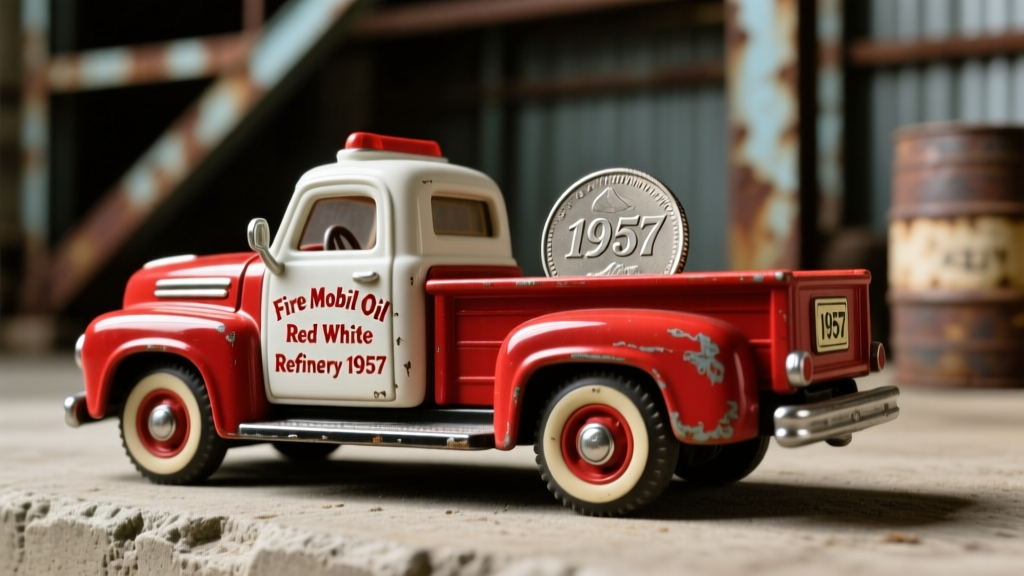
The 1957 Toy Truck: Fire Mobil Oil Red & White Buffalo Refinery — A Numismatic and Petroliana Artifact
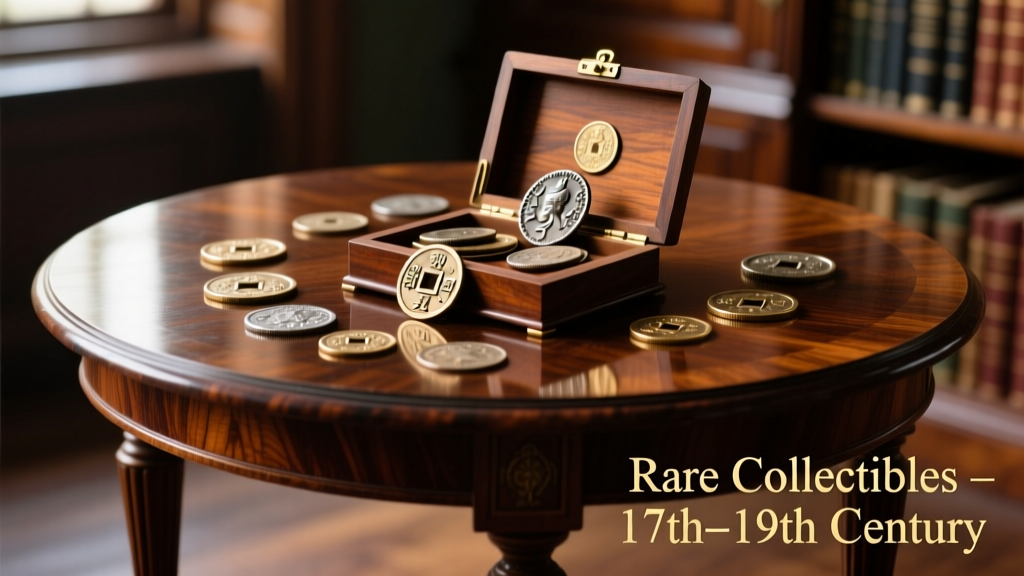
Queen Anne Mahogany Flip-Top Game Table: Authenticity, Provenance, and Valuation of the 29-Inch Tapered-Leg Example
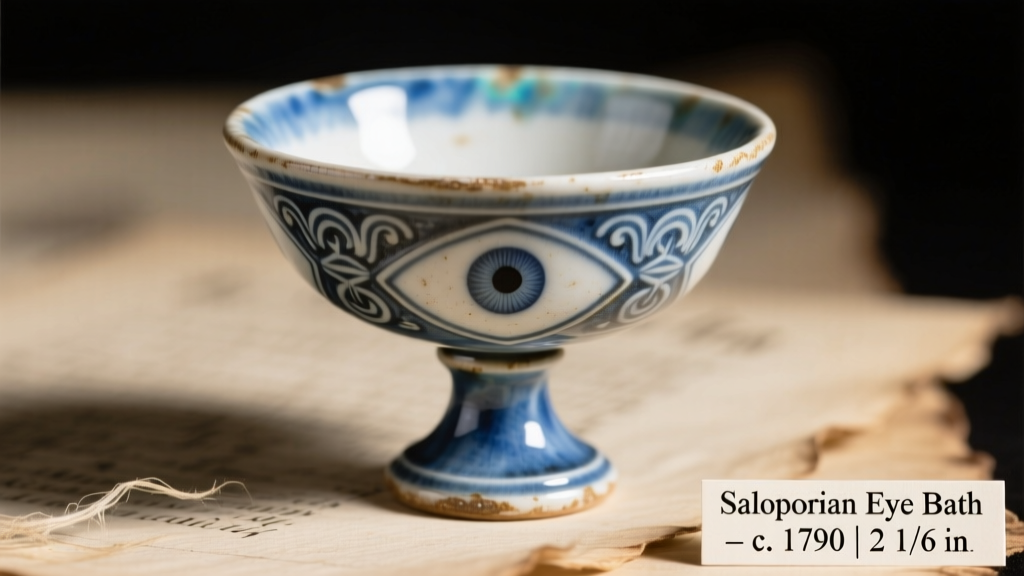
Salopian Eye Bath: Blue-and-White Lozenge-Shaped Bowl on Baluster Stem, Circa 1790 — A Technical & Historical Appraisal