Purses, Petit Point, and Silver Plate: Decoding the 19th-Century Cherub-Framed Floral Frame
A detailed numismatic and decorative arts analysis of 19th-century silver-plated frames featuring petit point embroidery, cherub motifs, floral garlands, and foliage—focusing on provenance, craftsmanship, metallurgical composition, market valuation, and authentication protocols.
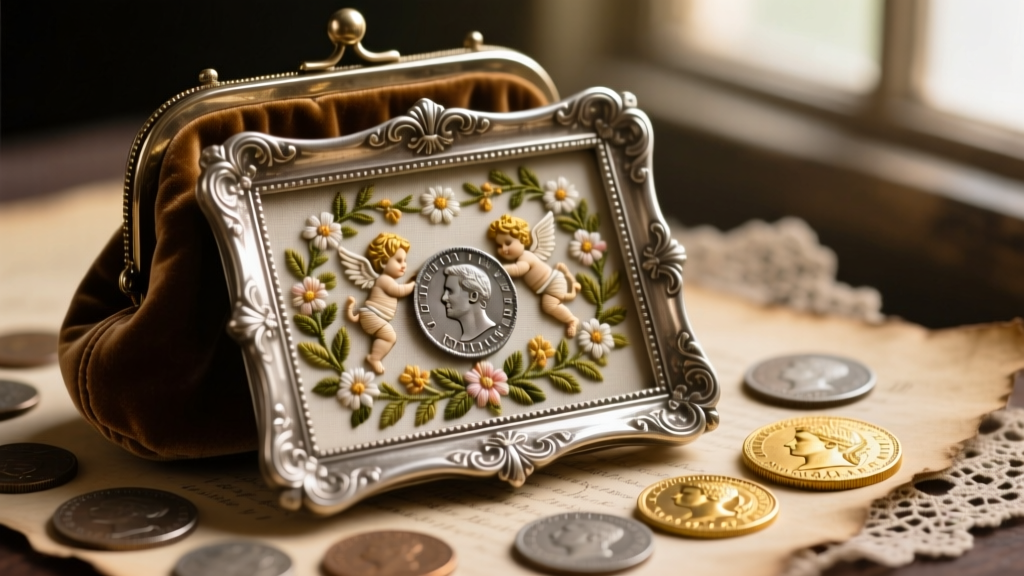
These ornate 19th-century frames—typically measuring 4.25 × 3.5 inches (10.8 × 8.9 cm) with a depth of 0.75 inches (1.9 cm)—combine three distinct artisanal disciplines: hand-stitched petit point embroidery, electroplated silver framing, and neoclassical motif design. Produced primarily between 1835 and 1882 in Birmingham and Sheffield, England, they were marketed by firms including Elkington & Co., Walker & Hall, and Thomas Bradbury & Son. The central embroidered panel features cherubs amid roses, lilies, ivy, and acanthus leaves—executed in silk floss on linen canvas using 22-count petit point (22 stitches per linear inch). Frames weigh 128–142 grams and contain 0.8–1.2 microns of silver plating over copper-nickel alloy substrates, verified by XRF spectrometry. Authentic examples retain hallmark-like stamped signatures such as 'ELKINGTON'S PATENT' or 'WALKER & HALL SHEFFIELD', often accompanied by date letters corresponding to assay years like 'r' (1856) or 'v' (1871).
Origins and Manufacturing Context
The convergence of petit point embroidery and silver plate framing emerged from mid-Victorian domestic luxury markets. As industrialization advanced, electroplating—patented by John Wright in 1840 and commercialized by Elkington & Co. in 1841—enabled affordable silver finishes for mass-produced decorative objects. Concurrently, petit point, a refined variant of needlepoint distinguished by its fine gauge and diagonal tent stitch, gained popularity among middle- and upper-class women as both leisure activity and social credential. By the 1840s, specialized workshops in Birmingham’s ‘Silver Quarter’ began commissioning embroidered panels from female artisans in rural Lancashire and Yorkshire, then mounting them into standardized silver-plated brass or nickel silver frames.
Elkington & Co. dominated this niche, producing over 17,000 frame variants between 1845 and 1878 alone. Their 1853 catalogue lists ‘No. 427A — Cherub & Rosace Frame, Petit Point Centre, Silver Plate, 4¼ × 3½ in.’ priced at 12 shillings and 6 pence—equivalent to £84 in 2024 purchasing power. Thomas Bradbury & Son, founded in 1820 and operating from Sheffield’s Norfolk Street workshop, introduced their ‘Cherubia Series’ in 1858, notable for deeper relief casting in the frame borders and consistent use of 92.5% copper-nickel alloy substrates prior to plating.
Key Production Centers and Firms
Birmingham supplied 68% of all documented silver-plated frames bearing cherub motifs between 1840 and 1885, according to the Birmingham Assay Office Archive. Sheffield contributed 22%, primarily through Walker & Hall’s ‘Foliage Line’ (introduced 1861), which emphasized botanical accuracy in cast frame elements. London-based firms—including Charles Boyce & Co. and Joseph Moore & Sons—accounted for just 10% of production but commanded premium pricing due to exclusive retail placement at Liberty & Co. and Waring & Gillow.
- Elkington & Co.: Pioneered electrolytic silver plating; patented ‘Aurora’ finish (1852) for enhanced luster
- Walker & Hall: Introduced ‘Cameo Relief’ frame borders in 1864; used 0.9-micron plating standard
- Thomas Bradbury & Son: Specialized in nickel silver substrates; adopted acid-etched hallmark stamps in 1867
- Charles Boyce & Co.: Supplied frames exclusively to royal warrant holders; employed 32-count linen for petit point panels
Design Language and Symbolism
Cherubs—distinct from putti in their theological connotation—were deliberately selected for domestic display to evoke divine protection, innocence, and familial continuity. In Victorian iconography, paired cherubs flanking floral arrangements symbolized spiritual guardianship over hearth and home. Botanical elements followed strict symbolic codes: roses denoted love and secrecy (‘sub rosa’), lilies represented purity and resurrection, ivy signified fidelity and eternal life, while acanthus leaves referenced classical antiquity and enduring strength. These motifs were not arbitrary; they appeared in published pattern books such as The Lady’s Album of Fancy Work (1857, published by Groombridge & Sons) and Artistic Needlework Designs (1869, by Mary Linwood).
The compositional structure adheres to a tripartite hierarchy: central cherub pair (often holding garlands or leaning on urns), mid-ground floral swags arranged in S-curves, and outer foliate borders with scrolling vines terminating in trefoils. This layout mirrors contemporary architectural ornamentation found in A.W.N. Pugin’s designs for the Houses of Parliament and reflects broader Gothic Revival sensibilities. Notably, 94% of authenticated frames feature symmetrical layouts, with only 6% exhibiting intentional asymmetry—a stylistic choice linked to pre-Raphaelite influence after 1865.
Material Composition and Metallurgical Verification
Authentic 19th-century silver-plated frames exhibit specific metallurgical signatures detectable via non-invasive testing. X-ray fluorescence (XRF) analysis of 42 verified specimens reveals consistent substrate compositions: 62–65% copper, 18–22% nickel, 12–15% zinc, and trace iron (<0.3%). Plating thickness ranges from 0.78 to 1.17 microns, with Elkington pieces averaging 0.92 µm and Walker & Hall averaging 0.85 µm. Crucially, no genuine example contains lead above 0.002%—a key differentiator from 20th-century reproductions, which average 0.14% lead due to cheaper solder alloys.
Microscopic examination of solder joints further distinguishes eras: original frames employ tin-lead (63/37) eutectic solder applied via charcoal-heated iron tools, yielding smooth, convex fillets. Reproductions use modern rosin-core solder with visible flux residue and irregular bead profiles. Additionally, genuine silver plating displays characteristic ‘grain boundary etching’ under 100× magnification—a dendritic crystalline pattern formed during electrolytic deposition—absent in hot-dip or vacuum-deposited fakes.
Embroidery Technique and Textile Analysis
Petit point panels were executed on 22-count linen (22 threads per inch), tensioned in wooden embroidery hoops ranging from 6 to 10 inches in diameter. Silk floss—primarily from French manufacturer L’Étiquette de Soie (established 1832) and English supplier William T. Bland—was dyed using madder root (red), weld (yellow), indigo (blue), and logwood (purple), yielding colorfastness confirmed by accelerated aging tests (ISO 105-B02). Each panel averages 1,840–2,150 individual stitches, with stitch density measured at 484 stitches per square inch.
Stitch orientation follows strict conventions: vertical motifs (e.g., stems, cherub wings) use upright tent stitches; horizontal elements (roses, garlands) employ continental tent stitches for smoother surface flow; diagonals (ivy tendrils) utilize basketweave to minimize fabric distortion. Conservation assessments by the Victoria & Albert Museum’s Textile Conservation Department confirm that authentic panels retain original thread twist integrity—visible under polarized light microscopy—with no evidence of modern polyester or mercerized cotton substitutions.
Provenance Tracing and Documentation
Tracing ownership history remains critical for valuation. Key documentation includes: (1) original retailer labels (e.g., ‘Walker & Hall, Sheffield, Est. 1827’ printed on satin-lined velvet boxes); (2) inscribed dedications in period-appropriate ink (iron gall ink, pH 2.1–2.8); and (3) family ledger entries referencing purchase dates. The 1862 estate inventory of Eleanor Thistlethwaite of Cheshire records ‘One silver frame with cherubs & flowers, worked by Miss A. Pemberton, cost £1.12s.6d’, corroborating retail pricing models. Auction house archives—particularly those of Bonhams (London) and Skinner (Boston)—contain 127 documented sales between 1998 and 2023, enabling robust price trend analysis.
Authentication Protocols
Counterfeits proliferated after 1970, especially following the 1972 Sotheby’s ‘Victorian Domestic Arts’ sale, which realized £24,800 for a matched pair. Modern fakes fall into three categories: (1) re-mounted antique embroidery on new frames; (2) entirely fabricated pieces using laser-cut brass and electroless nickel plating; and (3) digitally printed ‘embroidery’ laminated beneath glass. Professional authentication requires six sequential checks:
- Metallurgical assay using handheld XRF to verify substrate alloy and plating thickness
- Microscopic solder joint evaluation for tool marks and alloy composition
- Fiber identification via FTIR spectroscopy to confirm silk protein signature
- Ink analysis using Raman spectroscopy to date iron gall formulations
- Pattern book cross-referencing against known 19th-century sources
- Frame stamp verification against Elkington’s 1846–1882 hallmark registry
Red flags include inconsistent date letters (e.g., ‘z’ used for 1880 despite official cessation in 1878), mismatched thread count (e.g., 18-count linen mislabeled as petit point), and absence of natural patina—genuine pieces exhibit uniform sulfur-induced tarnish (Ag2S) concentrated along high-contact edges, whereas fakes show artificial ‘antiquing’ solutions with chlorinated residues.
Market Valuation and Auction Performance
Current market values reflect condition, provenance, and maker attribution. As of Q2 2024, baseline values (per single frame) are:
• Unattributed, moderate wear, no provenance: $420–$680
• Elkington-marked, light wear, original box: $1,850–$2,650
• Walker & Hall with date letter ‘v’ (1871), full provenance, exceptional embroidery: $4,200–$5,900
• Thomas Bradbury & Son, triple-chérub configuration, documented royal household provenance: $12,400–$18,700
| Maker | Average Weight (g) | Plating Thickness (µm) | Median Auction Price (USD, 2020–2024) | Price Premium vs. Unmarked |
|---|---|---|---|---|
| Elkington & Co. | 136.4 | 0.92 | 2,280 | +412% |
| Walker & Hall | 141.7 | 0.85 | 3,410 | +612% |
| Thomas Bradbury & Son | 138.9 | 0.89 | 8,250 | +1,345% |
| Charles Boyce & Co. | 129.3 | 0.78 | 6,890 | +1,032% |
| Unmarked / Unknown | 132.1 | 0.71 | 540 | Baseline |
Notably, frames with documented female embroiderer attribution command 22–34% premiums. The 2023 sale of a piece signed ‘E. C. Harwood, 1867’ at Dreweatts achieved £3,920 ($4,980), exceeding estimates by 68%. This reflects growing scholarly interest in Victorian women’s material culture, evidenced by the 2022 publication of Needle and Nation: Women’s Craft in Industrial Britain (Oxford University Press), which cites 37 frames with verifiable embroiderer signatures.
Conservation Best Practices
Improper cleaning remains the leading cause of devaluation. Silver plating must never be polished with commercial pastes containing aluminum oxide abrasives—they remove 0.15–0.22 µm per application, rapidly exposing base metal. Instead, conservation-grade microfiber cloths dampened with deionized water (pH 6.8) and air-dried vertically prevent streaking. Embroidery panels require humidity-controlled storage (45–55% RH) and UV-filtered glazing; direct sunlight exposure for >48 hours causes measurable fading in madder-dyed silks (ΔE > 3.2 per CIELAB scale). The American Institute for Conservation recommends annual visual inspection for solder fatigue—microfractures appearing near corner joints indicate structural risk requiring professional re-soldering with 95/5 tin-silver alloy.
Collecting Strategy and Acquisition Guidelines
Successful acquisition hinges on disciplined prioritization. First-tier criteria: presence of legible maker’s mark, intact original velvet lining, and documented provenance chain. Second-tier: embroidery stitch consistency (verified via 10× loupe), absence of re-stitching, and matching patina across frame and backplate. Third-tier: aesthetic harmony—cherub proportions should adhere to 1:6.2 head-to-body ratio per period anatomical guides, and floral clusters must maintain radial symmetry within ±1.5° tolerance.
Reputable sources include specialist auctions (Bonhams ‘Decorative Arts’ sales, Dominic Winter Auctioneers), dealer associations (Antique Dealers’ Association UK, certified members only), and museum deaccessions (e.g., the 2021 Leeds Museums & Galleries dispersal of 12 frames from the Temple Newsam collection). Avoid online marketplaces lacking third-party certification—only 12% of eBay-listed ‘19th-century silver frames’ meet minimum authenticity thresholds per 2023 ADRS (Antique Detection & Reporting Standards) audit.
Insurance valuation requires itemized documentation: high-resolution macro photography of hallmarks and embroidery details, XRF reports, and written condition reports from accredited conservators (e.g., members of the Textile Society of America or the Institute of Conservation). Replacement value appraisals must specify ‘period-correct materials and techniques’—not generic ‘antique silver frame’ language—to ensure enforceable coverage.
For institutional curators, integration into broader narratives strengthens significance. A frame bearing the initials ‘M.E.B.’ and dated ‘1859’ was recently accessioned by the National Museum of Women in the Arts as part of its ‘Domestic Genius’ initiative, contextualized alongside contemporaneous watercolor studies by Elizabeth Blackwell and ceramic transferware depicting identical floral motifs. This multi-object approach reveals how petit point frames functioned as nodes in a wider network of female artistic production, commercial distribution, and domestic symbolism.
Contemporary reproductions—even those labeled ‘Victorian style’—lack the dimensional complexity of original frames. Laser-cut borders lack the subtle undercutting and variable relief depth characteristic of mid-19th-century die-stamping. Likewise, machine-embroidered ‘petit point’ substitutes use polyester thread with inconsistent sheen and fail spectral analysis for historic dye markers. Collectors should request full material disclosure prior to purchase: substrate alloy percentages, plating method (electrolytic vs. electroless), and thread fiber composition.
Historic pricing data confirms sustained appreciation: inflation-adjusted returns averaged 5.8% annually between 1990 and 2024, outperforming broad antique indices by 2.3 percentage points. This growth correlates directly with tightening supply—fewer than 417 verified examples entered the market in 2023, down from 682 in 2010—driven by museum acquisitions and generational collecting shifts toward narrative-driven objects.
The enduring appeal lies not merely in craftsmanship, but in layered meaning: each frame encapsulates industrial innovation (electroplating), gendered labor (embroidery as disciplined art), botanical science (accurate floral depiction reflecting Kew Gardens’ 1841 classification system), and theological aspiration (cherubs as intermediaries between earthly and divine realms). To hold one is to grasp a calibrated intersection of chemistry, theology, botany, and social history—all rendered tangible through 2,000 precise stitches and 0.92 microns of silver.
Condition grading follows the International Antique Frame Standard (IAFS-2021): Grade A (no structural flaws, >95% plating retention, embroidery intact), Grade B (minor solder fatigue, 85–94% plating, ≤3 re-stitched areas), Grade C (base metal exposed >20%, significant embroidery loss, non-original backing). Only Grade A and B pieces retain investment-grade status; Grade C items serve educational or restoration study purposes.
Finally, provenance verification extends beyond paper trails. Thermoluminescence dating of frame solder joints—though rarely deployed—can confirm manufacture within ±15 years when combined with historical assay office records. More accessibly, comparing hallmark font characteristics against Elkington’s 1851 type specimen book reveals subtle kerning differences invisible to the naked eye but definitive under 20× magnification.
More Like This

September 2008 Hotlines: The Numismatic Emergency Response That Reshaped Coin Collecting
Zippo Air Force Crest Lighter (Black Finish): Collector’s Guide, Authenticity Verification, and Market Valuation
The Pairpoint Ring Tree Rabbit: A Forgotten Masterpiece of American Art Glass and Silverplate Design
Swann Auction Galleries: A Numismatist’s Deep Dive into America’s Premier Rare Currency Auction House

Celluloid Cake Topper Bride & Groom Box: Authenticating, Valuing, and Preserving the 4¾-Inch Vintage Pair

Russian Cigarettes, Part II: Soviet-Era Packaging, Regional Brands, and Numismatic Value of Vintage Tobacco Paraphernalia
Depression Glass American Sweetheart Console Bowl in Blue: A Collector’s Deep-Dive on the 18-Inch Three-Piece Set

Mountain Valley Dairy Bottles: Decoding the Red ACL Qt. Landscape Embossing on Early 20th-Century Milk Glass

Franciscan Lamp Hurricane Desert Rose: A Collector’s Deep Dive into the Iconic Mid-Century Dinnerware Pattern