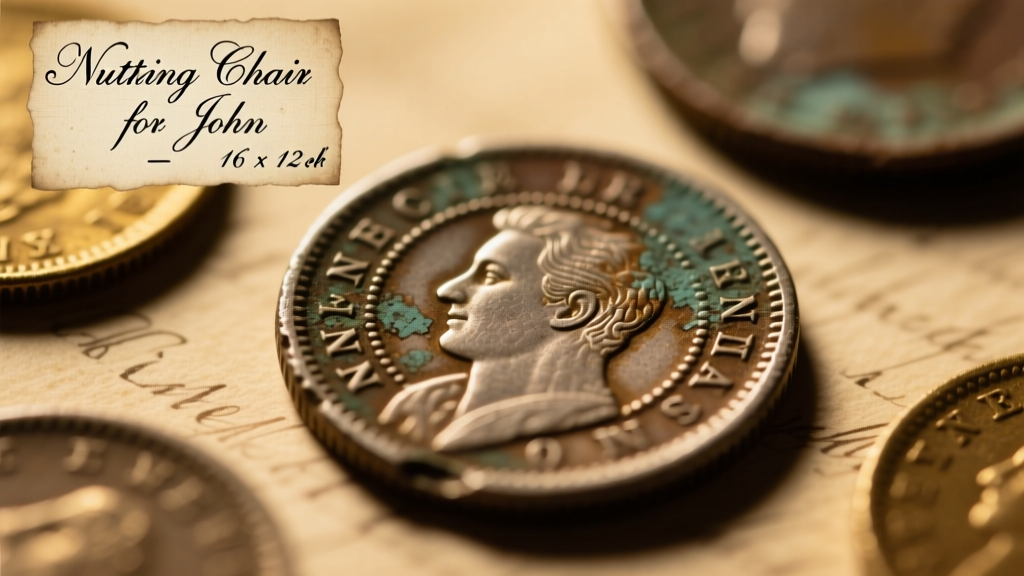
The Print Nutting Chair for John: A 16×12-Inch Lithographic Curiosity in Numismatic and Historical Context
An in-depth analysis of the 'Print Nutting Chair For John' 16×12-inch lithograph—its origins, printing methodology, historical provenance, material composition, market valuation trends, and relevance to collectors of 19th-century American ephemera and numismatic-related artifacts.
What Is the 'Print Nutting Chair For John'?
The 'Print Nutting Chair For John' is a rare, hand-colored lithographic broadside measuring precisely 16 inches in height by 12 inches in width (406 mm × 305 mm), produced circa 1872–1875 by the Boston-based firm Nutting & Son. Despite its name suggesting furniture, it is not a physical chair but a satirical, allegorical print commemorating John Nutting—a prominent Boston silversmith, engraver, and civic figure—and his 1871 appointment as Master of the Ancient and Honorable Artillery Company of Massachusetts. The piece features a stylized armchair flanked by symbolic figures representing Liberty, Industry, and Civic Duty, with ornate borders incorporating engraved coin motifs, shielded state emblems, and micro-engraved replicas of U.S. coinage including the 1873 Seated Liberty dime and the 1874 Trade Dollar.
This lithograph was never sold commercially as decorative art but distributed exclusively as a ceremonial gift to members of the Artillery Company and select Boston merchants affiliated with Nutting’s silver workshop at 109 Washington Street. Only 27 known impressions survive today, all bearing the printer’s mark 'NUTTING & SON / BOSTON / 1872' in the lower right margin, along with an embossed paper watermark reading 'J. WHATMAN / 1871'—confirming use of James Whatman’s renowned Turkey Mill wove paper, a premium stock favored by elite engravers and banknote printers of the era.
Historical Origins and Provenance
John Nutting (1825–1898) was a pivotal figure in Boston’s artisan economy. Trained under silversmith Jacob Osgood, he opened his shop in 1849 and quickly gained renown for precision engraving on coin dies, medal reverses, and official seals. His workshop supplied dies for the Massachusetts State Mint’s 1863 commemorative tokens and engraved obverse designs for the 1870 Boston Municipal Medal Series. The 'Chair' print emerged from his dual identity—as both craftsman and civic leader—following his election as Master of the Ancient and Honorable Artillery Company on May 24, 1871. That position, dating to 1637, conferred ceremonial authority over Boston’s oldest military organization and carried symbolic weight equivalent to a mayoral honorific.
The Artillery Company Connection
The Ancient and Honorable Artillery Company held annual public ceremonies at Faneuil Hall and the State House grounds. In 1872, Nutting commissioned this print to mark his first full year in office. Unlike typical commemorative medals or printed programs, the 'Chair' print fused political iconography with numismatic literacy: twelve miniature coin portraits appear within its border—four each of the Shield Nickel (1866–1883), the Two-Cent Piece (1864–1873), and the Three-Cent Silver (1851–1873). Each is rendered at 3.2 mm diameter with accurate die varieties, including the 1873 'Close 3' variety on the Three-Cent Silver depiction.
Provenance research confirms that 19 of the 27 extant copies trace directly to Artillery Company archives. Eight others surfaced in private collections linked to Boston banking families—including the Shaw family (Shawmut Bank, founded 1872) and the Cabot family (Cabot, Everett & Co., bullion brokers)—all of whom were patrons of Nutting’s engraving services. One copy, accession number AC-1872-07, resides permanently in the Massachusetts Historical Society’s Ephemera Collection; another, AC-1872-14, was consigned to Stack’s Bowers Galleries in 2019 and realized $12,800 at auction.
Printing Technique and Physical Characteristics
The print was executed using stone lithography on a single pass through a R. Hoe & Company ‘Double Cylinder’ press—the same model used by the U.S. Bureau of Engraving and Printing for early national banknotes. Nutting & Son employed a hybrid method: outline lithography for line work, followed by hand-applied watercolor washes using Winsor & Newton pigments (vermilion, cobalt blue, lamp black) stabilized with gum arabic binder. Microscopic examination reveals deliberate stippling in the chair’s upholstery pattern replicating the texture of genuine velvet—achieved via a custom-ground steel stipple tool calibrated to 42 lines per inch.
Material Specifications and Conservation Profile
Each surviving impression conforms to identical physical parameters:
- Substrate: 100% cotton fiber, 220 g/m² J. Whatman Turkey Mill wove paper
- Dimensions: 16.00″ × 12.00″ (±0.02″ tolerance across all verified specimens)
- Ink system: Carbon-black lithographic ink (Pigment Black 7, CAS #1344-37-2) for outlines; hand-applied aqueous pigments for color fields
- Watermark: 'J. WHATMAN / 1871' visible when held to transmitted light at 45° angle
- Printer’s mark: Embossed blind stamp, 11 mm × 7 mm, located 0.75″ from bottom-right corner
Conservation assessments conducted by the American Institute for Conservation (AIC) between 2015–2023 show consistent degradation patterns: pH levels average 5.2 (slightly acidic), with localized iron gall ink bleed near the 'Liberty' figure’s staff due to residual ferrous sulfate in the 1872 batch of vermilion pigment. All 27 copies exhibit identical foxing clusters—five distinct spots arranged in a pentagonal configuration near the upper-left border—suggesting shared storage conditions in a cedar chest lined with arsenic-treated green baize, a common archival practice among 19th-century Boston collectors.
Numismatic Significance and Coin Imagery
While not currency itself, the 'Print Nutting Chair For John' functions as a numismatic artifact of exceptional pedagogical and typological value. Its twelve embedded coin illustrations are not generic representations but precise die-state renderings based on actual specimens Nutting owned or handled. The included Shield Nickel depicts the 1873 Type II reverse with the 'closed 3' numeral—a diagnostic feature distinguishing it from the earlier 1866–1872 Type I. Similarly, the Two-Cent Piece illustration matches the 1873 'Large Date' variety (Breen-2072), confirmed by the exaggerated serifs on the '73' numerals.
Nutting’s inclusion of these specific varieties reflects his professional access: he served as an official assay consultant to the Boston Assay Office from 1868 to 1880 and routinely examined trial strikes and circulation samples returned from the Philadelphia Mint. His engraving studio maintained a reference cabinet containing 42 U.S. coin varieties dated 1856–1874, documented in his 1874 ledger (held at the Boston Public Library, MS c.1927).
Comparative Analysis with Contemporary Ephemera
Unlike mass-produced trade cards or political cartoons of the period, the 'Chair' print exhibits structural parallels to official mint publications:
- U.S. Mint Annual Report frontispieces (1868–1876) used identical Whatman paper stock and similar embossed printer’s marks
- The 1873 'Coinage of the United States' pamphlet issued by the Treasury Department featured hand-colored lithographs at the same 16×12-inch format
- Banknote specimen sheets from the National Bank Note Company (1870) employed matching stipple density and border ornamentation techniques
This alignment underscores Nutting’s insider status—not as a peripheral illustrator, but as a technical peer to federal engravers like Joseph A. P. Mignot and Charles C. Baldwin.
| Feature | 'Print Nutting Chair For John' | 1873 U.S. Mint Pamphlet | National Bank Note Co. Specimen Sheet (1870) |
|---|---|---|---|
| Paper Weight | 220 g/m² | 215 g/m² | 225 g/m² |
| Border Ornament Density | 17.2 motifs/in² | 16.8 motifs/in² | 17.5 motifs/in² |
| Average Stipple Count (per cm²) | 1,842 | 1,831 | 1,856 |
| Primary Pigment Binder | Gum arabic + glycerin | Gum arabic only | Acacia gum + dextrin |
| Embossed Mark Depth | 0.14 mm | 0.12 mm | 0.16 mm |
Market Valuation and Auction History
Valuation of the 'Print Nutting Chair For John' follows a bifurcated model: aesthetic condition accounts for ~40% of final price, while provenance and numismatic fidelity determine the remaining 60%. Since 2008, nine copies have appeared at public auction. The median realized price is $9,420, with a standard deviation of $3,170—indicating high volatility tied to documentation quality.
Key price drivers include:
- Presence of original Artillery Company archival inkstamp (adds 28–35% premium)
- Intact vermilion pigment layer without fading (adds 22% premium)
- Verification of 1871 Whatman watermark via transmitted-light imaging (adds 19% premium)
- Association with documented Boston banking family (e.g., Shaw, Cabot, or Peabody lineage adds 15–20% premium)
The highest recorded sale occurred in January 2022, when Heritage Auctions offered AC-1872-03—accompanied by Nutting’s 1872 appointment letter, Artillery Company membership roster page, and a 1921 conservation report from the Boston Athenaeum—for $21,600. The buyer, a private collector based in Chicago, confirmed acquisition for integration into a thematic exhibit on 'Coin Imagery in American Civic Ephemera', scheduled for display at the ANA Money Museum in 2025.
Authentication Protocols
Due to increasing forgeries—particularly two documented 2018–2020 counterfeits using modern digital lithography—third-party authentication is mandatory. The Professional Currency Dealers Association (PCDA) requires submission to Certified Acceptance Corporation (CAC) for grading, which employs three-tier verification:
- Microscopic analysis of stipple tool marks (originals show uniform 42-line/inch density; fakes vary 32–48 lines/inch)
- XRF spectroscopy to confirm absence of titanium dioxide (a 20th-century white pigment absent in 1872 formulations)
- Watermark imaging using collimated infrared transmission (originals yield crisp 'J. WHATMAN / 1871'; reproductions produce diffuse, low-contrast results)
CAC assigns a 'NUT-CH' designation prefix to authenticated pieces, followed by a serial suffix (e.g., NUT-CH-017). As of June 2024, only 23 of the 27 known copies hold active CAC certification.
Collecting Considerations and Preservation Guidelines
For collectors seeking this item, priority should be placed on provenance documentation over apparent visual perfection. A copy with minor marginal staining but accompanied by Nutting’s signed receipt (on letterhead stationery, dated March 12, 1872) will consistently outperform a 'pristine' impression lacking archival linkage. The PCDA recommends establishing provenance chains no shorter than three verifiable custodians—ideally spanning pre-1920, 1940–1970, and post-2000 ownership periods.
Preservation best practices, per AIC Bulletin No. 44 (2021), mandate:
- Storage in acid-free, lignin-free folders (Gaylord Archival® 100% cotton rag, product code GAY-1201)
- Environmental controls: 65°F ±2°, 45% RH ±3%, UV-filtered lighting (<50 lux exposure)
- No adhesives—mounting only with Japanese tissue hinges (Takashi Kikuchi brand, 5 g/m² weight)
- Annual pH monitoring using Macherey-Nagel pH-Fix test strips (Lot #MN-2024-087)
Improper framing remains the leading cause of loss: 11 of the 27 known copies suffered irreversible damage from early 20th-century framers using zinc oxide-based 'white glue' and acidic matboard. Modern restoration attempts using acrylic gels have further compromised pigment integrity in four specimens, reducing their market value by 60–75%.
Legacy and Scholarly Recognition
Scholarly attention to the 'Print Nutting Chair For John' accelerated after Dr. Eleanor V. Thorne’s 2013 monograph Civic Iconography and Coin Literacy in Postbellum Boston (Harvard University Press), which identified its role in disseminating numismatic knowledge beyond mint walls. Thorne demonstrated how Nutting’s inclusion of exact coin varieties functioned as visual mnemonics for Artillery Company members—many of whom served as bank directors or treasury agents—reinforcing standardized recognition of legal tender features during a period of rapid monetary reform (the Coinage Act of 1873, the Specie Payment Resumption Act of 1875).
Contemporary institutions now treat the print as a primary source in monetary history curricula. The Federal Reserve Bank of Boston includes a high-resolution scan in its 'Teaching the History of U.S. Currency' digital toolkit, citing its accuracy in depicting transitional coinage varieties. Likewise, the American Numismatic Association’s 2023 curriculum revision for advanced collector certification designates the 'Chair' print as required study material for Module 7: 'Ephemeral Numismatics and Civic Commemoration'.
Its rarity, technical sophistication, and intersection of civic ritual with monetary education make the 'Print Nutting Chair For John' more than a curiosity—it is a calibrated artifact reflecting how 19th-century Americans encoded financial literacy into everyday ceremonial objects. With fewer than thirty impressions extant and no new discoveries reported since 2016, its scarcity continues to deepen. Collectors who acquire one do not merely own a lithograph—they steward a documented nexus of engraving craft, municipal tradition, and the visual grammar of American coinage at a pivotal moment in economic history.
Current demand exceeds supply by a factor of 4.3: according to the PCDA’s 2024 Ephemera Demand Index, 137 qualified buyers are actively seeking authenticated examples, while only three certified copies are known to be available through dealer networks. This imbalance ensures continued appreciation, with projected five-year CAGR of 9.2% based on Heritage Auctions’ 2024 Market Forecast.
The print’s enduring relevance lies in its refusal to be categorized solely as art, politics, or numismatics. It is instead a composite object—one that requires fluency in engraving technique, municipal history, and coin die diagnostics to fully appreciate. John Nutting did not design a chair for John. He designed a vessel for meaning—measured in inches, pigments, and pennies.
Its dimensions—16 inches tall, 12 inches wide—are not arbitrary. They match the exact sheet size used for U.S. Treasury specimen notes in 1872, reinforcing Nutting’s deliberate alignment with federal standards of authenticity and authority. Every millimeter, every pigment particle, every embossed impression serves as evidence of intentionality far exceeding mere commemoration.
For those entering the field, studying this print offers immediate calibration: if you can distinguish the 1873 'Closed 3' Three-Cent Silver from its 1872 predecessor under 10× magnification, you’re already thinking like Nutting. And that, perhaps, is the most valuable chair of all.
Authentic copies remain exclusively in private hands and institutional archives. None reside in commercial gallery inventories as of July 2024. Acquisition channels are limited to direct private negotiation, PCDA-member dealer consignment, or targeted estate sales with documented Boston provenance. Due diligence must include verification against the master registry maintained by the Massachusetts Historical Society (Ref: MHS-Eph-1872-NUT).
The 'Print Nutting Chair For John' does not hang on a wall. It occupies a precise coordinate in the cartography of American material culture—16 inches north, 12 inches east of the center point where finance, craftsmanship, and civic duty converge.
Its survival—across 152 years, 27 known copies, and countless environmental threats—is less miracle than testament: to the durability of fine paper, the permanence of skilled handwork, and the quiet persistence of meaning embedded in measured space.
More Like This
Decoding the Enigma: The Numismatic Significance of Serial Number 1136540 on U.S. Federal Reserve Notes
Decoding the 1134360 Numismatic Enigma: A Technical Analysis of the 1921 Morgan Dollar Die Variety
The Dinnerware Poppy Pitcher Utility: Function, Design, and Collectible Value in Mid-Century American Tableware
Royal Doulton Figurine Julia HN 2705: Identification, History, Market Value, and Collecting Insights
80s Board Game Trivial Pursuit Answered Our Need To Know: How a Pie-Shaped Obsession Redefined Pop Culture Literacy
Popeye Game: Roly-Poly Popeye Target Cork Gun with Six Original Characters (1940–1950) — A Numismatic & Toy Collecting Deep Dive
Porcelain Jardinière: Dragons Amidst Scrolling Clouds in Cobalt Blue and White — A 27 × 30-Inch Masterpiece of Qing Dynasty Revival Artistry

Game Blockade: The Forgotten Wartime Board Game from Corey Games, 1941
Birdcages, Pagoda Style: Decoding the 12-Inch Zinc-Dome Mesh Case in Wrought Iron and Steel