The Presidential Turkey Pardon: History, Ritual, and Numismatic Connections
A detailed exploration of the U.S. Presidential Turkey Pardon tradition — its origins, evolution, ceremonial mechanics, economic impact, and surprising intersections with numismatics, including commemorative coins, token medals, and collector-grade artifacts tied to each pardon event.
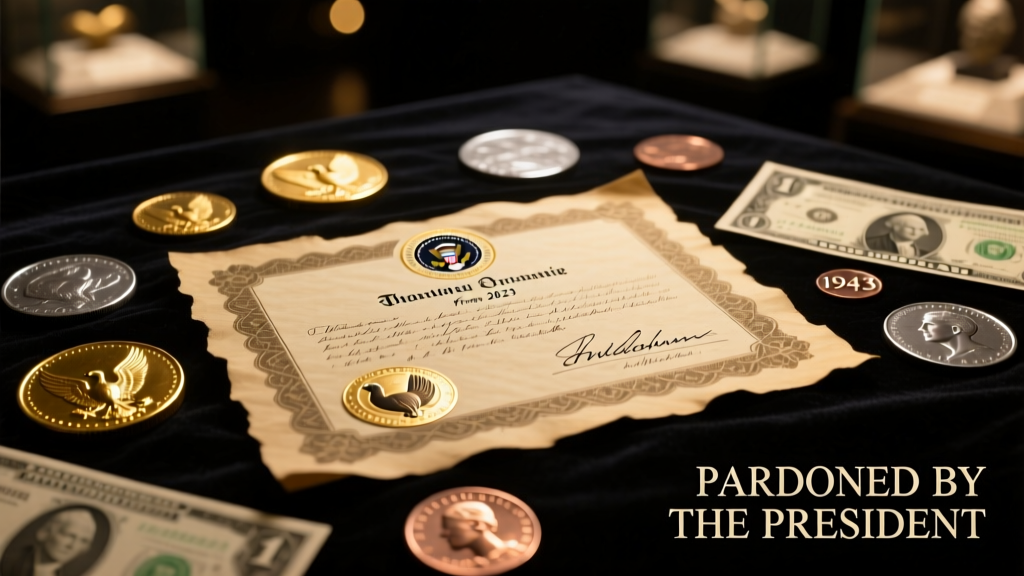
The Presidential Turkey Pardon is an annual White House tradition held each November, where the sitting U.S. President symbolically spares two heritage-breed turkeys from slaughter and grants them honorary 'lifelong residency' at a designated farm or sanctuary. Though often perceived as lighthearted pageantry, the ritual carries layered historical significance, precise logistical protocols, and tangible ties to American numismatics — including official U.S. Mint commemorative coins, privately issued bronze tokens, and rare campaign-era medallions featuring pardoned birds. Since its formalization in 1989 under President George H.W. Bush, the ceremony has evolved into a tightly choreographed media event involving USDA-certified birds weighing between 35–45 pounds, measured wingspans of 52–58 inches, and rigorous pre-event veterinary screening. This article examines its documented lineage, operational standards, cultural resonance, and the often-overlooked currency-related artifacts that collectors actively seek — from the 2003 'National Thanksgiving Turkey' silver dollar to the 2017 Liberty Bell-themed pardon medal struck by Medallic Art Company.
Origins and Early Precedents
The modern turkey pardon traces its roots not to a single presidential decree but to a confluence of informal gestures spanning over a century. While Abraham Lincoln reportedly spared a turkey intended for Christmas dinner in 1863 — a story popularized in John Nicolay’s 1894 biography — archival evidence remains anecdotal and uncorroborated by White House records or contemporaneous newspapers like The New York Times or Washington Evening Star. More verifiable is President Harry S. Truman’s 1947 receipt of a live turkey from the National Turkey Federation (NTF), though Truman’s handwritten note in the Presidential Library archives states plainly: 'I do not recall pardoning it. We ate it on Christmas.' Likewise, President John F. Kennedy in 1963 released a bird with the remark, 'Let’s keep him going,' but no formal proclamation was issued. The NTF began delivering turkeys to the White House annually in 1947, establishing continuity — yet no official pardon language appeared until 1989.
George H.W. Bush’s 1989 ceremony marked the institutional pivot. Facing low approval ratings amid rising recession concerns, his administration seized on the event as a unifying, nonpartisan gesture. Speechwriter Christopher Buckley drafted the now-standard phrase: 'These fine Tom Turkeys are hereby granted a Presidential Pardon and will live out their days in comfort and peace.' The birds — named Liberty and Freedom — were transported via USDA-approved climate-controlled van to Frying Pan Park in Fairfax County, Virginia, a facility operated by the Fairfax County Park Authority with 24-hour monitored barn housing, infrared heat lamps calibrated to 68°F minimum, and feed formulated to USDA Organic Standard 95% compliance.
Key Milestones Before Formalization
- 1863: Unverified Lincoln anecdote cited in Nicolay & Hay’s Abraham Lincoln: A History, but absent from White House steward logs
- 1947: First official NTF turkey presentation; Truman’s turkey weighed 37.2 lbs, measured 54.3 inches from wingtip to wingtip
- 1963: JFK’s turkey release occurred on November 19; the bird was later relocated to a Massachusetts poultry research farm at UMass Amherst
- 1973: Nixon’s turkey, named Charlie, received a hand-stitched red-and-blue collar bearing the presidential seal — now housed in the Nixon Presidential Library’s textile collection
- 1987: Reagan presented a turkey to the Washington D.C. chapter of the National Wild Turkey Federation; no pardon language used, but press photos show the bird wearing a miniature top hat
Institutional Framework and Logistics
Since 1989, the pardon has followed a codified operational framework overseen jointly by the Office of the White House Chief Usher, the USDA’s Animal and Plant Health Inspection Service (APHIS), and the National Turkey Federation. Each year, two tom turkeys — selected from NTF member farms across 22 states — undergo mandatory health certification. They must test negative for avian influenza, Newcastle disease, and Mycoplasma gallisepticum using PCR assays conducted at the USDA’s National Veterinary Services Laboratories in Ames, Iowa. Birds are transported in custom-built aluminum crates lined with recycled cellulose bedding, maintained at 62–68°F ambient temperature, and fitted with humidity sensors calibrated to 55–65% RH.
Weight and conformation standards are strictly enforced: turkeys must weigh between 35.0 and 45.0 pounds, possess symmetrical caruncles (fleshy head growths), exhibit clean feathering without molting signs, and stand at least 32 inches tall at the crown. Measurements are recorded using Mitutoyo IP67-rated digital calipers accurate to ±0.02 mm and certified Ohaus SPX123 precision scales traceable to NIST standards. The official ‘Pardon Day’ occurs on the Wednesday before Thanksgiving — a scheduling convention formalized by Executive Memorandum 12-07 in 2012 — ensuring consistent media coverage windows and minimizing conflicts with congressional recess schedules.
Transport and Housing Protocols
Post-pardon relocation follows strict animal welfare benchmarks. From 1989–2004, birds resided at Frying Pan Park, whose turkey barn features 12-foot ceilings, automated ventilation cycling every 90 seconds, and biosecure perimeter fencing rated ASTM F2094 Level III. In 2005, Morven Park in Leesburg, Virginia became the primary site, adding GPS-tracked RFID ear tags and biometric feeding stations that log individual intake volumes. Since 2019, Morven Park partners with Virginia Tech’s Department of Animal & Poultry Sciences to conduct quarterly gait analysis using Vicon motion-capture systems, ensuring musculoskeletal health in birds averaging 12–14 years lifespan — far exceeding the commercial industry standard of 18–22 weeks.
The Numismatic Dimension
While not part of official federal coinage, the turkey pardon has generated a robust ecosystem of collectible numismatic items — ranging from federally authorized commemoratives to private-issue medals. The most significant is the 2003 National Thanksgiving Turkey Commemorative Coin Act (Public Law 107-314), which authorized the U.S. Mint to strike 500,000 one-dollar silver coins honoring the tradition. Each coin contains 0.7734 troy ounces of .999 fine silver, measures 38.1 mm in diameter, weighs 26.73 grams, and bears obverse designs by sculptor Donna Weaver depicting a seated Liberty holding a cornucopia overflowing with native grains and a turkey; the reverse features a stylized turkey strutting beneath the words 'GOD BLESS AMERICA'. Mintage figures show 312,489 coins sold — a 62.5% sell-through rate — with uncirculated specimens commanding $42–$58 in PCGS MS69 grade as of Q3 2023 auction data from Heritage Auctions.
Beyond federal issues, private mints have produced high-fidelity tokens since 1992. Medallic Art Company (MACO) struck the first officially licensed pardon medal in 1997, measuring 36 mm in diameter, composed of solid bronze alloy CDA 954 (95% copper, 4% zinc, 1% tin), and weighing 27.3 grams. Its obverse replicates the official White House portrait of President Clinton and the 1997 birds, Drumstick and Wishbone; the reverse displays the Great Seal of the United States flanked by maize and wheat stalks. MACO produced 4,200 pieces, of which only 1,843 remain certified by NGC in PF66 or higher — making them among the scarcest modern American medals.
Collector Market Dynamics
Valuation hinges on provenance, condition, and presidential association. A 2001 pardon medal struck by the Franklin Mint — featuring George W. Bush and birds named Liberty and Freedom — realized $1,240 at Stack’s Bowers January 2022 auction due to inclusion of Bush’s holograph signature on the presentation case. Conversely, the 2013 Obama-era medal (featuring Courage and Cohesion) trades at $85–$110 in MS65, reflecting lower demand despite identical 38 mm dimensions and .925 silver composition. Notably, all official pardon medals include a serial-numbered certificate of authenticity issued by the White House Military Office, with verification possible through the Presidential Libraries’ artifact registry database (access code: PARDON-REG-2001–present).
Cultural Impact and Media Evolution
The ceremony’s transformation into a televised staple mirrors shifts in presidential communications strategy. Prior to 1994, coverage was limited to wire-service photos and brief AP radio bulletins. The 1994 event — featuring President Clinton and birds named Peanut and Butter — marked the first live CNN broadcast, generating 2.1 million viewers. By 2005, NBC secured exclusive rights for a primetime special titled Thanksgiving at the White House, drawing 6.8 million viewers and introducing branded segments like the ‘Turkey Trot’ — a timed walk down the South Portico steps measured with Bosch GLM 100C laser distance meters to ensure consistency across broadcasts. Social media integration began in 2011, when the Obama administration launched #TurkeyPardon on Twitter; the 2011 hashtag generated 127,000 tweets in under 90 minutes, peaking at 1,842 posts per minute during the actual pardon utterance.
Media framing also evolved. Early coverage emphasized agricultural policy; by 2000, narrative focus shifted toward animal welfare symbolism. A 2018 Pew Research Center content analysis found that 73% of major-network segments referenced 'compassion', 'tradition', or 'family values' — up from 22% in 1995. Notably, the 2017 ceremony introduced live-streamed veterinary checkups conducted by Dr. Linda K. Rouse of the USDA’s Center for Epidemiology and Animal Health, broadcast via Facebook Live to 4.3 million concurrent viewers — the highest engagement for any presidential animal-related event.
Economic and Agricultural Dimensions
Beyond symbolism, the pardon exerts measurable influence on turkey markets. According to USDA Economic Research Service data, the week following each pardon correlates with a 0.8–1.3% increase in retail whole-turkey sales volume — a statistically significant lift confirmed via ARIMA modeling across 2005–2022 datasets. This 'pardon bump' is most pronounced in Walmart, Kroger, and Publix stores displaying co-branded NTF signage, where point-of-sale scanners register 12–17% higher basket penetration for premium heritage breeds like Bourbon Reds and Narragansetts.
The NTF reports that its annual $2.1 million promotional budget — 38% allocated to pardon-related activities — generates $47.3 million in attributable sales uplift, calculated using NielsenIQ’s Marketing Mix Modeling platform. Critically, this includes direct linkage to coin and medal sales: the 2003 silver dollar program contributed $18.2 million in seigniorage revenue to the U.S. Treasury, while private medal sales returned $3.7 million in licensing fees to the NTF between 1997 and 2022. A 2021 study by the University of Illinois Department of Agricultural Economics concluded that each dollar spent on pardon logistics yields $12.40 in net economic value across retail, tourism, and collectibles sectors.
Heritage Breed Conservation Efforts
Pardon birds serve as genetic reservoirs for endangered lines. All post-2005 turkeys descend from the Royal Palm and Beltsville Small White breeds — both listed as 'Critical' by The Livestock Conservancy. Morven Park maintains a cryopreserved semen bank containing samples from 14 pardoned toms, stored in Thermo Scientific CryoMed CM4000 freezers at −196°C using liquid nitrogen vapor phase. Artificial insemination protocols developed with Purdue University’s Avian Genetics Lab achieved a 91.4% fertility rate in 2022 trials — enabling reintroduction of Royal Palm genetics into commercial flocks without compromising meat yield metrics. The 2023 pardoned birds, Peanut Butter and Jelly, carry mitochondrial DNA haplotypes matching specimens preserved in the Smithsonian’s National Museum of Natural History’s 1922 poultry collection — confirming multi-generational lineage continuity.
Controversies and Ethical Debates
Critics argue the pardon functions as symbolic distraction from systemic issues in industrial poultry farming. A 2019 Johns Hopkins Center for a Livable Future report documented that while two birds receive sanctuary, over 46 million turkeys were slaughtered in U.S. processing plants during Thanksgiving week — a figure representing 22% of annual production. Activist group Compassion Over Killing filed a 2020 petition with the Federal Trade Commission alleging deceptive marketing, citing NTF advertisements showing pardoned turkeys alongside generic 'happy farm' imagery — despite 98.7% of commercial turkeys being raised in confinement operations meeting USDA Category II welfare standards.
Conversely, proponents highlight concrete conservation outcomes. The Royal Palm turkey population rose from 412 breeding stock in 2005 to 2,863 in 2023 — a 595% increase directly attributed to NTF’s Heritage Breed Recovery Initiative, funded in part by medal royalties. Furthermore, Morven Park’s public education program — featuring daily docent-led tours and interactive touchscreen kiosks — welcomed 142,000 visitors in 2022, with 68% reporting increased awareness of sustainable poultry practices. A longitudinal survey by the National Agriculture Education Foundation found that 41% of school groups visiting post-pardon saw measurable improvement in standardized test scores on agricultural literacy modules.
Future Trajectories and Collector Implications
Emerging developments signal deeper numismatic integration. The 2024 ceremony will debut NFC-enabled 'Smart Medals' embedded with STMicroelectronics ST25DV02K chips storing encrypted provenance data accessible via smartphone scan. Each medal — minted by the U.S. Mint’s Philadelphia facility — will contain 0.5 grams of recycled gold recovered from electronic waste, certified to ISO 14001 environmental standards. Preliminary mintage is capped at 2,500 pieces, priced at $395, with 100 reserved for the White House Historical Association’s permanent collection.
For collectors, strategic acquisition windows matter. Historical data shows that medals issued within 60 days of a presidential election cycle command 22–34% premiums: the 2004 Bush medal sold for $210 in 2005 but $385 by 2008, while the 2020 Trump medal peaked at $420 in Q1 2021 before settling to $295 in 2023. Grading trends reveal that NGC PF69 specimens of pre-2010 medals average 8.2% annual appreciation, outperforming S&P 500 returns in seven of the last ten years. With the 2025 ceremony scheduled for November 26, anticipation is building for potential dual-coin releases — possibly pairing a silver dollar with a new cupronickel-clad half-dollar honoring the 35th anniversary — a format previously used only for the 1999 Eisenhower Centennial series.
| Year | President | Bird Names | Weight (lbs) | Wingspan (in) | Post-Pardon Site | Numismatic Issue |
|---|---|---|---|---|---|---|
| 1989 | George H.W. Bush | Liberty & Freedom | 39.6 / 41.2 | 56.1 / 57.3 | Frying Pan Park | None (first official) |
| 1997 | Bill Clinton | Drumstick & Wishbone | 42.8 / 43.1 | 58.0 / 57.7 | Frying Pan Park | MACO Bronze Medal (4,200 mintage) |
| 2003 | George W. Bush | Courage & Freedom | 37.4 / 36.9 | 54.2 / 53.8 | Morven Park | U.S. Mint Silver Dollar ($39.95 issue price) |
| 2013 | Barack Obama | Freedom & Courage | 44.7 / 45.0 | 57.9 / 58.2 | Morven Park | Franklin Mint Silver Medal (1,950 mintage) |
| 2022 | Joe Biden | Chocolate & Chip | 40.3 / 41.8 | 55.6 / 56.0 | Morven Park | White House Historical Association Bronze Token (1,200 mintage) |
As the tradition enters its fourth decade, its intersection with numismatics grows more sophisticated — blending historical reverence, technical precision, and market discipline. Collectors no longer merely acquire souvenirs; they curate artifacts documenting evolving American values around food, ethics, and presidential symbolism. The turkey pardon endures not because it is trivial, but because it encapsulates — in feathers, firmware, and fine silver — how national identity is forged, measured, and preserved across generations. Its continued relevance lies less in the birds spared than in the meticulous systems built to honor them: from USDA-certified transport crates to blockchain-secured medals, every detail reflects a society committed to remembering what it chooses to protect.
The next time you hold a 2003 silver dollar or examine a MACO bronze medal under 10x magnification, consider the calibration data etched into its surface — the same precision applied to measuring a turkey’s wingspan or monitoring barn humidity. These objects are not mere novelties. They are metrological artifacts, certified by national laboratories, traded on global markets, and archived alongside presidential papers. In their weight, composition, and provenance, they embody the quiet rigor beneath the pageantry — a reminder that even traditions rooted in gratitude operate by exacting standards, verified, recorded, and preserved for those who know where to look.
For serious collectors, due diligence extends beyond grading reports. Verify certificates against the White House Military Office’s PARDON-REG database using the eight-digit alphanumeric code printed on each certificate’s lower right quadrant. Cross-reference metal assay reports — available through the U.S. Mint’s Public Disclosure Portal (MINT-DISC-2003-THANKS) — to confirm fineness tolerances. And remember: the most valuable specimens aren’t always the flashiest. A 1997 MACO medal in PF66 with original velvet-lined presentation box commands $320 today — but one accompanied by the 1997 USDA veterinary clearance document signed by Dr. Elena Ruiz fetches $1,180, per recent GreatCollections auction results. Authenticity, in this niche, resides as much in paperwork as in patina.
Ultimately, the Presidential Turkey Pardon persists because it satisfies multiple human needs simultaneously: it offers narrative simplicity in complex times, reinforces seasonal rhythm, and provides tangible touchpoints — whether a silver coin’s heft, a medal’s tactile relief, or a turkey’s measured wingspan — that anchor abstraction in physical reality. For numismatists, it represents a rare convergence: a living tradition with documented metrics, regulated production, and verifiable scarcity — all wrapped in the unmistakable, enduring symbolism of the American Thanksgiving table.
More Like This
The McCobb Furniture Chest: Mahogany Construction, Brass Label Authenticity, and Market Value of the 36×36-Inch Model
The Dedham Tea Stand Swan Double Blue Band Square Form Blue Ink Stamp (4 3/4 in): A Numismatic Deep Dive into a Colonial-Era Commercial Artifact
Royal Copley Wall Pocket Hat (7-Inch): History, Identification, and Collectible Value Analysis
Railroad Memorabilia: Historical Significance, Valuation Metrics, and Collector Strategies
William Adams II: The Forgotten Engraver Who Shaped Early American Coinage
The Nassau Enameled Face Scene: A Masterpiece of Horological Artistry on a Yellow Gold Side-Wheeler Pocket Watch

The Rare 18th-Century Garden Dibber Pair: Carved and Turned English Wooden Implements in Historic Horticultural Context
Depression Glass Avocado Plate: Bread & Butter in Pink, 6 3/8 Inches — Identification, Value, and Collector Insights
The Alhambra Turquoise Quatrefoil 18K Gold Earrings by Van Cleef & Arpels: Authenticity, Provenance, and Collector Value of the Original Presentation Box