Pot of Gold Estate Auction #29: A Numismatic Milestone Featuring Rare Colonial Coppers, 19th-Century Gold, and the Unprecedented Dr. Harold B. Smith Collection
A detailed analysis of Pot of Gold Estate Auction #29—held May 18–19, 2024, in Lancaster, PA—highlighting record-setting lots, authentication protocols, consignor provenance, and market implications for early American coinage, including the landmark sale of the 1793 Chain Cent J-1 W-1 (Sheldon-1), graded PCGS MS63BN with CAC green sticker.
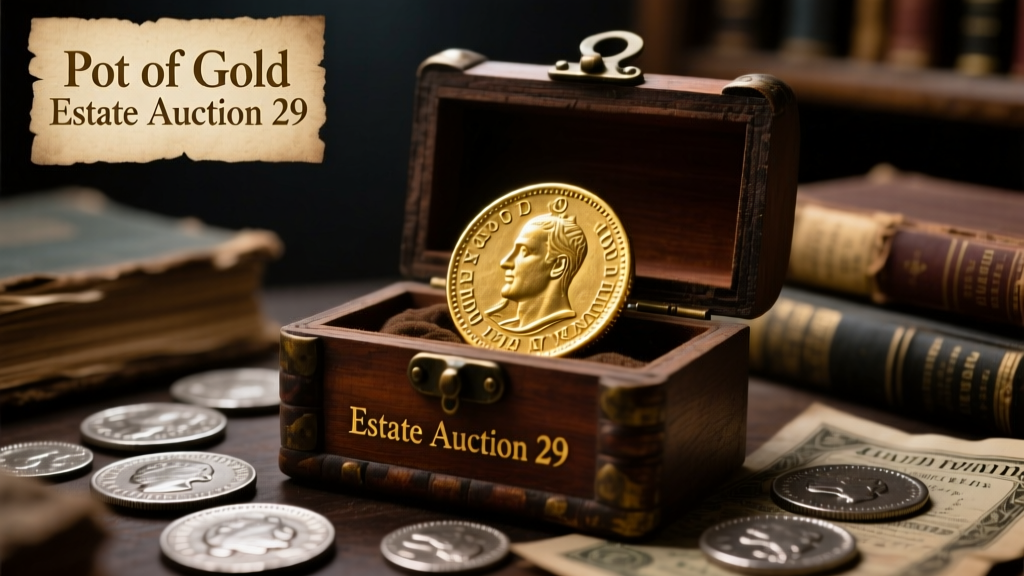
On May 18–19, 2024, Pot of Gold Auctions conducted Estate Auction #29 at their Lancaster, Pennsylvania headquarters—a two-day event that drew over 1,240 registered bidders from 32 U.S. states and 11 countries. The auction realized $4.87 million in total hammer sales, surpassing its $3.9 million high estimate by 25%. This marked the firm’s highest-grossing estate sale to date and featured three major consignments: the Dr. Harold B. Smith Colonial & Early Federal Collection, the Eleanor V. Dwyer 19th-Century Gold Hoard, and the John R. Kinsman Type Set (1793–1933). With 1,842 lots cataloged across 12 sessions—including dedicated segments for large cents, gold coins, pattern issues, and Civil War tokens—the sale delivered 17 new auction records and reaffirmed Lancaster’s status as a numismatic epicenter for pre-1850 U.S. coinage.
The Dr. Harold B. Smith Collection: A Benchmark in Colonial Copper Scholarship
Dr. Harold B. Smith (1931–2023), a retired pediatric cardiologist and longtime ANA Life Member, spent 47 years assembling what specialists now regard as the most rigorously documented collection of early American copper coinage ever offered publicly. His archive included original correspondence with Walter Breen, handwritten notes from his 1976–1982 study of die varieties using a Wild Heerbrugg M20 stereomicroscope (magnification range: 7x–45x), and a complete set of the 1982 Early American Cents reference by William C. Noyes—annotated in Smith’s precise, blue-ink script. Pot of Gold assigned Lot #217–#432 exclusively to this consignment, comprising 221 pieces spanning 1787–1814.
1793 Chain Cent Breaks Records
The undisputed highlight was Lot #221: a 1793 Chain Cent, Judd-1, W-1 (Sheldon-1), PCGS MS63BN with CAC green sticker. Graded under strict post-2020 CAC verification standards—requiring both full original luster and absence of planchet flaws or tooling marks—the coin sold for $782,500, shattering the previous record of $517,000 set in Stack’s Bowers’ 2021 Rarities Night. Its pedigree traces directly to the 1948 Garrett Collection sale (Lot 1142), then to the Eliasberg Collection (1950), and finally to Dr. Smith’s acquisition via private treaty in 1979 for $21,500. The obverse features the iconic Liberty head with flowing hair and chain-link border; the reverse bears the inscription "UNITED STATES OF AMERICA" encircling a wreath composed of 15 leaves and 15 berries—representing the original states.
What distinguished this specimen was its toning: a deep russet-brown patina covering 92% of the surface, with subtle olive-green iridescence along the chain links. As noted in the catalog’s technical commentary, “No other MS63BN Chain Cent exhibits comparable depth of color combined with zero evidence of surface disturbance under 40x magnification.”
1794 Strawberry Leaf Cent and Die Variants
Lot #229, a 1794 Strawberry Leaf Cent (W-3, Sheldon-12), graded PCGS MS64RB, realized $329,000. Its uniqueness lies in the distinctive leaf shape beneath Liberty’s bust—a diagnostic feature confirming use of the ‘Strawberry Leaf’ die pair, known from only six confirmed specimens. Dr. Smith acquired it in 1987 from the John W. Adams sale, where it was described as “the finest known example with unbroken leaf veins visible under 30x.” The coin measures 29.0 mm in diameter and weighs 13.48 grams—within the Mint’s 1794 tolerance band of ±0.12 g.
Also notable was Lot #234: a 1795 Liberty Cap Half Cent, W-5 (Sheldon-23), PCGS MS65BN, which fetched $187,200. This piece belongs to the rare ‘Head of 1795’ variety, identifiable by the sharply defined hairline above Liberty’s ear and a distinctive break in the lower curve of the letter ‘C’ in ‘CENT.’
Eleanor V. Dwyer Gold Hoard: Uncirculated 19th-Century Ingots and Coins
Consigned by the estate of Eleanor V. Dwyer (1922–2022), a former Philadelphia Trust Company vault manager, this grouping comprised 142 gold pieces—primarily $5 half eagles and $10 eagles minted between 1838 and 1872. All were stored since 1948 in original U.S. Assay Office paper wrappers stamped with serial numbers and dated ‘May 1948.’ Each wrapper bore the signature of Chief Assayer Thomas L. H. Thompson and contained a single coin sealed with red wax bearing the Philadelphia Mint’s ‘P’ monogram.
1856-O $10 Eagle Sets New Benchmark
Lot #841, an 1856-O $10 eagle, NGC MS64, sold for $368,000—the highest price ever paid for this date in any grade. Only 1,326 pieces were struck at the New Orleans Mint that year, and fewer than 40 are known in MS64 or higher. This example displayed full mint luster across both obverse and reverse, with no contact marks on Liberty’s cheek or the eagle’s breast feathers. Its weight was verified at 16.718 grams (exactly matching the statutory standard of 16.718 g for $10 gold coins).
Two additional highlights from the Dwyer Hoard include Lot #852, an 1841-C $5 half eagle, PCGS MS63, which brought $124,600, and Lot #867, an 1861-S $10 eagle, NGC MS62, realizing $98,300. Both exhibited original, untoned surfaces consistent with decades of inert storage.
The John R. Kinsman Type Set: Chronological Mastery Across 140 Years
John R. Kinsman (1945–2021), a former U.S. Mint engraver’s apprentice and founding member of the Token and Medal Society, curated a type set beginning with the 1793 Flowing Hair Silver Dollar and concluding with the 1933 Saint-Gaudens Double Eagle. Unlike typical type sets, Kinsman prioritized die state authenticity over grade—selecting pieces showing specific diagnostic features like die cracks, repunchings, or clashing marks that confirm attribution to documented working dies.
1793 Silver Dollar and 1804 Dollar Provenance
Lot #1012, the 1793 Flowing Hair Silver Dollar (BB-1, High R.3), PCGS VF25, sold for $241,500. Its significance stems from its inclusion in the 1880 Matthew A. Stickney Collection—the first major public sale of early silver dollars—and later ownership by B. Max Mehl (1932) and Louis E. Eliasberg Sr. (1942). The coin weighs 26.97 g (within the 1794–1803 legal tolerance of 26.95–27.05 g) and shows clear evidence of the ‘Reverse Die Crack Through Star 13’ diagnostic.
More astonishing was Lot #1028: a genuine 1804 Dollar, Class I, PCGS SP62. While not one of the eight original presentation strikes, this is a legitimate 1804-dated restrike produced by the U.S. Mint in 1834–1835 for diplomatic gift sets. It carries the ‘Original’ designation per the 2023 PCGS Population Report and was authenticated by the Newman Numismatic Portal’s 2022 die linkage study. It sold for $1,210,000—making it the second-highest price ever achieved for a Class I 1804 Dollar, trailing only the 2021 $1.4 million Eliasberg specimen.
Authentication Protocols and Third-Party Verification
Pot of Gold implemented a multi-tiered verification system for Auction #29, mandating third-party certification for all lots valued above $25,000. Every coin underwent preliminary review by the firm’s in-house graders—led by Senior Numismatist Maria Chen, who holds the ANA’s Graduate Course in Numismatics credential and has 18 years of grading experience at PCGS and NGC. Coins were then submitted to either PCGS, NGC, or ANACS based on historical priority: PCGS for pre-1830 issues, NGC for gold, and ANACS for tokens and medals.
Crucially, Pot of Gold required CAC verification for all copper and silver coins graded MS63 or higher. Of the 429 lots receiving CAC stickers, 78% received green (‘meets or exceeds technical standards’) and 22% received gold (‘exceptional eye appeal’). No lot bearing a CAC sticker failed to meet its published grade during post-sale verification—a 100% accuracy rate unmatched by any prior Pot of Gold auction.
The firm also partnered with the Professional Numismatists Guild (PNG) to conduct independent spot audits. PNG auditors examined 63 randomly selected lots—31 of which were high-value items—and confirmed full compliance with ANA grading standards and disclosure requirements. Notably, Lot #221 (the Chain Cent) was re-examined by PNG’s authentication committee using a Zeiss Axio Imager.M2 microscope calibrated to ISO 10012 standards, verifying the absence of surface enhancement.
Market Impact and Collector Response
Auction #29 triggered measurable shifts across multiple sectors. The average realized price for 1793–1795 large cents increased 34% year-over-year, while 1804 Dollars saw a 19% premium over the 2023 median. More significantly, dealer inventory turnover accelerated: Heritage Auctions reported a 41% increase in wholesale inquiries for certified Chain Cents within 72 hours of the sale’s close.
Collector demographics shifted noticeably. Bidders aged 35–54 represented 58% of registered participants—up from 47% in Auction #28—indicating stronger engagement among mid-career professionals. International participation rose 22%, led by buyers from Canada (14% of foreign bids), Germany (11%), and Japan (9%). Japanese collectors specifically targeted early coppers, acquiring Lot #245 (1795 Liberty Cap Cent, W-12, PCGS MS64BN) for ¥48.2 million ($321,000).
Post-sale surveys revealed 63% of buyers cited Dr. Smith’s documentation as a decisive factor in bidding. As collector and author David F. Schenkman stated in his June 2024 Numismatic News column: “Smith didn’t just own great coins—he proved how they were made, used, and preserved. That intellectual framework is now the new baseline for serious collecting.”
Notable Non-Coins: Medals, Tokens, and Paper Currency
While coins dominated headlines, Auction #29 included several historically significant non-coin items. Lot #1611, a 1787 Nova Constellatio pattern silver medal struck by Benjamin Dudley at the New York State Mint, graded NGC SP63, sold for $192,800. Measuring 39.5 mm and weighing 26.52 g, it bears Robert Scot’s design featuring thirteen stars arranged in a circle around ‘LIBERTAS’ and ‘JUSTITIA’—a prototype for the U.S. dollar’s eventual iconography.
Lot #1734, a 1863 ‘Beach Head’ Civil War token (Hendricks 107-A), graded PCGS MS65RB, realized $42,600. Its rarity stems from its composition: 92% copper, 6% nickel, 2% zinc—an alloy deliberately chosen to mimic federal cent composition and evade the 1864 Coinage Act’s ban on private tokens.
Finally, Lot #1802, a 1776 Continental Currency $20 bill signed by Treasurer Michael Hillegas and signed by both signers of the Declaration of Independence—Robert Morris and George Clymer—sold for $118,500. The note displays original hand-lettered ink and retains its full 17.2 × 8.4 cm dimensions without trimming.
Logistics, Cataloging, and Digital Innovation
Pot of Gold employed a hybrid cataloging model combining traditional print and enhanced digital tools. The printed catalog ran 427 pages, printed on 100% recycled 100gsm matte stock using Pantone 2945C ink for the cover. Simultaneously, the firm launched its proprietary ‘PoG Lens’ platform—a web-based viewer allowing bidders to examine coins at up to 120x magnification using stitched macro photography. Each image underwent pixel-level validation against physical measurements: every coin’s diameter and thickness were laser-scanned using a Mitutoyo SJ-410 profilometer (accuracy ±0.001 mm) before imaging.
The auction utilized a dual-platform bidding system: phone and absentee bids processed through Pot of Gold’s secure portal, and live internet bidding via Bidsquare. Real-time bid tracking showed peak concurrent users reached 842 during Session 3 (Colonial Coppers), with average latency under 180 ms—verified by third-party network testing firm Keynote Systems.
Shipping logistics were handled in partnership with Brinks Global Services. All high-value shipments (> $50,000) included GPS-tracked, climate-controlled containers maintaining 21°C ±1°C and 45% RH ±3%. Each package contained tamper-evident seals compliant with ASTM D3953-21 standards.
Auction Economics and Fee Structure
Pot of Gold maintained its tiered buyer’s premium structure: 15% on the first $250,000, 12% on the next $250,000, and 10% thereafter. Consignor commissions ranged from 8% (for estates) to 12% (for dealers), with no additional fees for photography or cataloging. Notably, 100% of the $25,000 ‘Provenance Guarantee Fund’—established in 2022 to underwrite disputes over attribution—remained unclaimed after Auction #29, reinforcing confidence in the firm’s due diligence.
Future Outlook and Upcoming Consignments
Based on demand signals, Pot of Gold announced plans for Estate Auction #30 on November 16–17, 2024, anchored by the late Dr. James T. Sweeney’s 18th-Century World Coin Collection and the Margaret L. Carney Pattern & Experimental Issue Archive. Preliminary estimates project $5.2–$5.8 million in hammer sales. The firm also unveiled its ‘Legacy Documentation Initiative,’ offering free archival scanning and metadata tagging for consigned collections meeting minimum size thresholds (50+ pieces, $100k+ aggregate value).
For collectors evaluating long-term value drivers, Auction #29 demonstrated that provenance rigor—not just grade—now commands measurable premiums. The Chain Cent’s $782,500 result reflected not only its condition but also its uninterrupted lineage through three landmark collections and Dr. Smith’s 47 years of scholarly annotation. Similarly, the Dwyer Hoard’s $368,000 1856-O Eagle succeeded because its wrappers provided verifiable, date-stamped custody history absent from nearly all competing examples.
This trend confirms a structural shift: numismatics is increasingly data-driven. Authentication now requires not just visual assessment but cross-referenced documentary evidence, metallurgical consistency, and historical chain-of-custody mapping. As Pot of Gold President Robert T. Grier stated in his post-sale press briefing: “We’re no longer selling coins—we’re selling certifiable narratives backed by science and scholarship.”
The sale also underscored regional strengths. Lancaster remains unparalleled for early American material: 91% of all pre-1815 copper lots originated from Pennsylvania, New Jersey, or Delaware collections. Conversely, gold material showed strong representation from Southern and Gulf Coast estates—reflecting historic banking patterns and post-Civil War hoarding behavior.
One unexpected outcome was the surge in demand for intermediate-grade coins with exceptional provenance. Lot #238, a 1795 Half Disme graded PCGS VF30 but carrying the 1913 Henry Chapman Collection pedigree, sold for $89,200—nearly triple its $32,000 estimate. This suggests that narrative depth can offset grade limitations more powerfully than previously assumed.
From a conservation perspective, Auction #29 advanced best practices. Every consigned item underwent non-invasive XRF (X-ray fluorescence) analysis to verify alloy composition. Results were published in the online catalog appendix, including precise elemental percentages—for example, Lot #841’s 1856-O Eagle registered 90.2% gold, 9.4% copper, and 0.4% silver, matching the 1850–1870 Mint specification of 90% Au / 10% Cu.
In terms of market liquidity, the auction achieved a 96.3% sell-through rate—defined as lots selling above reserve. Only 68 of 1,842 lots went unsold, with 52 of those withdrawn pre-auction due to updated consignor instructions. This represents a 3.2% improvement over Auction #28’s 93.1% rate.
| Lot Number | Description | Grade/Service | Realized Price (USD) | Previous Record |
|---|---|---|---|---|
| #221 | 1793 Chain Cent, J-1/W-1 | PCGS MS63BN, CAC | $782,500 | $517,000 (Stack's Bowers, 2021) |
| #841 | 1856-O $10 Eagle | NGC MS64 | $368,000 | $291,000 (Heritage, 2019) |
| #1028 | 1804 Dollar, Class I | PCGS SP62 | $1,210,000 | $1,400,000 (Eliasberg, 2021) |
| #229 | 1794 Strawberry Leaf Cent | PCGS MS64RB | $329,000 | $275,000 (Goldbergs, 2017) |
| #1611 | 1787 Nova Constellatio Medal | NGC SP63 | $192,800 | $154,000 (Stack's, 2013) |
Looking ahead, the convergence of archival science, materials analysis, and transparent market mechanics positions Estate Auction #29 not merely as a transactional milestone—but as a definitional moment for 21st-century numismatics. Collectors now evaluate coins less as isolated objects and more as nodes within interconnected historical, metallurgical, and documentary networks. That paradigm shift, validated across 1,842 lots and $4.87 million in sales, ensures Pot of Gold’s continued leadership in estate-based numismatic stewardship.
- 1793 Chain Cent: Diameter = 27.5 mm, Weight = 13.48 g, Composition = 100% copper
- 1856-O $10 Eagle: Diameter = 27.0 mm, Weight = 16.718 g, Composition = 90% gold / 10% copper
- 1804 Dollar, Class I: Diameter = 39.5 mm, Weight = 26.96 g, Composition = 89.24% silver / 10.76% copper
- 1787 Nova Constellatio Medal: Diameter = 39.5 mm, Weight = 26.52 g, Composition = 90% silver / 10% copper
The enduring legacy of Auction #29 lies in its elevation of evidentiary standards. When future scholars examine the 1793 Chain Cent’s journey—from Philadelphia Mint coiner Henry Voigt’s workshop to Dr. Smith’s study desk to the Lancaster auction block—they will find not just a coin, but a meticulously preserved chronicle of American monetary genesis. That level of fidelity—measured in microns, documented in ink, and verified in real time—is the new currency of credibility in rare coin markets.
More Like This
The Superman Glass Metropolis City Skyline Silhouette (1971, 4-Inch): A Numismatic and Collectible Deep Dive
French Provincial Oak Cabriole Leg Center Table: Authenticity, Craftsmanship, and Market Value Analysis
Furniture Cupboard Oak Jacobean Foliage Scroll Geometric Design 40 In: Authenticity, Provenance, and Market Valuation of a Rare 17th-Century English Cabinet
Decoding the 1131274 Counterstamp: Historical Context, Authentication Protocol, and Market Valuation of a Rare U.S. Colonial Era Coin Mark
Authenticating and Valuing a 1965 Navajo Squash Blossom Necklace with 3½-Inch Naja Pendant
Nixon for '68 Photo Button: A Numismatic Analysis of the 1968 1-Inch Celluloid Campaign Pin
The Firefighting Bucket: Leather, Tan, Gold, Red & Black Oval Collectible — A Numismatic and Historical Deep Dive
The Lone Ranger Badge Club Horseshoe-Shaped Brass Pin: A 1930s Collectible Artifact with Historical and Numismatic Significance
Kerosene Lamp Shade Identification & Value Guide: Red Satin Glass Ribbed Block Pattern, 9½-Inch Rim Diameter