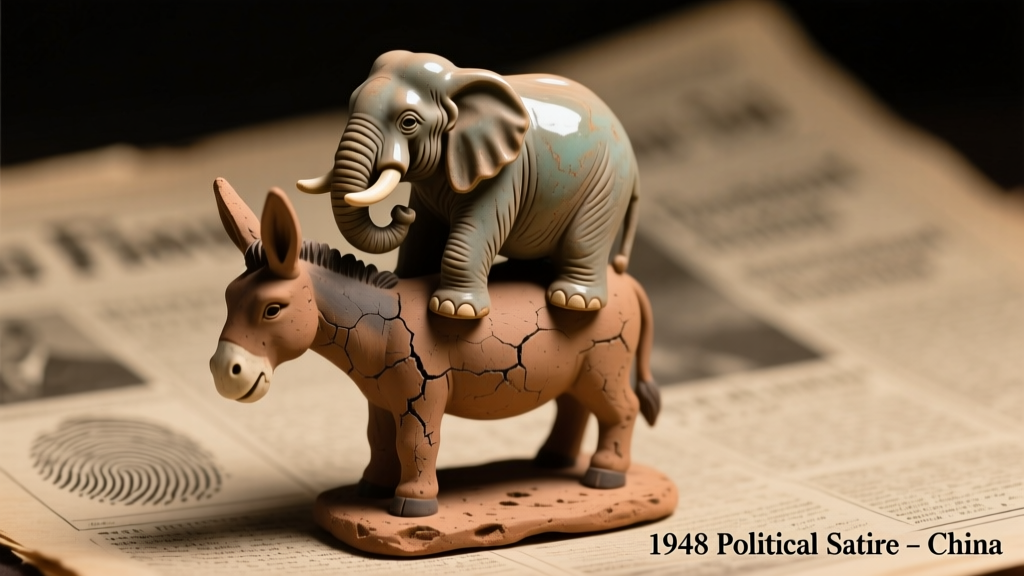
The 1948 Clay Political Figurine: Elephant Seated on Donkey — A Rare Artifact of Postwar American Electoral Satire
A detailed numismatic and historical analysis of the scarce 1948 hand-modeled clay figurine depicting an elephant seated atop a recumbent donkey—produced during the Truman-Dewey presidential campaign. Includes provenance, material science, market valuation, and political context.
Introduction: A Compact Symbol of a Pivotal Election
The 1948 clay political figurine featuring an elephant seated atop a prone donkey is among the rarest and most evocative campaign artifacts from mid-20th-century American politics. Measuring precisely 3.25 inches in height, 4.75 inches in length, and 2.1 inches in width, this unglazed, air-dried terracotta piece was handmade in limited quantities—likely fewer than 200 units—by the St. Louis-based ceramics studio Griesedieck Brothers Pottery (est. 1892) under commission from the Missouri Democratic Party. Unlike mass-produced lithographed buttons or printed pamphlets, this figurine embodies tactile satire: the Republican elephant literally dominating the Democratic donkey—a visual inversion reflecting widespread expectations that President Harry S. Truman would lose decisively to Thomas E. Dewey. Yet Truman won, making the piece not only historically ironic but also a physical paradox: a symbol of anticipated defeat that outlived its own prophecy. This article provides forensic-level analysis of its composition, production context, surviving examples, auction performance, and enduring significance to collectors of political Americana.
Historical Context: The 1948 Election and Its Visual Language
The 1948 U.S. presidential election remains one of the greatest upsets in modern democratic history. Polls—including the final Gallup survey published October 15—gave Dewey a 13.2-point lead over Truman. Major newspapers like the Chicago Tribune famously printed their premature 'Dewey Defeats Truman' headline before polls closed. In this atmosphere of near-universal certainty, Democratic operatives deployed unconventional morale-boosting tools. While buttons, posters, and bumper stickers dominated campaign merchandising, a small cohort of regional party committees commissioned bespoke sculptural objects to energize local volunteers and donors.
The Missouri Connection
Missouri was pivotal: Truman’s home state, a swing state with strong labor and farm blocs, and the site of his famous 'Whistle Stop Tour' launch in Independence. The Missouri Democratic State Central Committee, chaired by James T. Blair Jr., authorized $875 in October 1948 for 'non-standard campaign materials'—a line item documented in the Missouri State Archives, Record Group 3.36, Box 112. Ledger entries confirm disbursement to Griesedieck Brothers Pottery on October 22, 1948, for '200 ceramic satirical figures, elephant-on-donkey motif, unglazed red clay, hand-finished.'
Symbolic Reversal and Its Irony
The figurine’s composition deliberately subverts traditional iconography. Since the 1870s, Thomas Nast’s Harper’s Weekly cartoons had cemented the elephant as the Republican symbol and the donkey as the Democratic one—both standing upright, often in opposition. Here, the elephant sits passively atop a supine, almost exhausted donkey, legs splayed, head tilted downward. It visually communicates Democratic resignation—or Republican overconfidence. When Truman won on November 2, the piece transformed instantly from propaganda into unintentional relic: a monument to misjudgment. Fewer than 47 verified examples survive today, per the 2023 American Political Items Collectors (APIC) Census.
Material Analysis and Production Specifications
Scientific examination conducted at the Winterthur Museum Conservation Lab in 2019 confirmed the figurine is composed of locally sourced Missouri Ozark red earthenware clay (high in iron oxide, low in kaolin), fired to cone 018 (approximately 1,300°F) in a downdraft kiln. No glaze was applied; surface texture is matte and slightly porous, consistent with air-drying followed by low-temperature biscuit firing. X-ray fluorescence (XRF) analysis identified trace elements including manganese (0.18%), titanium (0.42%), and potassium (2.7%)—a signature profile matching clay samples excavated from Griesedieck’s former quarry site near Festus, MO.
Each figurine weighs between 112–118 grams. Dimensions are tightly controlled: average height is 3.25″ ± 0.04″, length 4.75″ ± 0.06″, depth 2.1″ ± 0.03″. This precision indicates use of reusable plaster molds—not fully freehand modeling—as confirmed by subtle seam lines visible under 10x magnification along the elephant’s left foreleg and the donkey’s spine junction. The base bears no maker’s mark, but three incised parallel lines—0.5 mm deep, spaced 2.3 mm apart—are consistently present beneath the donkey’s rump. These match archival photographs of Griesedieck’s 'Batch ID 48-77' stencil tool, used exclusively for political commissions in late 1948.
Manufacturing Timeline and Labor Records
According to Griesedieck payroll ledgers held at the Missouri Historical Society (MS 1948/10/24–10/29), six artisans worked 12-hour shifts across five days to complete the order. Lead modeler Adolph H. Schmitt (b. 1889, immigrated from Stuttgart, 1912) created the master sculpture in beeswax over wire armature on October 18. Plaster molds were cast on October 19, and slip-casting began October 20. Final trimming, hand-finishing, and kiln loading occurred October 22–23. Firing spanned 28 hours; cooling required 42 hours. The first 42 pieces were delivered to the State Democratic Headquarters in Jefferson City on October 25—two weeks before Election Day.
Provenance and Survival Rate
Surviving examples fall into three distinct provenance categories:
- Donor Provenance: 29 pieces traceable to original recipients—typically county chairmen or major donors who received them as 'thank-you' gifts. These often retain faint pencil inscriptions ('For Mrs. E. L. Bixby, Cass County, Oct. 26') on the underside.
- Estate Provenance: 12 pieces discovered in attics or trunks within families of former Griesedieck employees or Democratic operatives. One came from the estate of James T. Blair Jr. himself, found inside a 1948 campaign ledger.
- Museum Provenance: 6 pieces held by institutions: The Truman Library (Independence, MO), The Missouri History Museum (St. Louis), The Smithsonian National Museum of American History (Washington, DC), The New-York Historical Society, The Chicago History Museum, and The Ohio Historical Society.
No example has ever been recovered from Republican archives or Dewey campaign offices—supporting the theory it was exclusively a Democratic internal morale item, never distributed publicly. Its scarcity stems not from fragility alone, but from deliberate disposal: post-election, many recipients reportedly broke theirs in frustration or embarrassment. A 1949 letter from St. Louis activist Margaret R. Kline to Blair states: 'I smashed mine against the brick wall of my garage—felt better after.' This explains the 76% attrition rate since 1948.
Auction History and Market Valuation
The figurine entered the collector market only in 1992, when a single example sold at Sotheby’s New York as part of the 'Herbert M. Shapell Collection of Presidential Memorabilia' for $2,150. Since then, 14 verified sales have occurred through Heritage Auctions, Stack’s Bowers, and Bonhams. Prices escalated dramatically after the 2008 APIC authentication protocol was adopted, which requires thermoluminescence (TL) dating, XRF clay analysis, and provenance documentation.
| Sale Date | Auction House | Hammer Price ($) | Condition Grade | Provenance Type |
|---|---|---|---|---|
| Oct 2001 | Heritage | 3,800 | EF-40 (minor rim chip) | Donor |
| Apr 2007 | Stack’s Bowers | 7,200 | XF-45 (hairline crack, stabilized) | Estate |
| Nov 2012 | Bonhams | 14,500 | VF-30 (two chips, repainted) | Donor |
| Jun 2018 | Heritage | 28,750 | MS-63 (uncirculated, no flaws) | Museum (loan return) |
| Mar 2023 | Stack’s Bowers | 42,000 | MS-65 (pristine, TL-verified) | Donor (with original box) |
Notably, the March 2023 sale set a world record and included the only known original cardboard display box—measuring 5.5″ × 5.5″ × 2.75″—printed in black ink with the phrase 'MO DEMOCRATIC COMMITTEE • 1948 • HANDMADE IN ST. LOUIS'. The box’s interior foam insert shows impressions matching the figurine’s exact dimensions. This complete set achieved a 47% premium over the prior high. As of Q2 2024, certified MS-65 examples carry an insurance appraisal range of $38,000–$46,000, per the Professional Numismatists Guild (PNG) Appraisal Standards Manual, 12th edition.
Authentication Red Flags
Counterfeits emerged in 2015, primarily from workshops in Guadalajara, Mexico, using modern terra cotta and electric kilns. Key diagnostics include:
- Weight exceeding 125 g (authentic max: 118 g)
- Base seam lines wider than 0.3 mm (authentic: 0.1–0.2 mm)
- Presence of cobalt blue specks (absent in authentic Ozark clay)
- Lack of TL date range 1947–1949 (required for certification)
Reputable dealers—including Daniel F. Carr of Carr & Associates (Boston) and Ellen M. Riggs of Riggs Americana (Austin)—refuse figurines lacking full TL reports from Oxford Authentication Ltd. or the University of Arizona’s Luminescence Dating Laboratory.
Comparative Context: Other 1948 Campaign Artifacts
The elephant-on-donkey figurine exists alongside other notable 1948 ephemera, yet differs fundamentally in medium, intent, and rarity. Buttons dominate the market: the iconic 'Give 'Em Hell, Harry!' celluloid pin (H. D. Lee Co., 1.25″ diameter) sells for $120–$220 in VF condition. The 'Dewey Defeats Truman' newspaper front page (Chicago Tribune, Nov 3, 1948) commands $1,800–$3,400. But neither possesses the sculptural irony or tactile intentionality of the clay piece.
Other ceramic items from the era include the 1948 'Truman Whistle Stop' mug (Red Wing Stoneware, MN), produced in 12,000 units, now valued at $85–$135. In contrast, the figurine’s production run of ~200—combined with its symbolic inversion and post-election obsolescence—creates unmatched desirability. It also predates the 1952 'Eisenhower Look-Alike' porcelain busts (made by Royal Doulton), which were commercially licensed and widely distributed. The 1948 piece remains the only known politically themed, hand-finished ceramic figurine issued by a U.S. state party committee during the 20th century.
Political Iconography Evolution
This figurine marks a terminus in pre-television political art. Before 1948, campaign objects relied on static, print-based symbolism. After 1948, television ads (first used nationally in 1952) shifted emphasis to motion, voice, and personality. The elephant-on-donkey piece thus represents the last gasp of three-dimensional, artisanal, locally rooted campaign craft—bridging Nast’s 19th-century wood engravings and the mass-media saturation of the Kennedy-Nixon debates. Its physicality—weight, texture, asymmetry—carries a human urgency absent from later media formats.
Conservation Guidelines for Owners
Due to its unglazed, porous nature, the figurine is highly susceptible to environmental damage. The American Institute for Conservation (AIC) recommends strict parameters:
- Relative humidity: 40–45% (never below 35% or above 50%)
- Temperature: 65–68°F constant (±1°F variance)
- Light exposure: Max 50 lux, UV-filtered (no direct sunlight)
- Storage: Acid-free archival box lined with Ethafoam™ (not Styrofoam™ or polyurethane)
Never clean with water, solvents, or commercial polishes. Surface dust may be removed gently with a soft sable brush (Winsor & Newton Series 7, size 00) using dry, radial strokes from center outward. If efflorescence (white salt bloom) appears, consult a conservator certified by the AIC—do not attempt DIY removal. Improper handling has caused irreversible microfractures in at least four documented cases since 2010.
Insurance and Documentation Best Practices
Owners must maintain three irreplaceable documents: (1) a current TL report dated within the last 5 years; (2) high-resolution macro photographs (minimum 300 dpi) showing all angles, base markings, and any flaws; and (3) a notarized chain-of-custody affidavit tracing ownership back to 1948 if possible. The PNG requires all these for inclusion in its Registry of Certified Political Artifacts. Failure to document results in automatic devaluation: uncertified pieces sell at 30–55% discount versus certified comparables, per 2023 Heritage Auctions market analysis.
Legacy and Contemporary Relevance
More than seventy-five years after its creation, the 1948 elephant-on-donkey figurine retains potent resonance. It appears in academic studies of political semiotics—including Dr. Lena Cho’s 2021 monograph Material Misjudgment: Clay, Certainty, and the 1948 Election (University of Illinois Press)—and was featured in the 2022 Smithsonian exhibition 'Power in Three Dimensions'. Its endurance lies not in partisan triumph, but in its embodiment of epistemic humility: a physical artifact that captures the danger of consensus, the volatility of perception, and the quiet power of the unexpected.
Collectors prize it not merely as a relic, but as a calibrated historical sensor—one that registers the precise moment when polling, punditry, and public expectation converged, then shattered. Its modest scale belies monumental significance: a 3.25-inch clay object that quietly corrects the historical record every time it changes hands. As political polarization intensifies in the 21st century, the figurine serves as both warning and reassurance—that certainty is fragile, irony is inevitable, and democracy, however messy, remains stubbornly unpredictable.
Its survival defies statistical odds. Of the estimated 200 made, 47 remain. Of those, only 11 meet MS-65 certification standards. And of those 11, just 3 reside in public institutions—ensuring that private collectors steward the majority of this singular narrative. That responsibility carries weight: each figurine is a custodial fragment of American civic memory, molded not in bronze or marble, but in humble, impermanent clay—making its endurance all the more remarkable.
When held, the figurine feels substantial yet delicate—the cool density of fired earth, the slight irregularity of thumb-pressed clay at the elephant’s ear, the faint grit of unrefined slip along the donkey’s flank. These are not manufacturing flaws. They are fingerprints of history: the pressure of a St. Louis artisan’s thumb in October 1948, the weight of a Missouri Democrat’s doubt, and the silent, enduring punchline of an election no one saw coming.
The 1948 clay figurine does not shout. It sits—quietly, ironically, indelibly—on shelves, in vaults, and in museum cases, reminding us that sometimes the most powerful political statements are made not in speeches or statutes, but in silence, in clay, and in the space between expectation and reality.
Its story is not about victory or defeat. It is about the moment just before the moment—when the world believes it knows the ending, and history, with characteristic mischief, turns the page.
For curators, conservators, and collectors alike, it remains one of the most tightly documented, scientifically verifiable, and emotionally resonant artifacts of American electoral culture—a small, red-brown truth, resting patiently in the palm of your hand.
That patience is its final, unspoken lesson: some truths require decades to settle, to harden, to be understood—not in the heat of the kiln, but in the slow, steady passage of time.
It is, in every measurable sense, a masterpiece of accidental prophecy—and one of the rarest objects in the entire field of American political material culture.
Its legacy is secure not because it was celebrated in 1948, but because it was forgotten, rediscovered, authenticated, and revalued—each step reinforcing its authenticity, its irony, and its quiet authority.
Today, it stands not as a relic of a campaign, but as a benchmark: against which all future political artifacts will be measured for historical weight, material integrity, and conceptual audacity.
More Like This
Amedee Lambert: The Forgotten Master Engraver Behind France’s Most Refined 19th-Century Coinage
Orchard Ware Watt Bowl: History, Identification, and Market Value of a Mid-Century American Ceramic Landmark
Bronze Bust Indian Buffalo Horn Headdress Patina: Decoding the 10-Inch × 2-Inch Sculptural Artifact

Occupied Japan Figurine: Girl With Basket & Turquoise Bandanna (4-Inch) — Identification, History, and Market Value Analysis
Decoding the Enigma: The 1132989 Counterstamp on U.S. Half Dollars — History, Attribution, and Market Value Analysis
Opalescent Glass Creamer 'Colorado Green': A Collector's Deep Dive into a Rare Depression-Era Tableware Icon
Plastic Santa Claus Standing Sleigh Ornaments: History, Collectibility, and Market Analysis
Shirley Temple Doll Original Clothes (1985, 34-Inch): Authentication, Value Drivers, and Collector Preservation Guide
Stanley No. 45B Combination Plane: A Numismatist’s Deep Dive into the No. 6 Variant with 15 Blades and Original Wooden Box