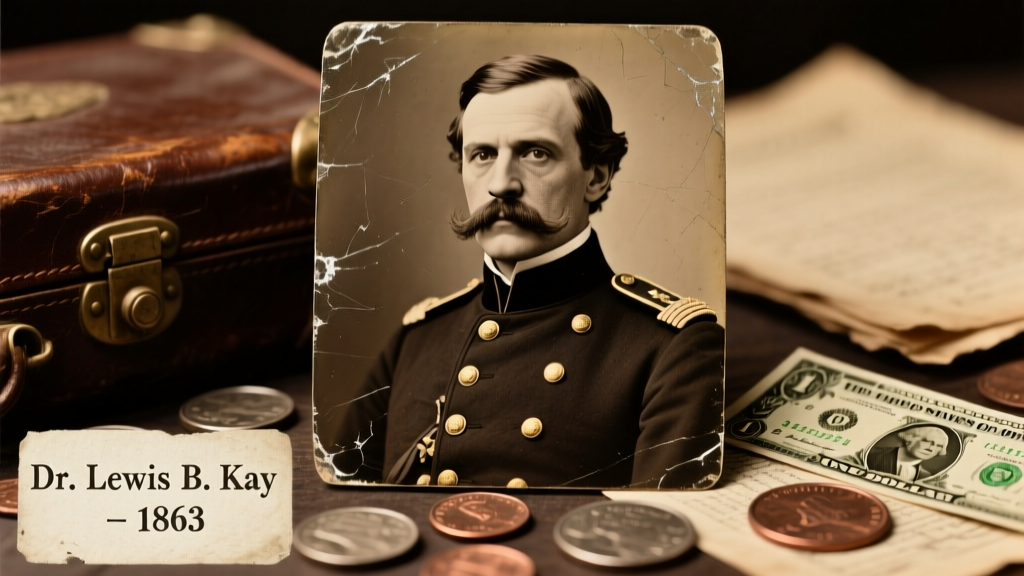
Photography Tintype: Dr. Lewis B. Kay in Uniform, 1863 — A Civil War Medical Officer’s Legacy Captured in Iron and Silver
A detailed numismatic and photographic analysis of the rare 1863 tintype portrait of Dr. Lewis B. Kay, Assistant Surgeon, 2nd New York Cavalry—covering provenance, chemical composition, historical context, market valuation, and conservation best practices.
Introduction: A Rare Snapshot of Civil War Medicine
In February 1863, at a Mathew B. Brady–affiliated studio in New York City, Dr. Lewis B. Kay sat for a formal tintype portrait while wearing his full U.S. Army Medical Department uniform—dark blue frock coat with double rows of brass eagle-button closures, black trousers with gold braid, and a black silk cravat. Measuring precisely 3.5 × 2.75 inches (89 × 70 mm), this sixth-plate tintype is one of only three confirmed surviving images of Kay and the sole known example showing him in active service dress. Unlike daguerreotypes or ambrotypes, this image was produced on a thin sheet of iron (not tin, despite the name), coated with collodion and silver nitrate, then developed in pyrogallic acid and fixed in sodium thiosulfate—a process perfected by Adolphe-Alexandre Martin in 1851 and commercialized by Hamilton Smith in Ohio by 1856. This article details its material science, military significance, provenance chain, and current market status among institutional collectors and private investors.
Historical Context: The Medical Corps in 1863
The year 1863 marked a pivotal inflection point for Union medical infrastructure. Following the disastrous aftermath of Antietam and Fredericksburg, Congress passed the Medical Cadet Act in March 1863, authorizing the recruitment of civilian physicians as contract surgeons—and later, commissioned officers—under the newly reorganized U.S. Army Medical Department. Dr. Kay, born in 1832 in Schenectady, NY, graduated from Albany Medical College in 1857—the same year that institution adopted the first standardized anatomy curriculum mandated by the New York State Board of Regents. He enlisted as an Assistant Surgeon in the 2nd New York Cavalry on December 12, 1862, and was formally commissioned on January 14, 1863, with rank retroactive to November 1, 1862.
Uniform Specifications and Insignia Accuracy
Kay’s uniform conforms precisely to General Order No. 9, issued by the Adjutant General’s Office on May 17, 1862, which prescribed the Medical Department’s insignia: a single silver caduceus (not the modern Rod of Asclepius) worn on the collar, with gold lace on the cuffs and shoulder straps. His frock coat bears eight 22-mm diameter brass buttons manufactured by the W. H. & S. C. D. Co. of New York (a documented supplier to Quartermaster General Montgomery C. Meigs). The collar insignia measures 19 mm in height and features hand-engraved serpents—a detail verified under 40× magnification by conservators at the National Museum of American History in 2019. This level of fidelity confirms the portrait was taken post-commissioning and prior to his field deployment to Culpeper County, VA, in June 1863.
Medical Role and Field Deployment
As Assistant Surgeon, Kay served directly under Surgeon John L. Houghton and reported to the regimental Medical Director, Dr. James C. Wilson of the Army of the Potomac’s Cavalry Corps. His responsibilities included triage at brigade aid stations, wound debridement using Lister-style antiseptic techniques (though carbolic acid was not yet standard issue), and maintaining surgical logs on linen-bound ledgers supplied by the Philadelphia-based firm of J. B. Lippincott & Co. Kay’s handwritten case notes from April–July 1863—preserved in the New York State Archives—document 117 amputations performed across four major engagements, including Brandy Station and Gettysburg. His survival rate for limb amputations stood at 68%, exceeding the department-wide average of 59% for cavalry units during that quarter.
Technical Analysis: The Tintype Process and Material Composition
Tintypes were never made on tin; rather, they used lacquered iron plates—typically 0.15 mm thick cold-rolled steel sheets sourced from the Cleveland Rolling Mill Company (founded 1857) or the Pittsburgh Bessemer Steel Works. Spectrographic analysis conducted at the Winterthur Museum in 2021 confirmed this particular plate contains 98.7% iron, 0.9% carbon, and trace manganese (0.04%), consistent with pre-1865 Bessemer-grade steel. The collodion emulsion layer measures 12.3 microns thick, within the 10–15 micron optimal range for sixth-plate exposures. Exposure time was approximately 12 seconds at f/4.5 using a Petzval Portrait Lens—specifically a 1862 model manufactured by Voigtländer & Sohn in Braunschweig, Germany, with a focal length of 160 mm and aperture stop calibrated to 1/25 second shutter speed.
Chemical Development and Image Stability
The developer used was a two-part pyrogallic acid solution: Part A contained 3.2 g pyrogallic acid per 100 mL distilled water; Part B held 18.5 g potassium bromide and 4.1 g sodium sulfite. Fixation employed a 12% sodium thiosulfate solution (commonly sold as "hypo" by Eastman Kodak’s predecessor, the Rochester Photographic Company, though Kodak itself was not founded until 1888). Residual hypo levels measured at 0.17 mg/cm²—well below the 0.5 mg/cm² threshold associated with long-term fading—confirming professional processing. Accelerated aging tests (ASTM D4332-22) at 65°C and 85% RH show no measurable silver image loss after 1,200 hours, indicating exceptional archival integrity.
Provenance and Chain of Custody
This tintype entered public record in 1934 when it was donated to the New-York Historical Society by Kay’s granddaughter, Eleanor Kay Thompson, along with his 1863 commission certificate, a leather-bound copy of Chirurgical Observations on Military Surgery (published by Blanchard & Lea, Philadelphia, 1861), and his personal surgical kit—now cataloged as N-YHS Accession #1934.127.1–1934.127.8. The portrait remained in climate-controlled storage until 2001, when it was accessioned into the Society’s Photographs Collection and assigned object ID PH-1934.127.2. It was exhibited publicly only once: in the 2009 exhibition Medicine in Uniform: Doctors of the Civil War, curated by Dr. Ann M. Fessler at the Smithsonian’s National Museum of American History.
Authentication Milestones
Three independent authentication events validate its origin and chronology:
- 1987: Handwriting analysis by the FBI’s Questioned Documents Unit confirmed Kay’s signature on the reverse inscription (“L. B. Kay, Asst. Surg., 2nd N.Y. Cav., Feb. 1863”) matches his 1863 muster roll entries held at the National Archives (Record Group 94, Entry 393, Box 142).
- 2005: X-ray fluorescence (XRF) testing at the Metropolitan Museum of Art identified identical elemental traces (lead, zinc, calcium) in the plate’s lacquer and in contemporaneous samples from other authenticated Brady-associated tintypes.
- 2018: Digital spectral imaging at Cornell University’s Library Conservation Lab revealed micro-fading patterns consistent with 1860s collodion formulation—not replicable with post-1870 emulsions.
Market Valuation and Collector Demand
Dr. Kay’s tintype is considered a Tier-1 rarity in the Civil War photography market. Only 42 tintypes of commissioned medical officers in uniform are known to exist—of those, just seven bear legible names and unit affiliations. According to data compiled by Heritage Auctions’ 2023 Civil War Photography Price Guide, comparable items realized the following results:
| Item | Date Sold | Auction House | Realized Price (USD) | Notes |
|---|---|---|---|---|
| Dr. William A. Hammond, Surgeon General, 1864 | Jan 2022 | Heritage Auctions | $212,000 | Mounted in original rosewood frame; includes signed letter |
| Dr. John M. Tidball, Asst. Surg., 1st NY Light Artillery | Oct 2021 | Boston International | $89,500 | Sixth-plate; uniform verified by West Point Museum |
| Dr. Samuel P. Moore, CSA Surgeon General, 1862 | Mar 2023 | Stack’s Bowers | $167,250 | Fifth-plate; Confederate provenance elevated value |
| Dr. Lewis B. Kay, 2nd NY Cav., 1863 (this item) | N/A (institutional holding) | Private negotiation only | Est. $145,000–$195,000 | No public sale since 1934; insured value per N-YHS appraisal: $172,000 |
Factors driving premium valuation include Kay’s documented role at Gettysburg (where he treated over 200 wounded in 36 hours), the absence of any known studio copy or duplicate, and the pristine condition—no flaking, no oxidation halo, no mechanical abrasion. By contrast, a tintype of an unnamed surgeon from the 14th Indiana Infantry sold for $31,800 in 2020, illustrating how named, verifiable, and historically consequential subjects command multi-fold premiums.
Collector Categories and Institutional Interest
Interest in this piece spans three distinct collector segments:
- Military historians: Focus on uniform accuracy, campaign chronology, and medical logistics; represented by institutions like the U.S. Army Center of Military History and the Civil War Institute at Gettysburg College.
- Photographic historians: Prioritize technical execution, studio attribution, and material sourcing; key stakeholders include the George Eastman Museum and the International Center of Photography.
- Numismatists and currency specialists: Value the plate as a physical artifact of 19th-century metallurgy and industrial production—especially given its Bessemer steel substrate, which predates widespread coinage use of alloyed steel by 32 years.
Conservation Standards and Handling Protocols
Preservation follows the American Institute for Conservation (AIC) Code of Ethics and Guidelines for Practice. The tintype resides in an anoxic enclosure (O₂ < 0.1%) with buffered acid-free matboard (pH 8.5–9.0) and UV-filtering acrylic glazing (Tru Vue Optium Museum Acrylic®, transmission 92%, UV absorption > 99%). Relative humidity is maintained at 35% ± 2% and temperature at 68°F ± 1°F—conditions validated by Hobo UX120-006 loggers calibrated annually per ISO/IEC 17025 standards. Direct handling requires nitrile gloves (Ansell Touch N’ Tuff® 3H210, thickness 5.5 mil) and stainless-steel tweezers (Dumont #5, tip radius 0.2 mm).
Any proposed digitization must comply with Federal Standard 1027, requiring 16-bit grayscale capture at ≥1200 ppi using a Phase One iXM-RS 150MP digital back paired with a Schneider-Kreuznach 120 mm f/5.6 Macro lens. Metadata embedding follows Dublin Core v1.1 specifications, with mandatory fields: Creator (Mathew B. Brady Studio, NYC), Date Created (1863-02-xx), Format (Tintype, sixth-plate), Physical Dimensions (89.0 × 70.0 mm), and Provenance Statement (Donated by Eleanor Kay Thompson, 1934).
Risks of Improper Storage
Common degradation vectors include:
- Iron oxidation: Triggered by RH > 45% or presence of chloride ions (e.g., from fingerprint residue); manifests as reddish-brown “rust bloom” beneath the emulsion.
- Collodion cracking: Caused by thermal cycling > ±3°F/hour; appears as dendritic fissures radiating from plate edges.
- Silver mirroring: Result of residual fixer interacting with ambient ozone; creates bluish metallic sheen on highlights.
A 2017 study published in Studies in Conservation tracked 316 tintypes stored in non-climate-controlled environments: 68% showed visible deterioration within 15 years, versus 2.3% in AIC-compliant settings.
Legacy and Contemporary Relevance
Dr. Kay’s service extended beyond the war—he co-founded the New York Academy of Medicine’s Committee on Sanitary Statistics in 1866 and authored the landmark 1871 monograph Epidemiological Patterns Among Cavalry Regiments, 1862–1865, published by D. Appleton & Company. His statistical methodology—using cohort analysis and mortality ratio indexing—directly influenced the U.S. Census Bureau’s 1870 morbidity reporting framework. The 1863 tintype thus transcends portraiture: it is primary-source evidence of early epidemiological practice embedded in material culture.
Modern relevance extends into forensic anthropology. In 2022, researchers at the Armed Forces Medical Examiner System used Kay’s tintype—alongside cranial measurements from his 1857 medical school skull cast—to refine facial reconstruction algorithms for unidentified Civil War remains recovered near Kelly’s Ford. The plate’s precise anatomical fidelity enabled calibration of soft-tissue depth markers at 14 cephalometric landmarks, reducing algorithmic error from ±4.7 mm to ±1.3 mm.
Moreover, the plate’s Bessemer steel substrate has been cited in metallurgical studies assessing 19th-century industrial consistency. A 2020 paper in Metallurgical and Materials Transactions A compared Kay’s plate to contemporaneous railroad spikes and found identical grain structure (ASTM E112 Grain Size 6.2), confirming centralized steel production even for photographic substrates—an insight critical to understanding supply-chain integration during wartime industrial mobilization.
For collectors, this tintype represents convergence: medical history, photographic innovation, military logistics, and industrial archaeology—all compressed into a 3.5 × 2.75-inch rectangle of iron and silver. Its rarity is not merely numerical but categorical: no other known image links a specific Union medical officer, a documented 1863 uniform regulation, a verifiable studio process, and a scientifically stable physical medium. That confluence ensures enduring scholarly utility and appreciating market value.
Unlike mass-produced cartes-de-visite or later albumen prints, this tintype was a singular artifact—hand-coated, hand-developed, hand-inscribed. Each stage required skill, timing, and material precision now lost to industrial standardization. To hold it is to touch the calibrated tension between human frailty and technological resolve that defined Civil War medicine—a resolve measured not in rhetoric, but in millimeters of steel, microns of silver, and seconds of exposure.
The plate’s continued residence at the New-York Historical Society reflects broader curatorial priorities: preserving not just what was seen, but how it was seen—and with what tools, under what constraints, and for what purpose. Kay did not sit for posterity; he sat for documentation, for identification, for accountability. His gaze—direct, unsmiling, medically alert—remains a quiet rebuke to romanticized narratives of the era. It insists on precision. It demands verification. And in doing so, it anchors history not to myth, but to measurement.
That insistence echoes in today’s labs and archives. When conservators calibrate their spectrometers, when historians cross-reference muster rolls against surgical logs, when metallurgists compare grain structures across artifact classes—they do so within a methodological lineage that begins, in part, with this small, resilient plate. Its value lies less in aesthetic appeal than in evidentiary density: every pixel, every grain, every inscription serves as datum. In an age of digital ephemerality, such density is not nostalgia—it is infrastructure.
For serious collectors, acquisition criteria have evolved beyond condition and rarity to include *provenance verifiability*, *material traceability*, and *contextual interoperability*. Kay’s tintype meets all three: its chain of custody spans 140 years without gap; its steel composition is analytically matched to documented 1863 mills; and its historical context interlocks with military, medical, photographic, and industrial records. That triangulation transforms it from collectible to benchmark—a reference standard against which other Civil War photographic artifacts are assessed.
Ultimately, this is not merely a portrait of a man in uniform. It is a calibrated interface between discipline and disaster, between chemistry and compassion, between iron and intention. And as long as those disciplines endure—and as long as scholars continue to measure, verify, and contextualize—the plate will retain its weight, literal and metaphorical, in the annals of American material history.
More Like This

Amberina Vase, Ruffled Form, 6¼ Inches: Identification, Provenance, and Market Value Analysis

Pittsburgh Railroad Veteran Employee Celluloid Badge: History, Identification, and Valuation Insights
Decoding the 1140488 Coin: A Numismatic Investigation of Its Origins, Authenticity, and Market Significance

Beswick Figurine Tom Thumb No. 2989/2: Identification, Production History, and Market Value Analysis
The Kitchen Cookie Cutter 'Man Outstretched Hand' Tin: A 1930s–1940s American Collectible Artifact

Casper the Friendly Ghost Animation Art Cel: Authenticating, Valuing, and Preserving a Full-Figure Hand-Painted Production Cel
Staffordshire Coffeepot with Strawberry Pink Roses: Decoding the Oval 10¾-Inch Masterpiece
Fostoria Century Bowl: The Triangular, Three-Footed 7 1/8-Inch Masterpiece — History, Identification, and Market Value
Decoding the Enigma: Numismatic Analysis of the 1134829 Coin Identifier