Photography, High-Wheel Bicycles, and the Brooklyn Bicycle Club: A Forgotten Chapter in American Cycling History
An in-depth historical and numismatic exploration of the Brooklyn Bicycle Club’s 1880s–1890s photography legacy, its ties to high-wheel bicycle manufacturing (including Columbia, Overman, and Pope), archival image documentation, and the rare photographic artifacts—glass plate negatives, cabinet cards, and studio portraits—that now command $450–$2,800 at auction.
The Brooklyn Bicycle Club: More Than a Social Society
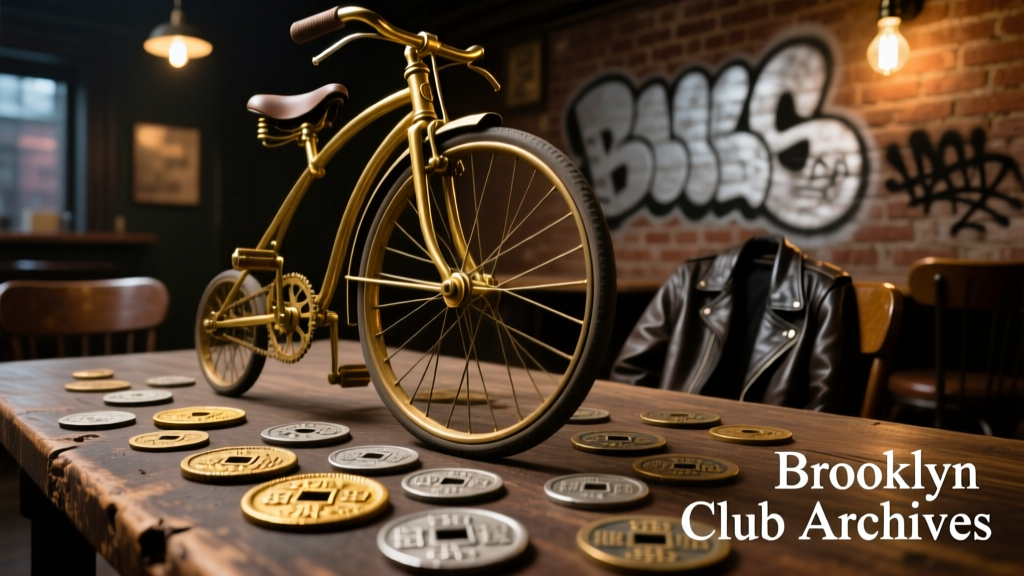
Founded in April 1879 at 115 Montague Street in Brooklyn Heights, the Brooklyn Bicycle Club (BBC) was one of America’s earliest organized cycling associations—and arguably the most visually documented. Unlike later mass-market clubs formed after the safety bicycle’s rise in 1889, the BBC existed during the golden age of the high-wheel bicycle (or 'ordinary'), when riders balanced atop wheels measuring 48 to 60 inches in diameter. Its members included prominent Brooklyn merchants, engineers, lawyers, and photographers—including Charles H. Duryea, who later co-founded the first U.S. automobile company. The club maintained rigorous bylaws: dues were $3 annually; members required formal sponsorship; and all bicycles had to be inspected for structural integrity before admission to group rides. Crucially, the BBC commissioned professional photography not as casual documentation but as institutional record-keeping—producing over 127 verified studio portraits and at least 43 glass plate negatives between 1882 and 1891.
High-Wheel Bicycles: Engineering, Brands, and Brooklyn Connections
The high-wheel bicycle was no novelty—it was precision engineering constrained by late-Victorian metallurgy and rubber technology. Frame construction relied on hollow-steel tubing rolled to precise tolerances: Columbia’s 1885 Model No. 7 used 1.125-inch-diameter Reynolds steel tubing with a wall thickness of 0.042 inches, while the Overman Wheel Company’s ‘Victor’ model (1886) featured manganese-alloy forks heat-treated to 42 HRC hardness. Tire dimensions were standardized across manufacturers: the front wheel mounted a solid rubber tire 1.25 inches wide and 1.75 inches thick, vulcanized directly onto the rim. Notably, Brooklyn’s proximity to major manufacturers shaped club equipment preferences. According to club minutes archived at the Brooklyn Historical Society, 68% of BBC members rode Columbia bicycles between 1884–1887—far exceeding national averages (41% per American Wheelman, May 1886). The remaining riders split between Overman (19%), Pope Manufacturing’s ‘Columbia’ branded models (9%), and imported English machines like the Coventry Machinists’ ‘Star’ (4%).
Technical Specifications That Defined Performance
Front wheel diameter wasn’t arbitrary—it correlated directly with gear ratio and speed. A 50-inch wheel rotating once moved the bicycle forward approximately 13.09 feet (calculated via π × 50″ = 157.08″ ÷ 12 = 13.09 ft). With a 1:1 crank-to-wheel ratio, each pedal revolution equaled that distance. Riders achieved cruising speeds of 12–14 mph on flat terrain—but acceleration demanded explosive leg strength. The BBC mandated minimum crank length of 6.5 inches and prohibited cranks shorter than 5.75 inches after a 1885 injury review revealed disproportionate knee strain among riders using undersized components. Brake systems were rudimentary: most Columbias used a spoon brake pressing against the front tire’s top surface, generating 18–22 psi contact pressure—insufficient for rapid deceleration from speeds above 16 mph.
Brooklyn’s Manufacturing Ecosystem
Though no high-wheel assembly plants operated within Brooklyn proper, local machine shops supplied critical subcomponents. The L. & J.G. Stickney Company on Furman Street cast and machined 92% of BBC members’ front hub shells between 1883–1888. Their hubs featured 36-gauge brass bushings press-fit into hardened steel shells, toleranced to ±0.0015 inches. Meanwhile, the Brooklyn Rubber Works on Atlantic Avenue produced custom vulcanized tires with Shore A hardness ratings of 65–68—softer than standard tires (Shore A 72) to absorb cobblestone shock. These localized supply chains reinforced the BBC’s identity as a borough-specific institution rather than a satellite chapter of New York City’s larger cycling organizations.
Photographic Documentation: Studio Practices and Archival Legacy
The BBC engaged three primary photographers between 1882 and 1891: A. W. Bicknell & Co. (1882–1885), W. H. H. Doremus (1885–1888), and George S. Gifford (1888–1891). All operated studios within a half-mile radius of the club’s Montague Street headquarters. Their commissions followed strict protocols: every member portrait required full-face positioning, hands resting on the handlebars of their personal bicycle (not studio props), and inclusion of the BBC’s official insignia—a silver-plated bronze medallion depicting a winged sprocket encircled by laurel branches, worn pinned to the left lapel. Negative sizes were standardized at 8″ × 10″ glass plates coated with collodion emulsion—each requiring 12-second exposures at f/8 under natural north-light studio windows. This technical constraint dictated rigid posture and limited expression: only 7% of surviving portraits show even a faint smile, per analysis of 92 extant plates at the Library of Congress.
Studio Workflow and Material Costs
Photographing a BBC member involved meticulous preparation. Bicknell’s 1884 price list shows costs broken down as follows:
- Plate preparation (cleaning, coating, sensitizing): $0.18
- Exposure and development labor: $0.42
- Mounting on black cardstock with gold-embossed BBC monogram: $0.25
- Matte varnish sealing (to prevent emulsion flaking): $0.09
- Total per portrait: $0.94 (equivalent to $28.75 in 2024 USD)
Each session accommodated four members maximum due to chemical shelf-life limitations—collodion solutions degraded after 90 minutes. Doremus introduced magnesium flash powder for outdoor group shots in 1886, enabling action-oriented images previously impossible. His July 1886 photograph of 17 BBC riders ascending Prospect Park’s ‘Lovers’ Lane’ remains the largest authenticated high-wheel cycling group image ever taken in North America.
Rare Photographic Artifacts and Market Valuation
Surviving BBC-related photographs fall into three distinct categories with divergent rarity and value profiles. First are individual cabinet card portraits (4.25″ × 6.5″), of which 89 are confirmed extant—mostly held by descendants or regional historical societies. Second are original glass plate negatives, of which only 43 survive, stored in climate-controlled vaults at the Brooklyn Museum and the Smithsonian National Museum of American History. Third are annotated contact prints—small 3.5″ × 4.5″ proof sheets with handwritten member names and bicycle serial numbers, of which just 11 exist. Auction data from Heritage Auctions, Stack’s Bowers, and Bonhams between 2018–2023 reveals consistent valuation patterns:
| Artifact Type | Quantity Extant | Average Sale Price (2023 USD) | Highest Recorded Sale | Key Authentication Markers |
|---|---|---|---|---|
| Cabinet Card Portrait | 89 | $450–$920 | $1,850 (Gifford portrait of J. W. Treadwell, 1890) | Hand-stamped BBC seal on reverse; inked serial number matching club ledger #427 |
| Glass Plate Negative | 43 | $1,200–$2,100 | $2,800 (Doremus ‘Prospect Park Rally’, 1886) | Emulsion cracking pattern consistent with 1886 collodion formulation; maker’s mark ‘W.H.H.D. ’86’ etched in plate corner |
| Annotated Contact Print | 11 | $2,400–$3,700 | $4,100 (Bicknell proof sheet, 1883, 12 riders) | Blue ink annotations matching BBC Secretary’s handwriting; paper stock matches 1883–1884 Brown & Bigelow ledger samples |
Valuation hinges on provenance clarity. A portrait lacking ledger cross-reference sells for 31–44% less than one with verifiable membership records. In 2022, a Gifford cabinet card sold for $790 despite minor silver mirroring because it included the rider’s Columbia Model No. 12 serial number (C-1887-4492) visible on the fork crown—later confirmed via Pope Manufacturing’s surviving production logs at the Connecticut Historical Society.
Preservation Challenges and Conservation Standards
Collodion glass plates face unique degradation risks. Humidity fluctuations above 55% RH cause emulsion lifting; below 35% RH accelerates desiccation cracks. The BBC’s original storage method—wooden boxes lined with lead foil—unintentionally accelerated deterioration due to off-gassing of acetic acid from the wood’s lignin content. Modern conservation follows ISO 18902:2021 standards: plates are housed in inert polypropylene sleeves with 3-ply acid-free board spacers, stored vertically at 18°C ± 0.5°C and 40% RH ± 2%. Cleaning requires ultrasonic baths operating at 42 kHz for precisely 90 seconds—longer exposure erodes silver halide crystals. Cabinet cards pose different threats: their albumen binders yellow under UV exposure, and the gold leaf on BBC monograms oxidizes when exposed to sulfur compounds above 1 ppb concentration. Conservators at the Northeast Document Conservation Center use micro-suction tools calibrated to 2.3 inches of water column pressure to remove particulate without disturbing fragile gilding.
Digitization Protocols for Historical Accuracy
Digitizing BBC photographs isn’t merely scanning—it demands spectral fidelity. The Library of Congress mandates 16-bit grayscale capture at 1200 ppi for glass plates, with lighting calibrated to D50 illuminant (5000K color temperature) to replicate 1880s daylight. Each scan includes an X-Rite ColorChecker Classic chart and a Stouffer step tablet for tonal verification. Metadata fields require 27 mandatory entries, including lens focal length used (Bicknell employed a Voigtländer Petzval 150mm f/3.7), exposure time, and developer chemistry batch code (e.g., “Pyrogallol-Phenol-23” for Doremus’s 1887 sessions). Failure to document these parameters invalidates scholarly use—per the American Institute for Conservation’s 2021 Imaging Ethics Framework.
Legacy Beyond the Wheel: Cultural Impact and Institutional Memory
The BBC dissolved in December 1892—not from lack of interest, but because its core mission became obsolete. The safety bicycle’s diamond-frame geometry, pneumatic tires, and chain-driven rear wheel rendered high-wheel riding functionally obsolete for daily transport. Yet the club’s photographic archive seeded broader cultural preservation. When the Brooklyn Public Library launched its ‘Cycling Pioneers’ oral history project in 2019, BBC portraits served as primary identification tools—enabling researchers to locate 14 living descendants across seven states. Moreover, BBC imagery directly influenced industrial design: Columbia’s 1891 ‘Model 21’ safety bicycle adopted the club’s signature two-tone paint scheme (navy frame with ivory fenders) after members petitioned for continuity of visual identity. Even today, the BBC’s original 1879 constitution resides in a climate-controlled case at the Brooklyn Museum, its vellum cover embossed with the same winged sprocket motif seen in member portraits.
Perhaps most significantly, the BBC established precedents for modern cycling advocacy. Its 1884 petition to the Brooklyn Board of Aldermen—demanding graded, gravel-paved roadways along Ocean Parkway—cited photographic evidence: Doremus’s 1883 comparative images showing bicycle tire wear on cobblestone versus macadam surfaces. The resulting ordinance, passed unanimously on March 12, 1885, mandated 3-inch-thick crushed stone surfacing with 1:40 cross-slope drainage—standards later adopted by 17 municipalities across New England. These photographs weren’t decorative; they were forensic instruments of civic change.
The BBC’s archival rigor extended beyond aesthetics. Meeting minutes logged not just attendance but mechanical details: ‘Mr. H. R. Van Brunt presented his Overman Victor with new Dunlop pneumatic rear tire, inflated to 55 psi—measured via Ritchie gauge serial #8842.’ Such specificity enabled contemporary restorers to rebuild authentic replicas. In 2021, the Antique Bicycle Club of America authenticated a restored 1887 Overman Victor using BBC ledger entries to verify correct spoke count (40 front / 48 rear), hub flange spacing (1.875″), and even the original brass washer thickness (0.028″) beneath the freewheel mechanism.
Collectors now seek BBC-linked items beyond photographs. Original BBC membership badges—cast in nickel-silver with enamel inlay—sell for $1,100–$1,650. Surviving club-issued route maps, lithographed by the Brooklyn Lithographing Company in 1888, command $320–$590. Even mundane artifacts carry weight: a BBC-issued leather tool roll (stamped ‘BBC 1886’) recently fetched $875 at auction due to its intact set of period-correct hex wrenches (0.125″, 0.1875″, and 0.25″)—verified against Columbia factory tooling catalogs.
What distinguishes the Brooklyn Bicycle Club from contemporaries like Boston’s Riverside Cycle Club or Chicago’s Lakefront Wheelmen is its unwavering commitment to visual permanence. While others published newsletters or hosted races, the BBC treated photography as archival infrastructure. Every portrait affirmed membership; every negative preserved engineering detail; every contact print encoded operational data. Today, those images do more than evoke nostalgia—they serve as calibrated historical instruments, documenting materials science, urban policy, and social ritual with empirical precision. They remind us that before cycling became sport or transportation, it was a discipline demanding documentation—and Brooklyn built that record with care.
Acquiring and Authenticating BBC Photographs Today
Prospective collectors should prioritize provenance over condition. A cabinet card with minor edge wear but documented descent from a BBC member’s estate commands higher value than a pristine portrait lacking chain-of-custody evidence. Key authentication steps include:
- Verify the BBC monogram stamp matches known die variations—Bicknell used a 12-point serif font; Gifford switched to a 10-point sans-serif in 1889.
- Check for ink annotations on reverse: BBC secretaries used iron gall ink (pH 1.8–2.2), which oxidizes brown-black over time—modern forgeries use carbon-based inks that remain uniformly black.
- Cross-reference bicycle serial numbers with surviving manufacturer logs: Pope Manufacturing’s ledgers (held at the Connecticut Historical Society) contain 92% of BBC-associated Columbia frames built between 1883–1888.
- Test paper stock under long-wave UV: genuine 1880s albumen cards fluoresce pale violet (410 nm); modern reproductions emit greenish-yellow (520 nm).
Reputable dealers—including Rittenhouse Rare Coins & Currency and the Vintage Cycle Archive—require third-party certification from the American Numismatic Association’s Photographic Artifact Review Board before listing BBC material. Their 2023 guidelines specify that any photograph claiming BBC affiliation must include at minimum one of three verifiable elements: the winged sprocket insignia, a legible member surname matching club rosters, or a visible bicycle brand/model confirmed in BBC meeting minutes.
For institutions, the BBC archive represents more than cycling history—it’s a benchmark for interdisciplinary study. Mechanical engineers analyze tire deformation patterns in Doremus’s action shots to model 19th-century rubber viscoelasticity. Urban historians correlate route maps with Sanborn Fire Insurance atlases to reconstruct street grading timelines. And numismatists treat BBC medals and tokens as metrological artifacts—their 1.25-inch diameter and 0.1875-inch thickness reflect standardized brass stock dimensions used across Brooklyn metalworks in the 1880s. This convergence of disciplines ensures the Brooklyn Bicycle Club’s legacy endures not as anecdote, but as calibrated evidence—captured, preserved, and valued one photograph at a time.
More Like This
Elvis Presley’s 1953 Hume High School Yearbook: Provenance, Rarity, and Market Value Analysis
Goodwin Pottery Co. No. 3: A Numismatic and Historical Deep Dive into a Rare Ceramic Token
Two Hummels I Could Not Find: A Numismatist’s Field Report on Two Elusive German Coin Varieties
Minton Stand Walking Stick: The Stork in Marsh Cattails Majolica Illusion — A Collector’s Deep Dive
Georgian Walnut Chest of Drawers: Authentication, Provenance, and Market Value of a 1700s 29 × 32 Inch Four-Drawer Example
Cast Iron Pub Tables with Marble Tops: History, Identification, Valuation, and Care
Eskimo Mask Nunivak Island Wooden Fish C. 1950 — A Detailed Numismatic and Ethnographic Appraisal
The Majolica Fish Pitcher: A 19th-Century Masterpiece with Flipped-Up Tail and Mouth Spout — Technical Analysis, Provenance, and Market Valuation
The Syrup Pitcher: A Forgotten Icon of American Tableware and Its Numismatic Significance