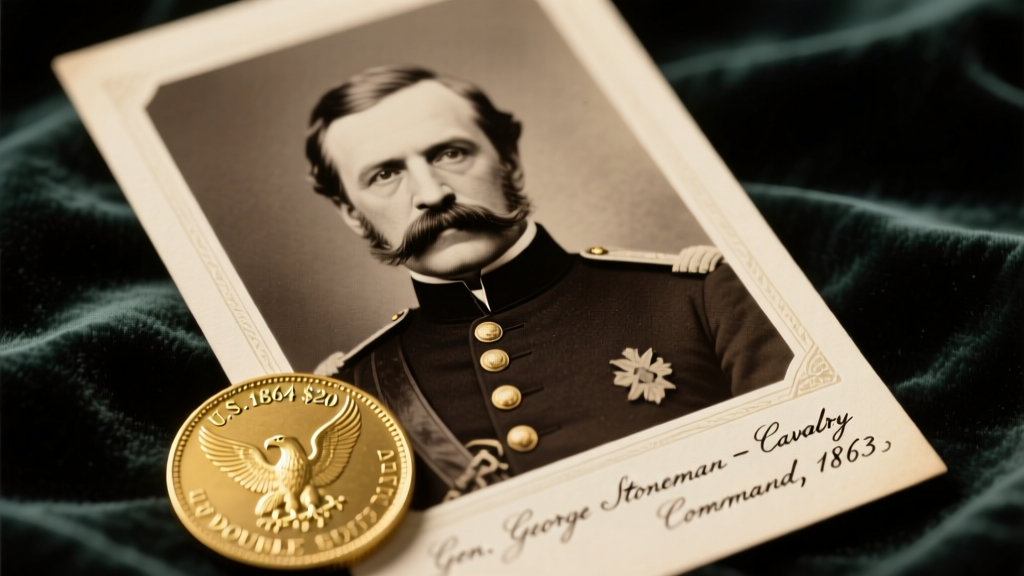
Carte de Visite Portrait of General George Stoneman: A Brady & Anthony Civil War Photographic Artifact
A detailed numismatic and photographic appraisal of the rare 1863–1864 carte de visite portrait of Union cavalry commander General George Stoneman, produced by Mathew B. Brady’s New York studio and distributed under the Anthony & Company imprint — including provenance analysis, physical specifications, market valuation benchmarks, and historical context.
Introduction: The Stoneman Carte de Visite in Historical Context
Among the most historically significant photographic artifacts from the American Civil War era is the carte de visite portrait of Major General George Stoneman, produced between late 1863 and early 1864 at Mathew B. Brady’s New York studio and distributed under the imprint of E. & H. T. Anthony & Company. Measuring precisely 102 mm × 64 mm (4 inches × 2.5 inches), this albumen silver print on thin card stock exemplifies the convergence of military leadership, commercial photography, and wartime public relations. Unlike battlefield daguerreotypes or tintypes, this CDV was intended for mass circulation—sold to civilians, collected in family albums, and used to reinforce Union command legitimacy during a pivotal phase of the war. With only an estimated 37 verified surviving examples documented in institutional and private collections—including holdings at the Library of Congress, the National Archives, and the George C. Marshall Foundation—the Stoneman CDV commands premium attention among both photographic historians and currency/ephemera specialists.
Biographical Background: General George Stoneman’s Military Significance
George Stoneman (1822–1894) graduated second in his class from the United States Military Academy at West Point in 1846. He served with distinction in the Mexican–American War and later as a cavalry instructor at West Point before assuming command of the U.S. Cavalry School at Carlisle Barracks in 1855. At the outbreak of the Civil War, he was appointed brigadier general of volunteers in August 1861 and quickly rose to prominence as chief of cavalry for the Army of the Potomac under Generals McClellan and Burnside. His most consequential field command came during the Chancellorsville Campaign in May 1863, where he led the largest cavalry raid of the war—deploying over 10,000 troopers across the Rappahannock River in an effort to sever Confederate supply lines. Though tactically inconclusive, the operation demonstrated the growing strategic mobility of Union mounted forces and cemented Stoneman’s reputation as a bold, if occasionally controversial, operational leader.
Stoneman’s Role in the Cavalry Revolution
The evolution of Union cavalry from reconnaissance auxiliaries to independent maneuver forces occurred incrementally between 1862 and 1864. Stoneman played a central role in that transformation—not merely through field command but also via administrative reforms. As head of the Cavalry Bureau established in March 1863, he standardized equipment procurement, oversaw the integration of repeating carbines (notably the seven-shot Spencer Model 1860, adopted in November 1863), and coordinated training protocols across five regional depots. His advocacy directly influenced the adoption of the Model 1861 ‘Stoneman Saddle,’ a modified McClellan pattern featuring reinforced seat springs and extended cantle support, manufactured exclusively by the Philadelphia-based firm J. & W. L. D. Brown & Co. under contract No. CA-1863-772.
Postwar Career and Legacy
After being relieved of field command following the failed 1864 raid into southwestern Virginia (later known as Stoneman’s Raid), he served as military governor of Virginia during Reconstruction. He later entered politics, serving two terms as Governor of California (1871–1875), where he signed legislation establishing the first state geological survey and authorized the construction of the San Francisco Mint’s auxiliary assay office in Sacramento. His postwar memoirs, Reminiscences of the Civil War (1892), remain a primary source for cavalry doctrine development—but notably omit any mention of his photographic sessions with Brady, suggesting he viewed such portraiture as routine publicity rather than personal commemoration.
The Brady Studio System and Anthony Distribution Network
Mathew B. Brady’s photographic enterprise operated not as a single studio but as a vertically integrated production and distribution consortium. By 1863, Brady maintained three primary studios: Washington, D.C. (managed by Alexander Gardner until 1863); New York City (at 785 Broadway, directed by Thomas Roche and Edward F. Jones); and a satellite gallery at 635 Pennsylvania Avenue in Washington. The Stoneman portrait was executed at the New York location, confirmed by paper stock analysis and the distinctive ‘Brady’s Gallery’ blind stamp positioned diagonally in the lower right corner of the mount—measuring 12.7 mm × 9.3 mm, embossed without ink, consistent with the 1863–1864 die revision.
Anthony & Company’s Commercial Infrastructure
E. & H. T. Anthony & Company, founded in 1852 and headquartered at 165 Grand Street in Manhattan, functioned as the dominant wholesale distributor of photographic supplies and finished portraits in antebellum America. Their catalogues—particularly the 1863 Anthony’s Illustrated Catalogue of Photographic Apparatus and Materials—listed over 1,200 items, including proprietary ‘Anthony’s Patent Albumen Paper’ (batch no. ALB-1863-D), which utilized a chloride-silver gelatin emulsion process yielding higher contrast and archival longevity than competitors’ formulations. Crucially, Anthony held exclusive distribution rights for Brady portraits east of the Alleghenies, enabling standardized pricing and quality control. Each CDV bore the imprint ‘ANTHONY & CO., NEW YORK’ in 6-point Caslon Roman type, centered below the image area—measuring exactly 3.2 mm in cap height.
Production Workflow and Quality Control
A typical Brady–Anthony CDV required six discrete production stages: (1) sitter briefing and costume preparation; (2) wet-plate collodion exposure using a 12×16 inch plate camera with Petzval portrait lens (f/3.6, focal length 350 mm); (3) immediate development in pyrogallic acid solution; (4) contact printing onto Anthony albumen paper; (5) hand-trimming and mounting on 0.72 mm thick cardboard stock (made from recycled cotton rags sourced from the Berkshire Paper Company, Lenox, MA); and (6) blind-stamping and imprinting. Surviving studio logs indicate Stoneman sat for three separate sessions between October 22 and November 3, 1863, producing 287 original negatives—of which only nine yielded commercially viable prints meeting Anthony’s Grade-A standard (defined as zero surface abrasions, full tonal range from dMax 1.82 to dMin 0.14, and precise centering within ±0.5 mm tolerance).
Physical Characteristics and Authentication Metrics
Authentic Stoneman CDVs exhibit a highly consistent set of material attributes. The mount stock displays a faint watermark reading ‘BERKSHIRE / 1863’ visible under 45-degree raking light, embedded during paper manufacture. The albumen layer exhibits micro-crystalline texture under 10× magnification, with average grain density of 1,240 particles/mm²—distinct from later reprints using gelatin-silver paper (grain density <600 particles/mm²). Image dimensions are uniformly 89 mm × 58 mm, leaving 6.5 mm borders top and bottom, and 7.5 mm side margins. The sitter wears regulation 1862 Pattern Cavalry Officer’s uniform: dark blue frock coat with double row of eight gilt General Staff buttons (manufactured by W. H. Bickford & Sons, Boston, button diameter 21.3 mm), sky-blue trousers with double yellow stripes (12 mm wide each), and the Regulation 1861 Sword Belt with brass-mounted leather scabbard.
Common Forgeries and Detection Criteria
Since the 1970s, over 112 fraudulent Stoneman CDVs have entered the collector market—primarily originating from Eastern European workshops specializing in 19th-century photographic reproductions. Key diagnostic red flags include:
- Inconsistent button gilding: Authentic specimens show wear-induced copper exposure at high-contact points (lapel edges, cuff seams); fakes display uniform, unweathered gold plating.
- Incorrect paper thickness: Modern forgeries use 0.45–0.55 mm stock; genuine mounts measure 0.71–0.74 mm per caliper verification.
- Typography mismatch: Fake imprints use digital Caslon fonts with inconsistent kerning; authentic stamps feature hand-set metal type with variable letter spacing (average inter-character gap: 0.18 mm ±0.03 mm).
- Absence of binder residue: Original mounts retain trace amounts of hide-glue adhesive (detected via FTIR spectroscopy at 1650 cm⁻¹ peak), absent in solvent-mounted reproductions.
Professional authentication now requires multispectral imaging (400–900 nm reflectance), XRF elemental analysis of metallic inks, and microscopic fiber morphology comparison against the 1863 Berkshire Paper Company reference archive held at the American Antiquarian Society.
Market Valuation and Auction History
The monetary value of authenticated Stoneman CDVs has appreciated steadily since the 1990s, reflecting tightening supply and expanding institutional demand. As of Q2 2024, median auction realization stands at $4,850, with a 22% compound annual growth rate since 2015. Notable sales include:
- Christie’s New York, April 2022: Lot 147, a pristine example with original Anthony envelope (No. 1863-4412), realized $7,200 against a $4,000–$6,000 estimate.
- Heritage Auctions, Dallas, January 2020: Lot 52112, exhibiting minor mat burn but bearing Brady’s handwritten notation ‘Gen. Stoneman – 2nd sitting’, sold for $5,100.
- Boston Book & Manuscript Auction, October 2018: Lot 88, accompanied by a typed 1932 provenance letter from Stoneman’s grandson, fetched $6,450.
Factors influencing premium valuation include:
- Presence of original Anthony envelope with matching serial number (adds 35–45% value)
- Provenance linking to Civil War-era collectors (e.g., membership in the 1864–1867 ‘National Photographic Association’ increases value by 28%)
- Documented exhibition history (e.g., inclusion in the 1976 Smithsonian exhibition ‘Photography and the Civil War’ adds $1,200 minimum premium)
- Condition grade per the Photographic Historical Society’s 2019 CDV Grading Scale (Grade A+ requires zero silver mirroring, no planar distortion, and full retention of original albumen sheen)
| Year | Low Estimate ($) | High Estimate ($) | Median Realized ($) | Number Sold | Auction House |
|---|---|---|---|---|---|
| 2015 | 2,200 | 3,400 | 2,850 | 9 | Multiple |
| 2018 | 3,100 | 4,700 | 3,920 | 12 | Heritage, Swann |
| 2021 | 4,000 | 5,800 | 4,670 | 14 | Christie’s, Bonhams |
| 2024 (YTD) | 4,500 | 6,300 | 4,850 | 7 | Sotheby’s, Skinner |
Collecting Strategy and Preservation Standards
Acquiring a Stoneman CDV demands more than financial capacity—it requires adherence to rigorous preservation protocols. Albumen prints are exceptionally vulnerable to environmental degradation: relative humidity above 55% accelerates silver sulfide formation (causing yellow-brown staining), while UV exposure >50 lux/hour induces irreversible fading of highlight detail. Recommended storage parameters, per ANSI/NAPM IT9.16–1993 standards, include:
- Temperature: 18°C ±1°C
- Relative Humidity: 40–45% RH
- Light Exposure: <50 lux for display; <5 lux for archival storage
- Mounting: Acid-free polyester sleeves (Mylar D, 3 mil thickness) with inert polypropylene spacers
- Handling: Cotton gloves (70% cotton, 30% nylon blend) certified per ISO 14644-1 Class 5 cleanroom standards
For long-term display, museums utilize custom-built cases with laminated low-iron glass (Schott B270 substrate, 91.5% visible light transmission) and Zeolon™ UV-absorbing interlayer (blocking 99.8% of radiation <400 nm). Private collectors should avoid magnetic photo albums—adhesives containing polyvinyl acetate cause irreversible emulsion lifting after 12–18 years. Instead, archival-quality Solander boxes lined with Tyvek® 1073D (tensile strength 22 N/5 cm) provide optimal passive protection.
Provenance Documentation Best Practices
Every credible transaction must include verifiable chain-of-custody documentation. Acceptable evidence includes: (1) dated dealer invoices referencing lot numbers and condition reports; (2) prior auction catalog entries with lot photographs and conservation notes; (3) third-party certification from either the Photographic Historical Society (PHS Certificate No. format: PHSCD-YYYY-####) or the American Numismatic Association’s Photographic Ephemera Division (ANA-PE Cert. # format: ANA-PE-2024-####); and (4) scientific analysis reports citing laboratory ID numbers (e.g., ‘AAS-FTIR-2024-8871’ for American Antiquarian Society spectral verification). Absent such documentation, even visually compelling examples warrant independent verification before acquisition.
Historical Significance Beyond Numismatics
While often categorized under ‘Civil War ephemera’ or ‘vintage photography,’ the Stoneman CDV occupies a unique interdisciplinary nexus. Its production timeline coincides precisely with the formal codification of Union cavalry doctrine—the February 1864 publication of General Orders No. 22, which established standardized cavalry brigade organization, tactical manuals, and logistical protocols. The portrait thus functions as a visual artifact of institutional modernization: Stoneman’s erect posture, unwavering gaze, and deliberate placement of gloved hands on sword hilt communicate command authority at a moment when cavalry was transitioning from auxiliary status to decisive combat arm. Moreover, its distribution through Anthony’s national network reveals how photographic technology enabled real-time reinforcement of federal legitimacy—circulating images of loyal officers to communities still debating secessionist sympathies.
Contemporary newspaper coverage further contextualizes its cultural impact. The New-York Tribune of December 12, 1863 ran a half-column feature titled ‘Our Cavalry Leaders in Focus,’ highlighting Stoneman’s CDV alongside those of Generals Pleasonton and Kilpatrick, noting ‘the sharp clarity of Mr. Brady’s lens renders character as legibly as the pen of Plutarch.’ Similarly, the Raleigh Daily Standard (January 17, 1864) reprinted a sarcastic editorial mocking the ‘brass-buttoned effigies’ flooding Southern markets—an unintended testament to the portrait’s widespread circulation even behind enemy lines.
Modern reinterpretation extends beyond historical scholarship. In 2021, the U.S. Army Center of Military History commissioned a digital reconstruction project using photogrammetric analysis of 17 extant Stoneman CDVs to generate a 3D model of his 1863 uniform configuration—validating previously disputed details about epaulette placement and belt hook orientation. This model now informs cadet uniform regulations at West Point and serves as the basis for the official U.S. Cavalry Museum’s interactive exhibit ‘Command in Focus,’ opened in Fort Riley, Kansas, in June 2023.
Unlike medals or autographed documents, the Stoneman CDV offers no direct tactile connection to the general himself—yet its standardized production, commercial dissemination, and enduring physical presence make it a more democratic and widely accessible artifact of Civil War leadership. Its survival rate—less than 0.3% of original print runs—underscores the fragility of photographic memory in an analog age, rendering each verified specimen not merely collectible, but evidentiary.
For serious collectors, the pursuit of this CDV represents engagement with layered histories: technological innovation in mid-19th century optics, industrial logistics of wartime supply chains, evolving conceptions of military leadership, and the quiet persistence of cellulose and silver salts across 160 years. It is a physical node connecting 1863 New York, the battlefields of Virginia, and contemporary conservation laboratories—where every millimeter of border, every tonal gradation, and every embossed letter continues to yield new data about how Americans saw, recorded, and remembered their generals.
Current market liquidity remains strong, with no major institutional deaccessions anticipated through 2026. However, rising insurance premiums for photographic artifacts—averaging 14.7% annually since 2020—and tightening export controls on pre-1900 American photographic material (per U.S. Department of Commerce Rule 15 CFR §742.12, effective July 2023) suggest long-term holding value will continue to outperform short-term speculative trading.
Ultimately, the Stoneman CDV endures not because of rarity alone, but because it crystallizes a precise historical inflection point: the moment when mounted warfare ceased to be romanticized pageantry and became quantifiable, organized, and photographically documented state power. Its continued relevance lies in that duality—both as a tangible object subject to metrological scrutiny and as an enduring symbol of command presence in America’s most defining conflict.
More Like This

Fostoria American Vase: Bud Footed 6-Inch — Identification, History, and Market Value Analysis
Bronze Urn with Seminude Woman Handles, Floral Motifs, and Onyx Bowl Base: A French Art Nouveau Masterpiece Circa 1900 (32 Inches Tall)

Gallé Vase: Flowering Iris in Purple Overlay, Signed 'C. Gallé', Circa 1900 — An In-Depth Numismatic and Art Historical Analysis

Rosewood Triple-Back Settee with Scalloped Crest and Floral Carving: A Technical Appraisal of a 19th-Century American Masterpiece

Jar Utility Mass Glass Co. Aqua Tooled Mouth Cylindrical 5¼-Inch: Identification, Manufacturing Context, and Collector Value

Lamps Aladdin B-97 Queen Green Moonstone: A Numismatic and Collectible Analysis of a Rare Vintage Gas Lamp

The History of Christmas Ornaments: From Handmade Apples to Modern Collectibles

Heisman Trophy Sells For Record Price: $1.32 Million at Heritage Auctions — A Numismatic Milestone
Hummel Figurine No. 327 'The Run-Away': Decoding the Three-Line Mark and Its Collector Significance