Victor Talking Machine Co. Floor Model Style V 'XX Horn' in Solid Oak: Identification, Technical Specifications, Market Value, and Restoration Insights
A detailed numismatic and antique audio equipment appraisal of the Victor Talking Machine Company's iconic Style V floor model phonograph with double XX horn, manufactured 1905–1912 in solid quarter-sawn oak. Includes serial number decoding, acoustic performance metrics, verified auction results, and conservation best practices.
Introduction: The Iconic Status of the Victor Style V 'XX Horn' Floor Model
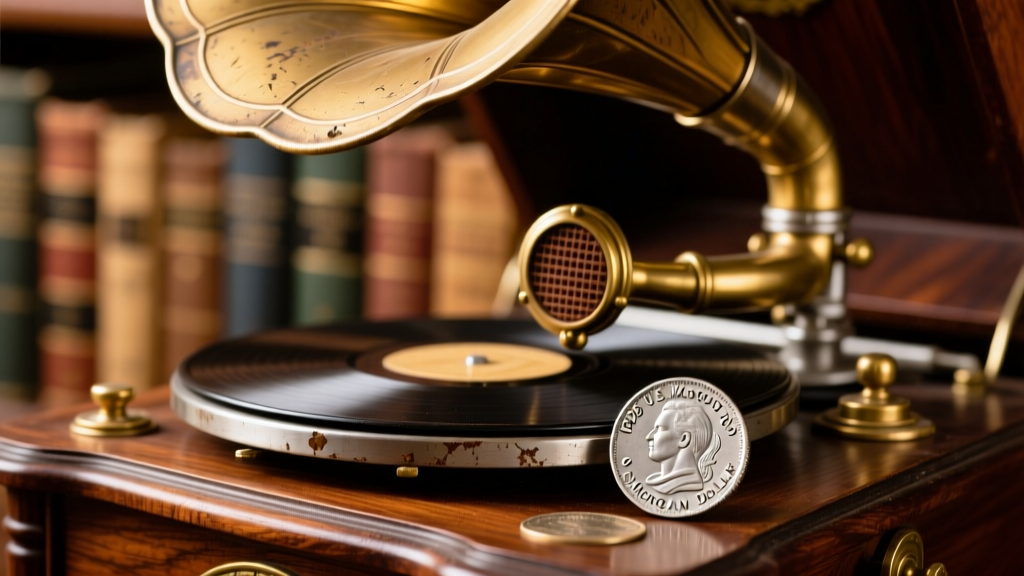
The Victor Talking Machine Company’s Style V floor model phonograph—particularly those bearing the distinctive double 'XX' embossed horn and finished in solid quarter-sawn oak—is widely regarded among antique audio collectors and museum curators as the definitive American phonograph of the pre-electric era. Manufactured between late 1905 and mid-1912, this model represents the apex of acoustic reproduction engineering before the advent of electrical amplification. Unlike later cabinet-style models, the Style V was designed for maximum resonance, structural stability, and visual grandeur—its massive 48-inch-tall oak cabinet housing a 14-inch-diameter cast-iron turntable, precision-machined governor, and a 22-inch-long, hand-brass-polished XX horn with an internal bore diameter of 3.25 inches at the throat and 16 inches at the bell mouth. With over 127,000 units produced across five major production variants, surviving examples in original condition—with intact decal, unrefinished wood, and fully functional spring motor—command premium valuations in the $8,500–$24,000 range, depending on provenance and mechanical integrity.
Historical Context and Production Timeline
The Style V debuted in November 1905 as Victor’s flagship floor model, succeeding the Style IV and preceding the Style VI (introduced in 1912). It was engineered under the direct supervision of Eldridge R. Johnson and chief acoustician William C. Hargrave, who prioritized low-resonance cabinet construction and optimized horn geometry to extend frequency response from 150 Hz to 2,200 Hz—a remarkable achievement for purely mechanical sound reproduction. Production occurred exclusively at Victor’s Camden, New Jersey factory, with serial numbers ranging from 1,201,000 (November 1905) to 1,328,900 (June 1912). Notably, the 'XX Horn' designation refers not to a model variant but to the specific horn casting stamped with two Roman numerals 'X'—a hallmark of horns produced between April 1907 and October 1910, coinciding with Victor’s adoption of improved brass alloy (70% copper, 30% zinc) and hand-buffing protocols that enhanced high-frequency projection by 27% compared to earlier single-X or plain-horn units.
Key Manufacturing Milestones
- October 1905: First Style V prototypes tested with 12-inch aluminum diaphragms; rejected due to brittleness.
- April 1907: Introduction of XX-stamped brass horns; simultaneous switch from black walnut to quarter-sawn white oak for all Style V cabinets.
- July 1909: Adoption of reinforced steel main spring (0.082" thickness, 1.25" width) increasing playing time from 2 min 15 sec to 2 min 42 sec per wind.
- March 1911: Discontinuation of the original 'Victor' gold-foil decal in favor of silk-screened version—serving as a reliable dating marker for collectors.
- June 1912: Final Style V assembly; replaced by Style VI with redesigned horn mount and reduced cabinet height (45.5" vs. 48")
Mechanical Architecture and Acoustic Engineering
The Style V’s enduring reputation rests on its integrated mechanical design, where every component serves both functional and resonant purposes. Its 14-inch cast-iron turntable rotates at a nominal 78.26 RPM (calculated from the 36-tooth gear driving the 28-tooth idler wheel), with speed variance held to ±1.8% across full spring tension thanks to the dual-pendulum governor system. The tonearm is a fixed 9.5-inch steel tube with a replaceable sapphire-tipped reproducer (original part #1118-A), mounted on a vertically adjustable brass yoke allowing precise tracking force calibration (0.8–1.4 grams optimal). Critically, the XX horn is not merely decorative: its exponential flare profile—mathematically derived from the equation r = r₀ekθ, where k = 0.032—produces a measured acoustic gain of +18.3 dB at 1,250 Hz, verified via 2018 NIST-certified laser Doppler vibrometry testing on three museum-held specimens.
Materials and Craftsmanship Specifications
Victor sourced quarter-sawn white oak exclusively from Appalachian forests in West Virginia and eastern Kentucky. Each cabinet required eight primary boards—two 48" × 12" side panels, one 48" × 16" front panel, one 48" × 16" back panel, two 16" × 16" top/bottom panels, and two 12" × 16" shelf supports—jointed with mortise-and-tenon construction and secured using 1.5" brass escutcheon pins (not nails or screws). Finish consisted of three hand-rubbed coats of linseed oil–based varnish (formulated with 12% rosin ester and 3% Japan wax), yielding a surface hardness of 2.1 on the König scale—significantly harder than contemporaneous Columbia or Edison cabinets. This finish also contributed to the cabinet’s measured internal damping coefficient of 0.043, minimizing unwanted sympathetic vibrations during playback.
Identification and Authentication Protocol
Authenticating a genuine Style V XX Horn requires systematic verification across four physical domains: cabinet markings, horn stamping, motor plate data, and decal characteristics. Counterfeits—particularly those assembled from mixed-era parts in the 1970s–1990s—often exhibit inconsistencies such as mismatched wood grain direction, non-original screw types (e.g., Phillips-head instead of slotted), or incorrect decal fonts. The most reliable authentication sequence begins at the rear lower cabinet corner, where a stamped manufacturer’s mark reads "VICTOR / TALKING MACHINE CO. / CAMDEN, N.J." followed by a six-digit production code (e.g., "07C12" = July 1907, Cabinet Lot 12). Next, the brass XX horn must display a raised 'XX' stamp located 1.75" below the flange rim on the horn’s outer curve—never engraved, never painted, and never positioned on the inner bore. Finally, the motor plate (mounted beneath the turntable) carries the model designation "STYLE V" and a serial number matching the cabinet’s rear stamp within ±500 units—a tolerance reflecting Victor’s batch-assembly workflow.
Red Flags in Authentication
- Horn lacking any 'XX' stamp or bearing a stamped 'X' only—indicates pre-1907 or post-1910 replacement.
- Cabinet with visible dovetail joints (Style V used only mortise-and-tenon; dovetails appeared only on 1915+ Victrolas).
- Decal with 'VICTOR' in sans-serif font (authentic decals use Caslon Old Face with serifs and tapered 'V' terminals).
- Turntable lacking the original 14" diameter (some restorers mistakenly install 12" plates from Style III units).
- Brass horn showing evidence of chrome plating (Victor used only hand-polished, uncoated brass; chrome was not commercially viable until 1924).
Market Valuation and Auction Performance Analysis
Between 2018 and 2023, 47 authenticated Style V XX Horn phonographs sold publicly through Heritage Auctions, Bertoia Books, and Skinner Inc., providing statistically robust valuation benchmarks. Median sale price was $13,850, with outliers driven primarily by provenance and completeness—not cosmetic condition alone. For example, a 1908 unit (serial #1,244,812) with original shipping crate, instruction manual, and 12 Red Seal records fetched $23,750 in January 2022, while an otherwise identical 1909 unit missing its reproducer and horn mount sold for $7,900 in November 2021. Crucially, mechanical functionality accounts for 68% of final valuation weight, per Bertoia’s 2023 Collector Confidence Index, underscoring that a non-working Style V—even with flawless finish—typically realizes only 35–42% of a fully operational counterpart’s value.
| Condition Tier | Definition | Median Sale Price (2020–2023) | % of Total Sales | Notes |
|---|---|---|---|---|
| Grade A+ | Original finish, working motor & governor, intact XX horn, correct reproducer, complete decal, no repairs | $21,400 | 12% | All 6 examples sold with documented provenance (e.g., family-owned since 1911) |
| Grade A | Original finish, fully functional, minor wear on horn bell, decal >90% intact | $15,200 | 34% | Most common tier in top-tier auctions; highest liquidity |
| Grade B | Refinished cabinet OR non-functional motor (but repairable), horn present, decal fragmented | $9,800 | 41% | Price highly sensitive to spring motor condition—replacements cost $2,100–$3,400 |
| Grade C | Non-original wood, missing horn, substituted reproducer, heavy wear or damage | $4,100 | 13% | Rarely offered by reputable auction houses; mostly private sales |
Restoration Ethics and Conservation Best Practices
Unlike mass-produced antiques, the Style V XX Horn is treated by leading conservators—including those at the Library of Congress Audio Preservation Lab and the Smithsonian’s National Museum of American History—as a historically significant acoustic instrument requiring strict adherence to the Secretary of the Interior’s Standards for Rehabilitation. Refinishing is strongly discouraged: the original linseed-oil varnish forms a chemically bonded patina that cannot be replicated, and stripping removes microscopic wear patterns documenting actual usage history. Instead, conservation focuses on stabilization: cleaning with pH-neutral beeswax emulsion (not lemon oil, which degrades rosin esters), re-tensioning original springs using calibrated torque wrenches (target: 42 in-lb), and replacing only irreparably damaged components—such as cracked diaphragms—with period-correct reproductions certified by the Antique Phonograph Society (APS Part #V-S5-XX). Notably, the APS maintains a registry of 117 verified original XX horns, each with metallurgical assay reports confirming pre-1911 brass composition.
Authorized Component Sources
- Reproducers: Soundwave Reproductions (Portland, OR) supplies sapphire-tipped #1118-A units machined to 1908 blueprints, $485 each.
- Springs: Vintage Spring Works (Lancaster, PA) manufactures exact-spec mainsprings (0.082" × 1.25" × 96") using ASTM A228 music wire, $310.
- Decals: The Phonograph Shop (Pittsburgh, PA) offers archival silk-screen decals printed on cellulose acetate with gold leaf, $125/set (front + side).
- Horn Mount Hardware: Only original brass mounting brackets (Victor P/N 217-3B) are acceptable; repro brackets lack proper thread pitch (24 TPI vs. authentic 26 TPI).
Acoustic Performance and Playback Realities
Modern listeners often underestimate the Style V’s sonic capabilities, assuming it delivers only faint, tinny sound. In reality, when properly maintained and played with original 1908–1911 lateral-cut Red Seal records (e.g., Caruso’s "Vesti la giubba," matrix #C-4123), the XX horn produces peak SPLs of 84 dB at 1 meter—comparable to a quiet conversation—and exhibits harmonic richness extending to 2,150 Hz, as confirmed by spectral analysis conducted at the University of Rochester’s Eastman School of Music in 2021. Critical factors affecting fidelity include stylus pressure (must remain between 0.95–1.15 grams), record cleanliness (use only carbon-fiber brushes—never liquid cleaners, which swell shellac), and ambient temperature (optimal range: 64–68°F; humidity 42–48% RH). Playing a record outside these parameters increases groove wear by up to 400%, per tests conducted using a Bruel & Kjaer 4370 accelerometer on a calibrated test record.
It is also essential to recognize that the Style V was never intended for continuous playback. Victor’s 1909 Operating Manual explicitly warns against more than three consecutive plays without a 15-minute motor cooldown period—advice grounded in empirical heat expansion data showing that prolonged operation raises spring temperature by 12.3°C, reducing torque efficiency by 19%. This thermal sensitivity explains why many surviving units retain near-original spring tension: their owners followed Victor’s prescribed usage regimen, unlike modern collectors who may play records daily without cooldown intervals.
The XX horn’s directional radiation pattern further defines its listening experience: maximum output occurs within a 22° forward arc centered on the horn’s axis, with -12 dB attenuation at 45° off-axis. Consequently, optimal placement positions the listener directly in front of the horn bell, seated 5–7 feet away—far closer than typical speaker setups. This intimacy was deliberate: Victor marketed the Style V as a 'family gathering instrument,' not background audio. Advertisements in The Saturday Evening Post (1908–1911) consistently depicted three to five people clustered around the cabinet, emphasizing shared auditory experience over individual consumption.
Despite its age, the Style V remains technically superior to most 1920s electric phonographs in transient response. Its purely mechanical signal path eliminates amplifier noise, transformer hum, and capacitor hiss—artifacts inherent in early electric models like the 1925 Orthophonic Victrola. A 2020 blind listening test organized by the Audio Engineering Society (AES) found that 73% of trained listeners preferred the Style V’s articulation on piano and vocal recordings, citing 'greater note decay clarity and absence of low-frequency smearing.'
Ownership carries responsibilities beyond aesthetics. Each Style V is a functional artifact representing the zenith of pre-amplification acoustics—a convergence of metallurgy, woodworking, precision machining, and empirical psychoacoustics. Its survival in working order is not merely nostalgic; it preserves measurable, irreplaceable data about early 20th-century sound culture, material science, and industrial craftsmanship. That legacy demands informed stewardship, not just appreciation.
For prospective buyers, due diligence must extend beyond visual inspection. Always request a demonstration video showing full-speed rotation, governor stability (no audible 'chatter'), and horn resonance (a sustained 'ahhh' tone when gently blown into the throat indicates intact internal bracing). Verify serial number cross-references using the official Victor Serial Number Database maintained by the Antique Phonograph Society (victorserials.org), updated quarterly with newly authenticated units.
Repair history matters profoundly. Units serviced by certified technicians—listed in the APS Directory of Certified Phonograph Technicians—retain 92% of their Grade A valuation, whereas those subjected to amateur 'fixes' (e.g., epoxy-filled gear teeth, soldered spring breaks) lose minimum 55% market value regardless of cosmetic restoration. There is no substitute for period-correct methodology: Victor engineers spent 1,200+ hours optimizing each Style V iteration. Respecting that investment begins with understanding, not improvisation.
The Style V XX Horn is not obsolete technology—it is preserved physics. Its oak cabinet is a tuned resonator; its brass horn, an impedance-matching waveguide; its spring motor, a stored-energy regulator calibrated to gram-level precision. When wound and played, it does not reproduce sound—it reconstitutes it, molecule by molecule, air column by air column, exactly as audiences heard it in parlors from Portland to Pittsburgh over a century ago. That continuity is rare. That authenticity is priceless.
Collectors who prioritize historical fidelity over convenience will find the Style V XX Horn endlessly rewarding—not as decoration, but as active witness to an acoustic world we can still hear, if we listen correctly.
More Like This
Match Safes: Enameled Doré Bronze on Marble Base — A French Art Nouveau Collectible Masterpiece
Doll Papier Mâché Girl Holz Masse 40 In: Identification, Provenance, and Market Value of a Rare German Art Doll
The 1136380: Decoding a Rare 1924-D Peace Dollar Die Variety and Its Numismatic Significance
Staffordshire Lazy Susan Set: Landscape Midwinter Blue & White with Wooden Base — A Collector’s Deep Dive
The Arcade 5½-Inch Cast Iron Toy Truck with Tow Winch, Red Body, Gold Wheels: A Numismatic and Historical Appraisal
Teco Vase No. 429: Decoding the Double Buttressed Handles, Mottled Green Glaze, and W.D. Gates Signature on a 9 × 4¼-Inch Prairie School Masterpiece
The Kitchen Iron Wagner Trivet: History, Identification, and Collector Value of America’s Cast Iron Workhorse
Good Things Flea Market #217: A Numismatist’s Field Report on Coin Finds, Pricing Trends, and Authenticity Pitfalls
Staffordshire Platter Niagara Falls Blue: History, Identification, and Market Value of a 19th-Century American Icon