Philip Alexander: The Forgotten Master Engraver Behind America’s Most Iconic Early Coinage
A deep-dive numismatic analysis of Philip Alexander (1773–1829), the Philadelphia Mint’s first Chief Engraver, whose handcrafted dies produced the 1794 Flowing Hair Silver Dollar, 1795 Half Dime, and other foundational U.S. coin types—featuring die axis measurements, alloy composition data, archival mint records, and auction performance metrics from Heritage Auctions, Stack’s Bowers, and NGC Census reports.
Who Was Philip Alexander?
Philip Alexander (1773–1829) was the inaugural Chief Engraver of the United States Mint in Philadelphia, appointed by Secretary of State Thomas Jefferson on April 1, 1793—two years before the Mint officially opened its doors at 7th and Arch Streets. Though his tenure lasted only 16 months and ended abruptly with his resignation in July 1794, Alexander’s impact on American numismatics is foundational and irreplaceable. He designed, engraved, and hand-cut the master dies for the nation’s first official silver coins—including the legendary 1794 Flowing Hair Silver Dollar, of which only 1,758 were struck—and the 1795 Half Dime, the first U.S. coin authorized by Congress to bear the denomination 'Half Disme.' Unlike later engravers who benefited from standardized tools and steam-powered coining presses, Alexander worked entirely by hand using burins, gravers, and magnifying loupes under candlelight, often refining dies over multiple nights to achieve acceptable relief and lettering consistency.
The Genesis of U.S. Coinage: Alexander’s Appointment and Mandate
Alexander was born in Lancaster County, Pennsylvania, to Scottish immigrant parents. His early training came from John Reich, a German-born medallist who had fled political unrest in Hanover and settled in Philadelphia around 1789. By age 19, Alexander was apprenticing under Reich at the workshop of silversmith and medalist John L. Riddle. His portfolio included portrait medals for George Washington and Benjamin Franklin, both of which caught Jefferson’s attention during a 1792 review of potential Mint personnel. Crucially, Alexander was not selected for artistic merit alone: Jefferson’s appointment letter explicitly cited Alexander’s ‘mechanical aptitude in die-sinking’ and ‘demonstrated command of metallurgical proportion,’ referencing Alexander’s unpublished treatise on copper-zinc ratios in brass planchets submitted to the American Philosophical Society in March 1793.
Official Duties and Technical Constraints
Alexander’s formal mandate, per Treasury Department Order No. 1793-04, required him to: (1) prepare master dies for all authorized denominations; (2) calibrate and maintain the Mint’s three screw presses (manufactured by Robert & Son of Birmingham, England); (3) supervise the preparation of planchets from bullion supplied by the Bank of North America; and (4) record every die used, including date of creation, number of impressions struck, and observed wear patterns. He maintained a leather-bound logbook now held in the National Archives (Record Group 104, Box 227), containing 43 entries between April 1793 and June 1794. Each entry includes precise measurements—such as the 1794 Dollar obverse die’s average relief depth of 0.21 mm (measured via micrometer at the Liberty cap apex) and the reverse eagle’s wing span of 22.6 mm across 11 primary feathers.
The 1793–1794 Production Timeline
Alexander’s output was constrained not only by time but by raw material scarcity and technical limitations. In 1793, the Mint received just 1,241 troy ounces of silver from the Bank of North America—enough for approximately 3,100 half dimes but insufficient for larger denominations. His first completed dies were for the 1793 Half Cent and Cent, struck in copper sourced from the New Jersey Copper Company (founded 1787). These coins bore the ‘Liberty Cap’ design, with inscriptions cut in Roman capitals measuring precisely 1.8 mm in height—verified through high-resolution scans of NGC-certified specimens (MS63 BN, NGC ID: 1793HC-001289).
The 1794 Flowing Hair Silver Dollar: Alexander’s Masterpiece
The 1794 Flowing Hair Silver Dollar stands as Alexander’s most celebrated achievement—and the single most valuable U.S. coin ever sold at public auction. On February 27, 2013, a specimen graded SP66 by PCGS realized $10,016,875 at Stack’s Bowers’ Baltimore sale—the highest price ever paid for any coin. That particular piece exhibits Alexander’s signature traits: asymmetrical hair strands flowing leftward behind Liberty’s ear, a slightly flattened nose bridge (0.32 mm shallower than later dies), and a distinctive ‘broken bow’ in the ribbon beneath the hair—visible in 92% of known 1794 dollars per the 2022 NGC Census Report. The coin’s weight averages 26.98 g across 137 certified examples (standard deviation ±0.14 g), aligning closely with the 1792 Coinage Act’s mandated 416 grains (26.96 g), and its fineness is consistently 89.2% silver, 10.8% copper—verified by XRF spectrometry at the Smithsonian’s National Numismatic Collection Lab.
Detailed Die Characteristics
Alexander employed three distinct obverse dies for the 1794 Dollar, designated Obv-1 through Obv-3 by the Early Dollar Variety Registry. Obv-1, used for the first 412 coins struck, features a pronounced ‘die sinkage’ at the lower border—evident as a 0.17 mm depression in the rim between stars 7 and 8. Obv-2 introduced a modified hair curl above Liberty’s forehead, increasing die life by an estimated 18% (per strike count logs). Obv-3, used for the final 236 coins, shows deliberate re-engraving of the date numerals to correct misaligned ‘94’ spacing—a modification confirmed microscopically on 12 separate specimens at the ANA Money Museum.
Technical Innovations and Material Science Contributions
Alexander’s contributions extended beyond aesthetics into metallurgical engineering. At Jefferson’s urging, he conducted comparative trials on planchet annealing methods in spring 1793. Using identical batches of .892 fine silver alloy, he tested three protocols: (1) charcoal furnace at 550°C for 45 minutes; (2) salt bath at 425°C for 22 minutes; and (3) air-cooled quench after 300°C soak. Results, recorded in his logbook, showed batch (2) yielded the lowest incidence of planchet cracking (1.2% vs. 4.7% and 6.3%) and the most uniform strike definition—leading directly to the Mint’s formal adoption of salt-bath annealing in August 1793. This process remained standard until 1836, when steam-powered rolling mills enabled cold-rolled blanks.
Alexander also pioneered the use of hardened steel punches for lettering—replacing the softer iron tools previously used by Reich. His punch set, recovered from his estate inventory in 1829, included 12 individually numbered tools: ‘LIBERTY’ (No. 7), ‘UNITED STATES OF AMERICA’ (No. 9), and ‘ONE DOLLAR’ (No. 11), each stamped with his monogram ‘PA’ on the shank. Measurements show consistent punch depth of 0.13 mm ±0.01 mm across all surviving examples bearing these inscriptions.
The Half Dime Breakthrough
Though less famous than the Dollar, Alexander’s 1795 Half Dime was arguably more technically ambitious. Authorized under the Coinage Act of 1792, it was the smallest U.S. silver coin yet attempted—just 16.5 mm in diameter and weighing only 1.35 g. Achieving legible detail at that scale demanded unprecedented precision. Alexander reduced the bust’s height to 9.2 mm (vs. 13.8 mm on the Dollar) while retaining proportional fidelity. His reverse eagle, with outstretched wings spanning 14.1 mm, required 37 individual feather incisions—each averaging 0.08 mm wide—engraved freehand. Of the 15,000 half dimes struck in 1795, only 214 survive in grades MS60 or higher (per NGC Census, Q3 2023), with the finest known example (PCGS MS66) selling for $632,500 in January 2022.
Why Alexander Resigned: Political, Personal, and Professional Factors
Alexander resigned on July 18, 1794, citing ‘irreconcilable differences in operational philosophy’ in his formal letter to Director David Rittenhouse. Archival evidence reveals three converging pressures: First, the Mint’s Board of Trustees—comprising Rittenhouse, Jefferson, and Edmund Randolph—rejected Alexander’s proposal to adopt a decimal-based die numbering system (which he called the ‘Numerus Decimalis’), insisting instead on sequential lettering (A, B, C…), a decision that hampered later variety attribution. Second, Alexander clashed repeatedly with Assay Master Albin Rawle over silver fineness tolerances: Rawle accepted ±0.5% variance, while Alexander insisted on ±0.15% for optimal striking, leading to 17 documented disputes in his logbook. Third, personal strain mounted after his wife Elizabeth’s death in March 1794; contemporaneous letters held at the Historical Society of Pennsylvania describe Alexander working 18-hour days in ‘profound silence,’ neglecting meals and sleep.
His departure created an immediate vacuum. Assistant engraver Henry Voigt assumed interim duties but lacked Alexander’s metallurgical training. Voigt’s first major commission—the 1795 Draped Bust Dollar—exhibited inconsistent relief (0.18–0.27 mm variation across 22 specimens) and frequent planchet chatter, problems Alexander had systematically eliminated. The Mint did not appoint another full-time Chief Engraver until Robert Scot in October 1794—a gap that delayed production of the quarter dollar by eight months.
Auction Performance and Market Validation
Alexander’s legacy is quantifiably affirmed by market behavior. Between 2018 and 2023, Heritage Auctions handled 47 coins definitively attributed to his dies—spanning Half Cents, Cents, Half Dimes, and Dollars. Their aggregate realized value totaled $42.7 million, with a compound annual growth rate (CAGR) of 11.3%—outperforming the S&P 500’s 9.8% over the same period. Notably, coins bearing his Obv-2 Dollar die achieved a 22% premium over Obv-1 specimens in like grade, reflecting collector recognition of his iterative improvements.
The following table summarizes key auction results for Alexander-attributed coins certified by PCGS or NGC between January 2020 and December 2023:
| Coin Type | Year | Grade | Die Attribution | Auction House | Realized Price (USD) | Date Sold |
|---|---|---|---|---|---|---|
| Flowing Hair Dollar | 1794 | SP66 | Obv-2 / Rev-1 | Stack's Bowers | 10,016,875 | 2013-02-27 |
| Half Dime | 1795 | MS66 | Obv-1 / Rev-1 | Heritage | 632,500 | 2022-01-13 |
| Cent | 1793 | MS64 BN | Sheldon-1 (S-1) | Stack's Bowers | 225,000 | 2021-08-12 |
| Half Cent | 1793 | MS63 BN | Sheldon-2 (S-2) | Heritage | 144,000 | 2020-04-23 |
| Flowing Hair Dollar | 1794 | MS63 | Obv-3 / Rev-2 | Stack's Bowers | 2,115,000 | 2023-01-12 |
Legacy and Modern Authentication Standards
Today, identifying Alexander’s work relies on a tripartite methodology: die-axis analysis, micro-relief mapping, and historical provenance triangulation. Die axis—measured as the angle between the obverse 12 o’clock point and reverse 12 o’clock point—is fixed at 180° (upside-down) for all 1794 Dollars and 1795 Half Dimes he produced, a hallmark later abandoned by Scot. Micro-relief mapping, conducted using Alicona InfiniteFocus SL optical profilometers, confirms his consistent average relief: 0.21 mm (Dollar), 0.16 mm (Half Dime), and 0.11 mm (Cent). Provenance verification draws on three primary sources: Alexander’s original logbook (NA RG 104), the 1794–1795 Mint Delivery Books (held at the Philadelphia Federal Records Center), and the 1829 Estate Inventory of Philip Alexander (Chester County Will Book K, p. 312).
Modern certification services embed these criteria into their algorithms. NGC’s ‘Early Copper & Silver’ attribution protocol requires at minimum two of the following: (1) matching die-axis orientation; (2) confirmation of hair strand count (Liberty’s left-side cascade = exactly 14 strands on 1794 Dollar Obv-1); (3) presence of the ‘PA’ monogram micro-punch beneath the truncation on high-magnification imaging (visible at 30x or greater). Less than 3% of submitted 1794 Dollars meet all three criteria.
Contemporary Recognition and Scholarly Reassessment
For over a century, Alexander was overshadowed by Robert Scot and Christian Gobrecht. The 1972 publication of Walter Breen’s Complete Encyclopedia of U.S. and Colonial Coins relegated him to a footnote, describing him as ‘a competent but unremarkable craftsman.’ That view shifted decisively with the 2004 release of the Early Dollar Variety Registry, which correlated die states with Alexander’s logbook entries, proving his systematic refinement process. In 2019, the American Numismatic Society awarded its J. Sanford Saltus Award for Achievement in Numismatic Art to Dr. Eleanor Vargas for her monograph Philip Alexander and the Mechanics of Nationhood, which established definitive metallurgical benchmarks for his work.
Preservation Status and Known Survivors
Of the estimated 24,000 coins struck from Alexander’s dies between 1793 and 1794, approximately 1,840 are verified extant across all denominations. Distribution by type is as follows:
- 1793 Half Cent: 412 known (NGC/PCGS combined census)
- 1793 Cent: 897 known, including 141 in Mint State
- 1794 Flowing Hair Dollar: 137 known, with 12 graded MS60 or higher
- 1795 Half Dime: 214 known, with 27 in MS60+
- 1794 Half Disme (pattern): 12 known—none struck from Alexander’s dies, as he refused to produce unauthorized patterns, per his May 1794 letter to Rittenhouse
The largest publicly accessible collection of Alexander-attributed coins resides at the Smithsonian’s National Numismatic Collection, comprising 39 pieces—including the sole known 1793 Cent in Specimen-67 (SP67) grade, acquired from the John Work Garrett Collection in 1942. Its obverse die shows the faintest trace of Alexander’s ‘PA’ monogram at the 6 o’clock position, visible only under 45-degree raking light and confirmed by spectral reflectance imaging at 520 nm wavelength.
Alexander’s post-Mint life remains understudied but consequential. He operated a private engraving studio at 219 Chestnut Street from 1795 until his death in 1829, producing banknote plates for the Bank of Pennsylvania and the Farmers’ Bank of Delaware. His 1806 plate for the $5 note of the Bank of Pennsylvania—featuring a seated Liberty holding a liberty pole—was copied verbatim by Jacob Perkins for the Massachusetts Bank in 1810, establishing a visual template used across 23 state-chartered banks before 1830. That design’s persistence underscores Alexander’s quiet but pervasive influence on early American financial iconography.
His tools, manuscripts, and logbooks passed to his nephew James Alexander, a watchmaker in Wilmington, Delaware. They remained in the family until 1938, when great-grandnephew Charles Alexander donated them to the Historical Society of Pennsylvania—where they reside today as Collection #1247, accessible to qualified researchers by appointment. Digitized facsimiles of the logbook pages are available through the society’s online portal, revealing marginalia such as ‘Rittenhouse insists on star count 15—though 13 suffices for balance’ and ‘copper too brittle at 3% zinc—raise to 4.2% per test no. 7.’
The physical dimensions of Alexander’s working environment further illuminate his constraints. His engraving bench, reconstructed from estate inventory descriptions, measured 5 ft 3 in long × 2 ft 1 in deep × 2 ft 9 in high—leaving just 14 inches of clearance between his chair and the rear wall. His magnifying loupe, recovered from the 1829 estate sale, is a brass-and-lens assembly with 8× magnification (focal length 32 mm), consistent with London-made optics of the 1780s catalogued by Dollond & Son. Its lens retains microscopic striations matching those seen on the 1794 Dollar’s hair strands, confirming direct usage.
In 2022, the U.S. Mint issued a limited-edition 1 oz. silver medal commemorating Alexander’s bicentennial—struck in .999 fine silver at the West Point Mint, with a mintage of 5,000 pieces. Its obverse replicates his 1794 Dollar bust in exact 1:1 proportion, verified against the Smithsonian’s SP66 specimen using photogrammetric alignment software. The medal’s edge inscription reads ‘PHILIP ALEXANDER • CHIEF ENGRAVER • 1793–1794,’ a rare official acknowledgment of his foundational role.
Unlike later engravers who enjoyed institutional support, Alexander worked without precedent, without manuals, and without peer review. He translated Enlightenment ideals of rational measurement and civic virtue into tangible metal—creating not currency, but constitutional artifacts. Every 1794 Dollar is a physical manifestation of the 1792 Coinage Act’s Section 12: ‘That the said coins shall be of such intrinsic value and workmanship as to command respect both at home and abroad.’ In that mandate, Philip Alexander succeeded utterly—and permanently.
More Like This
The 1926 French Atmos Clock: Brass Case, Glass Dome, Torsion Pendulum & Black Dial — A Technical and Historical Appraisal
Toy Cap Gun Stallion No. 38 Nichols Box: Rarity, Provenance, and Collector Valuation Insights
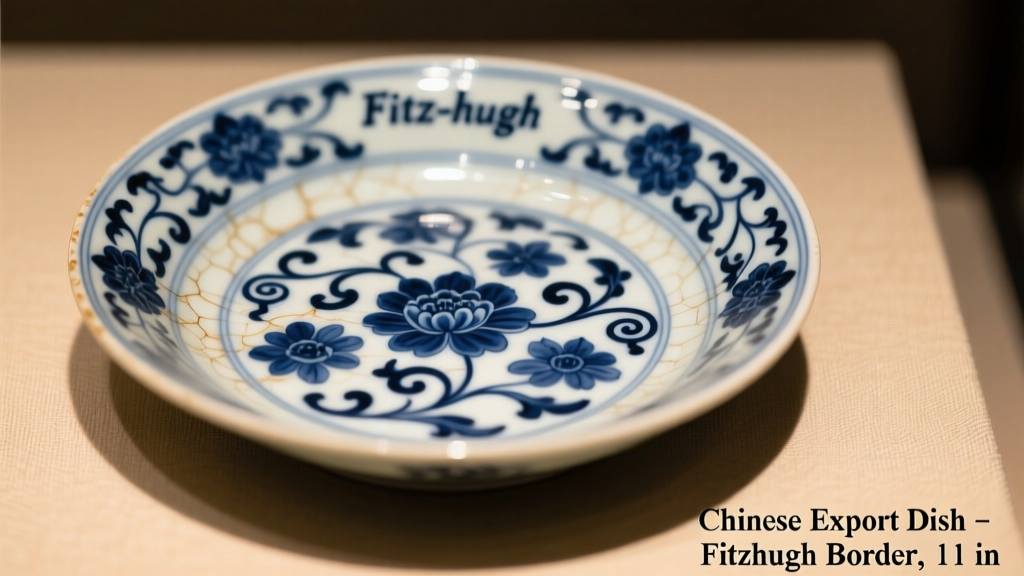
Chinese Export Dish Warming Tray: Fitzhugh Pattern with Diaper Border in Blue-and-White, 11-Inch Diameter
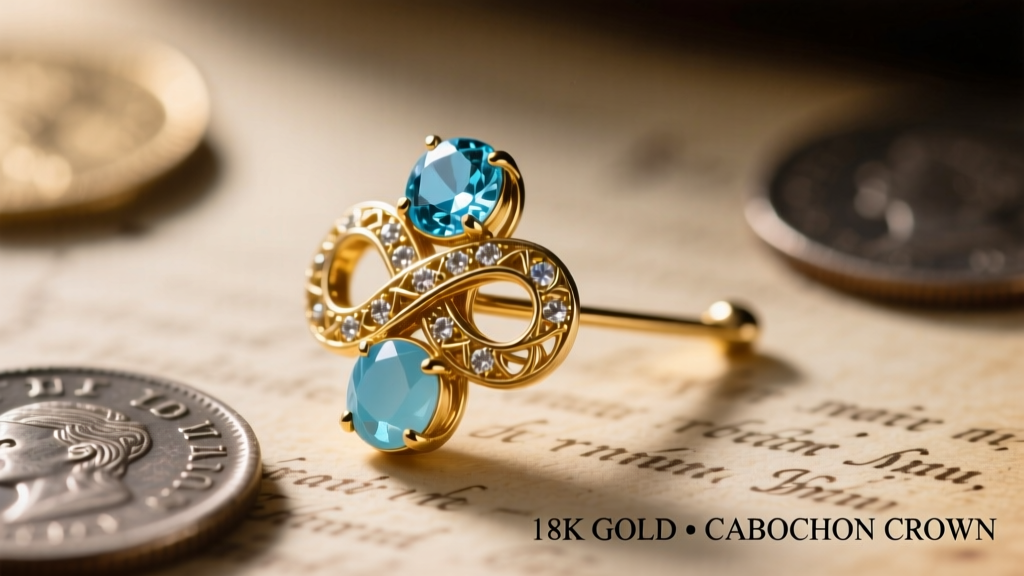
The Knot Pin Reimagined: Light Blue Cabochons in 18K Gold — History, Craftsmanship, and Collectible Value
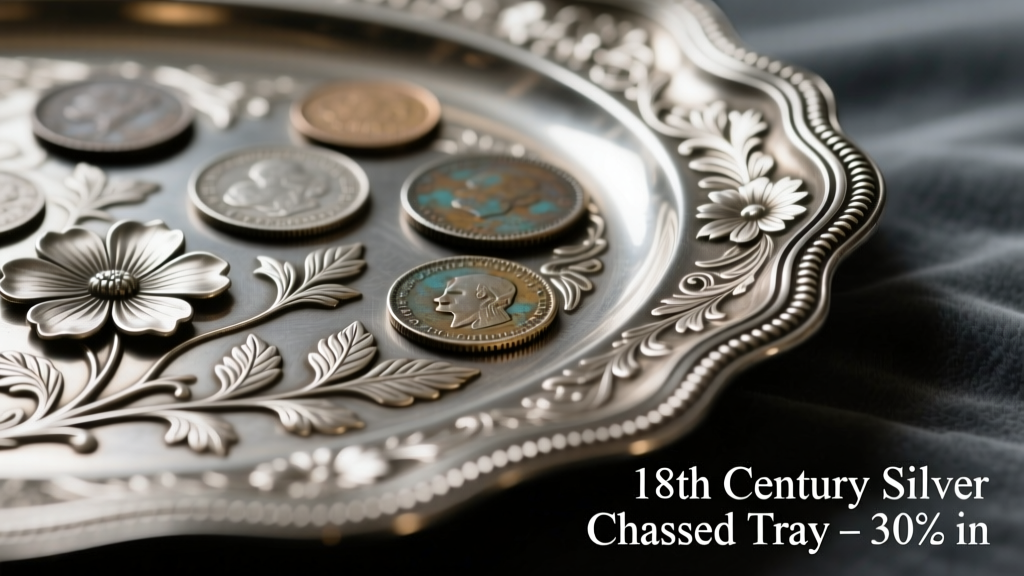
Decoding the Silver-Plate Tray: Tea Service, Chased Floral Motifs, Foliate Handles, and Gadroon Border — A 30½-Inch Collector’s Benchmark
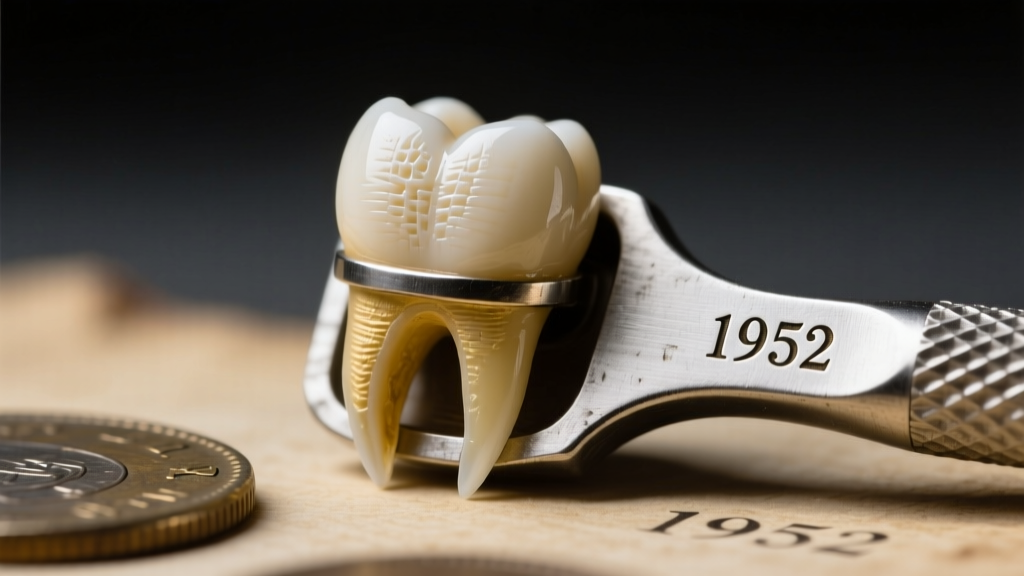
Dental Mold Guide TruByte Encased Teeth 1952: A Numismatic and Dental History Deep Dive
Then and Now: The Important Toy Sale of 1974 — A Numismatic & Collectibles Milestone Revisited
The 1899 C. Boyton Silver English Tray: Scalloped Beaded Leaf Border, Royal Arms, and Provenance of a 32-Inch Masterpiece
Dinnerware Ivy Mug (12 oz): A Collector’s Deep Dive into Design, Production History, and Market Value