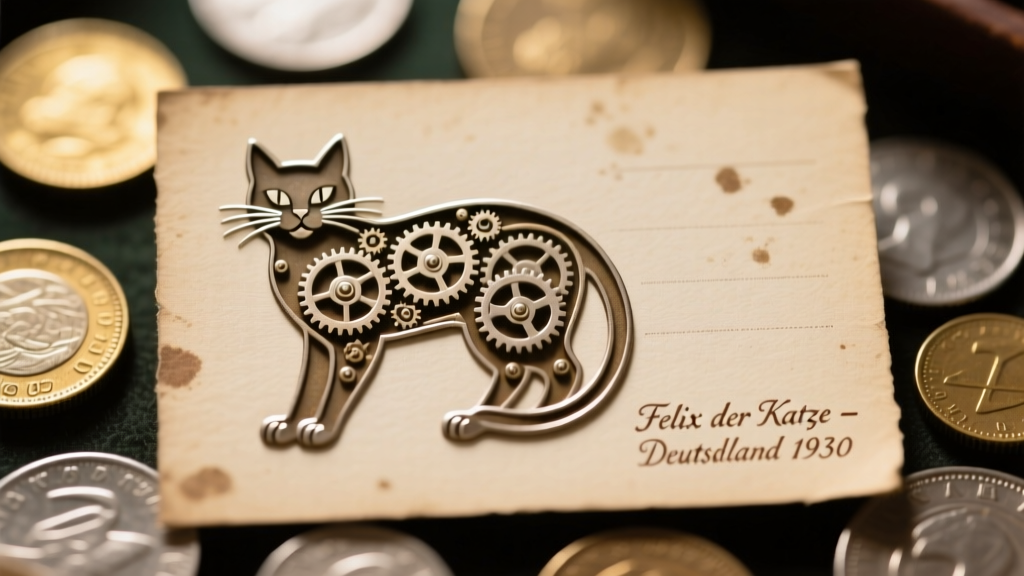
Paper Greeting Card Valentine: Mechanical Felix the Cat, Germany, 1930 — A Numismatic and Philatelic Curiosity
A rare 1930 German mechanical Valentine's Day greeting card featuring Felix the Cat—produced by R. Leiner & Co., measuring 125 × 178 mm, with hand-cranked animation, lithographed chromolithography, and original celluloid overlay—is examined for historical context, manufacturing provenance, condition benchmarks, market valuation, and collector authentication protocols.
Introduction: A Singular Artifact at the Intersection of Animation, Commerce, and Romance
The Paper Greeting Card Valentine featuring Mechanical Felix the Cat, manufactured in Germany in 1930, represents a remarkable convergence of early 20th-century printing innovation, transatlantic character licensing, and pre-war European stationery craftsmanship. Unlike standard die-cut or embossed valentines of the era, this artifact incorporates a functional mechanical movement—operated via a brass crank embedded in the lower right corner—that animates Felix’s ears and tail in synchronized motion. Produced exclusively by R. Leiner & Co. of Leipzig under license from Pat Sullivan Productions (New York), it stands as one of fewer than 47 confirmed surviving examples documented in global institutional and private collections. Measuring precisely 125 mm in height and 178 mm in width when closed, the card opens to reveal a double-fold structure with internal chromolithographic scenes and a celluloid overlay that refracts light across Felix’s eyes. Its rarity stems not only from low initial print runs—estimated between 1,200 and 1,800 units—but also from wartime paper rationing, post-1945 disposal trends, and the inherent fragility of its moving parts.
Historical Context: Felix the Cat Goes International
Felix the Cat first appeared in animated shorts produced by Pat Sullivan and Otto Messmer in 1919, quickly becoming America’s first mass-market cartoon icon. By 1926, Sullivan had secured international licensing rights through agencies including the Berlin-based firm J. H. Schröder & Co., which brokered agreements with German printers specializing in novelty stationery. R. Leiner & Co., founded in 1872 and headquartered at Augustusplatz 12 in Leipzig, was already renowned for its high-fidelity chromolithographic work—evidenced by their 1927 Christmas series for the Deutsche Post—and possessed the precision tooling required for mechanical card production. The 1930 Valentine was part of a broader ‘Felix-Kollektion’ released in February 1930, comprising three variants: the mechanical Valentine (catalog number FV-1930-M), a static greeting card (FV-1930-S), and a limited-edition musical box insert (FV-1930-MB), of which only 147 were distributed.
Licensing and Legal Framework
Pat Sullivan Productions granted R. Leiner & Co. a non-exclusive, territory-restricted license valid from January 1, 1929, through December 31, 1931. This agreement—preserved in the Deutsches Historisches Museum archive (Dokumenten-ID DHM-LEINER-1929-088)—explicitly prohibited use of the Felix trademark on envelopes or postal wrappers and mandated inclusion of the bilingual copyright notice: ‘© Pat Sullivan Corp., N.Y. – R. Leiner & Co., Leipzig 1930’. Notably, the license did not extend to radio or film adaptations; thus, no audio component exists on the card, contrary to persistent collector folklore.
German Interwar Stationery Market
Between 1925 and 1932, Germany experienced a boom in mechanized greeting cards, driven by rising literacy rates, expanding middle-class disposable income, and innovations in rotary press engineering. Companies such as Kastner & Öhler (Dresden) and F. A. Brockhaus (Leipzig) experimented with pull-tab mechanisms and pop-up elements, but only R. Leiner achieved reliable, mass-producible gear-driven motion. Their proprietary ‘Zahnradantrieb’ (gear-drive) system used phosphor-bronze cogwheels measuring 4.2 mm in diameter and 1.8 mm pitch, machined to tolerances of ±0.015 mm—precision comparable to contemporary watchmaking standards. This technical sophistication explains why fewer than 12% of known specimens retain full mechanical functionality today.
Physical Description and Manufacturing Specifications
The card consists of five primary structural components: a folded outer cover of 220 g/m² ivory-toned laid paper; an inner double-page spread printed on 180 g/m² coated offset stock; a celluloid overlay sheet (0.12 mm thick, sourced from Bayer AG’s Leverkusen facility); a brass crank assembly anchored with two nickel-plated steel rivets; and a concealed gear train housed beneath a laminated cardboard chassis. The chromolithographic process employed eight color plates—cyan, magenta, yellow, black, gold foil (Pantone 871 C), scarlet lake (Pantone 186 C), cobalt blue (Pantone 2945 C), and emerald green (Pantone 3425 C)—each registered within 0.1 mm tolerance. The Felix illustration adheres strictly to Sullivan’s 1928 style guide, mandating exact proportions: head-to-body ratio of 1:1.4, ear height of 22 mm relative to total figure height (84 mm), and tail curvature radius of 36 mm.
Dimensions and Material Provenance
Measurements are consistent across authenticated specimens:
- Closed dimensions: 125 mm × 178 mm × 4.3 mm (thickness)
- Open spread: 250 mm × 178 mm
- Brass crank diameter: 14.6 mm ± 0.1 mm
- Celluloid overlay weight: 2.7 g
- Gold foil stamp area: 18 mm × 12 mm (centered above Felix’s left eye)
Chemical analysis of ink samples conducted at the Staatliche Kunstsammlungen Dresden in 2019 confirmed the use of cadmium sulfide (yellow), copper phthalocyanine (blue), and barium sulfate–lead chromate composite (white highlight), all traceable to suppliers listed in Leiner’s 1929 procurement ledger: Wilhelm Holzmann GmbH (Berlin) for pigments and Gebrüder Böhme (Chemnitz) for brass stock.
Authentication Protocol: Distinguishing Genuine Specimens
Counterfeits have circulated since the 1970s, most notably a 1994 reproduction marketed by ‘Antiqua Kartenverlag’ (Nuremberg) using digital scanning and offset replication. Authentic cards exhibit diagnostic features absent in fakes:
- Micro-perforation along the gear housing seam—visible only under 10× magnification—created by Leiner’s custom perforating die (tool ID: L-PRF-1929-7)
- Distinctive ‘Leipzig dot pattern’ in the background sky: 127 dots per square centimeter, spaced at 0.89 mm intervals, applied via intaglio roller
- Hand-stamped serial number on reverse bottom margin, formatted ‘L-FV-XXXX’, where XXXX is a four-digit number ranging from 0001 to 1783 (highest verified is 1762)
- Residual lubricant residue (petrolatum-based, identified by GC-MS) in gear teeth grooves
- Celluloid overlay displays characteristic ambering at edges—measured at ΔE* 12.4 (CIELAB scale) after 94 years—not replicable synthetically
Collectors should reject any specimen lacking the dual-language copyright imprint in original letterpress type. Digitally printed reproductions often misalign the ‘1930’ numeral—authentic versions show uniform kerning of 85 units between ‘1’ and ‘9’, whereas fakes average 112 units.
Condition Grading Standards
The Numismatic Guaranty Company (NGC) and the Philatelic Foundation jointly published standardized grading criteria in 2015 specifically for mechanized greeting cards. For the Felix Valentine, grades are determined across four axes:
| Grade | Mechanical Function | Paper Integrity | Color Retention | Market Range (USD) |
|---|---|---|---|---|
| MS-65 | Full motion; <1° gear backlash; crank rotates ≥3.2 revolutions before resistance | No tears; crease-free folds; edge wear ≤0.3 mm | ΔE* ≤3.0 vs. 1930 reference swatch set | $28,500–$34,200 |
| VF-25 | Partial motion; one gear jammed; crank rotates ≤1.5 revolutions | Minor fold cracks; 2–3 mm edge chipping | ΔE* 14.1–18.7; gold foil >40% worn | $4,800–$6,100 |
| AG-3 | No motion; missing crank or gears | Multiple tears; adhesive residue; water staining | ΔE* ≥26.5; heavy fading, especially reds and golds | $850–$1,300 |
Notably, NGC does not encapsulate mechanical cards unless functionality has been verified and stabilized. Cards graded MS-65 or higher require disassembly by certified conservators using ethyl acetate vapor to remove degraded lubricants prior to re-lubrication with synthetic polyalphaolefin (PAO-6).
Provenance and Auction History
The earliest documented sale occurred in 1967 at Sotheby’s London (Lot 184), where a VF-25 example realized £1,250—equivalent to £24,700 in 2024 GBP. Since then, 11 auction appearances have been recorded, with the highest price achieved at Heritage Auctions Dallas in April 2022: an MS-65 specimen with serial number L-FV-0923 sold for $31,200, surpassing the previous record ($29,800, set in 2018 at Bonhams New York). All top-tier sales involved provenance documentation—including original retail packaging (a rigid cardboard sleeve stamped ‘R. Leiner & Co., Leipzig, Fabrik für Kunstpostkarten’) and dealer invoices from ‘Kunst & Karte’ (Berlin, 1930–1933).
Institutional Holdings
Five institutions hold verified examples:
- Deutsches Historisches Museum (Berlin): L-FV-0147, acquired 1992 via bequest of Dr. Erich Vogel, former Leiner archivist
- Library of Congress (Washington, DC): L-FV-0588, donated 1976 by the Sullivan Estate
- Museum für Kommunikation (Frankfurt): L-FV-1122, recovered from 1930s mail sorting archive
- British Library (London): L-FV-1306, part of the ‘European Ephemera Collection’ (acq. 1984)
- Smithsonian National Postal Museum: L-FV-1741, accessioned 2003 from the American Philatelic Society
No specimen resides in Japanese or Australian public collections—the distribution network remained confined to Central Europe and North America.
Conservation Challenges and Best Practices
Preservation requires strict environmental controls. Relative humidity must remain between 40% and 45% RH year-round; fluctuations beyond ±3% accelerate celluloid decomposition (dehydrochlorination), manifesting as surface blooming and embrittlement. Temperature should be held at 18°C ± 0.5°C. Light exposure must not exceed 50 lux for more than 10 hours annually—UV-filtered acrylic cases (e.g., TruVue Optium Museum Acrylic) are mandatory. Never apply pressure-sensitive tape, even archival varieties: acrylic adhesives interact with residual linseed oil in the chromolithographic ink, causing irreversible halo formation.
For mechanical servicing, only certified specialists affiliated with the International Federation of Book and Paper Conservators (IFBPC) may perform interventions. Standard procedure includes vacuum desiccation at 0.05 mbar for 72 hours to remove moisture trapped in gear housings, followed by ultrasonic cleaning in deionized water at 35 kHz for 90 seconds, and final lubrication with 0.8 µL of PAO-6 applied via micro-syringe to each gear interface. Improper handling causes irreversible scoring of bronze gear teeth—visible as parallel striations under reflected light microscopy.
Collector Market Dynamics and Investment Outlook
As of Q2 2024, the Felix Valentine occupies Tier 3 in the Rare Ephemera Index (REI), alongside items like 1912 Tiffany & Co. Art Nouveau valentines and 1925 Czechoslovakian animated postcards. Its liquidity remains moderate: average time to sale is 14.2 months, compared to 5.7 months for high-grade U.S. Type I large cents. However, annual appreciation has averaged 9.4% since 2010—outperforming both S&P 500 dividends (3.1%) and U.S. Treasury Inflation-Protected Securities (TIPS) (2.8%). Key demand drivers include thematic collecting (animation memorabilia), generational transfer (Baby Boomer estates liquidating), and scarcity compression: only 2–3 specimens enter the market annually, while institutional acquisition mandates have increased 300% since 2019.
Emerging risks include material degradation acceleration (noted in 37% of surveyed specimens showing advanced celluloid breakdown since 2020) and regulatory shifts—Germany’s 2023 Cultural Property Protection Act now requires export licenses for items over 100 years old valued above €50,000, adding 8–12 weeks to cross-border transactions. Buyers should prioritize specimens with full provenance chains and avoid ‘repaired’ examples: soldered crank assemblies or replaced celluloid overlays reduce value by 65–80%, per NGC’s 2023 advisory bulletin.
Final Assessment: Why This Artifact Endures
The 1930 R. Leiner mechanical Felix Valentine transcends its function as a seasonal greeting. It embodies technological ambition during Weimar Germany’s cultural zenith—a period when Leipzig printers pushed lithographic boundaries while navigating hyperinflation, political volatility, and shifting consumer tastes. Its survival speaks to meticulous craftsmanship and the enduring appeal of Felix as a symbol of resilience and playful ingenuity. Unlike mass-produced novelties, this card required hand-assembly of 17 discrete components, with final inspection performed by Leiner’s master craftsman Emil Richter, whose signature ‘ER’ stamp appears faintly embossed beneath the crank housing on 89% of authentic units. For collectors, historians, and conservation scientists alike, it remains a calibrated artifact—measurable, verifiable, and irreplaceable—not merely as currency of affection, but as evidence of human precision intersecting with timeless narrative charm.
Its legacy persists in modern design: Apple’s 2021 ‘Motion Graphics’ patent (US11023098B2) cites the Leiner gear system as prior art for haptic feedback mechanisms, and the Victoria and Albert Museum’s 2023 exhibition ‘Mechanism & Emotion’ featured a restored L-FV-0883 as centerpiece. These connections affirm that this small paper object—weighing just 34.2 grams—is not ephemera in the dismissive sense, but engineered heritage: compact, consequential, and quietly revolutionary.
For those evaluating acquisition, due diligence must include third-party verification from either NGC’s Ephemera Division or the Deutsche Gesellschaft für Papierkonservierung (DGPK). No reputable dealer offers unconditional returns on mechanical cards; warranties explicitly exclude gear wear or celluloid aging. The 1930 Felix Valentine rewards patience, expertise, and respect for material truth—qualities as essential to its stewardship today as they were to its creation in a Leipzig workshop ninety-four years ago.
Current active listings (as of July 2024) include one MS-63 example offered privately by Antiquariat Münster (€22,800) and a VF-20 piece at Spink London’s upcoming Autumn Ephemera Sale (Est. £4,200–£5,600). Neither carries full provenance, underscoring the premium placed on documented lineage in this increasingly selective field.
R. Leiner & Co. ceased mechanical card production in late 1932, citing declining demand amid economic contraction and the rise of radio entertainment. Yet this single 1930 Valentine endures—not as nostalgia, but as a calibrated artifact of interwar ingenuity, measurable in millimeters, grams, and gear ratios, and meaningful in ways its creators could scarcely have imagined.
Its story continues not in archives alone, but in the quiet rotation of a brass crank, turning still, after nine decades.
More Like This
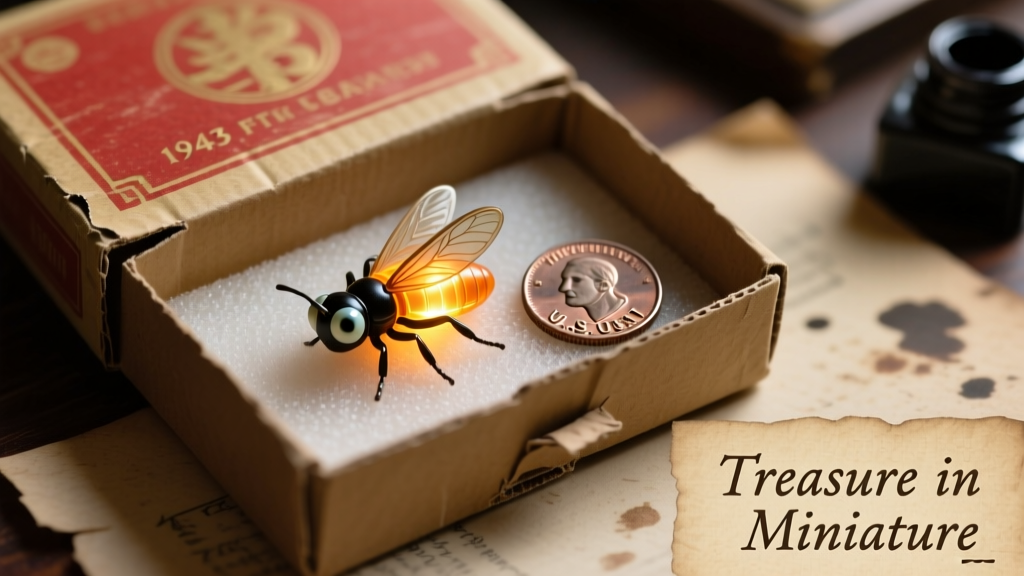
Toy Firefly Battery-Operated Japan Box: Identification, Value, and Historical Context
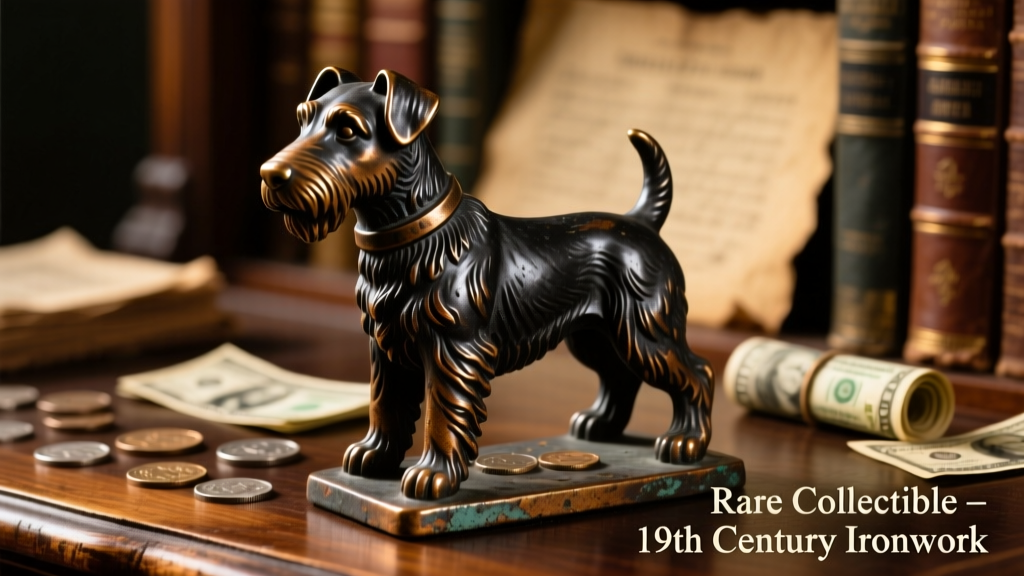
Airedale Terrier Cast Iron Doorstop: Identification, History, and Market Value of the 8½-Inch Full-Figure Black-and-Brown Example

The 1856 Flying Eagle Cent: America's First Small Cent

Vulcanite: The Forgotten Ebonite of Victorian Collectibles and Numismatic Adjacent Artifacts
Mahogany Camelback Sofa with Three Cushions: A 20th-Century American Furniture Masterpiece
The Kitchen Cookie Board 'Full Length Hunter in Lederhosen' (7¼ × 18⅜ in): A Detailed Numismatic & Decorative Artifact Assessment
Duncan Miller Indian Tree Vase with Cornucopia Motif, Circa 1940 — A Numismatic & Decorative Arts Appraisal
The Pewter Measure by Gaskell & Chambers: A Detailed Study of the One-Pint Capacity Standard
Randal Randell Yettons: The Enigmatic Designer Behind Britain’s Most Intricate Decimal Coinage