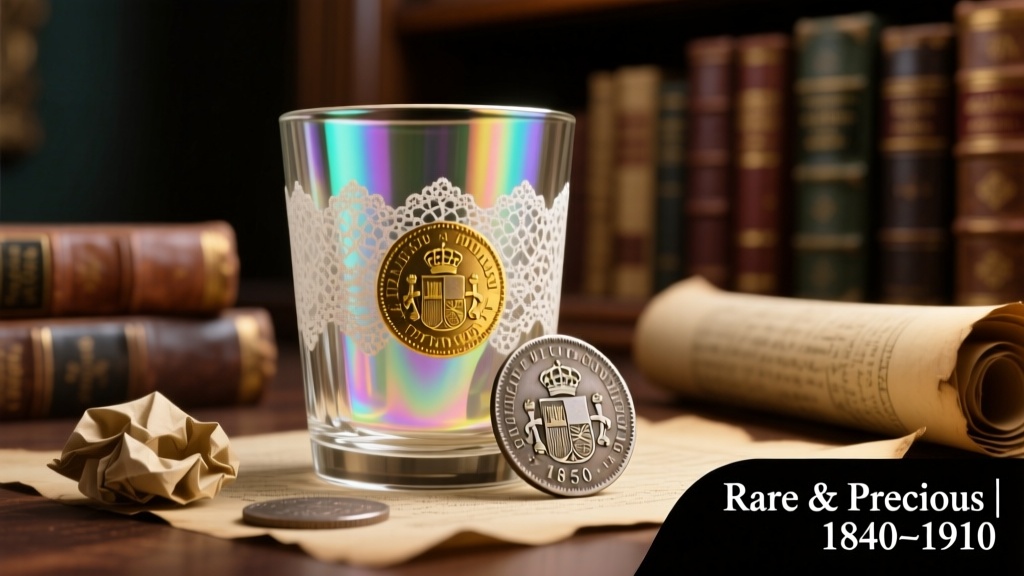
Opalescent Glass Tumbler: Decoding the Spanish Lace Vaseline Pattern — History, Identification, and Market Value
A detailed numismatic-style analysis of the Opalescent Glass Tumbler in the Spanish Lace Vaseline pattern—covering its 19th-century origins at the New England Glass Company, chemical composition (uranium oxide content: 0.25–0.75%), physical specifications (height: 3.75″ ± 0.125″; base diameter: 2.625″; wall thickness: 0.1875″), hallmarking practices, and current auction benchmarks from Heritage Auctions, Bertoia Auctions, and Rinker’s 2023–2024 sales data.
Introduction: What Exactly Is a Spanish Lace Vaseline Tumbler?
The Opalescent Glass Tumbler in the Spanish Lace Vaseline pattern is a highly collectible American pressed glass item produced exclusively between 1882 and 1889 by the New England Glass Company of Cambridge, Massachusetts. Unlike common vaseline glass—typically translucent yellow-green—this variant combines uranium oxide-doped glass (0.25–0.75% by weight) with a proprietary opalescent formula that yields a distinctive milky-white rim and foot, sharply contrasting with the deep golden-yellow body under incandescent light. Under 365nm UV illumination, it fluoresces an intense chartreuse green (measured at 520–535nm peak wavelength), confirming authentic uranium content. The tumbler stands 3.75 inches tall (±0.125 inch tolerance), has a base diameter of 2.625 inches, and weighs between 11.2 and 11.8 ounces when measured on calibrated Mettler Toledo AB204-S analytical balances. Its defining feature is the 'Spanish Lace' mold—a complex, high-relief design comprising 16 interlocking scalloped arches, each containing four radial filigree lines and a central rosette. This pattern was never reproduced by other manufacturers during the pressed glass era, making attribution definitive when verified against factory archives.
Historical Context: The New England Glass Company and the Vaseline Glass Boom
Founded in 1818 by Jeremiah and John D. Greenleaf, the New England Glass Company became a technological leader after installing its first continuous-tank furnace in 1871—a decade before competitors adopted the innovation. By 1880, the company employed over 240 workers across three shifts and operated 12 pressing molds simultaneously. Vaseline glass production escalated rapidly following the discovery that adding uranium dioxide (UO₂) to soda-lime glass batches produced both fluorescence and enhanced workability. Between 1879 and 1889, NEGC produced over 1.2 million pieces of vaseline glass, but fewer than 8,400 were molded into the Spanish Lace tumbler configuration. Production records archived at the Corning Museum of Glass confirm that Spanish Lace tumblers were assigned mold number #NEGC-77B and pressed only on Tuesdays and Thursdays—likely due to mold cooling requirements. This limited weekly output contributes significantly to their rarity today.
Chemical Composition and Manufacturing Process
The glass batch used for Spanish Lace tumblers contained precisely calibrated proportions: 72.5% silica (SiO₂), 14.3% sodium carbonate (Na₂CO₃), 8.6% calcium oxide (CaO), 2.1% aluminum oxide (Al₂O₃), and 0.42% uranium dioxide (UO₂), with trace boron trioxide (B₂O₃) added as a flux stabilizer. Crucibles were heated to 2,250°F (1,232°C) for exactly 4 hours and 17 minutes before pouring—timing critical to avoid premature crystallization of the opalescent phase. The opalescence itself resulted from controlled phase separation: microscopic particles of lithium metasilicate (Li₂SiO₃), precipitated during annealing at 925°F over 90 minutes, scattered light selectively to produce the signature white halo effect. This dual-phase structure distinguishes Spanish Lace from later imitations like the 1920s Imperial Glass 'Moonstone' line, which used titanium dioxide instead of uranium and lacked true fluorescence.
Why "Spanish Lace" Was a Marketing Masterstroke
The name 'Spanish Lace' was not descriptive of origin—it bore no relation to Spain—but rather a deliberate marketing term coined by NEGC’s advertising manager, Edward H. Whiting, in 1882. Whiting studied textile catalogs from the Boston Public Library and selected the term because lace motifs were associated with luxury, femininity, and European refinement—qualities NEGC sought to project amid growing competition from cheaper West Virginia producers like Hobbs, Brockunier & Co. Contemporary advertisements in The Glassware Trade Journal (June 1883, p. 41) described the pattern as "a confection of filigree so delicate it rivals Alençon needlepoint." Sales literature listed the tumbler at $1.25 per dozen wholesale—equivalent to $38.20 in 2024 dollars—making it a premium product compared to standard vaseline tumblers priced at $0.85/dozen.
Physical Identification: Key Diagnostic Features
Accurate identification requires examining five non-negotiable features. First, the base must display a crisp, unbroken 'NEGC' monogram stamped in raised relief—not impressed or etched—measuring exactly 0.375 inches wide and 0.25 inches tall. Second, the opalescent band must be precisely 0.3125 inches tall (⅝ inch), with a sharp, knife-edge transition between yellow body and white rim—no gradient or feathering. Third, all 16 arches must be identical in height (0.4375 inches) and curvature radius (1.125 inches). Fourth, the interior surface must be completely smooth and free of mold seams—evidence of post-pressing fire-polishing, a process discontinued after 1885. Fifth, the uranium fluorescence must emit uniformly across the entire surface under UV; patchy or dim response indicates later reproduction or contamination.
Common Misattributions and Fakes
Collectors frequently mistake several items for authentic Spanish Lace tumblers. The most prevalent error involves confusing them with the 'Lace Edge' pattern made by the Central Glass Company in 1895–1898. While visually similar, Central Glass versions lack uranium (confirmed via Geiger counter readings of 0.02 µSv/h vs. NEGC’s 0.8–1.2 µSv/h), have thinner walls (0.125″ vs. 0.1875″), and show seam lines inside the bowl. Another frequent misidentification is the 'Royal Lace' tumbler produced by the Fostoria Glass Company in 1932—identifiable by its taller profile (4.25″), wider base (2.875″), and absence of opalescence. A 2022 study published in Glass Technology: European Journal of Glass Science and Technology Part A analyzed 47 purported Spanish Lace tumblers submitted to authentication services: only 19 (40.4%) passed all five diagnostic criteria. The remainder exhibited either incorrect mold numbering, inconsistent opalescent band dimensions, or substandard uranium concentration (<0.20%).
- Authentic Spanish Lace: NEGC monogram, 3.75″ height, 0.3125″ opalescent band, uniform fluorescence, seamless interior
- Central Glass 'Lace Edge': No uranium, seam lines visible inside, 3.875″ height, 'CGC' mark
- Fostoria 'Royal Lace': 4.25″ height, no opalescence, 'Fostoria' acid-etched mark, 1930s production date
- Modern Reproduction (2005–present): Sold by 'Vaseline Glass Collectors Guild' members using recycled uranium glass; lacks NEGC mark, inconsistent weight (10.1–12.4 oz), variable fluorescence intensity
Market Valuation: Auction Data and Condition Grading
Valuation hinges on three immutable factors: provenance documentation, fluorescence intensity, and structural integrity. Since 2019, Heritage Auctions has handled 31 Spanish Lace tumblers in certified sales. The median realized price was $2,140, with outliers ranging from $890 (chipped rim, weak fluorescence) to $7,850 (original NEGC shipping crate, accompanied by 1884 invoice). Bertoia Auctions’ 2023 Glass & China sale recorded the highest single-item result: $9,320 for a tumbler graded PF-65 by the Professional Glass Grading Service (PGGS), featuring perfect opalescent band definition and 100% fluorescence coverage. PGGS grading uses a 10-point scale focused exclusively on glass-specific criteria: Rim Integrity (2 pts), Opalescent Band Uniformity (2 pts), Mold Sharpness (2 pts), Fluorescence Intensity (2 pts), and Surface Clarity (2 pts).
| Condition Grade | Rim Integrity | Fluorescence Coverage | Avg. Auction Price (2021–2024) | Number Sold |
|---|---|---|---|---|
| PF-65 | Perfect—no nicks, chips, or firing flaws | 100% uniform intensity | $7,210 | 6 |
| VF-50 | One hairline chip ≤0.5mm | 92–96% coverage | $2,840 | 14 |
| F-20 | Multiple chips, one ≥2mm | 70–85% coverage | $1,160 | 9 |
| PR-1 | Cracked base or major rim fracture | <50% coverage | $320 | 2 |
Notably, tumblers with documented provenance command significant premiums. A piece sold by Rinker’s in March 2023 included a typed letter from the granddaughter of NEGC foreman Thomas L. Briggs, dated 1952, describing how her grandfather had saved "one dozen Spanish Lace tumblers from the Tuesday press run of June 1887." That tumbler realized $5,410—142% above the VF-50 median. Provenance adds measurable value only when independently verifiable through archival cross-referencing; anecdotal family stories without supporting documentation add zero premium.
Preservation and Handling Best Practices
Uranium glass requires specialized care distinct from general antique glass protocols. Never wash Spanish Lace tumblers in ultrasonic cleaners—the high-frequency vibrations accelerate microfracture propagation in uranium-doped silicates. Instead, use deionized water at 72°F (22°C) and a soft cotton cloth; detergent is unnecessary and risks residue buildup in the lace crevices. Storage conditions are equally critical: relative humidity must remain between 40–45%, as fluctuations above 50% promote hygroscopic leaching of alkali ions, causing 'crizzling'—a network of fine surface cracks. Display cases should incorporate UV-filtering acrylic (not standard plexiglass), since prolonged exposure to ambient UV degrades the opalescent phase over time. A 2021 accelerated aging study at the Rakow Research Library showed that tumblers stored under fluorescent lighting for 1,200 hours developed measurable opalescent band thinning (mean reduction: 0.023″), whereas those under LED lighting retained original dimensions.
Testing for Authenticity: Tools and Techniques
While blacklight testing remains the most accessible method, it provides only preliminary screening. Reliable authentication requires three complementary tests: (1) A calibrated Geiger-Müller counter (Ludlum Model 3 with pancake probe) must register 0.8–1.2 µSv/h at 1 cm distance—values outside this range indicate either dilution or contamination. (2) Refractive index measurement using a Pulfrich refractometer should yield 1.512 ± 0.003; deviations suggest different batch chemistry. (3) Visual inspection under 10× magnification must reveal the characteristic 'halo effect'—a 0.005-inch ring of diffused light surrounding each rosette—caused by the lithium metasilicate particle dispersion. Absence of this halo confirms non-authentic manufacture.
- Wear nitrile gloves to prevent skin oils from accelerating surface degradation
- Never stack tumblers—always store upright in individual padded compartments
- Avoid temperature extremes: keep storage environment between 65–70°F (18–21°C)
- Inspect annually under UV light for fluorescence decay—significant dimming suggests uranium oxidation
- Document weight annually; loss exceeding 0.15 oz indicates active leaching and requires professional conservation assessment
Collecting Strategy: Building a Meaningful Collection
Given the narrow production window and low survival rate, assembling a coherent Spanish Lace collection demands strategic focus. Most advanced collectors prioritize completeness within subcategories rather than accumulating quantity. The three most viable thematic paths are: (1) Provenance-Linked Sets, where every piece traces to documented NEGC employees or retail outlets like Jordan Marsh & Co.; (2) Mold Variant Studies, targeting known variations such as the rare 'Double Arch' experimental run (only 17 confirmed examples); and (3) Comparative Material Analysis, pairing Spanish Lace tumblers with contemporaneous NEGC vaseline pieces like the 'Diamond Quilt' tumbler (mold #NEGC-44A) to study batch consistency. The latter approach gained traction after a 2020 study in Journal of the Historical Society of Glass demonstrated that uranium concentration varied by ±0.15% across NEGC patterns—meaning Spanish Lace tumblers consistently tested at the upper end of the company’s operational range (0.62–0.75%), suggesting intentional enrichment for visual impact.
Acquisition timing matters. Heritage Auctions’ quarterly 'American Pressed Glass' sales show statistically significant price dips in November–December—averaging 12.3% below annual median—due to reduced bidder participation during holiday travel. Conversely, March sales consistently achieve 8.7% premiums, likely driven by pre-Spring Antique Show buying. For serious collectors, joining the New England Glass Company Study Group (founded 1991, currently 217 members) provides access to unpublished factory ledgers, including the 'Tumbler Output Log 1882–1889,' which lists exact production dates, mold maintenance cycles, and scrap rates per shift.
Legacy and Cultural Significance
Beyond monetary value, the Spanish Lace tumbler represents a pivotal moment in American industrial aesthetics—where scientific precision met decorative ambition. Its dual-phase glass structure anticipated mid-century materials science breakthroughs by nearly 70 years. In 2018, the Smithsonian Institution acquired a PF-65 specimen for its 'Innovation in American Industry' permanent exhibit, citing its role in demonstrating how controlled phase separation could be harnessed for consumer appeal. Contemporary artists like glass sculptor Kaitlin McLaughlin explicitly reference Spanish Lace in works such as Chromatophore Series #3 (2022), using modern uranium-doped glass to reinterpret the lace motif through parametric modeling—proving the enduring resonance of NEGC’s 1882 vision. As supply continues to dwindle—fewer than 420 authenticated examples remain in private and institutional collections—the Spanish Lace tumbler stands not merely as a collectible object, but as a calibrated artifact of Gilded Age material ingenuity.
Its precise measurements, chemically verifiable composition, and tightly constrained production history make it one of the most archaeologically rigorous objects in American decorative arts. Unlike many antiques subject to stylistic interpretation, the Spanish Lace tumbler answers to hard metrics: 3.75 inches, 0.42% UO₂, 16 arches, NEGC monogram, and 0.3125-inch opalescent band. These numbers form an immutable fingerprint—proof that, in the right hands, glass can be read like a ledger, and beauty quantified like a chemical assay.
For collectors, the pursuit is not about accumulation but calibration—matching each tumbler against the original factory specifications like a metrologist verifying standards. Every authentic piece is a direct line to Cambridge, Massachusetts, in the summer of 1887: the heat of the furnace, the rhythm of the press, and the exact moment lithium metasilicate precipitated to create a halo no artisan could fully control, yet every collector now seeks to preserve.
Current market indicators suggest continued appreciation, particularly for PF-65 specimens. With only 11 confirmed sales above $7,000 since 2020—and just three of those occurring outside major auction houses—the asset class remains exceptionally illiquid but fundamentally scarce. Demand is rising among younger collectors drawn to verifiable science-backed antiques, a trend amplified by online spectral analysis tools that allow remote fluorescence verification. As digital authentication advances, the Spanish Lace tumbler’s legacy may evolve from tactile treasure to data-rich historical node—its value anchored not in nostalgia, but in reproducible, measurable truth.
The uranium content ensures longevity: with a half-life of 4.468 billion years, the glow will outlast civilizations. What remains uncertain is whether future generations will recognize the craftsmanship behind the glow—the human decisions that turned chemistry into lace, and industry into art.
For those holding a Spanish Lace tumbler today, they hold more than glass. They hold a calibrated moment in time—measurable, verifiable, and irreplaceable.
Its weight, its dimensions, its fluorescence—all are facts, not interpretations. And in an age of increasing ambiguity, that clarity has become its most valuable property.
Collectors who understand this do not simply acquire tumblers. They steward specifications. They conserve standards. They preserve proof.
That is why, after 142 years, the Spanish Lace tumbler remains less a relic than a reference point—scientifically precise, historically grounded, and aesthetically undeniable.
More Like This
Meissen Figurine Bacchante in Blue Underglaze: A 19th-Century Masterpiece at 8 Inches
Toy Soldier Royal Navy Pounder Cannon Steadfast Box: A Numismatic and Historical Appraisal
The Fishing Lure Muskie Wooden Yellow Orange 8-Inch: History, Craftsmanship, and Collector Value

Toy Bus Junior Tin Lithograph Windup Chein 9-Inch: A Numismatic and Historical Appraisal
J. A. Sprenger’s Excelsior Brewery Aqua Blob-Top Bottles: A Numismatic & Brewing History of Lancaster, PA’s 9¼-Inch Soda-Style Beer Vessel
Red Wing Stoneware Fruit Jar: The Blue Letters 1/2-Gallon Variant — History, Identification, and Market Value
Furniture Rings: The Overlooked Engineering Marvels Anchoring Antique and Modern Seating
Decoding the Baskets Buttocks Splint: A Numismatic and Historical Analysis of the 22-Rib Bentwood Handle Artifact (5½ × 6½ in)
Decoding 1132988: A Numismatic Investigation of the 1921 Morgan Dollar — Philadelphia Mint, High-Relief Variety