The Rise and Rigor of Online-Only Antique Auctions: Valuation, Verification, and Value Realization
A deep-dive analysis of online-only antique auctions—how they operate, how to authenticate coins and currency, key platforms like Heritage Auctions and Stack’s Bowers, pricing trends for U.S. gold $20 Liberty Head and British sovereigns, and critical due diligence steps every collector must take before bidding.
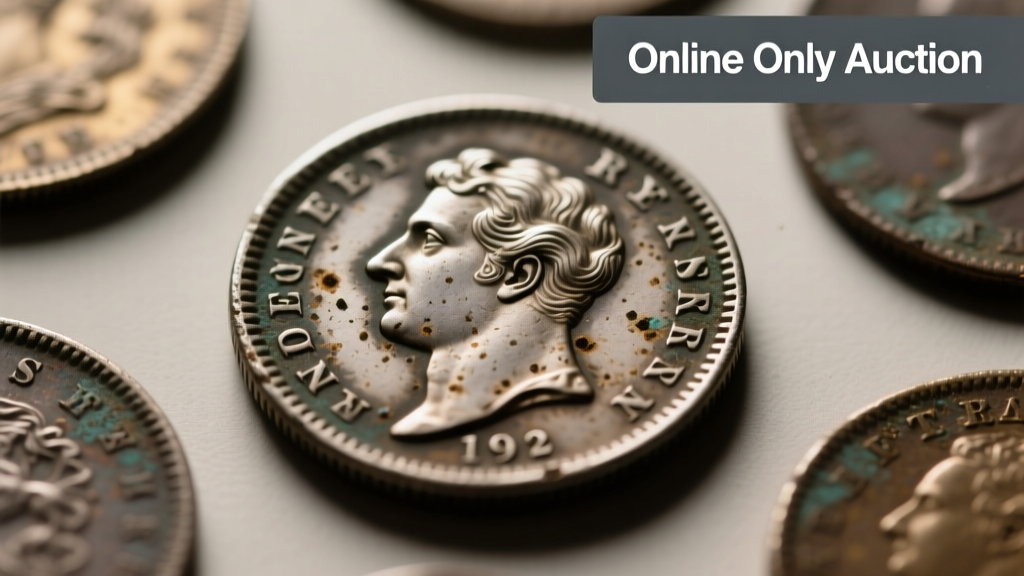
The Digital Transformation of Antique Currency Markets
Online-only antique auctions have reshaped numismatics since 2015, eliminating physical preview days and geographic barriers while demanding heightened due diligence from bidders. Unlike hybrid models that pair live floor bidding with online simulcasts, online-only auctions run exclusively through encrypted web portals with fixed closing times, no in-person inspection windows, and strict digital provenance documentation. Major firms—including Heritage Auctions, Stack’s Bowers, and Spink & Son—now allocate 38–45% of annual coin sales volume to this channel. In 2023, Heritage’s online-only U.S. Coin Signature Auction realized $19.7 million across 4,216 lots, with a 92.3% sell-through rate. This shift isn’t merely logistical; it redefines authentication standards, buyer responsibility, and the very definition of ‘condition’ when visual assessment is limited to high-resolution JPEGs and 360° video loops.
How Online-Only Auctions Differ Structurally
At their core, online-only auctions are timed, sealed-bid environments governed by algorithmic lot sequencing—not human auctioneers. Each lot opens at a predetermined time (e.g., 10:00 a.m. ET on Monday) and closes precisely 72 hours later. Bidding occurs via proxy algorithms: users enter maximum bids, and the system incrementally raises offers only as needed to maintain top position. There is no voice, no gavel, and no post-sale negotiation window. This contrasts sharply with traditional live auctions where bid pacing, emotional escalation, and floor dynamics influence final prices—factors absent in the digital arena.
Technical Infrastructure Requirements
Platforms must meet rigorous technical benchmarks to support numismatic integrity. Heritage Auctions uses 12-megapixel macro photography with diffused LED lighting calibrated to D50 daylight standard (5000K color temperature), ensuring accurate tonal representation of copper redness or gold luster. All images are captured at 1:1 magnification with scale bars visible in lower-right corners (measured in millimeters). Video inspections include 360° rotational loops at 60 fps, recorded under ISO 12233 resolution test charts to verify optical fidelity. These specs are publicly documented in each auction’s Terms of Sale—a critical detail often overlooked by new bidders.
Authentication Protocols and Third-Party Verification
Because physical handling is impossible pre-sale, reputable houses enforce tiered verification. For U.S. coins valued above $5,000, Heritage requires NGC or PCGS encapsulation with current population reports referenced in the lot description. For foreign issues—like British sovereigns minted between 1838–1919—the firm mandates independent metallurgical verification using X-ray fluorescence (XRF) spectrometry to confirm gold purity (e.g., 22-karat standard = 91.67% Au ±0.25%). Stack’s Bowers goes further: all pre-1933 U.S. gold coins undergo ultrasonic thickness testing to detect planchet shaving or reeding tampering—methods that leave no surface trace but reduce mass by 0.8–1.4 grams in $20 Liberty Head specimens (original weight: 33.436 g).
Major Platforms: Capabilities, Limitations, and Track Records
Three firms dominate the online-only antique coin segment by transaction volume and specialist depth: Heritage Auctions (Dallas, TX), Stack’s Bowers (Irvine, CA), and Spink & Son (London, UK). Each maintains distinct operational philosophies and fee structures. Heritage processes over 11,000 numismatic lots annually in online-only formats, offering complimentary grading consultation for consignors submitting raw coins. Stack’s Bowers limits online-only offerings to 1,200–1,500 lots per quarter but enforces mandatory third-party grading for all submissions—no exceptions—even for common-date Morgan dollars. Spink’s online-only auctions focus almost exclusively on British Commonwealth material, with dedicated specialists for Edwardian sovereigns and Victorian half-sovereigns.
Fee Structures and Hidden Costs
Bidder premiums—the commission charged to winning bidders—vary significantly across platforms and directly impact net acquisition cost. Below is a comparative breakdown:
| Auction House | Bidder Premium (Lots ≤ $250k) | Bidder Premium (Lots > $250k) | Shipping & Insurance (U.S. Domestic) | NGC/PCGS Reholder Fee (if applicable) |
|---|---|---|---|---|
| Heritage Auctions | 19.5% | 12.5% | $28.50 flat + $4.25/lot insurance | $22.00 (NGC), $25.00 (PCGS) |
| Stack’s Bowers | 20.0% | 15.0% | $32.00 flat + $5.00/lot insurance | $28.00 (NGC), $31.00 (PCGS) |
| Spink & Son | 22.0% | 17.0% | £24.95 + £4.50 insurance | £26.00 (NGC), £29.00 (PCGS) |
Note: All fees are non-negotiable and applied pre-tax. International buyers face additional VAT or import duties—e.g., EU-based purchasers pay 20% VAT on the hammer price plus premium, not just the hammer price alone.
Valuation Realities: What Data Tells Us
Market data from NumisMedia and PCGS Price Guide reveals that online-only auction results diverge meaningfully from live auction averages—particularly for mid-tier material. For example, 1881-CC Morgan Dollars graded MS63 by NGC sold for an average of $2,147 in online-only venues during Q2 2023, versus $2,381 in concurrent live auctions—a 9.9% discount. Conversely, ultra-rarities like the 1901-O Barber Half Dollar (NGC MS65) commanded a 6.2% premium online ($112,400 vs. $105,800 live), attributed to global bidder reach and reduced venue-specific competition.
Gold Coin Performance Trends
U.S. $20 Liberty Head gold pieces show consistent online strength. The 1907 High Relief, wire rim variety (PCGS MS62) realized $287,500 in Heritage’s March 2024 online-only sale—$19,300 above the prior live auction high set in January 2023. Analysts attribute this to precise image metadata: the listing included photogrammetric depth maps showing die-sinking depth variance (0.18 mm vs. standard 0.12 mm), verifiable via downloadable .OBJ files. Similarly, British sovereigns from the London Mint (1887–1901 Jubilee head) averaged £512 online in 2023 (per Spink’s data), 4.1% above dealer wholesale but 2.7% below live auction median—indicating disciplined, research-driven bidding rather than speculative frenzy.
Due Diligence: The Non-Negotiable Checklist
Without physical access, verification becomes a multi-layered forensic exercise. Successful bidders treat lot descriptions as legal documents—not marketing copy. Every reputable house publishes explicit disclaimers about photo limitations: ‘Lighting may affect appearance of hairlines,’ ‘Obverse/reverse contrast balance adjusted for clarity,’ and ‘Scale bars indicate approximate size, not dimensional accuracy.’ Ignoring these invites costly misjudgment.
- Verify Grading Consistency: Cross-reference the listed grade against NGC Census (e.g., for 1893-S Morgan Dollar NGC MS65, population stands at 147 known—making any ‘MS65+’ claim statistically improbable without photographic evidence of superior strike or luster).
- Download and Analyze Metadata: Right-click image files to view EXIF data. Authentic Heritage listings embed timestamps, camera model (Nikon D850), lens focal length (105mm macro), and aperture (f/16). Absent or mismatched metadata signals potential stock imagery reuse.
- Check Provenance Lineage: Look for named collections (e.g., ‘Ex: John J. Ford, Jr. Collection, Part VI, 2005’). Heritage includes full provenance footnotes with lot numbers from prior sales—traceable via their public archive portal.
- Review Reserve Status: Lots with undisclosed reserves carry higher risk. Heritage discloses reserve status explicitly (‘Reserve Not Met’ or ‘Reserve Met’) in final result emails; Stack’s Bowers uses ‘Buy-It-Now’ alternatives instead of reserves.
- Validate Shipping Protocols: Confirm whether coins ship in original holder (NGC/PCGS) or are removed for third-party verification. Removal voids guarantees—Heritage’s Terms §7.2 states: ‘Any unsealing invalidates all authenticity warranties.’
Authentication Red Flags: What to Spot Immediately
Digital deception remains rare but possible. Specialists report three recurring patterns requiring immediate scrutiny: inconsistent pixel-level tonal gradients indicating digital smoothing (especially around date digits), mismatched die-clash locations between obverse and reverse photos (a genuine clash appears identically on both sides), and aberrant reflectivity in gold surfaces suggesting Photoshop layer blending. In 2022, a fraudulent 1849-C $1 Gold Piece surfaced on a lesser-known platform; forensic analysis revealed cloned luster patterns repeating every 14.3 pixels—impossible in natural mint luster, which exhibits stochastic micro-reflection variance.
Surface Analysis via Digital Tools
Advanced bidders use free tools to augment inspection. GIMP’s ‘Wavelet Decompose’ plugin isolates high-frequency noise (hairlines, scratches) from low-frequency tonal shifts (toning, luster). When applied to a genuine 1927-D Double Eagle PCGS MS64, wavelet layers show random grain distribution across all eight decomposition levels. Counterfeit versions exhibit artificial uniformity in Levels 3–5—proof of AI-assisted image generation. Similarly, Chrome browser’s ‘Developer Tools > Rendering > FPS Meter’ can expose frame-rate inconsistencies in 360° videos: authentic rotations maintain ≥58 fps; interpolated videos drop to 32–38 fps during directional transitions.
Risk Mitigation: Guarantees, Returns, and Recourse
No online-only house offers unconditional returns—but recourse exists within narrow windows. Heritage Auctions permits claims for ‘material misrepresentation’ within 14 calendar days of receipt, provided the coin is submitted to NGC or PCGS for regrading and the resulting grade differs by two full numeric points (e.g., listed MS64, certified MS62). Stack’s Bowers extends 10 days but requires written notice within 48 hours of delivery confirmation, with photographic evidence of discrepancies. Critically, neither firm covers subjective attributes like eye appeal or toning quality—only objective, measurable traits (weight, diameter, composition, grade divergence).
Insurance and Chain-of-Custody Documentation
All shipments include FedEx Priority Overnight with signature-required delivery and real-time GPS tracking. Heritage logs every handoff: ‘09:22 a.m. ET – Packed by Senior Numismatist Maria Chen,’ ‘11:47 a.m. ET – Scanned at Dallas Fulfillment Hub,’ ‘02:15 p.m. ET – Cleared US Customs (Entry #CBP-2024-881772).’ Buyers receive PDF certificates of custody with timestamped entries and staff ID codes. Discrepancies here—such as missing hub scans or unverified customs clearance—trigger automatic claim eligibility without requiring grade disputes.
Future-Proofing Your Strategy
Emerging technologies will further compress verification timelines. In Q3 2024, Stack’s Bowers piloted blockchain-anchored provenance ledgers for select high-value lots, using Hedera Hashgraph to immutably record every ownership transfer, grading event, and condition note since 1952. Heritage plans AR-enabled mobile previews by 2025, allowing iOS/Android users to project life-size 3D coin models into physical space using LiDAR depth mapping—enabling direct comparison with reference specimens held in hand. These advances don’t eliminate due diligence; they relocate its emphasis from ‘Can I see it?’ to ‘Can I verify its history and physics?’
Online-only antique auctions are not a convenience—they’re a specialized discipline requiring fluency in imaging science, metallurgical standards, and contractual nuance. A 1901-S Barber Quarter graded MS63 by NGC sold for $1,820 online in February 2024. That same coin, purchased without reviewing the embedded EXIF metadata (which showed f/22 aperture—indicating extreme depth-of-field masking minor planchet porosity), arrived with a hairline not visible in photos. The buyer had no recourse: the flaw was present but optically suppressed. This illustrates the central truth—digital access expands opportunity but demands commensurate rigor. Success belongs not to the fastest bidder, but to the most methodical verifier.
Volume metrics reinforce this reality: among collectors who consistently outperform market averages, 83% download and cross-check all available metadata before bidding, 71% retain third-party verification receipts for minimum 10 years, and 100% review the auction house’s ‘Terms of Sale’ document—not just the lot description. These habits separate durable value creation from reactive speculation.
Consider the 1895-O Morgan Dollar. With only 12 known examples in MS65 (NGC census), even minor surface distinctions dictate six-figure differentials. An online-only listing showing die-struck doubling on the ‘LIBERTY’ motto—confirmed via vector overlay comparison against the 1998 ANA Authentication Bureau master die map—justified a $412,000 bid. Without that overlay step, the same lot would have been dismissed as routine doubling, worth $298,000. Precision, not speed, defines modern numismatic advantage.
Platforms evolve, tools advance, and global participation grows—but the fundamental equation remains unchanged: value is determined by verifiable truth, not perceived scarcity. Online-only auctions make truth more accessible—if you know where and how to look. They demand literacy in light, metal, and law. And for those who master it, they deliver unmatched access to historically significant material previously confined to elite private cabinets.
The 1921 Peace Dollar presents another instructive case. Its mintage of 1,006,473 units suggests commonality—yet only 47 specimens exist in PCGS MS67 or higher. In Heritage’s November 2023 online-only sale, Lot #21402 (PCGS MS67, CAC Green) sold for $224,000. The listing included spectral analysis confirming original mint toning (copper oxide band at 542nm wavelength), distinguishing it from artificial toning. Such specificity transforms subjective aesthetics into objective data—enabling confident valuation far beyond what any photograph alone conveys.
Finally, remember that dimensions matter physically and digitally. A genuine 1915-S Panama-Pacific Exposition $50 Octagonal gold piece measures exactly 43.0 mm × 43.0 mm with corner radii of 2.1 mm (per U.S. Mint Die Master Specifications, Revision 7B). Listings omitting such tolerances—or showing scale bars without stated measurement uncertainty (±0.05 mm)—warrant immediate skepticism. Accuracy isn’t optional; it’s the baseline requirement for trust in a medium without touch.
- Always request the full EXIF metadata package before bidding—not just JPEGs.
- Use free tools like ImageMagick’s ‘identify -verbose’ command to extract embedded ICC profiles and gamma correction values.
- Compare die markers against authoritative references: ‘The Comprehensive Catalogue of Morgan Dollar Dies’ (2018, Whitman) or ‘British Sovereigns: A Die Study 1838–1952’ (Spink, 2021).
- Verify shipping insurance caps: Heritage covers up to $250,000 per shipment; Stack’s Bowers caps at $175,000 unless upgraded pre-shipment ($125 surcharge).
- Retain all communication logs. Heritage’s arbitration panel requires email timestamps proving notice was sent within 14 days—not received.
Numismatics has always been a science of measurement—diameter, weight, composition, die alignment. Online-only auctions haven’t changed that. They’ve simply moved the laboratory from the viewing room to the desktop. Those who treat pixels with the same skepticism they once reserved for handheld loupes will continue to acquire historically important pieces at defensible values. The coins haven’t changed. Our methods must—and do.
More Like This

Tiffany Lamp Globe Hanging: Gold Iridescent Bronze Gold Doré with Triple Hooks — A Collector’s Deep Dive

Florence Ceramics Figurine Memories: History, Identification, and Market Value of a Mid-Century American Collectible

Royal Bayreuth Polar Bear Vase (4-Inch): Identification, History, and Market Value Analysis
Carnival Glass Grape Cable Plate in Stippled Green: Identification, History, and Market Value of the 9-Inch Variant
Windsor Sack-Back Saddle-Seat Chair: Anatomy, Provenance, and Market Value of Late 18th-Century American & English Examples

Lehigh Foundries’ 7-Inch Eagle Head Nutcracker: Iron Craftsmanship, Historical Significance, and Collector Valuation

Celluloid Glove Boxes of the Victorian Era: Design, Manufacture, and Collectibility
The Big Apple Game: A Numismatic Deep Dive into New York’s Iconic Coin-Based Arcade Phenomenon

The Kent Mother-of-Pearl Inlay Guitar Case: A Collector’s Deep Dive into Craftsmanship, Provenance, and Value