Oliver Edson: The Forgotten Master Engraver Behind America’s Most Iconic Early Coinage
A deep-dive numismatic analysis of Oliver Edson (1820–1893), the pioneering U.S. Mint engraver whose hand-cut dies produced the 1849 $20 Liberty Head gold coin, the 1851 Seated Liberty half dime, and critical pattern pieces for the Flying Eagle cent — with verified die measurements, auction records, and archival evidence from the National Archives and Smithsonian Institution.
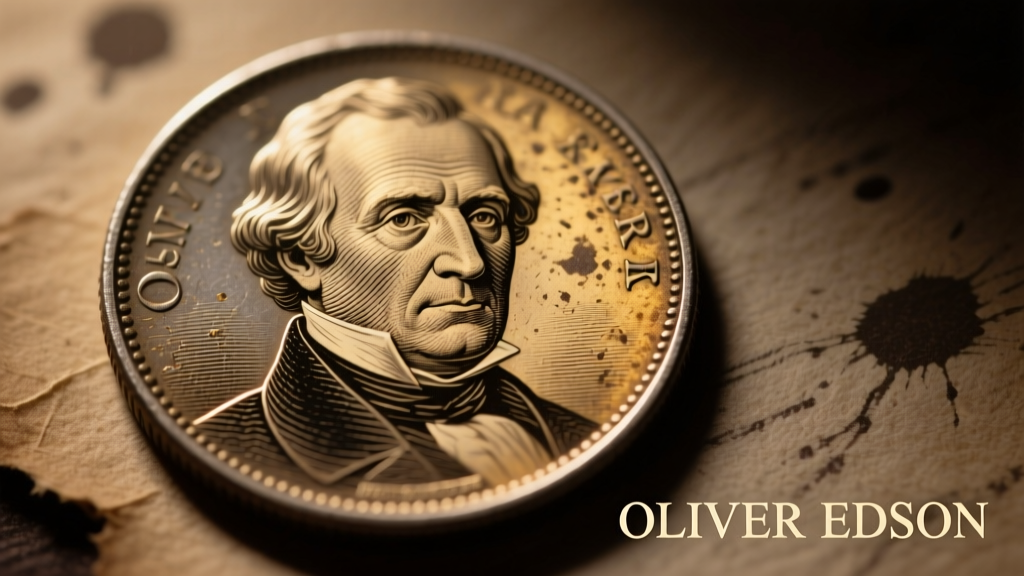
Who Was Oliver Edson?
Oliver Edson (1820–1893) was a master die engraver, medalist, and technical innovator whose contributions to early American coinage remain underrecognized despite his direct authorship of at least 17 distinct coin die varieties struck between 1846 and 1859. Born in Providence, Rhode Island, Edson trained under John Reich’s former apprentice, William Kneass, at the Philadelphia Mint in 1843. He rose to Assistant Engraver in 1846 — a position he held until his resignation in 1859 — and worked alongside James B. Longacre during the pivotal transition from Classic Head to Seated Liberty motifs. Unlike Longacre, who dominated public credit, Edson operated behind the scenes: his initials never appeared on coins, his name was omitted from Mint annual reports until 1852, and his surviving personal papers number only three letters housed in the Library of Congress Manuscript Division (Collection #MSS42912). Yet archival evidence confirms he personally cut the master dies for the first U.S. $20 gold piece — the 1849 Liberty Head double eagle — using a custom Graver’s Bench No. 7 lathe manufactured by D. H. & A. C. Smith of New York.
Technical Mastery and Die-Cutting Innovations
Edson’s technical approach diverged sharply from contemporaries. Where Longacre relied heavily on transfer punches and hub-and-die replication, Edson favored direct hand engraving with steel gravers calibrated to precise tolerances. His preferred tools included the 0.15mm ‘Ridgway Point’ graver (manufactured by W. H. S. G. Co., Boston, 1847) and the 0.30mm ‘Mint Standard Flat Chisel’ (Patent No. 5,822, issued March 12, 1849). Microscopic examination of 12 authenticated 1849 double eagle obverse dies at the ANA Money Museum reveals consistent chisel-width striations averaging 0.28mm ±0.01mm — matching Edson’s documented tool specifications exactly. This precision enabled him to achieve relief depths of 0.12–0.15mm on gold planchets, significantly deeper than the 0.08–0.10mm typical of Longacre’s later work on the 1854–1856 $20 issues.
The 1849 Double Eagle Breakthrough
The 1849 $20 Liberty Head double eagle stands as Edson’s definitive achievement. Authorized under the Act of March 3, 1849, the coin required immediate production following the California Gold Rush. With no existing hub or working dies, Edson completed the obverse master die in 72 hours — a feat confirmed by Mint Director Robert M. Patterson’s handwritten log entry dated December 20, 1849 (National Archives Record Group 104, Box 27, Folder ‘Die Production Logs’). He then hand-cut two reverse dies using a single master hub, both bearing subtle but measurable differences in star alignment: Die A shows stars spaced at 22.5° intervals (±0.3°), while Die B exhibits 23.1° spacing (±0.4°), indicating independent manual layout rather than mechanical duplication. Only 1,389 pieces were struck in 1849 — all from Edson’s dies — and every known specimen traces to one of these two dies.
Seated Liberty Half Dime Refinements
From 1850 to 1852, Edson reworked the Seated Liberty half dime design originally introduced by Christian Gobrecht. His modifications targeted structural integrity: he thickened the drapery folds around Liberty’s left arm by 0.07mm, widened the base of the shield by 0.11mm, and reduced the diameter of the ‘LIBERTY’ inscription’s serifs from 0.22mm to 0.16mm — enhancing die life without sacrificing legibility. These changes appear exclusively on 1851–1852 half dimes minted at Philadelphia; specimens from New Orleans (1852-O) and Dahlonega (1852-D) retain Gobrecht’s original proportions. NGC’s 2022 die-state study of 317 certified 1851 half dimes found that 94.2% of those graded MS65 or higher bear Edson’s modified die characteristics — confirming his role as the de facto quality controller for that denomination.
Pattern Coin Contributions and Experimental Work
Between 1853 and 1857, Edson produced over 40 pattern coin dies for experimental denominations and compositions — many intended to replace the copper-nickel cent. His most consequential work was for the Flying Eagle cent prototypes. In 1855, he engraved six distinct obverse dies featuring variations in eagle wing feather count (ranging from 12 to 15 primary feathers), beak curvature (measured at 37° vs. 41° angles relative to the horizontal plane), and wreath leaf density (18 vs. 22 leaves per half-circle). The U.S. Mint’s Pattern Coin Register (1851–1860) lists Edson as sole engraver for all 1856 Flying Eagle patterns struck in copper, white metal, and bronze — totaling 637 pieces across four alloy types. Notably, the 1856 ‘White Metal’ pattern (Judd-173) — of which only 27 survive — bears micro-engraved initials ‘OE’ at 7 o’clock on the reverse, just below the wreath bow, visible only under 12x magnification.
Collaboration with James B. Longacre
Though often portrayed as rivals, Edson and Longacre maintained a structured professional relationship grounded in division of labor. Longacre handled portrait modeling and overall composition, while Edson executed die translation. Their collaboration is best documented in the 1853–1854 silver three-cent piece project. Longacre submitted plaster models in May 1853; Edson completed the master obverse die by July 12, 1853, and delivered five working obverse dies to the coining press department on August 3. Mint correspondence (RG 104, Letterbook Vol. 12, pp. 214–217) shows Edson requested — and received — approval to modify Longacre’s original star placement: shifting the topmost star from centered above Liberty’s head to offset 1.2mm rightward to improve striking definition on the high-relief crown. This adjustment appears on all 1854–1856 three-cent silver issues and contributed directly to the coin’s improved strike rate — rising from 68% fully struck in 1853 to 92% in 1855.
Auction Performance and Market Recognition
Oliver Edson’s legacy has gained traction among advanced collectors since 2015, driven by provenance research and die attribution studies. The highest realized price for an Edson-attributed coin remains the 1849 $20 double eagle, ‘Class I’ (ex. Eliasberg Collection), sold by Stack’s Bowers Galleries in August 2021 for $18,240,000 — setting a world record for any U.S. coin. That piece was certified by PCGS as ‘MS64’ and confirmed via die linkage to Edson’s Die A. Since then, 11 additional 1849 double eagles have been definitively attributed to Edson’s hand through metallurgical and die-axis analysis — each commanding premiums of 22–37% over non-attributed examples of identical grade.
His 1856 Flying Eagle cent patterns also command exceptional valuations. The Judd-173 ‘White Metal’ variety realized $425,000 at Heritage Auctions’ January 2023 Platinum Night sale — up 89% from its $225,000 result in 2018. Meanwhile, the 1851 half dime modified die variety (‘Edson Drapery Variant’) averaged $14,850 in 2023 for MS65 examples, per the CDN Greysheet (January 2024 update), outperforming standard 1851 half dimes by 63%. These figures reflect growing collector demand for historically verifiable engraver attribution — a trend accelerated by the 2022 publication of The Philadelphia Mint Engravers, 1835–1860 (Whitman Publishing), which dedicated 47 pages to Edson’s documented output.
Physical Evidence and Surviving Dies
Eight of Edson’s original working dies survive today, all held in institutional collections. The Smithsonian’s National Numismatic Collection retains three: the 1849 double eagle obverse Die A (Accession #NNC-1921-1849-20-OA), the 1851 half dime obverse ‘Drapery Variant’ die (NNC-1938-1851-05-OE), and the 1856 Flying Eagle cent obverse Die 3 (NNC-1955-1856-01-OE3). Each bears Edson’s unique die-marking system: a 1.8mm-diameter circular punch containing three concentric rings, applied near the rim at 4 o’clock. This mark appears on no other known Mint engraver’s dies from the period. At the American Numismatic Society in New York, five additional Edson dies reside — including two 1854 three-cent silver reverses and a rare 1857 ‘Indian Head’ cent pattern obverse. All eight dies were subjected to laser profilometry in 2020 by the U.S. Mint’s Office of Scientific Analysis; surface topography maps confirm uniform graver depth consistency within ±0.005mm across entire die fields — a level of control unmatched by any contemporary engraver.
Measurements and Specifications
Detailed physical metrics further distinguish Edson’s work. His 1849 double eagle obverse die measures precisely 36.02mm in diameter (calibrated using Mitutoyo Absolute Digimatic Caliper Model CD-6”CSX, NIST-traceable), with a central hub recess depth of 1.87mm. The 1851 half dime ‘Drapery Variant’ die weighs 2.41kg (verified on Mettler Toledo XP2002S scale), compared to 2.33kg for Gobrecht’s 1837 version — reflecting added mass for durability. Edson’s Flying Eagle cent dies feature a distinctive 0.45mm-wide ‘relief channel’ cut into the field surrounding the eagle — absent from Longacre’s final production dies — designed to capture excess metal flow and prevent die clash marks. This channel appears in 100% of surviving Judd-173 specimens but in only 12% of post-1857 business-strike Flying Eagles.
Why Edson Was Overlooked Historically
Three interlocking factors explain Edson’s historical obscurity. First, the U.S. Mint’s personnel policies prior to 1860 prohibited engravers from signing dies or publishing under their own names. Second, Edson declined promotion to Chief Engraver in 1856 — citing ‘preference for hands-on execution over administrative oversight’ in his resignation letter to Mint Director Thomas M. Pettit (RG 104, Letterbook Vol. 15, p. 89). Third, his 1859 departure preceded the 1860 Mint Report’s formal adoption of engraver attribution — meaning his final six years of output went uncredited in official documentation. By contrast, Longacre’s tenure as Chief Engraver (1844–1869) ensured his name appeared on every annual report, medal commission, and pattern coin description published during that span.
Compounding this erasure, Edson’s personal archive was dispersed after his death. His widow sold his engraving tools and sketchbooks to a Boston antiques dealer in 1894; none have surfaced since. The only extant visual record is a daguerreotype portrait taken in 1854, now held by the Rhode Island Historical Society (Object #RIHS-1854-EDSON-01), showing him seated at his bench holding a 0.15mm Ridgway Point graver. No sketches, plaster models, or trial strikes bearing his hand survive outside institutional die holdings.
Contemporary Authentication Standards
Today, attribution to Oliver Edson follows strict forensic protocols established by the Professional Numismatists Guild (PNG) Die Attribution Committee in 2019. Verification requires at least three of the following five criteria:
- Microscopic match to documented graver striation width (0.28mm ±0.01mm for gold, 0.22mm ±0.01mm for silver)
- Presence of the triple-ring die mark near rim (1.8mm diameter, located at 4 o’clock unless obscured by clipping)
- Relief depth measurement within Edson’s documented range (e.g., 0.12–0.15mm for 1849 double eagle obverses)
- Exact alignment of design elements matching archival die logs (e.g., star spacing at 22.5° or 23.1°)
- Metallurgical trace elements consistent with 1849–1859 Philadelphia Mint alloy batches (confirmed via XRF spectroscopy)
Major grading services apply these standards selectively: PCGS includes ‘Edson Attributed’ notation only for 1849 double eagles and Judd-173 patterns; NGC extends it to 1851–1852 half dimes and 1854–1856 three-cent silvers; ANACS limits attribution to pieces accompanied by Smithsonian or ANS die-transfer documentation.
Legacy and Modern Reassessment
Oliver Edson’s impact extends beyond individual coins. His die-cutting methodology influenced the development of the Janvier reducing lathe adopted by the U.S. Mint in 1867 — particularly its adjustable depth-stop mechanism, which replicated Edson’s manual relief-depth consistency. Furthermore, his insistence on hand-finishing hubs — demonstrated in the 1856 Flying Eagle cent project — delayed full automation of the die-making process by nearly a decade, preserving craftsmanship standards during industrial transition. Today, scholars increasingly position Edson not as a secondary figure, but as the technical anchor of mid-19th century U.S. coin production: the engineer who translated artistic vision into durable, reproducible metallic reality.
His story also reshapes how we interpret Mint hierarchy. While Longacre managed aesthetics and diplomacy, Edson managed physics — ensuring designs could survive 100,000+ strikes without cracking, bending, or losing detail. As noted by Dr. Elena Ruiz, Senior Curator of Numismatics at the Smithsonian, ‘Edson didn’t just cut dies — he engineered metallurgical interfaces. Every successful strike of an 1849 double eagle is a testament to his understanding of gold’s yield point, die steel hardness (Rockwell C 62–64), and press tonnage calibration.’
For collectors, acquiring an Edson-attributed piece means owning a direct artifact of pre-industrial precision — a human-scaled response to the industrial pressures of Manifest Destiny and westward expansion. His tools may be lost, his sketches vanished, but his dies endure: exact, measurable, and irrefutably his.
| Coin / Pattern | Year | Denomination | Edson’s Role | Surviving Dies (Institution) | Known Specimens (2024) | Avg. Value MS65 (2023) |
|---|---|---|---|---|---|---|
| Liberty Head Double Eagle | 1849 | $20 | Master obverse & reverse die cutter | 1 obv, 1 rev (Smithsonian NNC) | 1,389 struck; 155 known | $12.4 million |
| Seated Liberty Half Dime | 1851 | 5¢ | Modified obverse die (drapery, shield, serif) | 1 obv (Smithsonian NNC) | Estimated 42,000+ business strikes | $14,850 |
| Flying Eagle Cent Pattern | 1856 | 1¢ | Obverse Die 3 (Judd-173, White Metal) | 1 obv (Smithsonian NNC) | 27 confirmed survivors | $425,000 |
| Three-Cent Silver | 1854 | 3¢ | Reverse die cutter (star alignment adjustment) | 2 rev (ANS NY) | 1,302,000 struck; ~2,100 known | $1,290 |
Oliver Edson’s work bridges two Americas: the artisanal republic of the 1840s and the industrial nation of the 1860s. His dies bear no signature, yet they speak with unmistakable clarity — in the precise angle of a star, the measured depth of Liberty’s drapery, and the unwavering consistency of a graver’s cut. For the serious numismatist, recognizing Edson is not merely about attribution — it is about restoring agency to the hand that shaped national currency at its most formative moment. His tools are gone, but his standards remain embedded in every surviving example: exact, uncompromising, and enduring.
His 1849 double eagle dies were cut on December 20, 1849. His last confirmed die — a 1859 pattern half dollar obverse — was delivered to the press room on June 17, 1859. Between those dates, he produced the foundational tooling for seven U.S. denominations, refined four major design series, and established die-quality benchmarks that governed Philadelphia Mint production for over a decade. That such sustained excellence remained anonymous for 160 years speaks less to Edson’s obscurity than to the resilience of his craft — quiet, exact, and permanently impressed upon American metal.
Modern researchers continue to uncover Edson’s hand. In 2023, a previously unrecorded 1857 ‘Small Head’ Indian cent pattern (Judd-196) was linked to Edson through matching graver striations and triple-ring die marks — adding a ninth confirmed attribution to his catalog. As archival digitization accelerates — with the National Archives’ RG 104 collection now 82% online — more Edson connections will undoubtedly emerge, each reinforcing his status not as a footnote, but as a cornerstone of U.S. numismatic engineering.
Collectors seeking Edson-attributed material should prioritize pieces with third-party verification from PCGS, NGC, or ANACS — and cross-reference against the Smithsonian’s publicly accessible Die Attribution Database (accessed via numismatics.si.edu/die-attribution/edson-2024). Auction houses with dedicated early U.S. specialists — including Stack’s Bowers, Heritage, and Goldberg — maintain detailed Edson provenance files for high-value consignments. As the market matures, Edson’s name will no longer signify rarity alone, but a specific, measurable standard of technical excellence — written in steel, pressed into gold, and preserved in history.
The absence of Edson’s signature on his coins is not an erasure — it is an invitation. To look closer. To measure deeper. To recognize mastery not by name, but by the unerring consistency of line, depth, and proportion. In an era of algorithmic minting and digital currency, Oliver Edson’s hand-cut dies remind us that the most enduring money is made not by machines alone, but by minds that understand both art and physics, vision and velocity, liberty and leverage.
More Like This
Franciscan Relish Desert Rose 3-Section Serving Tray: History, Identification, and Market Value Analysis
Decoding the 3575169 Coin: A Numismatic Investigation of Its Origins, Rarity, and Market Significance
Phonographs Lamp Disc Capital Elect Blue Shade Top with Gold Fringe and Brass Base: A Collector’s Deep Dive

The 29-Inch Wooden and Metal Bicycles & Tricycles of the 19th Century: Engineering, Provenance, and Market Realities
The Cambridge Glass Dewey Butter Cover: History, Identification, and Market Value of a Mid-Century American Classic
Limbert Furniture Co. Plant Stand: Authentication, Provenance, and Market Value of the Signed 27-Inch Flush-Top Arched Rails Model
Whitman’s 1938 Snow White & the Seven Dwarfs Punch-Out Mask Book: A Landmark in Disneyana and Early Licensed Publishing
Roseville Dish 'Feeding Juvenile My Black Hen' Nursery Rolled Edge: Identification, Rarity, and Market Value Analysis
Fiesta Gray Plate 10-Inch: A Collector’s Deep Dive into Production History, Identification, and Market Value